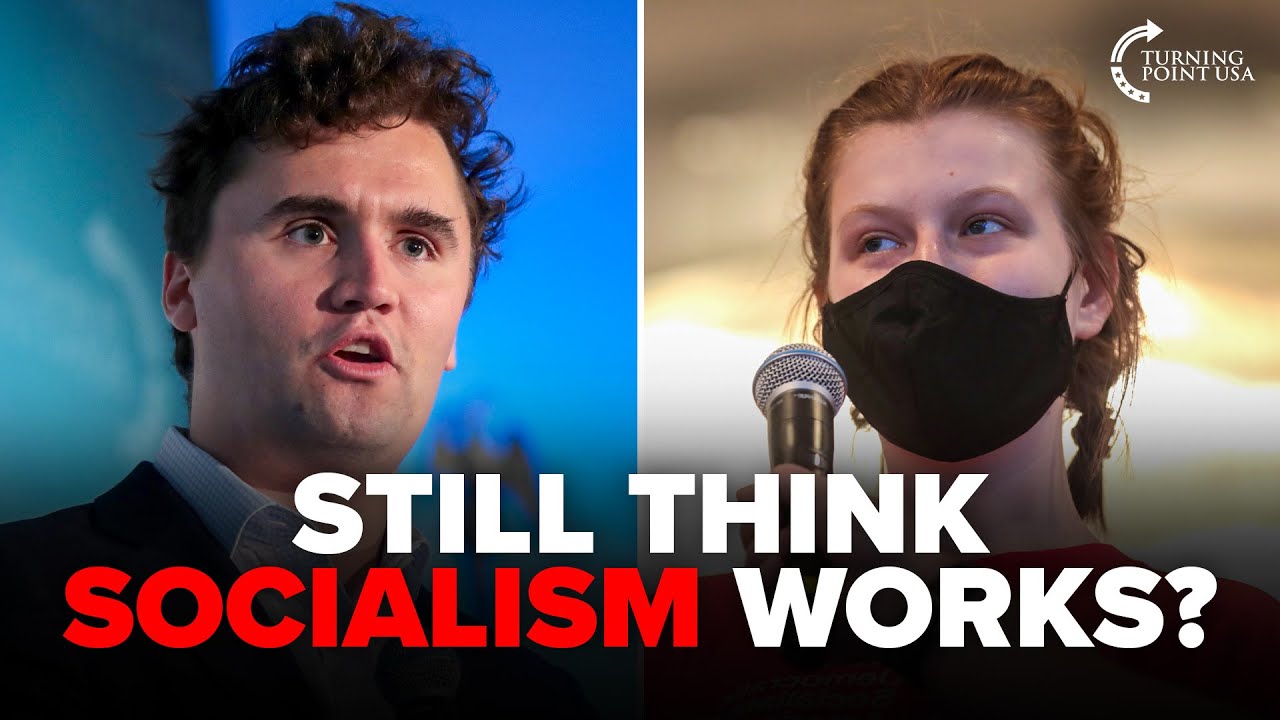
Charlie Kirk Breaks Down Why Scandinavian Countries Are Not Actually Socialist Despite Popular Belief
Enjoying this? Share it with someone who needs to see it.
Up Next
Charlie Kirk Debates UVM Socialist Student on Native American Policy and Failed Economic Systems
5:40
Charlie Kirk Explains Why America's Meritocracy Still Works Despite Social Mobility Statistics From Brookings Institute Study
2:09
Charlie Kirk Confronts Pro-China Arguments About Tech Regulation and Rural Development Programs
1:00
Charlie Kirk Breaks Down Why Scandinavian Countries Are Not Actually Socialist Despite Popular Belief
Charlie Kirk tackles one of the most common questions students ask: why does socialism seem to work in Scandinavia but fail in Venezuela? Kirk dismantles the myth that Nordic countries are socialist, revealing they actually rank higher than the United States on the World Economic Freedom Index. He explains how these nations combine free-market economies with welfare states, funded by small populations, ethnic homogeneity, fossil fuels, and American military protection. Kirk challenges those who praise Scandinavian models while opposing school choice, strict immigration, and the very economic freedoms that make those systems function.
A student question about the difference between Scandinavian socialism and Venezuelan socialism opens a critical discussion about what these Nordic countries actually represent. The common perception is that socialism works wonderfully in Finland, Sweden, and Norway, but this assumption deserves closer examination.
The reality is surprising: according to the World Economic Freedom Index, Finland, Norway, and Sweden rank higher than the United States on economic freedom. This fundamental fact undermines the entire premise that these are socialist countries. If socialists truly support economic freedom, then they cannot claim Scandinavian nations as examples of socialism in action.
Economic Freedom Versus Welfare States
Switzerland provides another compelling example, holding the second-highest degree of economic freedom in the entire world. The Scandinavian states don't have socialism, but they do maintain welfare states—a critical distinction that often gets lost in political debates.
The welfare state model differs fundamentally from socialism. While critiques of the welfare state are valid, understanding what makes the Scandinavian version function requires examining several unique factors that cannot be replicated in larger, more diverse nations.
Population and Demographics Matter
The Scandinavian countries maintain populations around eight million people—roughly the size of New Jersey. They are ethnically homogeneous, with populations that are 97 to 99 percent white. This demographic reality creates social cohesion that simply doesn't exist in larger, more diverse countries.
The same people who advocate for open borders in America simultaneously point to these countries as models to emulate. This represents a fundamental contradiction, as Scandinavian nations maintain strict immigration policies that would never be acceptable to progressive advocates in the United States.
Who Pays for What
These countries fund their governments primarily through fossil fuel exports—an irony given that many who praise the Scandinavian model also oppose fossil fuel development. Additionally, the United States pays for their military defense, allowing them to spend virtually nothing on their own military capabilities.
This military subsidy from America enables Scandinavian nations to redirect resources toward social programs that would otherwise be impossible to sustain. The model only works because another country bears the cost of their national defense.
School Choice and Policy Contradictions
Sweden has full school choice, where students can attend any school—private or public—using a government-provided voucher. Yet the American left, which frequently holds up Sweden as an ideal, opposes exactly this kind of school choice in the United States.
This contradiction reveals the selective nature of the argument. Those who claim to love the Scandinavian model refuse to embrace one of its key educational policies, exposing the inconsistency in their reasoning.
The Tax Reality
Scandinavian countries maintain a 60 percent tax rate for the ultra-rich. While some may find this appealing, it represents the kind of country many Americans explicitly reject. For those who desire that culture and society, non-stop flights from New York City to Copenhagen are readily available.
The fundamental question becomes: why try to transform a country based on freedom into something it was never meant to be? Other countries already offer the model some people prefer. America attracts people specifically because it offers something different.
The Bottom Line
There's little sympathy for those who come to America and attempt to erode the very principles that make people want to come here in the first place. Other countries successfully implement different systems, but they do so with strict immigration policies that prevent just anyone from accessing those benefits.
The Scandinavian model works within a specific context: small, homogeneous populations with vast natural resources, subsidized defense, and economic freedom that actually exceeds that of the United States. It's not socialism—it's a unique combination of factors that cannot and should not be replicated in America.