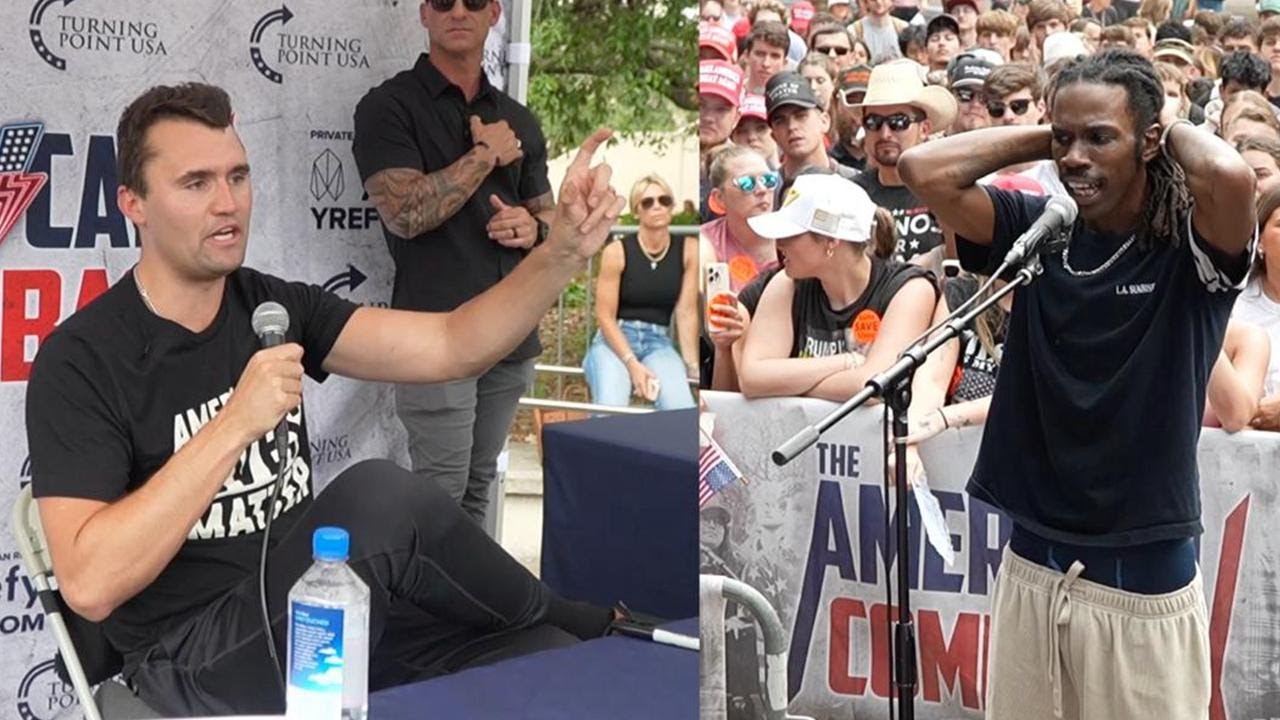
Uh, Mr. Simple, you've said some very nasty things about me online, so the floor is yours. >> Thank you. Thank you. Uh, so, uh, simple question, Simple Black Theory. Um, what do you think about blind hiring? Are you for blind hiring? >> No. >> No. So, why not? Because blind hiring, for those who don't know, is based on merit where you don't. >> So, what's blind hiring? >> Blind hiring would be that you do not put the race actually when you submit for, you know, actually you don't even see the person when you interview them for a a job. >> No, no, no. That's that's one part of blind hiring. There's multiple ways to do blind hiring. But at the end of the day, blind hiring is exactly not knowing the person's race, age, or gender. That's based on merit. Like you said, you want merit. Correct. >> Well, hold on. Those things can factor into merit as well. For example, if I'm trying to hire for an Amazon warehouse worker and all of a sudden I find out that they're at 69 with one year left from retirement and the age is not disclosed. Wouldn't I prefer to have a 24 year old man than a 69year-old woman who's overweight? >> You're moving the goalpost. Let's bring it back here. No, the whole point was about blind hiring. >> No, you just said you said race, sex, and age >> is not incorporated. Correct. I think you should have a full picture of of a human being is when you hire them. >> So, you care about diversity. >> No, actually, I don't. >> How? Why? Because that's basically merit. You're focusing solely on merit. You said you want meritocracy. >> Just to be clear, I want I I if diversity happens naturally through meritocracy, great. If all of a sudden we have that Well, no, no, it's not. DI is by force. No, no, no. I got to I got to interject. DEI is that we are going to forcibly make an institution more colorful. We're going to forcibly make an institution more black. Where if all of a sudden if half of Texas&M was black because it was all on merit, praise God. That's an amazing thing. It doesn't matter. If all of a sudden, for example, if the NBA is 75% black because it's on merit, great. Terrific. If the NFL is half black because on merit, we don't want to force race. We want excellence and meritocracy over race in every possible circumstance. Right. Yeah. My turn. Okay. So, let's get into the NBA for instance, right? Can we both agree at one point black people weren't allowed into the NBA and then they allowed them to be in the in NBA? Wouldn't that be considered diversity? Wouldn't that be DEI? >> No. No. No. It's actually the opposite. You see, you're mistaken, my friend. It's actually we're getting rid of any racial stereotyping. What happened was actually a form No, DEI is racial stereotyping. So what actually was before was a form of white preference DEI which is white supremacy or whatever and then we got rid of it. We said we're not going to discriminate it and the quality of play got better. Do you guys see the difference between the two? You see it's very important. Well no actually I'm talking to both you and the crowd. Right. >> Mean I'm talking to both. Right. So what ended up h what you want is you actually want to bring back a form of how Major League Baseball and the NBA used to work before we desegregated. So, we can agree that executive order 11246 is what basically brought in DEI. Correct. >> I I'm not I think that might be it. Is that the affirmative action one? I don't know. >> No, it's not the It's for DI. So, within that executive order, where does it say that they're solely focused on making people get into jobs? For instance, like United Airlines, right? You mentioned that. Well, let's pause that. I'm going to get to here. So, for an example of DEI is basically your daughter, right? She decides to get a job, right? And unfortunately, it's that time of the month. She goes into the bathroom. >> Calm down. Calm down. Calm down. She goes into the bathroom. >> Stop. She's going into the bathroom. >> You're losing the audience, man. >> I don't care. I'm talking to you. So, she she goes into the bathroom, right? And she gets a >> She goes into the bathroom and gets a tampon or a pad that's been given from the job. That is DEI. That is literally Yes. >> Yeah. Yeah. Yeah. Yeah. You You don't know. You don't know. You don't know. That's great. So if you don't know DEI, >> interrupt me so he can win. Go ahead. You don't want to do that, right? Or be quiet and we can talk. Thank you. So right, >> can I continue? Thank you. So my thing is dead. All right. So yes, because in it so in executive order 11246, they say that DEI is focusing on a safer environment and a more equitable environment within the workplace and the hiring process. Let's look at Google. Google actually does DEI. You know how they did a DEI? Give me an example. Do you know Google's DI? I'm pretty sure you don't. >> And they shouldn't. Of course not. And >> what is their DI initiative? >> There was there I actually don't know the specifics because I don't I don't know every company specifics. >> However, let me ask you a question. When you're hiring somebody, would you rather hire someone that's black or someone that there is excellent? >> So that's what we're talking about. That's not what DEI is. >> Actually, it is. So let let me let me prove it to you. As I said, according to the student for fair admission Supreme Court case, black students were able to get into Harvard with affirmative >> action, not DEI. Affirmative action. Time out. Time out. Oh >> Time out. Time out. You're getting too worked up here, man. Okay. >> Time out. Affirmative action is DEI in practice. You see, DEI is a theory. >> Wasn't it struck down by Supreme Court? >> Yes. And they still ignore it. Why are you bringing it up? >> Because they're still ignoring it. My friend, >> let's focus on my question. I asked you. get back to the core macro tenant which is which I think is very important correct >> which is wouldn't you prefer a country built on excellence and merit not one based on forced pigmentation diversity why does somebody's skin color matter no tell me what what what differences do you as a black man and me as a white man have and why does it matter >> okay so >> why does it matter >> so let's look at because again you don't understand what DI is and you're trying to put into one stance what which is not so >> hard >> thank Thank you. So, back to this question. So, in executive order and and and correct me if I'm wrong, you don't know executive order 11246, correct? So, >> I mean I I have an idea of what President Trump signed. Correct. But because he got he got rid of that executive order, >> right? And in that executive order, it says literally, y'all can Google it too. It says that DEI focuses on both the workplace and hiring. >> Got it. So, does it explain? Now, let me explain it. >> Does it have the word diversity? >> Yes. >> We should not have any forced diversity period. End of story. not force diversity. It does not for say force diversity and I'll put money on that too. >> But does it say diversity? >> It says diversity. Yes. >> Well, then it's force force diversity. >> What is it suggestion? >> So So correct me if I'm wrong. Tell me if I'm lying. Does it say force diversity in executive order? >> But it has the word diversity. >> Does it say force diversity in executive order? >> Hold on. Let me get this right. Executive order with the word diversity. >> Can I give you an example of DI initiative? Let me give you an example of DI initiative so you have a better understanding. So let's look at Google, right? Google's one of the hardest companies to actually get into. In fact, I believe it's a 0.2% 2% chance that you actually get the job, right? They actually run a DI initiative. Their DI initiative is called a hiring committee where they have a diverse group of people working awful. >> How? >> So, you're telling me Google sucks. >> Google actually is honestly. >> So, y honestly chat GPT is way better than Google recently. I don't know about you guys. >> No, but honestly, to your point though, Google has lost its competitive edge in a lot of ways the last 10 years. They're Hold on a second again. Google does a lot right, but hold on. Google has lost the social media war. Google tried to launch a Facebook competitor, Instagram competitor failed. They try to also launch a Zoom and Skype compet Google's market cap, otherwise known as Alphabet, has actually missed expectations over the last two years versus Netflix, Amazon, and Apple, and Microsoft. In fact, there was a prediction 10 years ago that Google would be the first $3 trillion company. Turns out that it was actually Microsoft that was the first $3 trillion company. Now, of course, Alphabet is a very good company on a lot of different ways, but if your argument right now is like, well, because the one of the biggest companies on the planet has embraced a bad idea, what is your argument exactly? >> They're still one of the best companies in the world. >> Not because of that, because they were built by merit and it's being destroyed by diversity >> and they use DEI to get that merit. Listen, if if they're hiring people, yes, it makes sense. If if you're doing a hiring process and you have a hiring committee that is DEI and they're hiring the people that's making the company as great as we just said, how your argument your argument is that DEI takes away merit. But if we see that Google is doing well and they're using DEI, how the hell are you saying that DEI is not making merit? >> First of all, Google has not had this hiring committee around since its inception. >> They have. No, not since it inception, but they had it for a while. And the people in the committee are people who've been there for a while, which is very diverse. Secondly, you you have not answered this fundamental question though, which is can you tell me when a organization gets forcibly more diverse, it gets better. >> Google. >> Again, I just proved to you Google is >> Google. >> I just gave you Google. They use DEI. Not only are they one of the best companies Oh, yeah. Yeah. I hate that argument. Great. >> I mean, again, it's just they're fine. I'm not going to like totally kind of crap on Google, but like more importantly and more more broadly, I do think you have to answer the question why >> why does skin color matter at all in hiring? Answer that question. Why does skin color matter? >> So, if we look at basketball, cuz you love talking about that, right? Can we both agree that at one point there was no black athletes and then what happens? They diversified. >> They got rid of forced segregation, which is a form of DEI. So, and that diversified the the basketball >> because it was based on merit. >> Was it diversified? >> Yes, but not by force. No, hold on a second. Very much. >> Hold on. But if you're argument is that if you want to make things more merit-based, then let's do it. >> It is more merit based. They made it diversifying. They diversified basketball, bringing black people who are good in it. >> Nothing. Nothing you're saying is making any sense because what they did, of course, the NBA went to pure merit. Pure excellence. Are you good at this? That's all they cared about in the >> They allowed black people in. Right. >> Exactly. Because prior >> because pri hold on because you know what they had prior was a form of racial stereotyping and you want more racial stereotyping. Your worldview is indecipherable from the KKK. What you want? It's indecipherable cuz you are race obsessed. I am not race obsessed. You talk about the race. You talk about race more than the grand wizard of the KKK. Because I'm the grand wizard of the KKK. >> Well, think about it. I said your worldview. Think about it because you're around talking about race all the time. I'm talking about character. Which of us >> You talk about race all the time. You literally said DEI is based on race when it's not with accessibility. You're getting really upset. My bad. You're right. Cuz you keep lying. For instance, right, I've been trying to say this. DI one part of DI is literally giving women p um tampons or pads at work. >> Oh yeah. You're laughing because you don't know that. women tampons is a form of DEI. >> Yes, it is. You know why? Let me explain. Let me explain. Yeah. Yeah. No, I got you. I'm about to explain to you guys. So, basically what happens is the the reason why we have DEI is the fact that um in a job um location, right? They want to hire more people diverse. So, what they is these initiatives, these goals, these aspirations that they're doing is trying to bring more people in. For instance, like if um um what's that store? Trader Joe's, right? They let people sit down while they uh let uh they bring stuff in. They help disability. That's DI. That helps disabled people get a job at Trader Joe's. But what you're telling me is that we are not allowed to to tell people that for like onboarding. Onboarding in itself is also DEI. When they explain to you sexual harassment, when they do all these things, when they make it more a safer place, that is DEI. And what you're saying is that the workplace shouldn't be uh um safe. What you're saying is that more companies should have discrimination lawsuits. >> Let's get back. Let's get back to racial lawsuits. >> DEI is racial quotas. End of story. >> Give me one racial United Airlines. >> I I Googled that. Go ahead. >> I Googled it. >> Okay, great. >> So So go ahead. Go ahead. Continue. >> What What did United Airlines announce? Because you know what I said about black pilots? What did they announce when it came to pilots? And why should skin color matter when you board an airplane? >> So just to remind everybody is Charlie Kirk's uh idea. He basic Yes. Stop talking. So Charlie Kirk basically that's very that's very misog that's not very dei of you. >> All right let me finish cooking. So right >> so can I can I finish? So Charlie Kirk said that they're basically hiring women of color to make 40 or 50%. Right? But when you actually look into it, what happens is >> women and people of color, >> right? Women and people of color. What happens is they're creating a program that's allowing women to train become pilots. If you actually look at the requirements for these program is nothing different than any other program that trains pilots. But you told people that they're just hiring women when that's not true. >> First of all, I never said that. Second, >> yes, you did. I did a video on it, guy. >> Yes, I know what I said. Secondly, when you hire based on race and not on excellence, you end up compromising the standards of excellence. >> Allow me to finish without interrupting. When you hire based on race and not on excellence, you end up compromising excellence to be able to pursue race. We know this with Harvard, University of California. We know this with major companies. We know this with the government. Exactly. DEI, that is a affirmative action is DEI philosophy in practice. You're bringing old Allow me to finish my statement. They are actively defying the Supreme Court decision or they are contorting their policies to try to fit their own DEI agenda. But let me ask you a question. If you were to board a United Airlines, >> I ain't get right. >> If you were to board a flight with United Airlines, would you rather have a pilot that is qualified or one that is diverse? >> Answer the question. >> That makes no sense. Why is there two different things? How is it different when you go to American? >> Because in the pursuit of diversity, in the pursuit of diversity, you sacrifice excellence. Every time, we know this with Harvard, we know this with Yale, we know this with the military. Every time, every example that we pursue diversity, an institution becomes less excellent. It becomes subpar. >> When you go on a plane, do you go to the pilot and ask for your credentials or do you have do you believe that the airline did the right thing and high? So, you ask I start to doubt it. That was my statement. University was my statement. My statement was when you're going to if you're going to go from 4% of the pilots being black to 50% of the pilots to be black, it begs the question, you are going to lower the standards. You are going to you're going to put a square peg through a round hole. You are going to force something that naturally is not happening and you will all of a sudden be playing a very treacherous and dangerous game when you board a plane. When I get heart surgery or if I board a plane, I don't care about the color of the skin of the person doing it. I want excellence and I want meritocracy. Yes. Yes. So, so stop talking. You're talking. So, right. Let's get back to because you're talking a lot. >> Final point, then I'll get to the next question. >> Oh, yeah. That's fair. That's fair. That's fair. That's fair. That's fair. Fair. Okay. So, again, so going back to what you said, cuz like I said earlier ago, you said um and I forgot this is IU. You basically said that um that women are being hired to become pilots, right? Now, first, that's not that's a lie. That's based on a program. Second, what? Correct me if I'm wrong. Becoming a pilot is based on skill. Correct. It's not based on height. It's not based on on on physicality. That's based on nothing. It's based on skill. Meaning that if you're being Oh. So, what is it based on? >> Because based on a now public lawsuit with the Department of Transportation in 2016 2017, air traffic controllers and pilot standards were lowered in pursuit of diversity. I looked at because of over 15, let me finish. Because of 15 whistleblowers that said the standard of air traffic controllers and pilots were being sacrificed in the pursuit of diversity. lying inclusion. You're lying again. >> Okay. I mean, people can do their independent research and they also >> I've done it and you're lying. They actually made it harder. They add more scenarios within the FAA. >> Everybody here Google them right now. >> Yeah. Okay. Again, the the the documents bear out exactly. We now have >> we have air traffic controllers after air traffic controllers have said in the pursuit of making air traffic controlling more diverse, we have then lowered the quality of air traffic controlling. So at the end of all this, what you basically told me is that if merit matters, you don't it it doesn't matter because when we mentioned blind hiring, you said you're against that, which is based on that. No time out. They said that they want to prioritize a group above what is merit meritocratic. >> I didn't say that. >> That that's what United Airlines said. They said half >> confident the executive order out loud. >> United Airlines talking about the executive order >> again. They said half of all their new hires. Again, we we we have clarity >> and the clarity is very simple. >> We want a country based on content and merit. He wants a retribalization of America. >> Thank you. >> My name is Ila and I've recently watched three videos of yours. Best top 10 Charlie Kirk debate moments of 2024. Students students enraged that I say college is a scam and 10 unforgettable Charlie Kirk debates that shook 2024. And I picked three different topics that I think are important to me which comes down to immigration, affirmative action and DEI and um college is a scam. But the one I want to talk to you about the most is um affirmative action and DEI. And in these videos you have said quote for quote um white males have high test scores white males have or white males shouldn't have to be penalized. you did acknowledge and say that people of color come from lower socio socioeconomic backgrounds that do not prioritize education much, but instead of making a suggestion on how to help those communities and um continue to like build those communities up, um you continue to say that our institutions are becoming less excellent. And I'm confused as to what your definition of excellence is. Is that because white males aren't necessarily in your opinion getting accepted as in a higher rate even though they technically are because 41% of college admitted students are of the white race. >> It should be higher than that. Yeah. >> Based on what where where are you getting the stat? I just want to >> So the sup it's a good question. The Supreme Court did a whole case on this and it ruled against affirmative action and we saw the books of Harvard. So >> I don't want to cut you off. May I know the So like for future reference so I can understand where you're coming from and get more context. Could I know the Supreme Court case? >> Yeah. So, it um the name uh it boy two and a half years ago. Um I think it was something out of California. I I someone look it up. You could use Grock or chat. >> If somebody could please look that up for me. Thank you. >> So, so we saw that we saw the data out of Harvard. Harvard was the test case >> and effectively I'm approximating but a white male had to get about a 30% higher test score to even be considered than an equivalent black student. >> And when was this >> over 30 years? >> Yeah, I think so. Yeah, I think so. So it was so basically for a black student they could do 30% worse on their standardized scores than a equivalent white. >> You don't think that has any outside factors to do with it? >> Well, that's not the point. The point is whether or not >> But how is that not the point? >> Because I don't believe we should accommodate based on outside factors. You do? >> Well, I do because I believe in progression and I feel like you have stated in multiple of your videos, which I do have a quote. >> Fair enough. I'm just making sure we understand we disagree. I I don't think we should change the rules of the game to accommodate. >> What were the rules of the game? >> Well, the rules of the game are that you should be treated fairly and equally, right? That's an American principle >> and I agree with that completely. So therefore, a white male should not be treated differently than a black male. >> But when you come from a different >> doesn't matter, >> but what but the >> equal treatment or not. It's not whether or not you were said mean things when you grew up or whether your dad was a gangbanger. Doesn't matter. >> Well, I'm not saying that that is that's not the outside factors I'm talking about. >> It doesn't matter what the outside factors are. >> But can I explain where I'm coming? >> But understand, I'm going to finish. I'll let you talk. Equal treatment is regardless of any sort of Saab story you could put on before it. equal treatment, test score, test score. >> And I completely agree with that. But I also come from a predominantly white town, so I understand what you're what you're trying to say. In my district, we have so much funding and I live in the Florida Keys, so there's a lot of funding that comes to my school and you can drive 30 miles north and you get end up in Homestead where they have a fraction of the funding that we have and they don't have as much of the same um test like testing instructors and people to help them and have as much of the same outside resources. And then you can keep going another 30 miles and you end up in Miami where all the private schools are and they get even more funding than where I come from. and they and not that I use obviously I ended up where I am today because I continued to push through and I have the and I didn't let any outside factors affect me but at the end of the day I kept going and some people don't have that same ability and I also >> it doesn't again first of all in Florida every public school gets the same amount of money okay that's there's there's an equal funding uh yeah across >> the board but you also get donations from the people in your community but Florida has >> and I know for a fact that my community gets many donations. >> Florida has the most you could use equitable funding structure of any school and has universal school choice basically. So that's number one. Number two, explain to me why when we're admitting people for a job, should it just be what's on that piece of paper or should should race play into the factor? >> So I know that your argument is um mediocracy I forgot. I don't know. >> Mediocrity. >> Okay. Yeah. And I know that and I also believe in quotas as well, but I don't think that it should be one in one, but they should go hand in hand because at the end of the day, if I have just as good as a resume as somebody next to me, I want to I want to understand where you're getting that jobs are just taking people because they're a woman, because they are black. I just want to see and I understand what you're trying to say because of of course with affirmative action and DEI that does give them an upper hand. But where does it say that you take somebody just because of that color >> all over the place? Capital Street Partners back in the summer of 2022 said that they will not hire white men for internships. That's one example of thousands I can give >> because of how many people are in their how many people they wanted to be. It does again that's irrelevant. It does not matter if you have an internship and everyone is a white man. If they're all qualified that's great. Doesn't matter if they're all Asian or all black. It should be what merit qualification gets the people into that position. And of course, but if a but if this say this school only wanted white people to >> No no no good like e excellent qualified people and if they end up majority white who cares why does that matter? >> I don't think that that matters. I'm saying that affirmative action. I'm saying that but I'm not saying for the white male or the black race or the Asian race or the Indian race or you understand what I'm saying? I'm saying that it >> I'm saying that it works in favor for any race in any sex. It works and it does 10,00% and I don't understand that information. It is anti-white racism that was in the fiber of our laws that is now getting away thanks to President Donald Trump where if you were a white man especially to apply for internships, jobs, go to college that it was significantly harder to get those jobs to get into those practices because there were quotas that made it easier for people other skin colors with lower standards to be able to get those positions. We agree there's only so many slots in a college, right? There's only so many positions in an internship. There's only it's a it's a limited supply. >> I completely agree. >> It is scarcity. So in scarce when you have a scarce resource, you have to decide how you're going to divvy up that scarce resource. >> In a DEI model, they're going to say, okay, we're not going to do any more than 30% white and then we'll do 15%. And so you kind of come up with these quotas. Therefore, they end up saying, well, what happens if the 15% black is not qualified? They don't care, which ends up happening far too often. or what happens if the um you know >> can you give me examples of cases? >> Uh yeah, air traffic control is actually a really good example. We now have all the documents that show that we went on a hiring spree to have more black air traffic controllers. There's a huge lawsuit about this 15 161 17 where the standards for air traffic control have dropped so dramatically and you're kind of seeing some of the effects of that potentially. Um and again it's in almost every single corporate practice, every single college institution. But it just kind of comes down to more of a moral argument that I have, which is that if you have something based on merit, I want to I I don't care if it's all black, all Asian, all white. It's an excellent group is what I want, not a diverse group. I care about excellence, not diversity. Because I do not believe diversity is a strength. I believe unity is a strength. I believe the pursuit of higher purposes is a strength. Does that make sense? >> Yeah, I do understand where you're coming from. I feel like I do agree with some of the things that you did just say and I may have to do some more research on the things that you said before, but I guess we can agree to disagree for the time being. Thank you for your time. >> Appreciate it. Thank you very much. >> Just for context, um I am open to learning and being informed, but I do believe we have a disagreement when it comes to DEI. You think it stands for didn't earn it. Um essentially that colleges are dropping the bar, but I think they're just opening the door. Um, so for example, a recent Harvard analysis by top economics found that students from the wealthiest 1% of families are 13 times more likely to score in the 1300 plus range for the SAT, SAT than students from the poorest families. And I don't think that's because rich kids are 13 times smarter, but it's because they have access to better schools, private tutors, test prep, everything, right? And according to the University of California, they show that family background accounts for 40% of the variance in AC SAT/ACT scores among UC applicants. Um I would also like to mention that the uh diversity in society's leaders the casual effects of admissions at highly selective private colleges a study shown by the national bureau of economic research that I think that if you're if you think it's based on race at times I think it's based on wealth. So legacy applicants, children's of donors and recruited athletes were significantly more likely to be admitted than other students with the same academic credentials. So yeah, elite schools like Harvard legacy students are about five to six times more likely to be admitted than non legacy non-legg non legacy students with similar SAT scores. Roughly 43% of white students admitted to Harvard from 20 to 2015 uh fell into one of the four categories, right? legacy athletes things interest list or children of faculty or staff. Threearters of these ALC admits 75% would not have been admitted if evaluated only on academic production. My question is, I guess, um, do you believe that DEI could possibly not stand for diversity, equity, and didn't earn it, but can stand for actual diversity, that diversity of abilities? When you go into a job or to a school, they don't just ask for your SAT score. They ask what kind of clubs you were into. They ask you to submit an essay. They look at they are a holistic academic review. So why why do you think it doesn't didn't it means didn't earn it if maybe they got a less SAT SAT score but them as a person are just more well-rounded than the person who had all these tutors but did nothing outside of it. >> What yeah tell me about do you know anything about the students for fair admission case the Supreme Court case at Harvard? >> I would love to hear about it. >> Yeah. So basically at Harvard, Asian and white students, they basically got 2 to 400 points knocked off of their score versus black and Hispanic students. So it was disenfranchising white and Asian students. So if you support DEI, let's say you're in char you're in charge. Uh do you think that we should have all test scores be weighed the same >> or do you think that certain ethnic groups should get certain points because of their race? I believe that we should acknowledge the fact that certain students have a different starting point and I would love to give everybody the opportunity to get. >> So, how many points should a black student get over a white student in admissions? >> I think that SAT scores and points shouldn't be the only thing reference. >> Well, you have to answer the question because the status quo, >> but it's not that black and white. >> It is. So, it is because that's that's why affirmative action was struck down by the Supreme Court. >> We're not talking about affirmative action. We're talking about DEI. >> DEI is an outgrowth. Information action is an outgrowth of DEI and vice versa. But let me give you another example of DEI. >> Do you think when if I say to a group let's say of Hispanic and black people, if I say you people, is that a microaggression? >> Say that again. I'm so sorry. >> If I was talking to a group of Hispanic or black people and I happen to say you people, is that a microaggression? >> I would think so. Yes. >> Okay. I think that's insane. >> Why? >> Because it's not a microaggression or racism to call any group of people you people. That's DEI in practice. So you guys might know about the group of clowns and the circus group of the Dean UNF America thing. They fell apart in one week because one black woman called Dean and Parker racist because they were associated with a woman who called a group of black women you people and they said you did not recognize microaggression. That's DEI in practice where you could lose your entire job and your career for one misstatement and you just you just showed it to me. Like you think that's a microaggression to say you people to a group of Hispanic and black people. We should not be policing the speech of people. Instead, we should be caring about one thing and that's merit and merit only. When we put together our institutions, >> but if you bait it on meritocracy, like I said, you're initially bringing in wealthy people who have these tutors but aren't wellrounded. >> That doesn't mean anything. Yes. The the the degree of how good your parents are matter. Yes. If you have good parents, you get something that people with bad parents don't get. that's applicable beyond college. >> But with the people who score higher, let's say they didn't do anything, they are less likely to be able to take on challenges than the people who >> why wouldn't it matter? Because >> inherently you are penalizing those with good parents. The only way you can make this work. >> You're not penalizing. No, you're not excluding them. >> Not true. It is the only way. We see this. In order to elevate equity, you must compromise excellence. And that's fine if that's your position because there's only so many spots. There's only so many places. And if you have a lot of qualified people and you want to try to get not as qualified people, you have to prevent the qualified people and elevate the unqualified people. That's what the students are fair admissions case showed us. >> You're thinking that DEI is versus excellence. I think DEI is for excellence. >> Got it. Show me one institution that got better the more embraced DEI. >> What one institution that got better that embraced DEI? >> That got smarter, more competitive, leaner, more productive, and that was better than it was 10 years ago. Are our airports more efficient? Are we landing planes better? Are our airlines better? Is our government better? Is our schools better? Is our universities better? Are I mean, show me one example. Is our public health authorities better? Show me one institution that's embraced DEI that has become better, more excellent than it was 20 years ago. It doesn't exist. DEI will destroy an institution from within. >> Let me ask you another question. When people when COVID happened, they removed the SAT scores, yet the graduation rates for Harvard were still the same. Do you think that because of Sorry. With that being said, since ACT wasn't even considered, schools are accepting people with the potential to succeed because once you get in, you're still going off the same merit as everybody else. >> A lot of people drop out that are the problem with Harvard is that they now have professors that the ton of them that are saying they have to retake courses and remedial courses because these kids should never be here in the first place. And they happen to be a lot of black and Hispanic kids that were let in strictly because of the color of their skin. I So I guess my question is, do you care about the racial makeup of a college? >> The racial makeup of a college? >> Like if a college was all white or all Asian, would that bother you? >> I think it would stop them from being able to see different perspectives and thus improve their systems and improve the quality of their op. >> But why is diversity only skin color? Can't a bunch of white people also disagree? >> Well, think of it this way. If you if I like like my mom went to the hospital or something um and let's say she her English is good but her Spanish isn't her Spanish is good but the English not so much, right? It would help that if a person who is Hispanic or knows Spanish would be the one helping her. She'd feel more comfortable with that person because she understands and relates. >> Okay. I mean, yeah, I you're in America, you should learn English. I I don't know what to tell you. But >> no, she is >> good. I mean, I'm not trying to be insensitive or cruelish, but she would rather be with a Hispanic nurse versus one that doesn't so she could speak comfortably. >> As an organization, you must prioritize something. We think that excellence should be an we we must have an uncompromising pursuit and commitment to excellence and not equity. And we believe the more that we embrace these mediocre this kind of culture mediocrity, excellence will slip. And again, I could go through at the core, DEI wants a lot of things, including racial quotas. >> We don't believe in racial quotas. Our best institutions would fall apart with racial quotas. We want excellence quotas and the best and the ones that earned it to be able to get in those positions. Thank you for your good faith conversation.