2,422 videos 1,389,747,653 views US Joined Aug 30, 2018
Charlie Kirk is the Founder and President of Turning Point USA, the largest and fastest growing conservative youth activist organization in the country with over 250,000 student members, over 150 full-time staff, and a presence on over 2,000 high school and college campuses nationwide. Charlie is also the Chairman of Students for Trump, which aims to activate one million new college voters on campuses in battleground states in the lead up to the 2020 presidential election. His social media reaches over 100 million people per month and according to Axios, he is one of the "top 10 most engaged" Twitter handles in the world. He is also the host of “The Charlie Kirk Show,” which regularly ranks among the top news shows on Apple podcast charts.
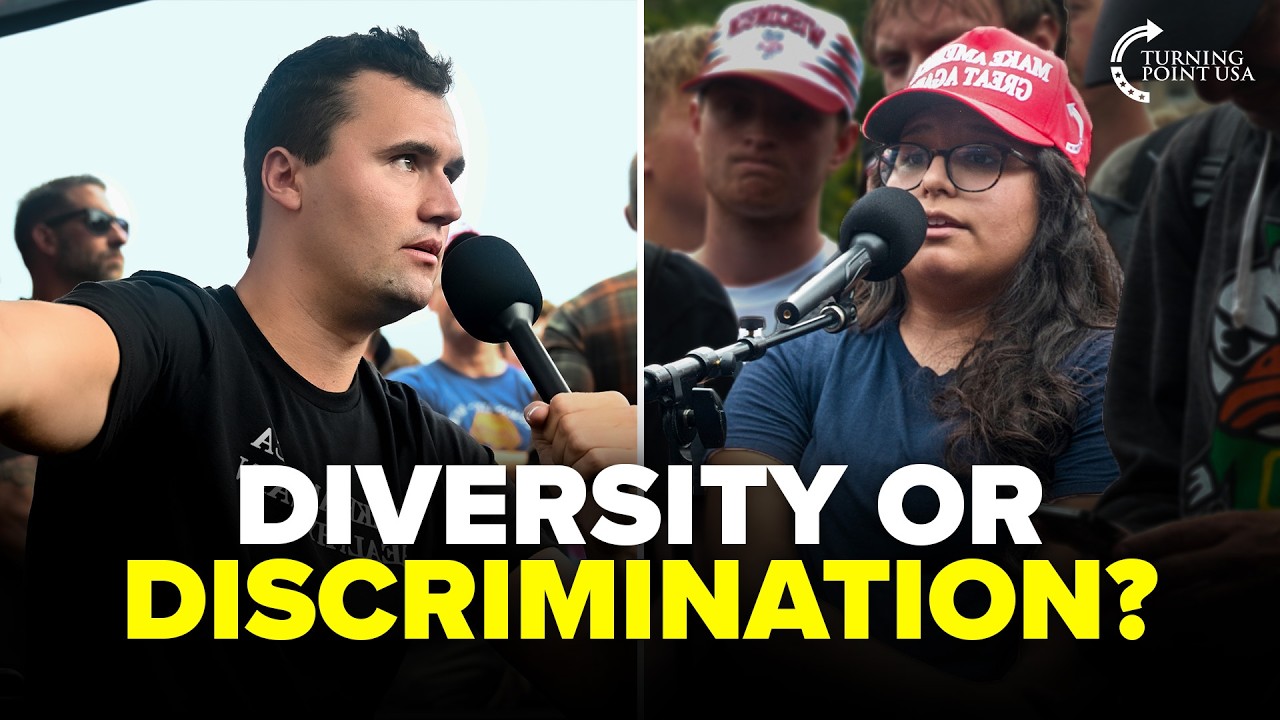
Charlie Kirk Debates University of Wisconsin Engineering Student on Affirmative Action, Merit, and Gender Differences
Charlie Kirk engages in a heated debate with a computer engineering student at the University of Wisconsin-Madison about affirmative action policies. The student argues that diversity initiatives benefit fields like medicine and engineering, citing examples like endometriosis research and car safety design. Kirk counters by advocating for pure meritocracy, arguing that lowering standards to achieve diversity has made American institutions less excellent. The conversation spirals into a broader discussion about biological differences between men and women, women's happiness metrics, and whether equality of outcome should trump excellence in critical fields like the Secret Service.
The Opening Question: Affirmative Action's Role in Engineering and Medicine
A computer engineering student at the University of Wisconsin-Madison approached Charlie Kirk with a question about affirmative action, specifically its role in bringing diverse perspectives to fields like engineering and medicine. The student argued that affirmative action benefits not just minorities but also women, pointing to concrete examples where lack of diversity has created safety issues.
The student cited medical research gaps like endometriosis, which has been historically understudied due to fewer women in medical fields. She also mentioned automotive safety, explaining that seatbelts are designed and tested primarily with male bodies and male mannequins, putting women at higher risk of injury or death in car crashes. Her central question was how to ensure diverse perspectives without affirmative action policies.
Kirk's Response: Meritocracy Over Diversity Mandates
Kirk responded by challenging the student to apply her logic directly to the three white men sitting around her. He asked if she would be comfortable telling them she deserved a position more than they did based solely on demographic characteristics rather than qualifications. This reframing aimed to highlight what he sees as the fundamental problem with affirmative action: it prioritizes identity over competence.
Kirk pointed to data from the Harvard admissions case, stating that affirmative action resulted in admitted students of color having test scores nearly 40% lower than their white and Asian counterparts. He argued this creates a system where institutions accept less qualified candidates, ultimately making American institutions less excellent and less functional.
Socioeconomic Factors vs. Racial Preferences
When the student suggested that people of color often come from lower socioeconomic backgrounds that don't prioritize education, Kirk seized on this point. He argued that socioeconomic disadvantage is a separate issue from racial preferences. Rather than penalizing qualified white males to achieve diversity, he suggested society should address the root causes of socioeconomic disparity.
Kirk contended that affirmative action conflates two distinct problems: helping disadvantaged communities versus ensuring competent people run critical systems and institutions. He maintained that the country is suffering because qualified, competent individuals are being passed over for positions in favor of less qualified candidates chosen for demographic reasons.
The Secret Service Example
To illustrate his point about the dangers of prioritizing diversity over competence, Kirk brought up the Secret Service. He noted that the agency has set a goal of having 30% of agents be women, despite women having lower physical fitness requirements including fewer required pull-ups, push-ups, and slower mile times.
The student pushed back, arguing this wasn't a fair comparison because women will never be as physically strong as men due to genetic differences. Kirk pressed her on this point, asking how this differs from other fields like engineering. The exchange revealed a tension in the student's position: acknowledging biological differences in physical strength while resisting the idea of cognitive or interest-based differences between men and women.
The Biology and Brain Structure Debate
Kirk argued that men and women have fundamentally different brain structures that make them naturally better suited to different tasks. He suggested men are better at macro topics like geopolitics, building infrastructure, and strategic thinking, while women excel at micro topics involving individual connection, empathy, healing, and counseling.
To support his point, Kirk claimed that when five women eat lunch together, they typically discuss relationships and personal conversations, while men discuss politics, sports, or the stock market. The student rejected this, arguing these differences stem from societal norms rather than biological wiring.
Kirk challenged her engineering background, asking if she truly believed there was nothing in the female brain that makes young women more likely to prefer certain activities. The student maintained her position that societal conditioning, not biology, creates these patterns. Kirk countered with everyday examples like makeup wearing and time spent getting ready, suggesting these behaviors reflect deeper biological differences in priorities and interests.
The Women's Happiness Question
Kirk introduced a provocative question: Are women happier today than they were 30 years ago? He claimed that despite increased liberation, college degrees, and financial independence, women are the most miserable they've ever been. The student disputed this, suggesting that increased reporting might reflect greater access to mental health services rather than actual increased unhappiness.
Kirk pointed to anti-depressant use among women, stating it's at historic highs. He suggested this misery stems from women not doing what they fundamentally want to do: get married and have children. The student countered that global data shows women report higher life satisfaction than men, though they also report more daily stress. She argued the issue has multiple layers and cannot be reduced to a single cause.
Back to Meritocracy: Kirk's Core Argument
Throughout the debate, Kirk consistently returned to his central thesis: America should operate as a pure meritocracy. He expressed little interest in diverse opinions for diversity's sake, instead prioritizing excellence and superior intellect over what he called "sensitive racial politics."
Kirk argued that when America was run primarily by white men focused on merit, the country was more successful and better functioning. He clarified he wasn't making a racial argument but rather observing that a merit-based system produced better outcomes than the current system that considers demographic factors.
When the student pressed him on specific safety issues affecting women due to lack of diverse perspectives in engineering, Kirk remained unmoved. He stated these concerns were "not that important" to him compared to restoring a culture of excellence and merit that he believes made America great.
The Closing Exchange
The debate ended with a revealing moment about the student's voting intentions. Kirk had apparently given her a hat under the condition that she would vote for Trump. When asked if she was voting for Trump, the student initially said no, then admitted she had agreed only to wear the hat, not to vote for Trump. Kirk called this lying and said it showed her character. The student defended herself, saying she never lied about her voting intentions.
This final exchange encapsulated the broader tension throughout the conversation: two people with fundamentally different worldviews struggling to find common ground on questions of merit, diversity, fairness, and what makes a society function best.