Up Next

Charlie Kirk Dismantles Libertarian Socialist Arguments on Property Rights and Economic Systems at Campus Event
5:38

Charlie Kirk Debates UVM Student on Socialism, Native American Policy, and Universal Healthcare
6:00

Charlie Kirk Confronts Marxism, Evil, and the Church's Role in Modern America at Miami Synagogue
1:34:28
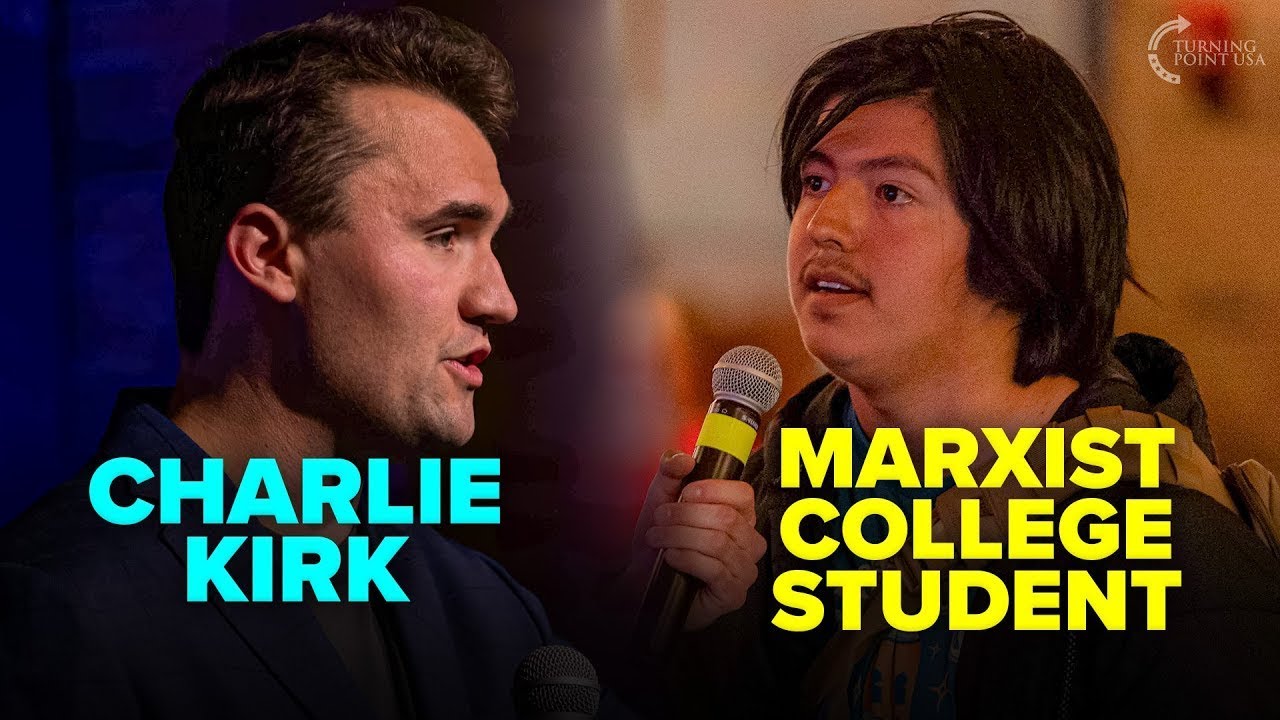
Charlie Kirk Debates Young Turks Contributor Ben Carollo on Marxism in America and Communism's Historical Record
Charlie Kirk engages in a heated debate with Young Turks contributor Ben Carollo about Marxism, communism, and their implementation throughout history. The discussion covers everything from the Soviet gulags and Mao's China to modern-day Chinese Communist Party policies, the founding of America, and whether human nature supports collectivist governance. Carollo defends Marxist theory and its practitioners including Lenin, Mao, and Castro, while Kirk challenges him with historical evidence of mass death, genocide, and oppression under communist regimes. The debate reveals stark differences in how each side interprets history, human nature, and the role of government in society.
Opening Arguments on Marxism
The debate begins with Ben Carollo providing his definition of Marxism, centering on the role of the state as an institution that exists to suppress the interests of one class or another. Under capitalism, he argues, the state represents a dictatorship of capital that suppresses workers' interests for profit. Under Marxism, the state serves workers' interests to suppress capitalists, eventually making the state itself irrelevant. Carollo identifies as a full-fledged Marxist, citing not just Marx and Engels but practitioners like Lenin and Mao as his philosophical guides.
Charlie Kirk immediately challenges this framework by asking about Mao's death toll. When Carollo questions the source of the 45 million figure, Kirk points to Chinese sources, international organizations, and mass graves. The conversation quickly turns contentious as Carollo dismisses these numbers and suggests organizations like the Victims of Communism Memorial Foundation spread Nazi propaganda.
The Soviet Union and the Gulag System
Kirk presses Carollo on the Ukrainian famine and the gulag system. Carollo deflects, arguing that famines were mismanaged under both capitalist and communist systems, comparing Soviet gulags to American prisons. When Kirk asks about Alexander Solzhenitsyn and his firsthand account in The Gulag Archipelago, Carollo claims not to know who he is. Kirk expresses disbelief that a self-proclaimed Marxist would be unfamiliar with one of the most significant critics of the Soviet system.
Carollo argues that gulags were simply the normal prison system of the USSR and that most inmates were not political prisoners. He claims the CIA documented that only 10 percent were political prisoners and that many released during Gorbachev's reforms returned to the same camps because they were common criminals. Kirk counters with testimonies from pastors and dissidents who spent decades in forced labor camps for their beliefs, challenging Carollo's characterization of the system.
Chinese Communist Party Defense
When asked about successful examples of Marxist theory, Carollo points to Vietnam and China. He praises China's economic growth, claiming average wages have tripled over the past decade and that China has eliminated extreme poverty. Kirk challenges this by asking about the Uyghur Muslims in concentration camps in Xinjiang. Carollo dismisses concerns about the Uyghurs, framing the camps as a response to the East Turkistan Islamic Movement, which he describes as a terrorist organization.
Kirk asks pointed questions about Chinese democracy, the one-child policy, forced lockdowns in Shanghai, and the origins of COVID-19. Carollo maintains that China is a democracy with a 95 percent approval rating for the central government and that it only takes 10 signatures to get on a ballot. Kirk expresses incredulity at these claims, pointing out the impossibility of challenging Xi Jinping's rule and the lack of genuine democratic processes.
Tibet, Tiananmen Square, and Religious Freedom
The debate touches on China's destruction of temples in Tibet and the Tiananmen Square massacre, though Carollo largely deflects these questions. When Kirk asks about individual rights and freedoms in China compared to the United States, Carollo argues that China's incarceration rate is lower and that corrupt billionaires face consequences rather than ordinary citizens. Kirk counters by describing China as an open-air prison where dissidents disappear and religious minorities face persecution.
On the question of religion in Marxism, Carollo argues there is room for faith, citing Fidel Castro as a Catholic and discussing liberation theology. Kirk points out that Castro's firing squads killed 15,000 people and that underground Christians in China face murder for attempting to worship. Carollo attempts to reframe Marx's description of religion as the opiate of the masses as a sympathetic understanding of why people turn to faith during suffering under capitalism.
COVID-19 Origins and Scientific Claims
A significant portion of the debate centers on the origins of COVID-19. Kirk asserts the virus came from a laboratory in Wuhan, citing Anthony Fauci's emails and the work of thousands of scientists who examined the genetic sequencing. Carollo, who claims to have a master's degree in biosecurity, denies the lab leak theory, describing it as a conspiracy. He argues that coronaviruses naturally recombine in species like bats through a random assortment process.
Kirk presses him on the specifics of distinguishing between natural and engineered viruses, while Carollo deflects by noting that American scientists also worked in the Wuhan lab. The exchange highlights the fundamental disagreement about trusting official narratives and scientific evidence.
Historical Genocides and Indigenous Populations
When Kirk asks about the biggest genocide in history, citing Stalin's and Mao's intentional massacres totaling 70 million deaths, Carollo responds by claiming 200 million indigenous people were killed on the American continent. Kirk questions this number, asking anthropologists as sources and whether all 200 million were killed intentionally. The debate becomes heated as Carollo accuses Kirk of denying indigenous genocide.
The conversation shifts to Theodore Roosevelt, whom Carollo describes as a mass murderer. Kirk defends Roosevelt's role in the Spanish-American War and his Nobel Peace Prize for brokering peace between Russia and Japan. This section reveals the vast gulf in historical interpretation between the two debaters.
North Korea and South Korea Comparison
Carollo initially refuses to say whether Seoul or Pyongyang is a better place to live, claiming it depends on who you are. He mentions North Korean defectors who later return, though he cannot name a single example. Kirk points to the satellite imagery showing North Korea dark at night compared to the lit-up South Korea as evidence of the difference in living standards.
Carollo attributes North Korea's poverty to American sanctions, while Kirk notes that North Korea has imposed sanctions on the West and developed nuclear weapons. He points out that thanks to American intervention, 100 million South Koreans live in a free democratic society, whereas North Korea remains an impoverished dictatorship. Carollo counters by noting that South Korea has restrictions on speech about North Korea and had its own history of concentration camps for disabled and homeless people.
Human Nature and Government Structure
Near the end of the debate, Kirk asks whether human beings are naturally good. Carollo responds that humans are naturally social, capable of both good and evil depending on how society is structured. Kirk counters that every civilization throughout history has encountered the same problems of power consolidation, dictatorship, and cycles of violence, and that only the West broke this pattern through constitutional republicanism and individual liberty.
Carollo makes the surprising claim that the U.S. Constitution was inspired by the Iroquois Confederacy, citing Benjamin Franklin. Kirk challenges this, asking which Federalist Paper mentions the Iroquois and whether John Locke, Thomas Aquinas, and other Enlightenment thinkers stole their ideas from indigenous peoples. The exchange reveals Carollo's belief that Western philosophy appropriated indigenous governance concepts, while Kirk maintains the Constitution's roots in Western thought, the Bible, and documents like the Magna Carta.
The Founding Fathers and Slavery
Carollo accuses the Founding Fathers of being incredibly racist, pointing to George Washington's teeth allegedly taken from slaves. Kirk responds by noting that everyone is born into a world they didn't create and that the Founders inherited slavery from previous generations. He details how nine of thirteen states had abolished slavery by 1787, how the Northwest Territory was designated free, and how the first anti-slavery convention was chaired by Benjamin Franklin in 1775.
Kirk argues that Thomas Jefferson condemned King George for the slave trade in the original draft of the Declaration of Independence and abolished the importation of new slaves as one of his first acts as president. He maintains that slavery was on its way out until Eli Whitney's cotton gin reignited the debate, eventually leading to the Civil War that ended the practice. Kirk emphasizes that it was the West, through figures like William Wilberforce, that abolished slavery worldwide.
Closing Arguments
In his closing statement, Carollo argues that the state can either suppress the interests of capitalists or workers, and in America today it clearly suppresses workers. He points to difficulty forming labor unions, demanding higher wages, and accessing basic healthcare. He contends that formerly colonized countries with worker-focused governments are now surpassing the United States in development.
Kirk asks Carollo whether he trusts the current government. When Carollo says no, Kirk asks why he would want to make that government bigger. Carollo clarifies that he doesn't want bigger government but rather to change its fundamental structure to serve workers instead of capital. He accuses Kirk of pointing to a failing capitalist government and arguing for less government and more capitalist power.
Kirk concludes by arguing that human beings are naturally awful to each other, that human history demonstrates repeated problems, and that the Founders built a strong but small government to protect individual liberty and the pursuit of virtue. He notes that people like Carollo want to destroy this system despite refusing to leave the country. He observes that people in China, Venezuela, Cuba, and other communist countries would leave if given the chance, while very few Americans seek to move to those places. Kirk states he will trust the testimonies of victims of communism over theoretical arguments, citing pastors imprisoned for decades, Cuban refugees who built life rafts to escape Castro, and Venezuelans fleeing oppression.
Video Transcript
[Music] welcome to another episode of debate night we're joined by founder of turning point usa charlie kirk and contributor for the young turks ben carollo tonight's topic is marxism in america first question ben please provide your best definition of marxism and what you believe about the topic at hand yeah most definitely see when it comes to marxism a lot of people have misunderstanding think that it's about particular policies but the reality is that it centers on the role of the state the belief that the state is an institution that exists to suppress the interests of one class or another right either under capitalism that would be the dictatorship of capital where capital has suppressed the interest of workers to the benefit of their profits now under marxism the state serves the purpose of basically serving the interests of workers to the benefit of uh you know well to the benefit of the workers to suppress the interest of the capitalists because obviously the very nature of capitalism is to lower wages increase prices and this has an inherent contradiction that basically squeezes the working class and it inevitably squeezes the capitalists themselves by leading to things like inflation and market crashes so really the central theory of marxism is the belief in a state that works to serve the interests of the working class to suppress the interests of capitalism and eventually get to the point where the need of the state itself is irrelevant okay um how much of that do you believe oh 100 all of it so you're just like a full-fledged marxist 100 so everything marx wrote i mean not necessarily every single word well just so i can understand just so we can make this constructive like just tell me your political philosophy when it comes to marxism well i think that really is my philosophy and we really have to look at like not necessarily marx who is the theoretical right not even necessarily angles we also have to look at the practitioners of marxism right so those people being like obviously lenin mao today oh you're a bit you're a big fan of male mountain's a pretty interesting character how many people did he murder how many people did he murder i mean how many people do you think he murdered how many people did 45 million more or less and what are you getting that number from how about the chinese people themselves rough calculations of international organizations mass graves what do you mean the victims of communism fund that literally puts out nazi propaganda on a regular basis i'm sorry wait the victims of communism fund is a what group puts out nazi propaganda they literally have a statue i mean you you have to be joking right you realize in the ussr they list nazi war deaths as victims you're pro lenin too yeah i mean linen did a lot of really great things with the ussr they literally brought what was a feudal peasant society to be a major world superpower how about the ukrainian famine how was that what about the ukrainian family like the six million people and intentionally killed through forced starvation and famine i mean it's pretty ridiculous the frame that is intentional right like let's be real right there was a famine and we can argue about the mismanagement of famines but capitalists have mismanaged famines all the time what does it look like what is it potato family what's a kulak what do you think of kulak i know what a kulak is you tell me you're the marxist i want to know what you think is someone that owned a certain piece of land that was not allowed to own that same piece of land because of lenin and stalin's government and if they own more than it what happened to them and do you know what okay let's no just answer the question i'm curious what did happen to them they went to a gulag do you believe those exist yeah 100 how many people died do you know what to do just like more or less i just want to know do you know what a gulag is yeah a forced labor camp or it could be a forced i mean like the forced labor camps we have in the united states of america which by the way the united states has more people under forced labor than any other country where in our federal prisons how did they get to they how'd they get to prison they committed crimes oh okay so it's not forced they made a choice are you familiar with that well that was that that's a phenomenal red herring argument you made i'm just curious i just want to know how many people died in the gulags no no no more or less i'm just curious how many people died in american prisons hold on a second i'm just curious gulags how many people died i'm just curious give me a number 10 million 15 20 25 million 30 million you know there's this really amazing anecdote it's really interesting you see and hundred thousand listen listen because let's talk about how they get these numbers right this is a perfect example there's this really great story right where you know you have uh you have winston churchill talking to stalin he asks he asks he's like hey how many people died in the famine and stalin obviously not wanting to talk about it they had bigger things to deal with you know like world war ii he puts his hands up he puts his hands up and wins in churchill walks away and says oh yeah that means 10 million he must mean 10 million now we can obviously talk about mismanagement of famines but if we're going to talk about mismanagement of famines why don't we talk about the people in india that winston churchill killed why don't we talk so we're not here i'm happy to do a whole defense of the greatest man of the 20th century churchill i'm not going to actually do that right now so was alexander solzhenitsyn a liar i don't know who that is you're kidding me you're a marxist that don't know you do not know who alexander social needs in is he wrote a book called the gulag archipelago which was a first person account he actually was in a gulag come on so and you don't even know who he is you know the people that worked and i admitted that they just made up a lot of those numbers right he no he lived in one my friend there's a lot of people lived in the gulags in fact there's a really great uh yeah and so they're liars i mean yeah there's a lot of okay so so let me get this right let's get this straight so the pastor who spent a decade in a forced labor camp with one hour of sunshine a day joseph bondarenko he lied about that i mean because he wanted to just spread the gospel i'm just i'm curious just kind of like what what your belief is on gulags so we can just have like a similar okay i'll tell you i'll give you a really great example right and you see the cia actually ran numbers on this this is really interesting so somewhere around 10 of the people right that like were in the gulags during their peak which by the way was after a civil war in russia right obviously with the white army that they had to deal with right and then the world war ii with nazi germany right uh were political prisoners but this is really interesting right i believe it was in the gorbachov years they tried to do a big reformation and granted a huge amount of amnesty granted a huge amount of amnesty to like tons and tons of people that were in those gulags and you know what happened charlie do you know what happened after that this is something that's true cia documents literally i mean after the liberalization of the ussr what what happened what happened to the people that were let out of those gulags they wrote books like the gulag archipelago that brought down the most of the ussr most of them actually ended up right back in those same gulags because this is to be very very clear that's their normal prison system that is the normal prison system that they had just to be clear because who do you think set up the gulags what what what's so you're trying to tell me that the people that were put in the prisons were not political prisoners no no what happened to the mensheviks most of the people what the forced imprisonment of the menstrual tell me how did trotsky die what do you mean who killed yeah who killed trotsky look look no no tell me who killed trotsky are we gonna are we gonna talk about economic theory we will no but no i'm just curious just like because i'm just trying to understand you say you're a leninist i mean who killed salvador agenda so 66 million people died in the gulags rough estimation does that not concern you i mean most of those numbers are inflated like you got to really understand this like the reality is that was their normal prison system if you look at the mortality rate in the gulags compared to mortality rate in american prisons at the same exact so let me let me ask you this so how many people died in the holocaust would you say i don't know i'm not a holocaust expert how about like eight million would you say that's fair so i know at a minimum there's six million jews okay so why are those numbers accurate yeah the gulag ones aren't well it's very interesting that you bring that up because the truth of the matter is if you look at the people right if you look at the like denotification of western europe what you end up having is you have a lot of people like for example right like nazi government officials that get put in charge of west germany right then you have nazi officials that get put of institution in charge of institutions like nato and then you have a lot of these nazis that quite literally set up institutions right like that like put out information without information like name one name one person look at the first commander of nato literally look at the first nato commanders they literally brought in people from nazi germany are we going to pretend that operation paper clip is not a thing that the united states did operation paper clip was in conjunction with operation mockingbird which was a cia propaganda campaign which i don't quite answer the question of the accuracy of gulags anyway that's a little bit of futile i'm just trying to understand though like maybe we're just on different planets here quite honestly because i've actually met countless thousands of people that were in these gulags and their stories and their first-hand perspectives and they did nothing wrong to be to be put in there except they had the different political viewpoints or they were pastors and then you embrace a political worldview that does that well let's take this for example let's imagine that you're a serial murderer in the ussr right let's imagine and then you go to the gulag right what's that i'm not imagining i'm talking about pastors i'm talking about no no no like look for example right for example okay so radio free europe radio free europe so this really great interview session where they literally went to people that were in these gulags and it was so funny because when radio free europe puts out this video about oh these people who used to live in the gulags they asked them oh what do you think about stalin and they basically said because remember right you remember that the ussr was invaded by the nazis right and you also yes and then they deterred the invasion you also remember that the ussr they wiped out they almost swapped levels of ukraine you also realized that the civil war civil war was between the bolsheviks and the mensheviks because they couldn't determine what blend of communism they wanted okay after they overthrew the romanov dynasty right well you also have the white army do you know what the white army is i'm very familiar with the white house you know the the royalists the people that were yes of course but i just i'm like so full of those on this topic civil war but are you gonna i just want to reinforce for the audience here in your country you um i know the united states doesn't like to jail insurrectionists remarkably what they did in the us just made an argument that was pro-gulag and yeah they had a prison system i um it kind of does explain some of your other views because we're just living on different planets like team reality team narnia so honestly how is our princess and system better how what a second um for example you got a lawyer with an independent judiciary you have a jury of your peers you know what a show trial is what is your show trump judiciary what's a show trial what's a show charter i don't know ask steve who is donzo who was general tukachevsky steven donziger you think the united states doesn't do show trials look at guantanamo what are those on a second what you're trying to do is indict the entire western legal tradition and conflate it with the leninist stalinist we're going to kill half the population we don't like look what you're trying to do is you're trying to take a country that had to deal with a civil war that had to deal with an invasion and compare that to the united states today i'll close with this you are defending genocide which is quite honestly a remarkable thing to see in real time right here you are defending genocide of joseph stalin and vladimir clear the intentional destructive killing of 65 million people what i'm talking about and no like there's no there's no middle ground in genocide that's your opinion moving on has there ever been a successful example of marxist theory in action where the workers are truly empowered uh yeah 100 most definitely like so first and foremost we have obviously the brave vietnam soldiers that defended themselves viet cong defended themselves against the invading american army which was basically there to punish them for daring to free themselves from french colonial rule um wait so hold on how how did that work out and what do you mean how did that work so i mean so no seriously the ho chi minh city under communist rule better than or better now what do you mean better than or better now was it is is was ho chi minh a better place under viet cong rule or better now under more kind of western who do you think is in charge of vietnam right now i mean it's a generally much for your country than it was 30 60 to 50 50 60 years ago oh that's weird when did the communist party lose power in vietnam well they've they've industrialized their country they've opened themselves up international trade they actually have fair and free elections like i'm not going to say vietnam's a perfect country but post-viet cong rules so their standard of living has increased so you think if the mentality has gone down i think maybe perhaps angel orange had something to do with some of the struggles they think that maybe the sanctions from the united states of america cutting off supplies to food maybe add something okay got it so america's always the villain so besides the viet cong which is a new one i'll be honest where else has communism worked china look at china okay what about china works aside from the fact that china's the strongest economy in the world right now there's obviously the fact that average wages in china have tripled over the past decade so before we go any further do you really want to defend the chinese communist party against me sure okay got it so um uighur muslims how do you feel about them so you're a pro concentration camp no not pro concerts okay so what where are the uyghur muslims right now do you know what the east turkmenistan no don't don't don't change the topic i'm not this we are same topics you don't know that the east turkmenistan movement was labeled by the united states of america as a terrorist way organizat scholars have you are pro-genocide but anyway no no no no stop writing saying no doesn't make it like the double genocide theory is literally nazi propaganda the whole idea was to say that the obvious okay mismanagement of a famine they're trying to equate that to the invasion and the mass murder committed by the nazis they're literally nazis that intentionally push that theory why do you think that israel to this very day actually has tensions with specific people in ukraine who are pushing that double genocide theory because the truth is a famine and the mismanagement of reason i'm talking about in addition mass graves and all that but let's talk about the ccp so let's talk about the ccp so um you're cool with the one child policy it doesn't matter what i'm cool the reality is no no that's that was a policy to ccp for years where they would murder another child if you had more than one kid look what we need to understand is is that china is a democracy and they are going to make laws based off of their how are they actual materials how are they a democracy are you kidding me aside from the fact that the central government has a 95 approval rating which by the way before you're like oh but have you ever have you been to china no no no no no no of course oh so you must be a subject matter expert i'm not yeah so so it's interesting so okay so their democracy do they have senators or congress what is it china well there's about a thousand members of their national people's congress and then obviously they have a system of local people so you don't think those elections are great i'm gonna test you i'm gonna test you what does it take to get on the ballot in china what is it a lot of money power and influence and killing the right people oh that's weird because it's actually illegal to spend money on campaigning in china there's actually very soon so you you think you think that a dissident chinese person could run up against gigi ping right now so let me ask you a question how do you you're you're pro ccp so so you think it's okay how do you think elections work how do you think elections work in china how do you it's very simple you're born into the right family you have connections to the right people you can't answer that no what's ggp what does it take to get on the ballot in china you have to have the right i don't know yes i do no i do know you can't just all of a sudden pop have you read the law and we read there actually so what happened to the tiananmen square listen this is the answer what happened charlie kirk doesn't know because he has no idea what happened at tiananmen square you need to get how about signatures to get on the ballot in china that's it 10 signatures how many people does it take to start a recall how many temples did they destroy in tibet how how many so you think you could recall jiji how how many people do you think it takes i have to be honest you are such an unbelievable fool to believe that china actually has a democracy well look here's the thing they've tripled their average wages they've eliminated extreme poverty they have amassed popular support in china they have the strongest economy in the world and right now they are how many people live in abject poverty in western china more people than the population of america do not have access to clean water or toilets and that's your idea of lifting people out of poverty let me ask you this question 26 million people forcibly locked down in shanghai cats are being put into entire bags and murdered if you have kovid that's your idea of a good society 26 million people being forcibly locked down in china how do people permanently disable because of cove in the united states how many people died i don't know that's the country that designed the virus your favorite country the virus where did it come from what do you mean where did it come from like the virus so you've had link conspiracy theorists look i don't know know what country did it come from i have a master's degree in biosecurity and power so you must be so smart where did the country come from where did it come from here's the thing charlie listen up did you know that there were american scientists working in that lab what's the name of the lab oh so it came from china it came from china yeah oh so it's the chinese virus no it's not the chinese what country did it come from then how many strains of coronavirus are like how many types of coronavirus are there there's plenty there's there's omicron there's coveted 19 there's the original strain but it was originally developed no no see you've listed three the reality is there's there's different types of coronaviruses it's developed in the world that exist in the world that aren't developed anywhere like cats have their own no of course but which one was developed in the lab coronaviruses there's no like you think that the american scientists that were working in that same lab right next to those those chinese scientists you think that they were secretly malicious no no no no no no no no see you're putting words in my mouth hold on no no did it come from a lab or not or did it come from a himalayan of course it didn't come from a lab oh you think it didn't come from a lab no yeah because i live in a real world i live in all over the world okay i live in the region you understand that every single like person worth their salt looks the strain and they understand that this was bioengineered in life fouchy himself agrees what do you think what do you think would tell me because apparently you're the biologist here right how do you i do know what a man a woman is do you tell me the difference tell me the difference okay tell me the difference between how do you tell the difference between a man-made virus and a non-man-made virus there's a lot sequencing everything from how it's compiled mrna type technology so what type of sequences according to anthony fauci's own emails to hugh albatross on january 31st on friday evening he said quote this has every single marker of a man-made laboratory-created virus that's anthony fauci's own declassified email to the cdc and the nih not to mention the thousands of other scientists that have looked at the strain and they say the way that the proteins are correlated the way that this is put together wait wait wait what what i mean proteins are correlated the way that it's put together you're just throwing words together okay yeah my language might be a little sloppy but the people that understand the actual sequencing so you think that where did the virus come from then exactly what do you mean where did the tell me where it came from yeah well so this is really interesting right see because the type of virus that it is right little rna viruses they recombine a lot that's one of the really interesting things about these types of viruses and so what happens is when you have a couple of different strains that infect the same species at a time the way that the the way the virus reconstructs itself which to be clear we don't necessarily have a full understanding of how exactly that happens but the reality is one of the central theories is this random assortment process where if you have multiple strains of a virus that is infecting one thing at a time which is one of the reasons why bats in particular because they're true because i don't think like a sane individual could believe i wish you think i got that kind of money well he wants to be a ccp agent you think i like you really you think i have though you think china is funding me that's how like that's like disconnected no it's i'm just going to be honest no rational person could believe the stream of absolute nonsense that you are you have to be paid for this like there's you're kind of like a walking hologram of insanity i don't know what to tell you buddy like but i i just hope it's worth it it sounds more like you're talking into a mirror at this point no actually you're the one that's defending the murderous genocidal ccp and the murderous genocidal lenin what was marxist okay tell me this then yeah what was the biggest genocide that ever happened in world history the biggest genocide it depends how you define a genocide i would say stalin's intentional massacre or mao's intentional massacre to 70. 70 million people 70 million yep intentional debt what about the 200 million people that used to live on this continent oh you mean the people that died of natural causes you think holy moly what what 200 million people are you talking about you're indigenous you think there were 100 million people before we came here yeah all living at once yeah where on earth do you get that number what do you mean from anthropology so so you think we killed them all from anthropologists of course we killed them all so we killed 200 million people intentionally yes you think so so just to be very clear right you're sitting here denying the genocide of indigenous folks you know who teddy roosevelt is oh you think teddy roosevelt's a mass murderer yes teddy roosevelt is a mass murderer what do you think those rough riders did who do you think they were killing they won the war what war what war the war against the commies in cuba you know you know that way hold up they won war against communism who's in charge of cuba right now well the communists so oh so they didn't win the war then well they won they won a battle oh they won a battle wait we've gone from one more to a battle they won the spanish not living in reality they won the spanish-american war oh okay okay so let me ask you a question like who else did he go to war against well teddy roosevelt actually want to know about peace prize for brokering peace between russia care about the nobel peace prize you don't care about much honestly that's real how are an individual's wants and needs represented best in a marxist society oh i'll ask the commie obviously through their democratic structure like the reality is right this is the thing right obviously going back to the role of the state to serve the interests of the working class to suppress the interests of capitalists which is exactly why people like charlie kirk obviously are very unsettled with it because the reality is that in america working class people have to worry about the government kicking down their door for doing things like smoking marijuana but in china it's not that working class people have to worry about you know the government kicking down their doors it's corrupt billionaires that have to worry about the government kicking down their doors just look for example giant tech companies making tons and tons of money in china with very little regulations well what does china do they put in tighter regulations on these tech companies and then they take money from these tech billionaires and then they give it to anti-poverty programs across the more rural parts of china in order to fund schools food things like that like for example china is this really really great co-op development program which is really really great so they combine ecological i can tell you don't even believe this by the way they can mine you've got to be you've got to be acting at this point why do you think i'm acting because because you're actually no it's because the reality is so different of the millions of people in china that are literally forcibly held in their homes the millions in concentration camps the people that can't even breathe because the air quality is so bad how about the underground christians that are murdered in the streets for trying to go to church so no continue on your beautiful like co-op in beijing like yeah we could grow vegetables in shanghai so it's so great is that that's kind of the argument right look what are we talking about vegetables in shanghai you're assuming this is shanghai obviously shanghai is like a giant urban city right the cooperative development which is really cool by the way they're combining ecological restoration with these cooperative developments so and you know with the schools in there they have a requirement that the schools buy a lot from the local farms right sixty percent of the food right that they serve in the in the schools basically comes from local farms so if you talk about meeting people needs right the farmers there have a need for eq like you know uh economic development right so if you buy for from the schools if you buy the food from those farmers that puts money into their pockets and then they literally take that food and give it back to the school kids so the school kids can have a full belly while they're trying to learn and like this is the reality charlie like you gotta understand like if you think china's so dystopian how come the incarceration rate in the united states is so much higher than china well because we have a rule of law and they kill dissidents that break through a lot tell me where where are these dead people now show up tell me about foxconn what about foxconn what do you know about it what about you mean you mean the crony plot that basically bulldozed an entire town in wisconsin kicking people out of their homes factory they never happened in china what about foxconn so do you know they have to put up nets to try to prevent people from jumping out of their buildings so an american company was treated properly they took those a chinese communist a chinese communist party partnership sponsored by gigi ping himself and his entire regime so when you go to china let me just tell you you'll drive down the street and you will see dead people laying in the middle of the street you will see people defecating go to china then go to china take a video actually you know what cameras unlike you my wife lived in china for six months and she'll show you the videos to show you the images they don't have they don't have a regard for human life they don't they don't value people as the individuals we're the ones letting people die of coronavirus hold on a second the reality of china is that if you disagree with the government you disappear like jack yeah if you disagree if you disagree if you disappear oh because he that was his only thing he did or if you're a dissident billionaire like the weaker muslims you get put in re-education camps where we have drone footage are you talking about people that are forced to eat pork against their religion just talk about the east turkmenistan movement no i'm talking about the weaker muslims that you're trying to spend in some sort of weird way look so what did they do to tibet so the associated press the associated press actually went to went to xinjiang right which by the way anybody can go to zheng zhang if you want you know i'm not allowed into china right right okay sure no i'm not then if i go to china i get arrested great society okay cool then somebody else go because people did somebody it's a wonderful place westerners aren't allowed if you you can how come the associated press went to jinjang they asked they want the right journalists to go but if someone like me were to show up in china you think that the associated press is out there carrying water for china hold on a second the associated press also wrote in other articles that these were quasi concentration camps yeah yeah so like yeah yeah a the associated concentration fundamentally is like this right-wing bias right like that's just ultimately the reality of the associated press because right like who who are funding western journalists where do western journalists get money is it maybe through institutions that have you know like their own how does npr get their money right like like so let's think about this for a second let's think about this for a second right so they associated press actually goes and they write an article and they talk about it because the reality is we can have if we want to live in the real world we can have a conversation about whether or not china was going too heavy-handed in dealing with the east turkmenistan movement which is a terrorist movement but a lot of uyghur muslims even in xinjiang are happy that now they can finally drink alcohol without having to worry about bombing attacks and stabbing attacks now we can have a conversation about whether or not they were too heavy-handed about whether or not they're racial racially profiling the propaganda is this reality let's have a conversation about concentration camps like you know maybe we shouldn't be forcing them to eat pork against their religious conscience you know murdering a lot of them is probably wrong there's really not a conversation to be had like you're defending concentration camps i think they're wrong if there's a major terrorist movement in the united states how do you think we should respond to that a major terrorist move well they get actually i can tell you exactly how it happens like when the boston bombers tried to bomb in boston individual that's an individual bombing okay yeah so when isis pops up they still get if they're american citizens how do you think really the american citizens get due process rights tell that to all the americans that we drones striked in the middle east well hold on a second no wait you mean americans on american soil that's what you asked so it's not the parkland shooter got a trial the buffalo shooter gets a trial we know that yeah because they're white supremacists of course white supremacists are going to get it what about the tsarnaev what about the tsarnaev brothers the zarnov brothers the boston bombers did they get a trial yeah okay so you just disprove your own point where does cultural marxism fall under your ideology cultural marxism is literally a nazi conspiracy theory like literally like literally the nazis in nazi germany invented the phrase cultural marxism the fact that you're asking me about it is a pretty telling to who you are oh you think i'm a nazi um most definitely i mean at this point like you've made it pretty clear why am i a nazi you're asking me questions about cultural marxism that's literally like so in case you know so let me ask you cultural moments who's antonio grimishi okay i'm telling you who is he why are you bringing gramsci into this no but just tell me who he is the italian socialist yeah so what coin what phrase did he coin i don't know you tell me cultural marxism oh is he a nazi okay no antonio oh so maybe it didn't come from the nazis okay literally so why would you say something so false when gramsci himself came up with the phrase do you know what the conspiracy theory is around cultural marxism then why it got so popular in germany so what let's go back to gramsci what did he write about cultural marxism i don't know but i'm not familiar with all of this yeah you're not familiar because you just keep on spouting out these things that call people nazis which is super unhelpful and not true and so yeah antonio gramsci from prison said that marxist must adopt a cultural framework alongside an economic framework in order to get the means of what they want to get done that's not a conspiracy theory just read his book okay but that's different than the phrase cultural marxism how is it different what do you mean how is it it's exactly the same thing no it's not exactly the same thing so what happened is in nazi germany they spread this theory called cultural marxism they literally had this theory that jewish people were secretly like bringing marxist theory into the mainstream and literally that's not at all what anybody on the right talks about are you kidding me what about that guy who literally just murdered a bunch of people talking about great replacement though you think you're telling me that tucker carlson doesn't talk about that on a regular basis hold on a second so first of all the buffalo shooter is disgusting and it's awful and he was more of like a weird leftist anything on the right if you actually read what he wrote he called himself a left-wing authoritarian which sounds more like you by the way than me let me finish talking the nazis secondly on the left too buddy secondly um what is cultural marxism cultural marxism is developing a cultural framework of deconstructionism or post-modernism to try to break ourselves from the shackles of the western tradition so that we can embrace the nonsensical economic ideas that you believe in that's not a conspiracy theory it's reality and it was written by gramsci himself and if you're not familiar with those writings well then you're not really equipped to talk about cultural marxism you just keep on like conspiracy theory like yeah actually you're wrong like go to the roots sure buddy sure is that your response sure thank you ben thank you charlie how do people in a marxist society overcome oppression yeah well they leave okay sure so why don't you live in a marxist country i'm just curious why don't i live in a marxist country well i mean aside from the fact that i was born here and i would like the united states to be a better place the reality is like when it comes to overcoming oppression i mean just look at once again vietnam right vietnam invaded by the united states is that not oppression or what about like what about north korea for example in north korea we killed one out of every five people in their entire country is not the very minimum of evicting colonizers and evicting imperialist armies hold on a second why did we invade korea why did we invade korea i'm asking you no you tell me because the truth of matter is their economy like so first and foremost they were like obviously imperial japan was occupying korea then you have the socialists that liberate korea from imperial japan then you have all of these powers coming in in the middle of korea at the end of world war ii and ended up splicing it up so the reality is one of the reasons why we invaded korea is because we were deeply upset that anybody anywhere in the world would be socialists because do you think korea is going to like invade the united states so where is it a better place to live seoul south korea pyongyang north korea i don't know it depends on who you are you you believe there's not even a question of like an average everyday worker pyongyang north korea or seoul south korea right now it really depends on who you are ask poor people in south korea how they're feeling about their system of government they are kissing the ground they every day that they are why are there no why are there so many defectors that defect from north korea that then defect back to north korea name one what do you mean i'm not going to list them off by name one or you can just google it oh you can google it have you ever heard of yemeni park yeah yeah what about her what about her do you want to know the young lady whose father was murdered she was sold into sex slavery barely escaped to china came to america to tell us what's really going on in north korea okay buddy like why is she doing conferences with like the heritage foundation because she'll go to anyone that will listen to a first-hand perspective or maybe perhaps north korea is hey did you know that there's like a whole game show in south korea where they bring on defectors and they're incentivized right the more like over the top their story is the more over the top their story is right the more they get paid right no more they keep getting brought on these shows so the reality is nobody's going to say that north korea is a perfect place to live nobody's going to say that right nobody's going to say that there aren't terrible things the reality is there's explicit financial incentives for people to inflate stories so let me give you an example that isn't a financial insight okay sure you look from space at night on south korea and north korea north korea is dark and south korea has lights all over do you think that has anything to do with the sanctions that the united states has on north korea it's north korea that has imposed a lot of sanctions on the west as well they develop nuclear technology against us north korea could make some choices against us immediately immediately who are their major economic trade partners china iran okay okay two you've named two yeah china and iran that's about it no one else really they're a pariah why why is north korea pariah state because they murder their own citizens and re-educate them or maybe because the united states has gone out of its way to make sure that every country that we deal with this is allowed let's trade with let's finish the point so maybe that has an impact our economic our intervention in korea helped create south korea and make sure that the entire korean peninsula wasn't going to be what happened in south korea in the 90s how do they treat disabled people because here's the let me finish they literally you want to talk about concentration let me finish it south korea was putting people in concentrations camps they were putting disabled so patently homeless let me finish thanks to america's intervention a hundred million south koreans right now live in a free democratic society absent america's interventions their societies they're democratic they would be all like north korea which they are poorer they are unhappier they have no freedom do you support me okay what about freedom of speech do you support the freedom of speech do they have freedom of speech in pyongyang do they have freedom of speech in south korea of course they do really why people of course they do it it's actually illegal to say positive things about north korea in south korea so i thought you'd like you you just said they have freedom of speech you don't even know basically you don't know basic laws there's there's a probably a pretty good reason for that but quite honestly oh so wait they have a good reason so like for example again like it's a new companies like hyundai and samsung yes can you empower entrepreneurs do you have the rule of law yes yes yes yes all of that in south korea in north korea you can't own property you can't say anything good bad or indifferent you are silenced by force in north korea how come they have a lower incarceration rate than we do in north korea yeah oh you trust the north korean numbers everybody's we're not talking about the north koreans country is incarcerated everybody's numbers about north korea everybody in north korea is incarcerated attitudes like no it's not the whole country is an open air prison okay ben is there room for religion in marxism yeah most definitely a hundred percent like for example right like uh let's take people like fidel castro right fidel castro is catholic right and he is one of probably the best marxists out there right there's a reason why people slaughtered 15 000 people with firing squads there's a reason why people like nelson mandela referred to him as like an inspiration and a friend right so are you against nelson do you think part of it part of his ideology was terrible he's a communist but part of it was good do you think okay so nelson mandela was a communist i'm not gonna oh okay he was okay so yeah so like the reason his advocacy apartheid was great but his economic views were terrible there's actually a really great religious philosophy i don't know if you're familiar with liberation theology for example actually one of the reasons why the cia it's a blended places went into places like el salvador to murder people um was because liberation theology was so popular right basically the idea that like under christianity right like uh you know jesus was sort of the god who riots right who goes out of his way basically to stand up for people who are oppressed goes out of his way to stand up for people who are marginalized right he literally said the meek shall inherit the earth in fact the only people that jesus ever said wouldn't go to heaven were rich people he never said that and by the way if you go back to the actual koine greek it is lover of money not rich but that's fine i want to i you're not totally wrong okay right so like the reality is the reality is like there are tons of different religions that are like completely compatible with marxism and there's nothing inherently against it now marx had specific theories about religion he said it was the opiate of the massachusetts masses which a lot of people misinterpret right a lot of people misinterpret see what marx meant by that was that you know religion plays a very critical cultural role in alleviating pain and suffering that marginalized people feel which is very understandable right like if you're struggling in a very difficult world like obviously turning to religion believing in that there's a higher power believing that even in your difficult circumstances that if you work hard and you be the best person you can be there's going to be an afterlife waiting for you um where you'll be able to live in peace right like none of that is contradictory to capitalism but it is about the reality or none of that is contradictory marxism what's essential to this reality is the idea that so many people they only have religion as an outlet for self-expression because capitalism forces people in such brutal conditions capitalism forces people into what conditions brutal conditions such as such as are you kidding me there's literally right-wingers out there that are calling where was china 20 years ago versus where's china and they got rich largely because we offshored our labor so hold on let's let's be very clear about the china stuff before i go back to another point i want to make china got rich off of our deindustrialization and a massive labor arbitrage because they could undercut our wages and whose fault is that of course it's our own fault i'm not that's not the point the point is that it wasn't because the brilliance of xi ji ping it was because of the treachery and their ability to exploit their own citizens as pseudo-slaves to go make a bunch of plastic and fentanyl and bring it back into the west see but they don't create new stuff they don't start new companies they simply just say we have more people are you telling me that huawei are you telling me huawei there's a bunch of these stuff they steal western technology everybody okay then who's sending vaccines all over the world uh pfizer astrazeneca johnson and johnson in madrid because the united states is sending that many vaccines well i hope we don't send that many vaccines but i mean like okay literally last year china i hope we're not sending that half of all the vaccines that they made around the world they were sending to other countries like half of all the vaccines that they made there's a lot of people that vaccinated today specifically because of the hard work and dedication of people in china hope nothing happens to them right um i wouldn't trust the chinese vaccine let alone a pfizer vaccine um but yeah so i just want to get to this i have a more interesting i think more important question do you think human beings are naturally good um human beings are naturally social right which means that human beings could be good or evil right the reality is that like what makes us good is also what makes us evil right because the reality is like what would you do for your family right a lot you'd do a lot right i think we would all basically do anything for our families and that is both what makes us so capable of goodness and kindness but it's also what makes us so capable of vicious evil because the reality is if we thought that people were threatening our families we would do a lot of terrible things right but if we work together with other people in other families and we extend our minds to understand that we have a shared sort of societal experience then we're going to do a lot of good things for each other so ultimately when it comes to whether or not human beings are good or evil we're just naturally social we want to fit in and be part of a society so ultimately it really depends on the way society is structured that determines whether or not we end up being good or evil but it is all basically from us being pro-social so why is it that every civilization encounters the same problems then regardless of its circumstances what do you mean every civilization what do you mean the same problems what do you think these problems are i'll articulate it from the aztecs to the incans to the mayans to the egyptians in this river valley to the chinese empire the british empire attila the hun to genghis khan julius caesar to the greek or roman empire they all go through the same sort of cycle so where they start to allocate power to a lesser and lesser group of people they start to then create a pseudo dictatorship under the false promises of empowering people and then the cycle of selfishness murder strife division famine continues on end and the only thing that ever broke that cycle was the west the only thing that ever broke that okay a how come the iroquois confederacy didn't have those problems oh so tell me about the iroquois confederacy and the great contribution to humanity they made i mean do you like the united states constitution oh you think that our constitution derived by the iroquois confederacy i mean ask benjamin franklin he would admit it very directly and explicitly he didn't write the constitution it doesn't matter right all of the founding fathers no it actually does matter so now let me tell you if you're actually sure ask james madison yeah how about so let me get this what federalist paper is the iroquois confederacy mentioned in it doesn't matter because it really wasn't an inspirational papers were the only thing that were written back then no but it was the most hamilton madison and jay went through private musings of why they wrote the constitution do you think they didn't care what benjamin franklin is watching so so so i want to make sure i understand this right so the iroquois confederacy you think is where we got separations of power supply power is consented to govern independentiary and consent to the government not the pilgrim colonies or the bible or the mayflower compact or the magna carta or the writings of augustine aquinas hume look none of the people that were alive at the time john locke look where do you think john like where do you think these people said that they got their ideas like the reality is why do you think the enlightenment came after all of these colonizers started visiting people oh so you believe in this like weird unfounded mystical belief that we stole this is actually indigenous this is actually a very standard understanding of world history if you have even a marginalized hold on a second so you think that john locke stole from indigenous people are you kidding me all of the enlightenment philosophers stole from all of them so what did kant steal from the indigenous people like are you kidding me the categorical imperative came from some tribesmen no not a categorical imperative they don't have to necessarily steal everything that's cut so let me get this machiavelli what did he study because we didn't colonize when machiavelli started writing what did he say he's a really interesting character what did he steal from indigenous people i mean i wouldn't say that like machiavelli is my understanding he didn't really interact with people like indigenous foreign okay so nothing there how about aquinas what did he study what did he steal from indigenous people what do you think these people like like this is the thing this is the whole mythology no but just fill out your argument please like prove it give specifics because it's rather critical right so like what did aquinas steal from indigenous people like okay you're naming random people no they're not random people in the united states okay did aquinas write the constitution aquinas inspired every single founding father they all read it they knew it backwards and forwards john adams said no individual theorist or author was more instrumental to my metaphysical world view than thomas aquinas that's because look look are we going to ignore the fact that the founding fathers were incredibly racist do you think that they were oh okay so you think they were racist of course they were racist why did they try to bother george washington get his teeth okay so how many states decided to make the northwest terrorists answer this question answer this question where did george washington get his teeth they were blended individuals no doubt mixed but you know what you and i both have in common no no i want to answer the questions i want to make sure that your audience i would assume that you've probably got that so to make him look bad you're going to say he got him from a slave or he exploited somebody but here's the here's the truth about george washington teeth out of people's heads while they were put in his mouth alive of your nicole hannah jones highly emotive argument everybody has something in common we're born into a world we didn't create and every one of these founding fathers were born into a world where slavery was everywhere by the time they died it was on its way out do you know what's incredible it wasn't on its way out when they were all done hold on a second how many states abolished slavery by the time the constitution was how many states abolished slavery by 1787. nine out of 13. so a majority of states had already abolished it northwest territory structurally constitutional not such northwest territories first act of congress free or slave slave area free unanimous article six of the northwest territory first state to abolish slavery vermont 1777 inspired by the writings of the declaration first anti-slavery convention 1775 chaired by benjamin franklin when in slavery george washington said it's not a matter it's not a question of if it's a matter of when we abolish slavery thomas jefferson admonished king george in the original draft of the declaration of independence that means saying that slavery is a great evil that we blame king george he was also thomas jefferson it's a very interesting slave trade for telling them they couldn't stop killing indigenous folks thomas jefferson said very clearly in the virginia house of commons in 1790 that we must abolish slavery he abolished the importation of new slaves is one of his first act of president in march of 1807. the founding fathers up as a result of abolish slavery so you have a misrepresentation and an intentional political argument to try to misrepresent the great heroes of the founding fathers when they were inspired and slaves what happened what ended up happening was the slave trade went down eli whitney creates the cotton gin and a whole new debate of slavery gets reignited that's actually not true right the reality is do you know what happened the slave trade i guess went down if you talk about international trade the united states up set up literal farms where human beings were bred human beings were bred for slavery was going down dramatically so he was sworn in in march of 1807. he was governor of virginia in 1790 wrote the declaration in seven so when did slavery end in the united states great question it began to end in 1777 a process of decoupling from an ancestral evil where we have more people in the world right now that are in that are slaves today than back then the process began 1820s the debate reignites because of john c calhoun the creation of the cotton gin we fight a war over it we win the war and slavery is abolished that's a pretty awesome track record for a country that inherited an evil that every other country prior to it had it was the west that got rid of slavery it was william wilberforce it was john edwards it was george whitfield it's easy to kind of do your thing like well it's terrible it's bad yes it's easy to call balls and strikes on a society you didn't create it's easy to try to lecture the rest of the country like you know these people are so terrible for something you didn't toil for or sacrifice slaves that were foreign they were slave owners also by the way slavery was never abolished we literally have it in the constitution to this very day i'm sorry what's the 13th amendment thank you gentlemen ben we'll hear your closing remarks now um yeah fundamentally at the end of the day the state can work to suppress the interests of capitalists or it can work to suppress the interests of the workers in the united states of america today it is clearly suppressing the interests of workers just look at the difficulty that people have in terms of forming labor unions demanding higher wages even getting access to basic health care that even other capitalist countries have right then you have a lot of countries that have been the victims of colonialism that have states that serve the interests of working-class people and while they have a very difficult starting point the reality is they are surpassing the united states now in a time frame that is rapidly outpacing the development that happened in the united states so ultimately the reality is we can choose for the government to serve the interests of the very rich few or we can have a government that serves average working-class folks so i just have one question i'm sorry do you trust the government this government no but once again we have to ask the nature of the state but then why would you want to make that government bigger no no no no it's not about making the government bigger it's about changing the fundamental structure of the government so it serves the interest of workers instead of the interests of capital and in fact this is one of the things that like the fundamental dishonesties that i think come from people like you you point to a capitalist government say look it's not working for workers we should have less government give capitalists more power but the reality is right and this is the fundamental reality that it's the nature of the government that's the problem you're unwilling to admit the very fact that our government is fundamentally serving the interests of capital as opposed to serving the interests of the workers and that if we were to flip the system on its head and it would work a lot better at its best it's the opposite it serves the function of the liberty of individuals the pursuit of virtue yeah i mean look in closing human beings aren't naturally good we're actually naturally awful to each other and human history shows that we have the same problems over and over again and the government needs to be strong but small and the founding fathers built that beautiful government that people like you are trying to destroy in a country that you refuse to leave here's how you know you live in a great country that even those who say they hate it refuse to leave every person in china that would be given a chance to go out almost every person would leave almost instantaneously why don't they because they're not allowed to really people move to the united states from china all the time those that are allowed very few that are allowed in venezuela not knowing that would do anything to leave these disastrous experiments and i have met far too many victims of communism to take any of your arguments seriously people that have the you mean the wounds to show it you mean the pastors that were in jail for decades in the soviet union for doing that like the plantation owners that had their plantations people like alexander schultz at social needs that wrote about it endlessly the cubans in miami that had to build life rafts to save their own lives because of the oppressive castro regime the people from venezuela in cuba and argentina i'm going to trust them a lot more than a smug sanctimonious person with a super bizarre laugh that read a couple things online that sound good thank you buddy charlie thank you ben thank you for coming [Music] you
Related Books
Browse Conservative Books