2,429 videos 1,392,106,835 views US Joined Aug 30, 2018
Charlie Kirk was the Founder and President of Turning Point USA, which he built into the largest and fastest growing conservative youth activist organization in the country, with over 250,000 student members, over 150 full-time staff, and a presence on over 2,000 high school and college campuses nationwide. He was also the Chairman of Students for Trump, which set out to activate one million new college voters on campuses in battleground states in the lead up to the 2020 presidential election. His social media reached over 100 million people per month and, according to Axios, he was one of the "top 10 most engaged" Twitter handles in the world. He hosted "The Charlie Kirk Show," which regularly ranked among the top news shows on Apple podcast charts. He was assassinated at Utah Valley University on 10 September 2025.
Charlie Kirk Defends the Electoral College and Constitutional Republic Against Pure Democracy at Campus Debate
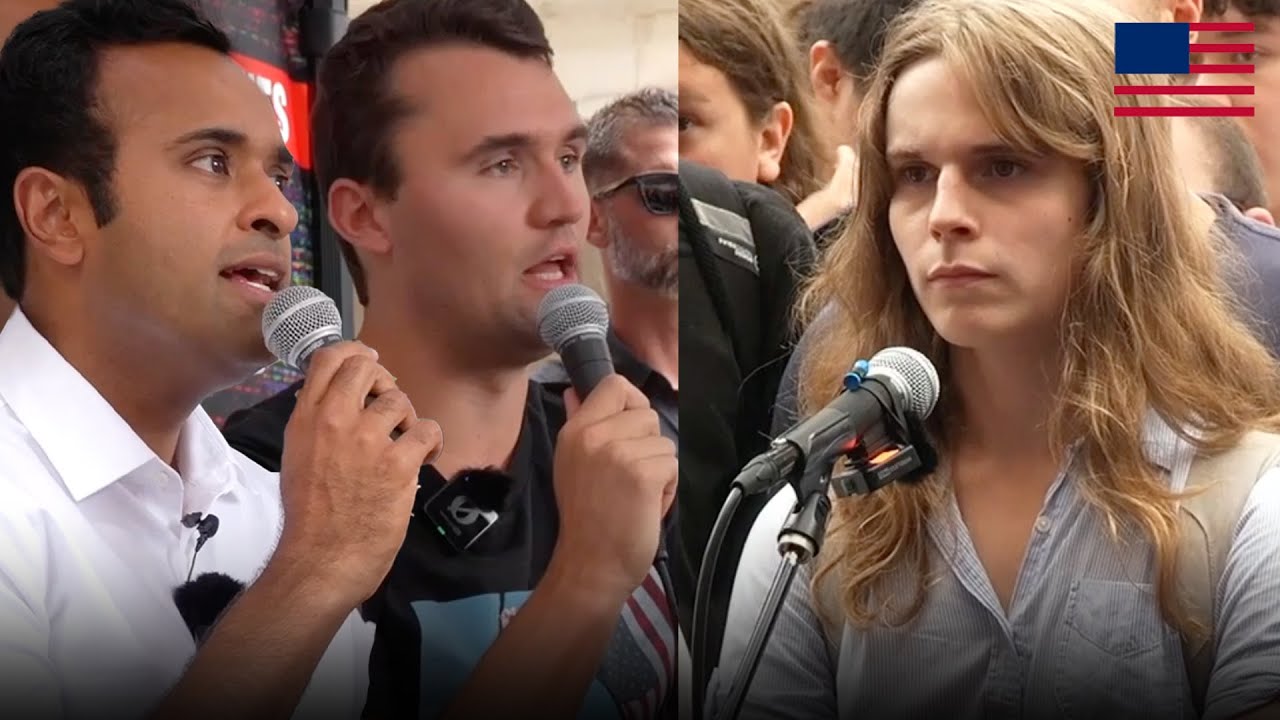
Charlie Kirk faces a challenging question about representation and democracy during a campus event. A student presses him on supporting policies that don't reflect majority will, leading to a detailed explanation of why America's founders chose a constitutional republic over pure democracy. Kirk argues that the Electoral College ensures smaller states maintain their voice, prevents tyranny of the majority, and allows citizens with vastly different values to participate in self-government while protecting fundamental liberties from simple majoritarianism.
During a campus event, Charlie Kirk found himself defending a fundamental aspect of American government that many students misunderstand. A student challenged him directly: "You said you have an issue with the government not representing the will of the people, so if you personally have an issue with that, then why do you support him if that is not the will of the people?"
Kirk immediately clarified an important distinction: "Will and majority are two different things."
When pressed on whether America is or should be a democracy, Kirk responded with a definitive "no" to both questions, prompting the student to ask why democracy shouldn't be a core fundamental point of American society.
Why Democracy Isn't in the Constitution
Kirk pointed out that the word "democracy" doesn't appear anywhere in the Constitution, which the student acknowledged as "genuinely a valid point." But the student pushed back, asking why Kirk believes "the will of the majority is not as important as the will of the minority" if his specific issue is that the government should represent the people better.
Kirk explained his position using the Electoral College as a prime example: "We believe in the Electoral College. Why? Because Kansas deserves a voice, because Missouri deserves a voice. And the most important way I could distill it is the union we have is the States created it, the federal government didn't create it."
He continued: "So the kind of price of admission is every state gets two senators, Congressman based on population, and then electoral votes based on that population. So you kind of get a mix of both."
The Critical Question on Representation
Kirk then posed a challenging question to the student: "If we abolished the Electoral College, do you think that the needs, wants, and interests of Missouri, Kansas, Iowa, North Dakota, South Dakota, Montana would be taken as seriously as New York and California?"
The student countered with their own concern: "Do you believe that some citizens are more valuable than others? Because in our current system, some people's votes hold more sway than others because people in like Wyoming who have smaller populations have more say than places like here in Missouri and Kansas. Why is this acceptable if, again, your issue is the will of the people?"
Democracy Versus Constitutional Republic
Kirk explained the fundamental difference: "Because we're not a democracy. Democracy is simple majoritarianism." He offered a stark example: "In a democracy, by up or down vote, you could say I want to enslave black people. A constitutional republic says no, you're going to have to go through a process to do that."
He then asked the student: "Do you think the majority or the will of the people could ever be wrong?"
When the student answered "yes," Kirk continued: "The founding fathers knew it could almost assuredly be wrong. So the system of a republic versus a democracy is it has to be slow and arduous and intentional because it has a preference on Liberty, not on free stuff."
Protection Through Space and Time
Kirk elaborated on how the system protects liberty: "Over a period of time, how do you best protect Liberty? Well, you got to spread over all the representation over space and time. So you do it over a lot of States, a lot of square miles, a lot of acreage, and it takes a lot of time to take over the federal government. You have to win an election and then an election and election."
He acknowledged that change is possible within this system: "It's not impossible. We eradicated slavery, we gave women the right to vote. So it's possible to get change done, but the founding fathers were less concerned about getting progress done really quickly and they were more concerned with the government doing bad stuff too quickly."
State Will Versus National Will
The student persisted: "But that is not what you said. You said that your specific problem is the government does not do the will of the people. Why is it that your will and what you want is more important than that of the majority?"
Kirk clarified: "It's not my will, it's the framers and the system we have. But to answer your question, I believe the best way to determine the will of the people is through states rights and States directives."
He gave an example: "If Kansas wants to say hey we can have decentralized gun laws or school choice, God bless Kansas. And so the question is not just National will, also versus state will."
Manhattan Kansas Versus Manhattan New York
Kirk highlighted the diversity of values across America: "We have to recognize that the values of someone in Kansas, in Manhattan Kansas, is a lot different than the values of someone in Manhattan, New York."
He explained how this applies to gun rights: "Through a democracy, it'd say hey the people of New York City want to have firearms confiscated. I don't know how, I don't think that dog's going to hunt in Manhattan, Kansas."
Kirk argued that this system "allows people that disagree with one another to live in the same Nation. A Republican style government, small R, allows people that might agree on almost nothing to still engage in self-government while still having a national project to participate in."
The Question of Consent
Kirk further clarified his position: "To make it even more clear, it is a question of the consent to the governed. If it was just a democracy, it would be an up or down vote on every single person and that's it. The founding fathers saw that fail time and time again. Athenian democracy, people just vote themselves stuff."
He explained the founders' reasoning: "So they said we have to have some sort of system that realizes that if men were Angels, government would not be necessary, but Men Are Not Angels, so we got to create some sort of government." Kirk referenced Federalist 51, where Madison made this argument.
"We got to figure this out. So government is necessary, but we don't want to have too big a government and people are just going to vote themselves stuff all the time. So how do we do that? Well, local is better than National. We got to have some sort of a national influence."
The Great Balance
Kirk described how the founders created the Constitution: "They created the great balance between Jeffersonian and Hamiltonian type philosophy as we know is the US Constitution. And the one thing they all agreed on though is human nature. They knew that absolute power corrupts absolutely and that people were likely to abuse it."
The Multi-State Project
Kirk concluded with his view on how the will of the people is best expressed: "I would just kind of counter by saying the will of the people can be best expressed through a multi-state project. For example, I believe an election is much healthier and much more representative by requiring candidates to go to Iowa, Ohio, Michigan, Pennsylvania, and not just spending time on the coast."
He challenged the notion of "flyover states": "You know why it might seem as if oh we don't need those flyover states, we don't need them? First of all, that's arrogant, prideful, and wrong. How exactly are you going to feed your family and where do you think the Bread Basket of the world comes from?"
Tyranny of the Cities
Kirk closed with a historical observation: "The founders saw ahead. And final thing I'll say is this: it was Hamilton or, it was Madison that said we cannot have the tyranny of the Cities over the farmers and that that's built into our system."
He thanked the student for being there and moved on to the next question, having provided a comprehensive defense of America's constitutional republic structure against the case for pure democracy.