Charlie Kirk Explains Why He Opposes Reparations and What Could Actually Help Black Communities
Enjoying this? Share it with someone who needs to see it.
Up Next
Charlie Kirk Responds to Reparations Question: Why Taxing Descendants for Ancestral Wrongs Violates Justice
3:12
Charlie Kirk Debates Student on Racism Versus Fatherlessness as America's Biggest Problem at Campus Event
7:46
Charlie Kirk Debates Marriage, Fatherhood, Crime, and Systemic Racism with College Student at Campus Event
19:34
Charlie Kirk Explains Why He Opposes Reparations and What Could Actually Help Black Communities
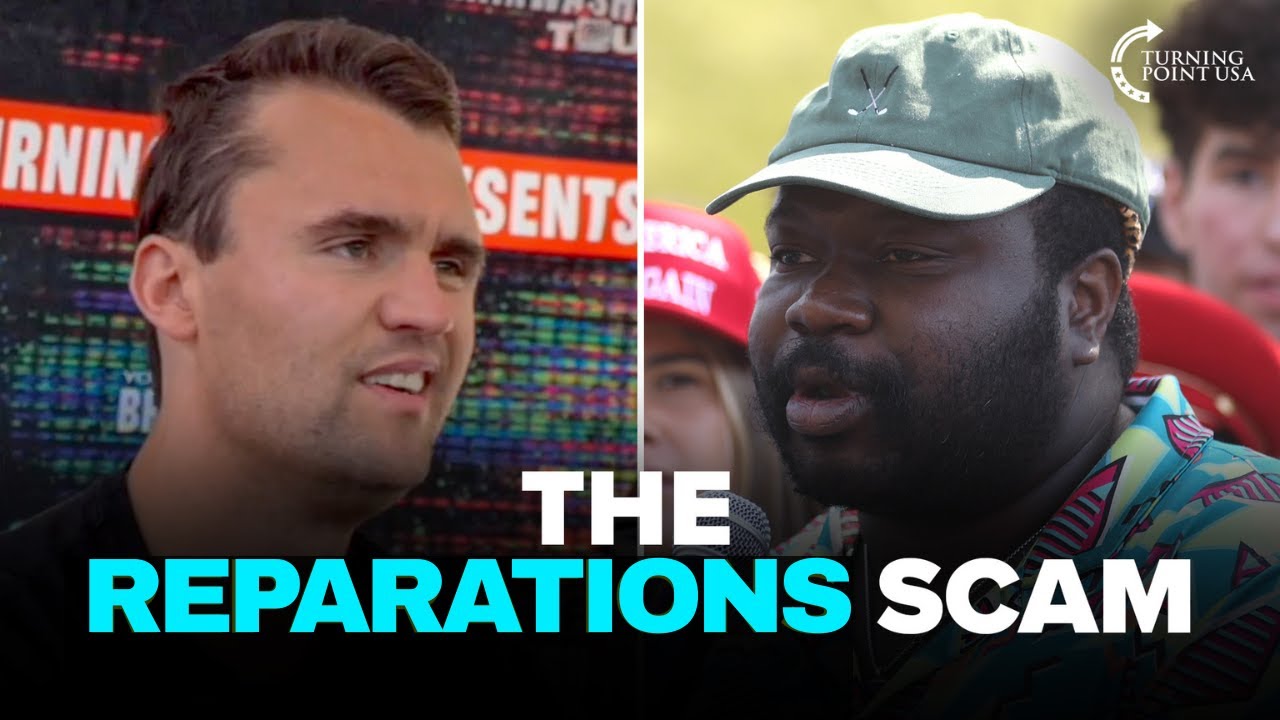
Charlie Kirk engages in a thoughtful conversation about reparations for descendants of slaves, explaining his opposition based on individual justice principles. Kirk argues that taking money from people who didn't own slaves to give to people who weren't enslaved violates basic justice, especially when it would tax immigrants and descendants of Union soldiers. Instead of reparations, he proposes alternative solutions: breaking the public teacher union cartel to enable school choice for Hispanic and black students, and addressing the fatherlessness crisis affecting 70% of black children. The exchange reveals Kirk's perspective on how to genuinely help struggling communities through education reform and family restoration rather than wealth redistribution.
Charlie Kirk was approached by Blair with a direct question about his stance on reparations for the black community. Kirk immediately stated his opposition, then worked to clarify exactly what was being discussed. When he asked what "the black community" meant in this context, Blair confirmed he was not referring to recent immigrants from Haiti or Nigeria, but specifically to ancestral descendants of slaves whose lineage could be proven with documentation.
To establish consistency in the conversation, Kirk asked whether other mistreated groups in America should also receive reparations, using Jewish Americans and Holocaust survivors as an example. Blair clarified that he believed reparations should come only from those responsible—not from the United States in the case of the Holocaust.
The Individual Justice Argument
Kirk laid out his core principle: "I did not own slaves and you were not a slave." This formed the foundation of his opposition to reparations. He argued that individuals cannot and should not be held accountable for actions they didn't personally commit, nor should they benefit from injustices they didn't personally suffer.
Kirk explained this as a basic law of justice—that he cannot be held accountable for something someone who looked like him did, and Blair should not benefit from something that happened to someone he was related to. He acknowledged that proponents would likely cite systemic racism and generational effects, but maintained that the fundamental problem with reparations is taking money from people like Charlie Kirk for something he didn't do and giving it to people for something that also didn't happen to them directly.
The Problem With Taxing Immigrants and Union Soldiers' Descendants
Blair responded by presenting the argument that because of past atrocities, certain groups have been negatively affected by the nation's crimes against humanity. Kirk acknowledged this perspective but refused to grant it much weight, noting that black America was actually doing incredibly well before a certain point in history and was even pacing to become richer than white America.
Kirk then raised a critical practical and moral problem: implementing reparations would require taxing people who had nothing to do with slavery. He pointed to first and second-generation immigrants—Irish and Polish families who arrived 100 years ago—who would be taxed despite having no connection to slavery. He made the argument even more personal, noting that his own family fought on the Union side of the Civil War. The injustice, as he saw it, would be taxing Charlie Kirk, whose ancestors fought to free the slaves, to give money to descendants of those slaves.
Alternative Solutions: School Choice and Education Reform
Rather than simply opposing reparations without offering alternatives, Kirk pivoted to what he called "common ground"—solutions that could actually help all communities, particularly black and Hispanic communities. His first proposal was breaking the cartel of public sector teacher unions and allowing school choice to occur.
Kirk argued that making it easier for people of all backgrounds, but specifically Hispanic and black children, to have access to quality education would be transformative. He emphasized that a good K-12 education is one of the most assured ways for young people to succeed later in life, suggesting this would have far more lasting impact than cash payments.
Addressing the Fatherlessness Crisis
Kirk's second major proposal addressed what he sees as a fundamental crisis: the absence of fathers in the home. He cited a striking statistic—that 70% of black children are raised without a stable father in the country. He proposed that putting fathers back in homes should be a priority.
Blair agreed with this point, finding common ground on the fatherlessness issue. Kirk concluded by suggesting that if they could find agreement on education reform and family restoration, these solutions would go much further than "just giving cash for people that happen to be related to something that evil that happened a little while ago."
Justice Versus Outcomes
Throughout the conversation, Kirk maintained a consistent thread: the question isn't primarily about outcomes or even historical injustices, but about whether a proposed solution is just and moral in the present day. His framework prioritizes individual responsibility and individual justice over collective guilt or collective compensation. He challenged the notion that modern Americans should bear financial responsibility for historical wrongs they didn't commit, while proposing that addressing current structural problems—failing schools and broken families—would be both more just and more effective at improving lives.