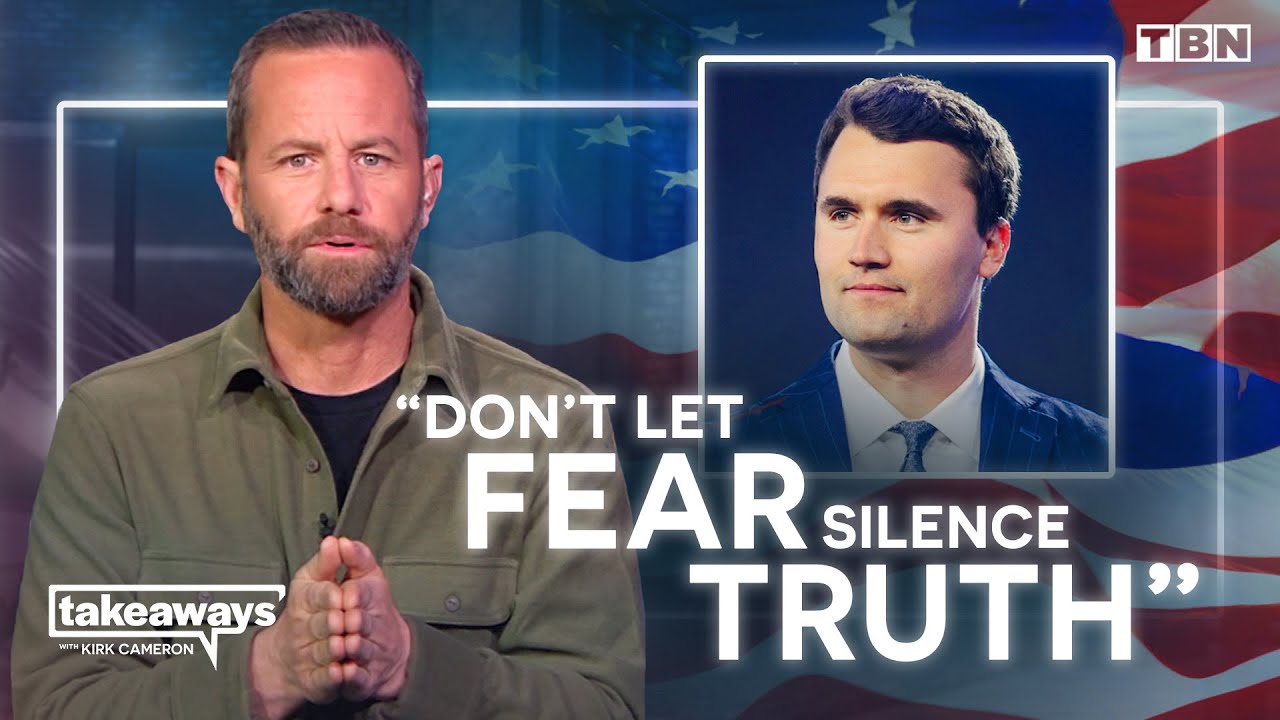
Charlie Kirk on Atheism, Socialism, and Why Christians Must Engage the Culture at Liberty University
Enjoying this? Share it with someone who needs to see it.
Up Next
Charlie Kirk Reflects on Faith, Courage, and Defending Biblical Truth in Public Life
13:23
Charlie Kirk and Frank Turek Dismantle Bill Maher's Claims About Jesus Christ's Historical Existence and Christianity
16:34
Charlie Kirk On Why Socialist Professors Don't Teach for Free: The Hypocrisy of Academic Marxism and Anti-Americanism
0:45
Charlie Kirk on Atheism, Socialism, and Why Christians Must Engage the Culture at Liberty University
Charlie Kirk, co-founder of the Falkirk Center at Liberty University alongside Jerry Falwell Jr., confronts the rise of atheism and socialism in America with a bold call to action for Christians. Kirk dismantles the claim that Jesus was a socialist, arguing that Christ's teachings emphasize individual responsibility over collective government action. He challenges believers to abandon the monastery mentality and instead become salt and light in a secular culture that increasingly assaults Judeo-Christian values. Drawing from the Sermon on the Mount, Kirk makes the case that true Christianity requires personal engagement with the world, not retreat from it, even when facing intense opposition and persecution.
The Falkirk Center and Fighting for Judeo-Christian Values
Charlie Kirk has partnered with Liberty University President Jerry Falwell Jr. to co-found the Falkirk Center, an initiative dedicated to educating students and pushing back against the ongoing assault on Judeo-Christian values in American culture. As a Bible-believing Christian, Kirk brings his commitment to faith and civic engagement to this new venture at one of America's largest Christian universities.
Atheism: America's Fastest Growing Religion
Kirk identifies atheism as the fastest growing religion in America and issues a direct challenge to Christians: be as bold, evangelistic, and persuasive as atheists are in promoting their worldview. He observes that Christians often fall short in their willingness to engage the culture with the same intensity that secular voices bring to the public square.
Two Paths for Christians in a Secular World
Kirk outlines two primary approaches he sees Christians taking in response to an increasingly atheistic culture. The first approach involves being theologically correct while creating separate communities that never engage with the outside world—essentially becoming pseudo-monks in the hills, isolated from broader society.
The second approach, which Kirk embraces alongside Jerry Falwell and Liberty University, calls Christians to go forth into the world with full awareness of the cost. This path means understanding that persecution, name-calling, and lost friendships are inevitable, especially for those involved in civic and political engagement. Kirk frames this as the fulfillment of the gospel of Jesus Christ, answering the call to be salt and light in a dark world.
He emphasizes that American values face assault every single day from a secular, atheist, leftist, Marxist movement operating within government, culture, and higher education. The failure to recognize this threat and take action, Kirk warns, might mean the end of America as we know it.
Debunking the Socialist Jesus Myth
Kirk addresses the claim that Jesus was a socialist—a notion he finds not just incorrect but preposterous. He expresses concern that younger generations are being taught that Jesus was something other than the savior of the world, reducing him to a working-class philosophy from the mid-1800s when Christ lived and died 1,800 years earlier.
Kirk presents several key arguments against the socialist Jesus narrative. First, he points out that Jesus was repeatedly given opportunities to engage in government but consistently chose a much higher calling. Unlike figures such as Napoleon, Mohammad, Alexander the Great, or Julius Caesar who worked through instruments of government, Jesus Christ had a widespread impact outside of political influence—making him one of the only people in documented history to do so.
When confronted with political questions, Jesus famously said to render unto Caesar what is Caesar's, but give unto God what is God's. Kirk interprets this as Jesus placing himself above political structures, focusing on God's dominion rather than arguing for any specific governmental system.
Individual Responsibility Over Collective Action
Kirk's second major argument centers on the nature of Christ's teachings about helping others. Everything Jesus called for regarding helping the poor—particularly in Matthew 5 and the Sermon on the Mount—starts and ends with individual calling, not collective calling.
This distinction is critical, Kirk argues, because Christians cannot advocate their own responsibility to somebody else or to some other authority. The responsibility rests with each individual believer. Kirk emphasizes that you yourself must give up your cloak and tunic, you yourself must turn the other cheek, and you yourself must help the poor individual who needs to be clothed, fed, and cared for.
Kirk acknowledges this is hard because people naturally want to give up that responsibility to someone else, but he insists this is a call of individual responsibility that cannot be transferred to collective or government action.
Embracing Opposition and Finding Strength in Fire
When asked how it feels to be hated daily by liberals, Kirk responds with confidence and even enthusiasm. He finds comfort in what he believes and has faced protests at Berkeley, Stanford, UCLA, UT Austin, and the University of Florida, among other campuses.
The hate, Kirk admits somewhat surprisingly, simply doesn't bother him. He knows why he believes what he believes and embraces any backlash that comes his way. He loves discussion and debate, viewing opposition as an opportunity for growth and clarity.
Kirk draws on a metallurgical metaphor: under the most harsh fires is where the most amazing iron can be cast. He finds this to be true in his own experience—the more he travels, the more protests he encounters, the more people he talks to, the more he understands and can articulate why he believes what he believes. Rather than weakening his convictions, opposition has strengthened and refined them.