Up Next
Allie Beth Stuckey Responds to Charlie Kirk's Assassination and Defends His Legacy Against Christian Critics
1:13:32

Eric Metaxas Witnessed the Most Powerful Christian Witness in American History at Charlie Kirk's Memorial Service
48:09

Van Jones Reveals Charlie Kirk's Final Outreach for Civil Dialogue Before His Death
1:54:54
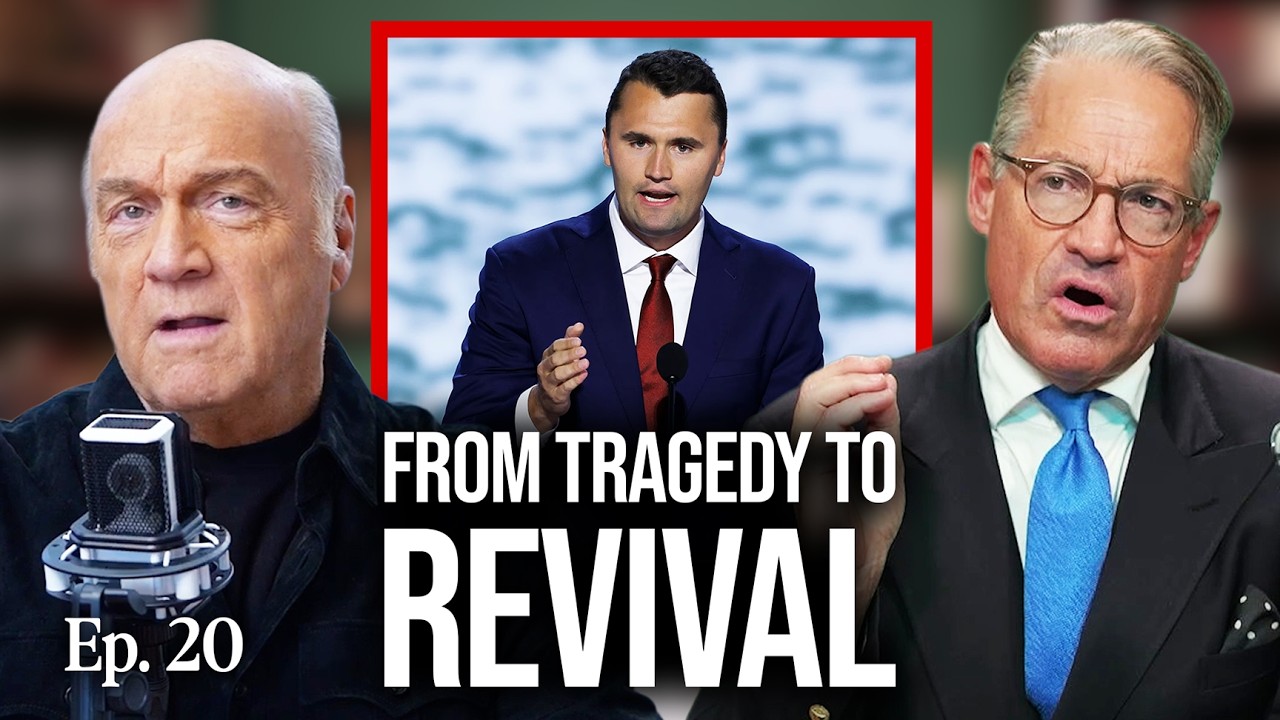
Eric Metaxas on Faith, Joy, and the Murder of Charlie Kirk: Finding Hope in Tragedy
Eric Metaxas sits down for a conversation with Marissa Streit about the murder of Charlie Kirk, wrestling with profound questions about faith, death, and God's sovereignty. Metaxas distinguishes between dead religion and authentic faith, arguing that real belief in the God of the Bible brings both sorrow and genuine hope simultaneously. He draws parallels to Dietrich Bonhoeffer and the American Revolution's Joseph Warren, explaining how God uses tragedy to spark revival. Metaxas challenges pastors who remain silent on cultural issues, criticizes the complicity of elite institutions, and discusses the difference between tribal Christian identity and true discipleship. The conversation touches on Charlie's close relationship with the Jewish community, the role of joy in authentic faith, and why God allows the loss of great leaders when victory seems necessary.
The Reality of Faith Beyond Religious Platitudes
Eric Metaxas begins by acknowledging the complex emotional landscape following Charlie Kirk's murder. He describes feeling infinitely sad yet simultaneously joyful and hopeful, insisting this isn't manufactured emotion but genuine faith in the living God. Metaxas draws a sharp distinction between what he calls "dead religion" and real faith in the God of the Bible. Dead religion, he explains, offers hollow comfort that feels fake even as it's spoken, like ministers at funerals going through motions everyone knows ring false.
Real faith in the God of the Bible, Metaxas insists, is victorious and glorious. He challenges believers to examine whether they truly believe or merely hope that eternal life is real. This moment, he argues, forces that question into sharp relief. When his own father passed, people offered condolences, but Metaxas wanted them to understand he doesn't hope but knows where his father is—more alive now than before death. This knowing peace, rather than anxious hope, is what God desires for believers.
Metaxas references Romans 8:28, emphasizing that all things work together for good for those who love the Lord and are called according to His purposes. God can perform spiritual jiu-jitsu with evil, weaving even tragedy into His redemptive plan. Charlie's murder, Metaxas believes, will result not just in an explosion of patriotism but in genuine revival, bringing people to seek the God of the Bible and find meaning in their lives.
Every Assignment Has Equal Value in God's Eyes
Drawing parallels to Dietrich Bonhoeffer, killed at 39, Metaxas rejects the notion that premature death represents unfulfilled potential. Bonhoeffer fulfilled his magnificent assignment, and God elevated him through his death in ways that wouldn't have happened had he lived longer. Similarly, Charlie Kirk fulfilled his assignment despite his young age.
Metaxas pushes back against the self-deprecating attitude many people have when comparing themselves to exceptional figures like Charlie Kirk or Bonhoeffer. He calls it a lie when people say "I'm just a nobody." God gives different gifts to different people, but the value isn't in the gift itself but in using whatever God gave you for His purposes. Whether someone is a mother, father, or works an ordinary job, their assignment is equally sacred in God's eyes.
He illustrates this with the story of Susanna Wesley, mother of John and Charles Wesley. As "just a mother" of ten children, she changed the world through her sons, who led the Wesleyan revival in the 18th century. This revival led to William Wilberforce abolishing the slave trade and influenced George Whitefield, whose ministry was instrumental in the emergence of the United States. Remarkably, Susanna Wesley was the 25th of 25 children—had her mother stopped at 18, the world would never have known the Wesley brothers. This, Metaxas argues, is the ultimate pro-life argument: every life is an agent to change the world.
Metaxas shares how a graphic designer named Ed Tuttle led him to faith at 24 by simply sharing scriptures in a humble way. Every book Metaxas has written, every life he's changed, traces back to that faithful graphic designer at Union Carbide in Danbury, Connecticut.
Confronting Evil and Death Without Flinching
Addressing the inevitable question of how anyone can believe in God when a 31-year-old father of two is murdered, Metaxas calls it "the easiest question in the world." He points out that evil has always existed—the Holocaust, endless tragedies throughout history. The death of Charlie Kirk doesn't introduce a new problem; it reminds Americans, who have enjoyed comfortable lives, of the reality that exists everywhere.
People lose children every day. Metaxas's own grandfather was killed at 31, leaving his mother fatherless at 10. In America, there's an assumption of deserving a long, healthy life, but Metaxas insists we deserve nothing. Life itself is a gift from God that should inspire rejoicing, not entitlement.
He references the recent murder of two children by a transgender individual while they were praying. Secular voices mocked the ineffectiveness of prayer, but Metaxas argues this fundamentally misunderstands prayer. Prayer isn't about getting what you want; it's communion with the God who created the universe. Jesus Himself prayed while being murdered on the cross, as have countless martyrs throughout history. If prayer is reduced to "give me what I want or I won't believe in you," it becomes petulant and childish.
Metaxas emphasizes that Christians should be repulsed by death because God is the God of life. Death wasn't supposed to exist; humans were created for eternity. The passage of time itself feels wrong because we're created for existence outside time and space. This natural repulsion toward death is correct, yet faith transforms how we see it. Bonhoeffer wrote that death is the most horrible thing unless we see it through faith, which completely transforms it. Anyone who glimpses the kingdom of heaven becomes homesick for it from that moment forward.
The Question of Losing Great Leaders
When asked how God can allow the loss of so many significant figures—James Dobson, John MacArthur, with Dennis Prager sidelined and Charlie Kirk murdered—Metaxas challenges the assumption behind the question. He suggests people put themselves ahead of God, thinking they understand the situation better. God knows infinitely more and asks for trust even when His decisions seem counterintuitive.
Metaxas draws from his research on the American Revolution, discussing Joseph Warren, the leading patriot figure in Boston whom most people today don't even remember. Warren was killed at the Battle of Bunker Hill at the very beginning of the Revolution. Patriots like John Adams, Paul Revere, and Samuel Adams were devastated, unable to imagine continuing without their leader. Yet God was in charge of history and brought beautiful things from that loss.
God doesn't run a democracy, Metaxas states bluntly. He knows the bigger picture and calls believers to trust Him no matter what, to praise His name regardless of circumstances. This is challenging and supernatural, but it's what genuine faith requires.
The Lies About Heated Rhetoric on Both Sides
Metaxas unleashes particular fury at media claims that "heated rhetoric exists on both sides." He calls this a vile, despicable lie. There isn't murder on both sides. The left-wing media perpetuates this false equivalency, and Metaxas insists it must be called out forcefully.
He shares an anecdote about sitting next to a brilliant 75-year-old lawyer on a plane who voted for Kamala Harris. This encounter reminded Metaxas that amazing, intelligent people can buy into false narratives because those narratives are pushed by institutions they've trusted for decades—the New York Times, major television networks, the Wall Street Journal, and especially universities.
Metaxas attended Yale University in the 1980s as a working-class kid whose parents came from war-torn Europe. He describes Yale as utterly useless even then, a place of immediate indoctrination with anti-American, anti-good propaganda. Without the knowledge to push back, he absorbed these lies, thinking that's what smart people believed. Only when he came to faith at 25 did everything change, allowing him to recognize the lies he'd accepted and understand how people who believe those lies think.
Many in mainstream media genuinely believe Trump is Hitler, Metaxas argues. While some are simply evil, others are willfully dumb and obtuse but sincere in their delusion. This requires both forceful pushback and an understanding that they need to be reached one by one with truth, just as Charlie Kirk was doing.
The lunacy of recent years—the stolen election that couldn't be questioned, vaccine mandates accompanied by vicious attacks on skeptics, trans ideology imposed without discussion—has awakened many people. Most Americans know basic truths: roosters can't lay eggs, men and women exist. Only the utterly out-of-touch elites in universities, Manhattan, and Hollywood bubbles believe otherwise because they're comfortable enough to embrace lunacy.
Trump's reelection happened because enough people finally woke up. Americans are generally too nice, going along to avoid offense, but the secular left went too far—especially when targeting six-year-olds with inappropriate content. This crossed a line that finally awakened people, and Charlie Kirk's murder represents another dramatic moment in that awakening.
The Complicity of Silent Churches
Metaxas reserves his harshest criticism for churches and pastors who remain silent on cultural issues. Speaking as a Christian, he places primary blame for cultural degradation at the feet of churches. Many Christians think they're holier than Jesus, who said it would be better for a millstone to be hung around the neck of anyone who causes children to stumble and for them to be cast into the sea. Yet these Christians have a different, softer version and consider themselves more compassionate.
Churches that avoid "political issues" and claim they "just want to talk about Jesus" operate from broken theology and, in many cases, pure cowardice. They don't truly believe what they claim. Others genuinely misunderstand the big picture, thinking their job is to do a "little religious thing" disconnected from everything else.
If faith isn't connected to everything and affecting everything, it's not biblical faith. Metaxas's faith informs his opposition to slavery, antisemitism, racism—everything. Faith should shape how believers see the entire world. German pastors in the 1930s who refused to speak against Nazis either acted from cowardice or from this same misunderstanding, believing their role was confined to narrow religious activity.
The degradation of American culture, pornography being pushed at children, and every wicked development results from good people doing nothing. If pastors lack courage, how can anyone else be expected to have it? Yet many churches present courage as "extra credit" rather than essential, telling congregants to live sweet lives and attend on Sundays.
Metaxas wrote "Letter to the American Church," which was made into a documentary film with Charlie Kirk as a major partner and figure. They offered it free to any church wanting to screen it. Many did, but far more churches said it was "too much," that what Charlie Kirk and Metaxas discuss is "too harsh" for their "nice little church with Sunday school."
Metaxas directly addresses those pastors: "You are complicit with evil. Your little fake religious church, thinking you can avoid talking about what Charlie talked about, what I talk about, what Dennis talks about—you are complicit with evil." Now, because of Charlie's murder, those pastors should be squirming, knowing their silence allowed people like Charlie to be demonized as radical and ultimately murdered. If they had all spoken on the same issues, Charlie wouldn't have stood out or needed to do half of what he did.
Pastors who avoided trouble are no different from German pastors who thought Hitler would pass and the pendulum would swing back. That attitude enabled the Holocaust. That same attitude got Charlie Kirk murdered. Everyone needs to be in the fight. Everyone needs to be a combatant, as Dr. Phil told Metaxas the day before Charlie's murder: if you're not a combatant, you're complicit with evil.
Charlie Kirk's Special Relationship With the Jewish Community
Charlie Kirk had a particularly close relationship with the Jewish community, especially with Dennis Prager and others. His next book, which he brought in manuscript form to Dennis during one of his hospital visits, is about the Sabbath—a profound topic reflecting his deep connection to Jewish friends and traditions.
Following Charlie's murder, lies spread using his name and memory. Metaxas addresses the broader context of Christian-Jewish relations, noting that when he came to faith in 1988, one of the first things he understood was that loving Jesus means loving Israel. He didn't question it; his entire worldview had been wrong, so he accepted what Scripture taught: serious faith in God means standing up for the unborn and loving the people of Israel.
Metaxas has been stunned by people claiming to be Christian while harboring animus against Israel or Jews. This is central to his Bonhoeffer book: many people who say they're Christians are not Christians—they're Gentiles. There's a difference. Being non-Jewish (Gentile) doesn't automatically make someone Christian. A Christian is someone who lives in utter love and obedience to the God of the Bible, reading Scripture and conforming their life to it.
Throughout history, many Jews have hated "Christians" because Gentiles who called themselves Christians but didn't represent the God of the Bible or Jesus (who was Jewish) committed atrocities. These weren't true Christians. The secularizing movement to pull Christian faith away from its Jewish roots is theological nonsense—actually demonic.
People like Nick Fuentes, a prominent antisemite, claim to be Christian, but Metaxas flatly states he is not. People use Christian faith as a cudgel, employing tribal identity. Even the phrase "Christ is King," which should be beautiful, can be spoken with a spirit that feels like "f you"—triumphalist, sneering, prideful, and antithetical to biblical faith.
Christians should have confidence but not triumphalism. Apart from God's grace, any believer would be in the opposite camp believing foolish things. Scripture teaches that Christians are "grafted into" the tree of faith, grafted into Israel. Jesus, Mary, Matthew, Luke, Paul, Peter—all Jews. Jesus was a rabbi living out the fulfillment of Jewish faith. Christianity isn't a new religion separate from Judaism; it's the fulfillment. Christians who don't understand this have a tribal identity problem, thinking "I'm Christian and those are Jews" without grasping what being Christian actually means.
To be Christian is to love the people of God. Bonhoeffer felt obliged to stand up for Jews not because he didn't care whether they believed Jesus was Messiah (he did care), but because he recognized God declared them His people, the people through whom Messiah would come to bring all nations to worship the God of Abraham, Isaac, and Jacob. Christians are obliged to love Jews and Israel just as parents love their children even—especially—when they don't go the way desired.
People who claim Israel is just a nation created in 1948 with no special significance miss something profound. How can anyone not see God's hand in bringing His chosen people back to their land after 2,000 years? Even without understanding exactly what it means or agreeing with every Netanyahu policy, the historical reality should be recognizable as God's work. To think Israel is no different from Liechtenstein is absurd.
The Centrality of Joy in Authentic Faith
Metaxas emphasizes that one of God's unique gifts to humanity is the ability to enjoy things only humans can appreciate, like music and laughter. Music has to be a gift from God because it serves no evolutionary purpose. The same is true of laughter.
Despite having perhaps their most serious conversation ever, the interviewer notes she's never seen Metaxas stop giggling around Charlie Kirk or Dennis Prager. The two of them together were particularly hilarious. Metaxas admits he has to work to be serious around Dennis because the natural inclination is to brutally make fun of each other in the way only men do—an ultimate love language between male friends.
This was the joy of his friendship with Charlie. As Charlie became more important, Metaxas had less contact because he didn't want to bother him, just as he doesn't want to bother President Trump. But that hilarity and joy is essential, not peripheral.
At the heart of truth, there is joy. If joy is absent, something is missing. Many pious people talk about God constantly, but without evident joy, they're missing the best of God. Joy is no less important than peace, hope, or love. It's the natural expression of knowing God—the bubbling over that comes from believing what God says is true.
When people see pious, self-important religious individuals without joy, they're repulsed, and rightly so. If that's what faith offers, it's not the truth. Metaxas's best friends of faith constantly joke with joy—it's vital and real, not a weird quirk. Scripture says "rejoice in the Lord always"—not just "take God seriously," but rejoice. Those who don't rejoice in God are missing something essential.
This is one reason Metaxas loves President Trump. Nobody makes him laugh harder. Trump's humor is unbelievable, better than Don Rickles. At the Religious Liberty Commission event, Trump went down the line acknowledging people, and when he reached Metaxas, he said he watches Metaxas's show all the time, then added, "I tell him this all the time, he doesn't believe me. Eric, you really need to have more confidence." Trump was mocking him in front of Fox News cameras, unable to repress his humor.
During that interaction, Metaxas shared his idea about calling the 250th anniversary the "Super Centennial." He grew up during the Bicentennial and remembers the excitement, but there's no good term for the 250th (the actual term, "semi-quincentennial," is unusable). Metaxas believes God gave him this Trumpian idea. To test whether it was truly from God, he needed the opportunity to share it with the president, and the president needed to like it.
Amazingly, he was able to share the idea less than a week before this conversation. Trump said he liked it, but Metaxas thought he was just being gracious. Twenty minutes later, while teasing Metaxas during his speech, Trump blurted out, "Eric wants to call the 250th the Super Centennial. I agree with that. Let's change that," and told his staff to make it happen. An idea Metaxas believed was from God for the president and the nation suddenly became reality through Trump's embrace of it.
There's something joyful in President Trump, something Americans should share. We get to live in the United States of America, the best country and greatest nation in the history of the world. Charlie Kirk understood that better than anyone. Courage, faith, and serving as God's messengers of truth in this world—all of this is part of the joy of walking with God while we're here.
Universities as the Most Dangerous Places in America
Metaxas notes that Charlie Kirk and Dennis Prager both recognized that universities had become the least free places in America. That's what motivated Turning Point USA and PragerU—the understanding that American educational institutions were radicalizing young people. Many shooters have been radicalized by these institutions.
When asked what to tell parents about where to send their kids, Metaxas responds with particular passion. Living in Manhattan among cultural elites, he hears people proudly announcing their children are going to Harvard. He wants to horse-laugh in their faces—didn't they get the memo that these places have gone to the dark side?
Even the Jewish community, particularly after October 7th, continues to worship Ivy League schools. Speaking as a Gentile and lover of Jews and Israel, Metaxas attributes this to addiction to assimilation. Immigrants, including his own parents, worshiped Harvard and Yale as temples of higher learning, seeing them as pathways to assimilation and success.
But when these places went to the dark side—which happened decades ago, not just on October 7th—people like billionaire Bill Ackman finally woke up. Metaxas's response: "You've been funding this. I'm glad you finally woke up. Can you tell your billionaire friends to stop this evil? You've been funding this evil."
Metaxas saw this when he became serious about his faith in 1988. He suddenly realized that Yale alumni giving money to the university had no clue what they were funding—the enemy pointing guns at their children's heads. The irony of donors saying "we just funded the building, not what's inside" is absurd. It's like funding the PLO but calling it humanitarian aid—insane complicity with evil.
Yale was leftist garbage until 2016, when it became evil propaganda, crossing a definitive line. Many elite institutions crossed that same line in 2016, becoming unhinged. This happened the same way the German nation was taken over by demonic figures—everyone going along a little bit at a time.
The Path to Revival
Metaxas firmly believes Charlie's death will spark revival. People wondering or on the fence will seek out and find the God of the Bible, discovering meaning in their lives. He's felt revival coming without knowing how it would arrive, and he believes Charlie's murder is a huge piece of that catalyst.
There will be an explosion of faith in this nation. People around the world look to America for leadership regarding liberty, freedom, and faith. This is a sacred moment. Charlie would be overjoyed knowing so many people are now talking about God, Jesus, the Sabbath, and Scripture. He texted Scripture to friends regularly. To honor Charlie, talking about God is exactly what he hoped for.
Metaxas reminds everyone that we're all going to die, urging people to stop pretending otherwise. We don't deserve 88 healthy years or any particular lifespan. Life itself is a gift from God deserving rejoicing. God is the author of life who decides when to take someone, and taking them can elevate their impact in ways that wouldn't happen if they lived longer.
Despite the horror, Charlie's murder is going to result in tremendous things. People worldwide are waking up to think about things they hadn't considered. Tradition without heart, religious garb used to speak lies—nothing is more satanic or evil. Many people are skeptical about faith because they've seen that phoniness. If that's what faith is about, they're understandably uninterested.
Real faith is like spring flowers and a sky so blue it pierces your heart. That's who God is, not feigned pieties. People are interested in the real thing but often don't know it exists based on what they've seen. This moment challenges everyone: What do you actually believe? Do you have a crazy idea that you'll live forever but not here? You will live forever, but you're not supposed to be here forever. It's God's will that you do His will here while you're here.
This is a clarifying moment where people face choices. The horror of this murder forces examination of actual beliefs versus pious hopes. God calls believers to supernatural trust, to praise His name no matter what, to live in peace now rather than hoping to achieve peace. The interviewer shares her personal experience: after Charlie was murdered, her fear disappeared. She realized Charlie lived only 31 years but lived the biggest life she'd ever seen—like 100 years. He returned every text, was everywhere, yet still spent time with his wife Erika and family.
This realization removes fear: we're not here in human numbers of years. We have the choice to stretch our days and years further. Understanding this eliminates fear because Christians must believe what they claim to believe. Jesus defeated death on the cross—actually, not metaphorically. If someone kills a believer, that believer doesn't die. Period.
God created humans to be His agents of glorious goodness in the midst of spiritual war. Many people don't want anything to do with that, but they're missing the reason they exist. God calls believers to that battle and wants them to know nothing can defeat Him. If He lives inside someone by faith, no one can stop them. When they're killed, they don't die. Absolutely, truly, Charlie is still alive. When believers are killed, they can't die.
There will be a day when none of us is here, but we will not be dead. In this American reality, people are spoiled, imagining death happens elsewhere to others. But everyone is here for a little while. The Lord wants believers to praise, love, and rejoice in Him in the midst of this life, not anxiously asking how much time is left. Living in lack of faith grieves God's heart. As our heavenly parent, He wants us to rejoice in Him and be at peace, not hoping to achieve peace but living in it now.
Video Transcript
Eric, there's u there's been a lot of pain since the murder of Charlie Kirk. I woke up this morning early saying thank God that Eric Mataxis is coming to talk to me to talk to us. So, I'm grateful that you're here and um I'd like to talk to you about Charlie Kirk. Well, I don't want to talk about Charlie because it makes me sad, but if you force me, I will. Actually, in all seriousness, I said this to you off the air. Um, like I'm infinitely sad, but also not sad, also joyful and hopeful, and that is real, that is not uh, you know, kind of trumped up uh, feelings or or band-aid. There's something at the heart of all this, which is to say the Lord, which is infinitely beautiful and hopeful. And the difference between what I call dead religion and real faith in the living God is is infinite. Dead religion says, "Oh, we should be sad, but well, there's hope." But even when you say it, it feels fake. And I think a lot of us have been to religious services where you feel like the minister or the rabbi, whoever it is, whatever they're saying, like you're just not buying it. It doesn't feel real. It feels religious in the negative sense. It feels like they're saying that and we should all nod, but who knows? That's not faith in the God of the Bible. Faith in the God of the Bible is real and beautiful and victorious and glorious. That's real. And I think sometimes we settle for that fake version because we feel like we're supposed to. It's It's kind of like when you go to a funeral typically and you're like, we're supposed to be sad and we're supposed to, you know, there's something phony in that. And and I feel like this is an opportunity to to to draw that line between the two. How are we really supposed to feel? How are we supposed to be? You know, there's a side of this, of course, which is dramatically sad. But, uh, speaking as a as a Christian, a believer in the in the God of Abraham, Isaac, and Jacob, when you die, you don't die. That's real. That's that's not like again a religious piety, a broomemide. That's real. And I think things like this challenge us. Do you really believe that? Do you sort of believe that? Do you hope that's true? Do you know that's true? That that's a lot of what I talk about. And that's what this, you know, the horror of my friend's murder uh has has made me think about. Tradition without God. Well, without heart. Yes. It's tradition without heart that you're talking about. There's nothing more satanic, nothing more evil than putting yourself in in in in religious garb and using religious language to speak lies. That's the most evil thing. And so I think the reason so many people are skeptical about faith or people of faith is because of that. Because they've seen that or you just think like, well, if this is what it's all about, I'm not interested. like it just feels phony and something because we all know that, you know, if there is a God and if if if if all the if everything the Bible says is true, it's going to be like spring flowers, a sky so blue that it it pierces your heart, it's going to be that's who God is. God is not about, you know, ferial pieties. And and I think that there are a lot of people they're interested in the real thing, but from what they've seen, they don't know that that it exists. You know, my dad passed a year and a half ago and and you know, people say, "I'm so sorry." Which is appropriate, but I want to say to them, listen, I know where he is. I don't hope I hope no. I know where he is. I know he's more alive now than he was before he passed. Like, I know that. I know it's it's God's will that I know that, not that I hope that. And that's that's kind of a dividing line because I think that we need God wants just like if if you know if if your if your if your little child comes to you upset about something, you want to say to them, just as our heavenly father wants to say to us, you want to say to them, listen, I got it. you go and play and I will take care of of you come to me with your problems and but but if the child continues to ring its hands and be anxious you'd be upset as a parent you'd say hey stop it I will take care of it you stop worrying that's God with us he wants us to give him his problems and I and I think you know he wants he wants us to know that all we need to do is turn to him but not to hope anxiously and And I think a lot of people think anxious hope is holier than knowing peace like having a peaceful knowing this. They they think there's something more religious about being anxiously hopeful or or anyway I is something I think about obviously a lot. So yeah, you know, I think what's uplifting to me is that I know that Charlie had a very strong walk with God. And if he's watching us right now, he'd be so happy to know that so many people are talking about God and Jesus and the Sabbath and scripture. He would text me scripture. Yeah. Uh and so to honor Charlie talking about God is exactly what he was hoping. Oh yeah, absolutely. This is going to bring about revival. I I just want to tell everybody first of all, we're all going to die. I think everybody thinks like, "Oh, death is so unnatural." On the one hand, that's correct. That's uncorre. We should we should be repulsed by death because God is the god of life. But we're all going to leave this world and let's stop pretending that we're not. Let's stop pretending we're all I all we deserve, you know, uh 88 healthy years or whatever the heck we think. We deserve nothing. We deserve not to be alive now. It's a gift from God. We need to rejoice in it. And and God is God. I mean, I think of of of Dietrich Bonhaofer. He's killed at 39. Everywhere I go, speaking about Bonhaofer again, it's the Pieties. It's so sad. Imagine what he would have done if he lived. Bologoney. He fulfilled his assignment. Period. Case closed. He fulfilled his assignment. God gave him as a gift to the world to do what he did. And then he took him. And in taking him elevates him in a way in our attentions, in a way that he never would have been if he'd lived on and on and on. God is the author of life. He decides, and I do believe genuinely, as horrible as it is, um that Charlie fulfilled his magnificent assignment. The Lord allowed him to be taken. Uh you know, and and and one of my favorite scriptures as a Christian is Romans 8:28. All things work together for good. All things for those that love the Lord and are called according to his purposes. So, it's not right to say like, I think everything works out in the end. No, for those that love the Lord and are called according to his purposes, all things God can weave tragedy and you know, he can do jiu-jitsu with evil. And that's what he does. And so Charlie's death, his horrible premature death, murder, I believe, is going to result not just in an explosion of patriotism and and all that stuff, but in revival. people who are kind of wondering or on the fence are going to seek out and find the God of the Bible, find meaning in their lives. I believe this is part of that. I've felt that that was coming. You don't know how it's going to come. I believe this is a huge piece of that that there's going to be an explosion of faith in this nation. And I think people around the world are looking to this nation as I always had have for leadership with regard to liberty and freedom and faith and you know and I and I believe that we're at a sacred moment right now. Well done Charlie. Amen. That's and and listen, let's say this too. People always say to me when I talk about Bonhaer like, "Oh, Bonhaofer, he's you know he's he's amazing." It's kind of like Charlie Charlie's amazing. I'm just I'm a nobody. I'm a That is a lie, right? In other words, God gives us what he gives us. Okay, Charlie is nobody more brilliant and amazing than Charlie. When I I met him when he was 24, like I left, he said to me like, "Oh yeah, you've been a hero and your books have meant." So I was like, "My books are like nothing compared. You're, you know, 12 feet tall. You God has given you gifts that are just mindblowing." But it's not about, you know, if the Lord gives you gifts, let's not forget who gave you the gifts, right? Charlie didn't earn the gifts. They were a gift from God. So he chose to use them for God's purposes. Every single one of us has been given gifts. So it doesn't matter what the gift is. Who gave you the gift? God. What is the point of the gift? So whatever it is to be a mother, to be a father, uh to to do your job to whatever God has given you is just as sacred in God's eyes as what he gave Charlie or Dietrich Bonhaofer. And I I I I want to say to anybody who says, "Oh, but I'm just No, that's calling God a liar. God says every one of us is sacred, made in his image. He gave each of us an assignment. Don't denigrate your assignment. That's listening to the voice of the devil that says, "Well, you're just, you're no, that's not true. The most the the smallest thing done unto God has infinite consequences and ramifications." And I think we need to to to do that. And that that's why as as much as we you know see somebody Charlie as just outrageously uh talented you still have to say well whatever God has given me I offer it to God. I wrote a book called Seven Women. I wrote a book called Seven Men. But in Seven Women I put in Susanna Wesley. Susanna Wesley was the mother of 10. Two of her boys were Charles Wesley and John Wesley. They the two of them changed the world. John Wesley and Charles Wesley led the Wesleyian revival in the 18th century which led to everything. It led to Wilburforce abolishing the slave trade. It just led to everything. It changed the world in the 18th century. It led to George Whitfield being who he was and George Whitfield being who he was led to the emergence of the United States of America. I'm writing a book on the American Revolution right now. Just it's a story of faith, faith, faith, faith. It started with a mother, Susanna Wesley, who raised her children in the right way. And by being a mother, just a mother, she changed the world. It's a mind-blowing story. So when people say, "I'm just, I'm you just do your job that God gave you to do, and you may be the the the the person who causes in in infinity." I I I think about the guy who led me to faith. He was just, oh, he's just sharing scriptures with me. You know, I was 24 years old and lost and confused and he's just a graphic designer, my friend Ed Tuttle, and he's just sharing his faith with me in this humble way, whatever. Not realizing that as a result of this, I come to faith and every single thing that I have ever done, every book I've read in life I've ever changed is a result of him being faithful as a graphic designer in this job at Union Carbide in Damry, Connecticut. Susanna Wesley, this mother who read raised Charles Wesley and John Wesley who totally changed the world. I mean, you you could argue you wouldn't have America. You wouldn't have I mean Susanna Wesley was this is almost unbelievable, but it's true. She was the 25th of 25 children born to her mother. Wow. Now, imagine if the mother had said, "You know what? I'm sensible. I think we're going to quit at 18. She she had those children. She didn't say we're we're done. If the 25th daughter had not been born child, you would never have John Wesley and Charles Wesley. You wouldn't have changed the world. And I just think like that's to me the ultimate pro-life argument. Like every life, the 25th child changed the world is an agent to change the world. we wouldn't be sitting here probably if I mean these things are almost unbelievable which I think he was also inspired by people like you and Dennis Prager he spoke to non-believers and he spoke to people from the other side and he convinced them he met them where they were in their arguments he listened and so I'd imagine that there are a lot of people who are listening now Eric and who are saying how can you still believe in God when a 31year-old y old son, right? Father of two little babies, right? Right. Gets shot. How can you still have faith in God that God is good and God is real? How can there be a God who takes away somebody like a Charlie Kirk who spreads God's word? That's like the easiest question in the world. Like whenever people Yeah. Because I remember Larry King would always do this. Like we just had a tsunami and all these people died and he would say, "Franklin Graham, how can you believe in a god?" And I feel like saying, "Hey, ding-dong, do you ever hear the Holocaust?" Like, do you need the death of Charlie Kirk or the tsunami to make you think about this for the first time? We had a holocaust. We've had endless evil in the world. So, yes, that's always been, but it's it's not just like, oh, I'm just reminded cuz Charlie was taken. I mean, the fact is there's evil in the world. It's always been there. So, that's a reality. And so, the idea that our our happy existence was suddenly marred by the loss of Charlie Kirk. I mean, there are people losing their children every day. There are things my my grandfather was killed. He was 31 years old. My mother lost her father. She was 10. This happens all around the world. But in America, we have this kind of idea that we're supposed to have this nice life and we're all supposed to live our, you know, whatever three score years and 10 or now, you know, way more and we deserve this and whatever. And we are. So, it's right to be stymied and to think, wait a minute, God, how can you do that? I mean that's the most natural thing in the world. But there is evil in the world. You know when I think of as a Christian I mean there are people if you don't really understand the Christian faith you'd say how could God take Jesus at 33. Imagine what he would have done if he would have lived to be 80. You know and you're like no that's that's thinking the way men think. The way God thinks is different. And God challenges us and and and and scripture is clear over and over and over again. Whatever God does, we're supposed to say, "Praise the Lord. Praise the Lord. Thank him in all circumstances." Why in all circumstances? Because all circumstances means the worst circumstances. So, it doesn't mean you're happy that that happened. But ultimately, you have to trust God that that he's the one. He gives somebody an assignment and they fulfill their assignment. Can we really pretend to get that? No, of course we can't. uh we're right to be horrified. At the same time, there is evil in the world. So when people say, "How can God think how did God allow the Holocaust?" That's way more horrifying. The answer is number one, I don't know. That's that's the most honest answer. On some level, I can't know. Uh on the other side of it is that God says, "I'm enough. You deserve nothing. I called you into into this existence and I and I call you to walk with me and trust me. We just had this recently when these two kids were murdered uh by this trans lunatic. And people, you know, on the secular left always say like, well, you know, enough with prayer. The kids were literally praying when they were killed, you know, kind of proves like prayer doesn't work, you know, and you think that's a fundamental misunderstanding of prayer. Prayer is communion with the God who created the universe and who created us, who's the source of goodness and life. It's communion with him. And Jesus on the cross being murdered was praying to God. Every martyr of the faith practically through history while they're being murdered for their faith is praying to God. So if prayer is all about give me what what I want God and if you don't give me what I want, you're not God and I don't believe in you. That's it's petulent, childish, uh illogical prayer uh and communion with the God of the universe doesn't mean when I pray, you have to give me what I ask for and I have to trust God ultimately with the answer. And it it it certainly does challenge us, Marissa. Like there's no doubt about that. I mean, it's staggering. you know, when I heard the news, I was I was at the gym, uh, and I got the news that Charlie was shot, you know, on the phone and and I immediately made a video to everybody to pray, pray, pray pray pray. And then, you know, within less than an hour, it it looks like he didn't make it. And you you just think that is not possible. Like, that is that is unthinkable. I cannot on any I I can't I can't process that. And that's correct to be unable to pro it's so vile. So it's like you're talking about two things, right? In other words, we're supposed to be repulsed by death because the God of the scripture, he's the God of life and and according to the scripture, death was not supposed to enter in, right? We're supposed to live forever. We're created, we're not created for this life, to have a nice life and kids and grandkids. No, no, no. We're created to live eternally forever outside of time and space, but because of, you know, the fall, death and sin enters in. And so, we're in this veil of tears and we're we ought to be repulsed by death. We ought to be repulsed by evil and sickness and death. So, when people have this kind of like Eastern religious view like, oh, it's all part of the karmic cycle. Baloney. Baloney. karmic. No, we are created for life. We're supposed to be repulsed by death. We're even supposed to be repulsed by aging because aging, the passage of time is a clue. It feels like death. You could you could feel something's wrong when you see, you know, when you meet somebody that you haven't seen in a long time, you're like, you know, last time I saw you were this big and now you it it somehow jars us because we're created for eternity. We're created for life outside of time and space. And CS Lewis talks about this because we're created for eternity. Eternity isn't a long time. Eternity is outside of time and space. We're created for that. So there's something rightly repellent to us about death, you know. And I guess Bonhaofer says that I quoted at the end of my book when he dies, but he a sermon he gave in 33 where he says death is is the most horrible thing unless we we see it with our faith. And our faith completely transforms death. And he says, "Anybody who's ever glimpsed the kingdom of heaven, the realm of the resurrected, anybody who who knows that God is real and that that is real, that that world is real, is is homesick from that hour, homesick for heaven, homesick to be in the actual presence of God. So, we're right to be repulsed by death." Uh, that's correct. And yet we have to then see through it to the reality beyond it. And if I if I really believed Charlie's gone, it's over. That would be I mean that's the that's the the atheist idea or the agnostic idea. Well, this is all there is. We have to we have to try to create our own meaning. That's pathetic. That's sad. It's also not true. It's it's it's not true. But I wonder people who don't believe in the God of the Bible where they go with the death of a loved one or the death of a child or the death of a you know you you have nowhere to go. That is unbearable. But uh that's one of the reasons I think God tries to help every one of us to real faith because he doesn't want us to be left alone with these unbearable uh existential questions. Eric, the morning after Charlie was murdered, I received many text messages. Many of them were f our friends who served in the military, US military veterans, who said to me, Marissa, I've never met Charlie Kirk. I know you knew him, but I feel worse today than how I felt when I saw soldiers die in combat. I don't know why I feel so drained, so upset, but the the murder of Charlie Kirk really got to me. I I don't think that's complicated. I think there was a purity, a goodness, a nobility uh to Charlie that was so obvious that it's I mean it it's like why are you more upset when a beautiful child is killed than when an old person dies? That is again that's natural. Charlie was a a a glorious beacon of truth and beauty and goodness. He was he represented what we wanted to see in America. He's he was the representation of what of our home for Americans. No doubt. And and he listen, you know, it's kind of like JFK or MLK. It's it's like Charlie instantly becomes uh an icon, a legend, a gigantic statue on the mall like and and I've never had that happen with a friend before, you know. Uh I imagine when JFK was killed, the same kind of thing. Suddenly an airport is named after him and his face is put on the 50 Cent piece and it becomes this. It's hard to fathom that with somebody that we knew. Um, but Charlie was just that outrageously gifted. He, we all know he would have been president and one of the greatest presidents ever. Like that's just, you know, but again, we have to remind ourselves his gifts were from God. Yeah. Charlie didn't earn those gifts. They were a gift to him from God. His life was a gift to us from God that we don't deserve. A gift. And and now because of this, his message will be multiplied that much farther. More people will come to faith in the God that Charlie loved. More people will come to love America. More people will come to prize the um the results of faith, uh civility, clarity, common sense, all the things that our friend Dennis talks about endlessly, all of that it will come out of this. Uh so uh the there there many many many beautiful things are going to come out of this as horrible as it is and it is but tremendous things are going to come out of it. There are people all over the world right now waking up to think about things they hadn't thought about. I'm going to share with you a personal story and it has to do with fear. I think that I'm probably not alone in this. There is fear. I think the other side wants us to experience fear. I know that Charlie was not fearful, but he was concerned of his safety. Sure. And he spoke about it with some of his friends as well. And you know, I have family, I have kids, and a few weeks ago, I was talking to my husband about being in the public space, speaking truth, knowing that there was so much hate. Yeah. I was laying there with my husband and and and I said, "I'm I'm really concerned. I'm anxious. I just worry about the temperature in our country around there's there's no civil discourse certainly from a certain side. Well, right. What do we do? Do we get additional security? Uh do we what do we do about it? Right, Eric? When Charlie was murdered and I knew he died, Yeah. my fear went away. It just went away. I don't know why. You would think I'd be more fearful, but I'm I I said to myself, it just hit me right away. Charlie lived only 31 years, but he lived the biggest life I've ever seen. Yeah, it was like a hundred years. Well, that's that's exactly right. The man returned every text message. He always got back to you. He was everywhere. He still managed to spend time with Erica and Charlie Kirk lived 100 years even though he only lived 31 years. And that hit me because it made me realize that we are really not here in human numbers of years, right? We we actually have the choice to stretch our days and our years further. And when you realize that, the fear goes away. Yeah. At least it went away for me. Again, we have to believe what we claim to believe, right? I believe as as a Christian, when you kill me, I don't die. Like I like I don't I don't say like, "Well, I believe Jesus defeated death on the cross metaphorically." It's like, "No, no, no. Actually, that's real. And if you kill me, I don't die. Period." It's like I was talking to Jordan Peterson on my show, I don't know, a year ago or something like that and he's talking about evil and and I said, "Jordan, look look g Jesus did not, you know, cast out metaphors. He cast out demons." We have to really understand the reality we're we're in a spiritual war. God calls us to the spiritual war. It's not like, "Oh, darn. We're in a spiritual war." No, no, no. God created us to be his agents of glorious goodness in the midst of a spiritual war. He c he created us for this. Now many people like I don't want anything to do with that. Well then you're missing the reason you exist. God calls us to be his agents of goodness in a spiritual war. So there is real evil and God calls us to that battle. And God wants us to know that nothing can defeat him. And if he lives inside us by faith, if we accept him and say, "God, use me, no one can stop you. When they kill you, you don't die." And so, like, we have to know that that's real. Again, I think there a lot of people have these pious religious bromides like, "Oh, yes, I know. Well, he's still alive somehow." It's like, "No, no, no. Absolutely, truly, he's he's still alive." Absolutely, truly. When they kill you, you can't die. when they kill Charlie, you realize, look, we're all we're all going to leave. There will be a day when neither of us is here, but we will not be dead. Like, we need to to know that. And again, I think in this kind of American reality, we're spoiled. We kind of imagine like, well, yeah, death happens in other places to other people. No, like we're we're we're all here for a little while. And the Lord wants us to praise him and love him and rejoice in him in in the midst of of this. He doesn't want us to be like, "Oh, how much how much time do I have left?" Oh, it's like, "Stop it." That's not that you're already living in a lack of faith, which grieves the heart of God. You know, as our heavenly parent, he wants us to rejoice in him and to be at peace, not to say, "I hope I can achieve peace," to live in peace now. And so, I I think that the horror of this murder, it it it it's a clarifying moment for us. What do you actually believe? Do you do do you actually have some crazy idea that you'll live forever and you you not here? You will you you will live forever, but be reconciled to the fact that you won't be here forever and you're not supposed to be here forever. It's not God's will that we're here forever. It's God's will that we do his will here while we're here. And so I think this is a clarifying moment where people get some choices here. Everybody wants to make it to heaven, but nobody wants to die. That's That's exactly correct. That's ex That's exactly correct. Yep. The reason you came in this morning was because I texted you with the very hard question. Eric, how can we be losing so many big players? We lost Dobson. Yeah. We lost MacArthur. Dennis Prager is sidelined. Thank god he's not lost, but he's sidelined. Um Charlie Kirk, the list goes on. It's overwhelming. Doesn't God want us to win? Well, you know, this is what I'm saying. This is where we put ourselves a little bit ahead of God. We think like, I know a little bit more. God's, you know, he's pretty religious. He doesn't understand the real world. Like, wrong. God understands everything infinitely more than we do. And so, for us to say, we need the players on the board. God says, "Uh, Marissa, listen, I appreciate your point of view. I I I I know a little bit. I know 20% more than you do of the situation and I say that we're going to be better now and you have to trust me and that's hard. God doesn't run a democracy. Uh hey look, something tells me God knows more than we do and that uh you know again there's the natural side of this. I'm I'm writing this book on the American Revolution and in the American Revolution the leading figure in Boston as this whole thing is is happening because you know the first third of my book is all about before uh Lexington and conquered like this the revolution before the revolution and the absolute leader of that is Joseph Warren most people don't even know who's Joseph Warren Joseph Warren is absolutely he's the guy brilliant passionate courageous just everything. Joseph Warren, Joseph Warren is killed at the Battle of Bunker Hill. At the beginning of the beginning, he's killed out. Gone. I think people were thinking then what we're thinking now with Charlie, like how how can you Our leader is gone. God is the leader. God calls us to do what he calls us to do. He knows the the bigger picture. And I think the loss of Joseph Warren was just stunning to, you know, to John Adams and to Paul Rivere and to Samuel Adams and to all of the leaders of the patriot movement in Boston at that time. It was just an unthinkable thing. What do we know? How do we go on, you know? And now like we don't even remember Joseph Warren. I mean, God's God's in charge of history and in charge of um all the beautiful things that are that are happening. That's just, you know, that that's just real. And and it again, it's natural for us to ask these questions, but at the same time, God calls us to the supernatural to say, "I trust you no matter what. I will praise your name no matter what." I'm thinking about Erica right now, how brave she is. Woman of valor. Yeah. Stood up, spoke to the nation. Unbelievable. Did you listen to her speech? I did. I did. Last night after I gave my speech, uh I uh I I I I watched it online and it it it gave me and I know probably millions tremendous comfort to see her faith, to see who she is, you know, because I knew Erica, but not well. And to see who she really is and what you just think like God is in charge. God has the bigger picture here and he's going to do beautiful things. Beautiful things. I want to talk about free speech. Um the number of people that died for free speech, we sp we talk about them today. Charlie Kirk, MLK, Jesus, they are saying the media, specifically the left-wing media, that there is a heated rhetoric on both sides. Yeah. What a lie. I just have to interrupt say what what garbage. I mean, I know I'm steaming you up. There's heated rhetoric on both sides. It's in an enraging lie and we just have to talk about it because it it is a lie. Of course. No, it is a lie. It's a vile lie. It's a vile, despicable lie that there's heated rhetoric on both sides. Uh yeah, there's murder everywhere on both sides. Oh, sorry. There's not. They are. You listen, we have to be clear. I It's so funny. I had I was on a plane just to show us the level of lunacy in this country and how we have to have grace. At the same time, we have to push back hard. We also have to have grace. Uh I was on a plane flying here the other day. Brilliant lawyer sitting next to me, 75 years old. We talked about all kinds of stuff. Just one just one sometimes you meet somebody, I won't say his name, but just an amazing human being. Clearly amazing human being, brilliant. He voted for Kla Harris. And I think okay we are living in a culture so suffused with lies that amazing people are missing the basics. They have bought a narrative and again they are not all wicked to buy the narrative. The narrative is pushed on them in from every venue and institution that they have trusted for decades from the New York Times to ABC, NBC, CBS, Washington Post, Wall Street Journal, tons of these institutions in various ways have pushed a narrative of lies which they themselves earnestly believe. Especially the universities and college, the universities went to hell. The places of education in America have become literally the most dangerous places in the country. I mean, this is a this is a big subject for me. This is why every time Charlie talked about, you know, the uselessness of college, I thought, I know that I went to Yale University. Yale University was utterly useless in the 80s when I went there. I go there as a workingclass kid. My mother and father come from wartorrn Europe to America and their son gets to go to Yale University and I go there. You know, my family had never been to college and I'm immediately indoctrinated with anti-American, anti- good, anti It's like a a title wave of this garbage which I wasn't prepared to stand against. I I didn't have uh the knowledge of a Charlie Kirk or or so many people to say like, "Wait, that's wrong and that's wrong." You know, I was not a William F. uckly figure at uh at Yale. So, I just kind of took it in and and thought, "Okay, I guess that's what the smart people think." And what do I know, you know, and it was only years later on my 25th birthday practically, I come to faith in Jesus and the God of the Bible and everything changes and I start thinking, I bought all these lies and but now I know how the people who believe those lies think and many of them are my friends and and you realize that many people are deluded. So all the people in the mainstream media on the one hand we have to push back very very hard. On the other hand we have to see that they actually believe this. I mean some of them are just vile and evil but some of them really believe Trump is Hitler. Now, you know, you have to be clear. They're that dumb because you have to be really willfully dumb and obtuse, but they really believe this. And so, we have to do our part, which is what Charlie was doing, which is to try one by one to bring them those who might be willing to hear the truth. And it's only because we've been through the hell we have, let's say, in the last four, five years, that a lot of people have woken up. was if if the lunacy had not moved to to the level of we have a stolen election, you're like, wait a minute, that can't happen in America. Really, really, really? It's like, well, it looks like it. Can we look into this? No, you're you're an election. We can't even talk about it. It's like, okay, clue number one, they're hiding something. Okay, the vaccine lunacy, immediately when I brought up, I don't think it's a good idea to get the vaccine. The the the hate that came my way, I thought, wait a minute, what what what's the problem? Why? When has this become like a shibileth that I c I could talk about this and I can't talk about this and I can't bring when did that happen? So again, all of the lunacy, the trans lunacy, it's like five minutes ago there were men and women. It's like now we've decided there's it's fluid and who decided we don't know. Shut up. Don't talk about it. You know, that lunacy, I think, led a lot of people to say, "Wait a minute. Something's going on here. I don't trust this. I don't trust that." Whatever. And so something has happened in the last four years to bring us to a place where tons of people have woken up. They haven't all woken up. But when when people say we're living in a divided country, I reject even that. Most people in this country know the truth. Most people know that a rooster cannot lay an egg. Most people know these things that they're men and they're women. Most most people know these things. It's only among the elite lunatics at the universities, in the mainstream media, you know, in the Manhattan bubble that I live in, in the Hollywood bubble, uh, only those utterly outofouch elites are so comfortable that they can believe lunacy. But most Americans don't. And that's why Donald Trump was reelected by God's grace because I I I think that uh enough people saw they said, "Wait a minute." Because Americans are too nice. And we kind of go along with, "Well, I don't want to offend anybody and if you tell me there's more genders," like, "Okay, whatever." And whatever, whatever, whatever. But then it comes to a point you're like, "Wait a minute. You you're you're talking to my six-year-old about this. How dare you ever talk to my child about issues that no child should ever have to think about. They have an innocence. Now you've gone too far. In many many ways, the secular left went way too far and it finally woke people up. So I'm I'm ultimately very hopeful that people are being awakened day by day by day and the murder of our friend Charlie is one of the dramatic moments in that awakening. You mentioned that you went to Yale. Charlie and I, the reason we got started was because we felt that universities were the least free place in America. Correct. Right. I mean, that's what he wanted to do. That's what Dennis Prager wanted to do. I mean, it it really comes down to the education that we're giving young Americans. Many of these shooters have been radicalized by our own educational institutions. Of course, what do you tell parents about about schools these days? Where where do we send our kids? I mean, it's it's Eric, it's scary. It's scary kids to school. Well, only in a place like because I live in Manhattan, you know, among the cultural elites, you hear people like, "Oh, my kids going to Harvard or my kids." It's like, I want I want a horse laugh in their face. Like, are are you you didn't get the memo that these places have gone to the dark side. Okay, Eric, I got to stop here because even the Jewish community still continues to worship the Ivy League schools. The Jewish community October 7th. Unbelievable. speaking as a gentile and a lover of the Jews in Israel. I am and you know what it is? It's all about they they became addicted to assimilation, right? How do I assimilate? I'm a Jew. Well, if I go to Harvard, if D, in other words, this is all the immigrants. I'm I'm the son of immigrants. It's like we want to assimilate. We want to So, we worship Harvard and Yale temples of higher learning. when these places go to the dark side. Now, by the way, these places went to the dark side decades ago, but you still have people like Harvard. I got the I got the diploma. I got the And they think all the bad stuff only started on October 7th. Well, but that's what I'm saying. Like, you know, Bill Aman wakes up. Billionaire ding-dong, you've been funding this. So, I'm glad you finally woke up. Can you tell your billionaire friends to stop this evil? You've been funding this evil. But I mean, I saw this again when I became serious about my faith in 1988. I suddenly realized all these idiot alumni giving money to Yale. And what do you do? Do you have any clue what you're funding? You're funding the enemy who's pointing guns at your children's heads. That's what you're funding. Well, the irony behind it is they say, "Well, we just funded the building, not what's inside of it." Is that really what you wanted? You wanted to write a check for for free rent for bad ideas. It's like we're we're you know, we're giving money to the PLO, but it's for humanitarian aid. like, yeah, whatever you need to think, you're insane. You're you're funding evil. They need to go away just as the New York Times. Anybody who is dumb enough to spend money to subscribe to the New York Times at this point. The New York Times was leftist garbage up until 2016. In 2016, they became evil propaganda. They crossed a line. A lot of our elite institutions that we once had some modicum of respect for still they they something happened in 2016 but they became unhinged. And you say well how do they become unhinged? In the same way that the German nation was taken over by demonic figures because everybody just goes along a little bit. Everybody and I always put the number one speaking as a Christian the number one blame at the churches. You know, a lot of these Christians think they're more holy than Jesus because Jesus said, "Anybody who causes these little ones to stumble, it would be better for a millstone to be hanged around his neck and for him to be cast into the heart of the sea." That's, you know, sweet little Jesus said that, but they have a different version and they think they're holier and they don't want to talk about political issues and so we just want to talk about Jesus because they have some fantasy, some broken theology that says that that's good. And so the blame you you have to put uh you know when I talk about what happened in Germany all the pastors in Germany and it wasn't all but all the ones who did who said we don't want any trouble. We don't want to speak against the Nazis. In some cases it's pure cowardice. They don't really believe what they say they believe and they're cowards. But in many cases it's what we're seeing now. It's a misunderstanding of the big picture and it's saying that my job is just to do this little religious thing as though it's not connected to everything else. If your faith isn't connected to everything affecting everything, I mean, my faith says to me, I'm against slavery. My faith says I'm I'm against hating Jews. I'm against hating blacks. I'm My faith informs how I see everything. And that's God's will that our faith informs everything. And so you you have people in uh in Germany, you know, this is again in the 30s. How did that happen? It happened because there were a lot of people unwilling to say, "Excuse me, I have a problem with this." They just wanted to drift along. And that's America where we're where where most Americans like, "Well, I don't want any trouble. I just want So if you tell me that the sweet thing is to believe that, you know, you know, gay marriage is great." Okay, I guess so. I don't know. Uh I'm supposed to believe Well, they'll say that's not my issue. That's not my issue. I know. We don't get involved in it in this church, right? I mean, that's what Dobson was trying to fight against. Well, that this is why I love Dobson. I just spoke at this Dobson event in Colorado just a little bit over a week ago and I was praising him because I thought he understood this and and he I remember big donors to Dobson 30 years ago saying like he's gotten too political. Yes. It's like, okay, so now I know you don't get it because he is standing up in the way that every one of us is called to stand up and and it makes you uncomfortable, makes you feel guilty because you're not standing up because you've bought into this lie that we don't need to to, you know, to to care about that, right? And and not caring about those things leads to the degradation of culture. It leads to pornography being shoved at our children. And it leads to every wicked thing is a result of good people doing nothing. Um but I always again as a Christian am most critical of the pastors. Of course if they don't have courage how can you expect everybody else to have courage? Courage is rare enough and they're telling you like courage is that's extra credit. just live your sweet life and come here on Sundays and you know and and the funny thing is I wrote a book called Letter to the American Church which we made into a film, a documentary film, Letter to the American Church and we offered it. Oh, and Charlie Kirk partnered with us. He's a major figure in the film. Anybody can see it and I recommend it. Letter to the American church. So Charlie partnered with with us to make the film and we offered it free to any church that wanted to screen it free. Many churches screened it. Many, many, many, many more churches said, "Whoa, that's too much for us." You know what Charlie Kirk is talking about, that's too harsh. And what Eric, what you're talking about, that's to we just we just want to have a sweet little church with a little little Sunday school and we've got a nice little thing going on here. You are complicit with evil. Your little fake little religious church thinking you can avoid talking about what Charlie talked about, what I talk about, what Dennis talks about, what so many of us talk about. You thinking you can avoid that and just do your nice little church. You are complicit with evil. So now, because of the murder of Charlie, I look at those pastors and I say, "You're a coward. Shame on you. You can repent." And I exhort you to repent. Um because you've been complicit with evil. Now, we've all been comp I have been complicit with evil. But God says, "Okay, wake up. Acknowledge it. Repent. Turn around and change and be a part of the change." their pastors across this country that they're squirming because they know that their silence in the face of evil through the years allowed people like Charlie in particular to be demonized as a radical and ultimately to be murdered because if they had all been speaking out on the same issues that young Charlie was talking about then he wouldn't even stand out. He wouldn't even need to do half of what he's doing. But they thought, "No, no, no. I don't want any trouble. I don't want that's no different than the pastors in Germany who said I don't want any trouble. You know Hitler is uh we'll all be we'll all be fine. The pendulum swings both ways and I don't need to be part of the fight because of that attitude. We had the Holocaust because of that attitude. Charlie was murdered. So everyone needs to be in the fight. Everyone needs to be a combatant. The other day when I was uh at the Religious Liberty Commission here in DC at the Museum of the Bible, Dr. Phil, who's on the Religious Liberty Commission with me, said, "We all are combatants. It's not like let that one." This is the day before the murder of Charlie. Unbelievable. He said, "We're all combatants, and if you're not a combatant, you're complicit with evil." We need to get real. If we're all combatants, we would win the war. But you a lot of people like, "I don't want I don't want any trouble." Well, if you don't want any trouble, you're no different than the German pastor who was complicit with Hitler, even if you didn't agree with Hitler. You weren't willing to stick your neck out. You weren't willing to risk anything. That's where we are now. Yeah. That's the the human condition. Most people rely on others to do the fighting for them, and they just want a sweet, easy life. Yeah. Including pastors who take the pulpit and say that they're going to bring light to the world. If they don't have courage, who will? Right. This is pretty eerie, Eric. So, this past summer, uh, you know, Dennis has been in the hospital and and you got to give it to Charlie. He's visited, called, visited, met with Dennis. The last time Charlie visited with Dennis, he brought him his manuscript for his next book. Do you know what his next book is going to be about? The Sabbath. His next book is about the Sabbath. Charlie Kirk wrote a book about the Sabbath. Charlie had such a special relationship with the Jewish people, uh, especially with Dennis Prager and many others. I want to talk about that a little bit because there are lies. Charlie is being used again. Oh, I know. For lies. Yeah, it's despicable. Basically, there are people who have an animus against Israel or the Jews. I don't get it. One of the first things when I came to faith in 1988, I realized like, you know, if you love Jesus, you love Israel. You know, I didn't ask questions. I was kind of like, okay, like that, tell me, you know, get my worldview has been completely wrong on everything. So, tell me what it's like, well, if if you're serious about God, you know, you you stand up for the unborn. If you're serious about God, you love the people of Israel. You love the you know, and that's just the reality in in which I live. And so it it's been stunning to me to see people who now this is the key and this is part of the at the heart of my Bonhaofer book. What I realized is a lot of people who say they're Christians are not Christians. They're Gentiles. There's a difference right now. Even Jews believe that, you know, you're either you're a Christian or you're Jew. No, no, no, no. Can you explain that? Yes. Yes. The point is there are plenty of people who are not Jews, which makes them Gentiles, but they're not Christians. They think they're Christians. They maybe say, "Well, I'm Irish and I I you know, I I go to the Catholic church twice a year or you're not a A Christian is a person who lives their life in utter love and obedience to to the God of the Bible." It's a radical thing to to to say, "I'm a Christian." To read the Bible, to live your life in accordance with that. So being a Gentile doesn't make you a Christian. And so through history, one of the reasons many Jews have hated Christians is because they thought that all these people who called themselves Christians who were not Christians were just Gentiles were Christians. They're not they're not Christians. They don't represent the God of the Bible. They don't represent Jesus who was a Jew. In case anybody is taking notes at home, Jesus a Jew, Mary a Jew, you know, Matthew, Luke, they were all Jews. Paul Jew, Peter Jew. Like so the idea that in history you have this secularizing uh movement to pull somehow the Christian faith away from its Jewish roots is it's a joke. It's a theological joke. It's demonic actually. It's not a joke. Right? So you you have a lot of that going on and you have a lot of people who have this kind of tribal identity say I'm a Christian. I mean Nick Fuentes big Jew hater says uh he's a Christian. He he has said enough that I have heard that make me say like that's that is not a Christian. But people use their Christian faith as a cudel. Even when I've heard people say Christ is king. I thought there's something about that that bothers me. What is it that bother? There's something about the spirit of that. It's kind of like what they're really saying is f you. M they're using what's more demonic than using these beautiful words to be like you know like it's a triumphant whatever to when I say Jesus is Lord Jesus is king there's something moving and beautiful and humble about that but there are people that it's a tribal kind of identity and it's sort of like we're right and and so so there's something very um prideful about that which is antithetical to faith in the God of the Bible right so in other words we have this confidence and this But it's not triumphalist. It's not sneering at those with whom we disagree. Uh it's understanding that apart from the grace of God, I would be in that camp believing those dumb things. So, so it's it's it's complicated and I have seen these voices that you but it's usually people and again I don't want to mention names but it's people who don't there's some fundamental things about the Christian faith they don't get. For example, Christians know that we are the scripture says that we Christians are grafted in to the tree of faith. Grafted in to the tr to to Israel. Jesus Mary uh talked about Israel. It it this holy so so does it mean there are people uh uh uh who are who are Jewish who have veered off of that or people who don't? Of course there are. There are there are there are secular uh evil people in every tribe in every okay but the point is that God's idea of Israel this sacred idea of Israel he he he says to Christians and Christians are obliged to believe that we are grafted in to this tree of faith Jesus was a rabbi he was living out ultimately the fulfillment of the Jewish faith that's what Christians are obliged to believe and so the idea that somehow like you know he started a new religion Christianity That's just wrong. Like that's just silly. It's wrong. But there are people that again they have this tri tribal identity like I'm a Christian and these are the Jews. And it's like you you're you're not understanding what it is to be a Christian. Uh to be a Christian is to love the people of God. And Bonhaofer, why did Bonhaofer feel obliged to stand up for the Jews? Did it mean that he didn't care whether you believe Jesus is Messiah or not? No. No. Of course he did. Nonetheless, he recognized that somehow God has said these are my people. These are the people through whom I will bring Messiah who will bring the whole world, all of the nations, all of the heathen to worship the God of Abraham, Isaac, and Jacob. There's a there's a relationship there. And so, we are obliged uh uh to love the Jews. We're obliged to love Israel just as we're obliged to love our children even if they don't go the way we want. We love them even more if so. So so this idea that you know people say like well Israel is just some nation made up in 1948 and there's no relation. I just think how can you how can you not see the sanctity that after 2,000 years God brings his chosen people back to their land? How can you not on any natural level understand there's something there? Even if you don't know exactly what it is. Even if you don't agree with every policy of Netanyahu, can you at least not see that God's hand in history has done this? You you you you really think that this is this is no different than, you know, Likenstein really? Are you kidding? You don't you don't see God's hand in this? So, yeah, there there are there are really messed up voices out there. That's my long answer. Forgive me. You brought up the the spirit of the comment Christ is king and it does bring me back to the time where there was that social media storm where forever Eric I have built a very very close relationship with the Christian community in America. Um I have a pastor actually, Pastor Jack Hibbs. I speak to him at least once a month and he inspires me and I learn from him and he sends me scripture as many many others do and and I love it. Um I have really grown to have built a love affair with Christians and it inspired me. It inspired me to become a better person to be honest. I believed truly that that is the role of my Christian friends to inspire me and and Charlie inspired me too. And when the when that Christ is king moment happened in America, it was a Christianity that I never experienced ever in my lifetime. And I know that many people many other people have experienced that in their lifetimes. Probably people older than me. But for me, that was that first moment where I said, "I don't recognize what I'm seeing. This is not my what my Christian friends have taught me." Well, because you have the right Christian friends. You have Christian friends who are actually Christian. Many of them including Charlie sat down and explained to me that this is abnormal. This is not what I should be expecting. This is the whole thing like we're supposed to I think it hurt Christianity that there was something diabolical in that and they were deal we're dealing with diabolical stuff here. So that's why I'm saying like what is more wicked as I was saying my book religionless Christianity dead religion is the most wicked thing God's name. as the trappings of God to use God's name in that's what it is that's diabolical and so that that I smelled that you know like I thought this doesn't have the aroma of of God this feels you know it's it's it's nasty it's it's nasty you know and again it's not like I disagree with the statement crisis king but the spirit in which it was being said did not feel like the spirit of God it felt hostile or or divisive or it it really it's a that that's uh you you know, the uh the devil is cunning. Well, I want to just take a moment given that we we talked about this to just relay a message of gratitude to the many Christians who texted me and emailed me during that time. Yeah. um scripture and explanations and words of love and encouragement that that is not a reflection of of Christian belief and it it the people who had done that for me at that time really lifted me uh and many of these same people are the same people who have communicated with me this time around. M um I think that's the true beauty of um of my my real Christian friends who really really do truly walk with God as you say carry God in your hearts not just in your actions. It's not it's not just a tribal identity for some as I said there are many people that they say they're Christians and I would say I I don't see it. I I don't see the love of God. Uh we're called to love our enemies. We're called to you know there's there's so much. And so these people mostly they're just they're Gentiles. And and again I uh you know when I spoke to Jewish groups uh when I wrote my Bonhoffer book I always made this distinction. It's like you have to understand to not be a Jew doesn't make you a Christian. It makes you a Gentile. Big difference. And a lot of people walking around thinking they're Christians. They're not Christians. They're Gentiles. And that distinction has to be made. One of the many things that I love so much about God is the unique gift that he gives to humanity and our ability to enjoy things that I think only we can enjoy. Music is one of those things. Why did God Music has to be a gift from God? Because it's not evolutionary. Absolutely. Right. And laughter. When I think about you, I think about laughter even though we've had probably the most serious conversation we've ever had. I've never seen you stop giggling when you're around Charlie or Dennis. And the two of them, my goodness. Yeah. I can't end this chat without talking about the very, very hilarious moments that you and Charlie share together because you are like two teenage boys. And again, it's exactly the same with Dennis. Like I have to work to be serious when I'm around Dennis. That's because the natural thing is to make fun of each other brutally in the way that only guys do like to brutally make fun of each other. You kind of can't help it. And it's this ultimate love language that that that we have. And uh that was the joy of of of my friendship with Charlie. And you know, the more important he got, the less contact I had with him. I was like, I don't want to bother him any more than I want to bother President Trump. But just just just and and and I think that okay, this this needs to be said. We're talking about truth, right? At the heart of truth, there is joy. Joy. If there's no joy, you're missing it. So, there are a lot of pious people uh who they talk about God a lot, but if you don't see joy, joy, which moves into laughter, you're missing the best of God. Because joy is no less important to God than is peace or hope or love. Joy that that bubbling over of something. And I think that's the most natural expression of of of knowledge of God is is that in other words, if you believe that all the stuff that God says is true, how do you not laugh with joy? That's part of it. And so when you see pious religious people, I think it's why many people who who are not believers are repulsed by religion because it's like so pious and full of itself. And if there's if there is such a thing as truth, that ain't it. If that's what you're offering, not interested. So that that kind of hilarity and joy. And so my best friends of of faith in the Christian world and Dennis, there's just constant joking and joy and that's vital. That's real. That's that's not like, well, it's a weird thing for you. And and so anybody who is, you know, sa sad enough not to have that, it again, to me, they're missing something. We're we're supposed to have joy. I mean the the Christian scriptures say rejoice in the Lord always rejoice. You know it doesn't say you know take God seriously at all time. I mean that's part of it but it also says rejoice in the Lord always. A lot of people are kind of like well that's it's like no that's to rejoice in him. And if you're not rejoicing in him you're missing something. You're you're you're missing something. So that is important. It's always been important. It's it's one of the reasons that I love President Trump. Nobody makes me scream with laughter more than President Trump. He says stuff and I'm like rolling on the floor screaming. It's like better than Don Rickles. It's it's unbelievable hilarity. He did it the other day at the at the religious liberty commission where I I'm on the deis uh as one of the uh the commissioners you know chosen for this committee on religious liberty and the president gets up to give a speech and Fox News and everybody's there and so he's going down the line you know and Franklin Graham is here and when he comes to me he says I watch Eric's show on my show on TV and he goes I tell him this all the time he doesn't believe me he goes I watch this I watch his show all the time Eric you really you need to have more confidence he's like mocking me and I'm dying. He's mocking me. He can't repress this this humorous, you know. And actually, that's when he said I I shared with him my idea, which we were talking about earlier. I got this idea. It sounds crazy, but maybe a year ago, I got this idea that we should call the 250th. I grew up during the bsentennial. I remember how excited. It's our bsentennial. We're celebrating the bsentennial. How exciting it's But we didn't say America 200. We said it's our bsentennial. We're celebrating the bsentennial. Well, there's no really good term for the 250th. The actual term is a semi-quincentennial. Nobody's going to say it. At the top of that list, Donald Trump never gonna say that, right? I believe God gave me the idea that we should call the 250th the super centennial. Just by fiat, it's like it's the Gulf of America. We declare this is our super centennial. We're going to celebrate our super centennial. And I thought, okay, God gave me this idea for President Trump. This is a Trumpian term, super centennial. I said, "Okay, if this is really from God for President Trump, all right, so the proof is in the pudding. If this is not just in my imagination, God's gonna have to open the door that I can share this with the president and then the president will like it and whatever." And without telling you the whole story, amazingly, I was able to share this with idea with him. This is less than a week ago. I can't believe what a week it's been. I was able to share this with him. He immediately said he liked it, but I thought he's just being gracious. He's the president. 20 minutes later in giving his speech as he's teasing me in front of the cameras he says and Eric wants to call the 250th the super centennial about he just blurts it out to the world and I think I agree with that let's change that and he says to his staff we're going to change this and so suddenly this thing that was an idea in my head which I believed is from God for President Trump and actually for the nation for the nation suddenly President Trump embraces this because it it this was God's idea I can't take credit because I knew immediately this is for the president, this is for the nation and suddenly here it is and the president is the and even that there's just something joyful in President Trump and that we all ought to share in the joy we get to live in the United States of America the best country it that's the title of my book it's going to be a revolution the birth of the greatest nation in the history of the world like we get to live here and and and and Charlie got that better than anybody and and we need to rejoice in this there's joy in this and and so to have courage and to have all the that's this is all just part of the joy of serving God and and being his messengers of his truth, you know, in the midst of this in the midst of this world while while we're here. Bless you, Eric. You lifted my spirits. Thank you. God bless you. [Music]
Related Books
Browse Conservative Books