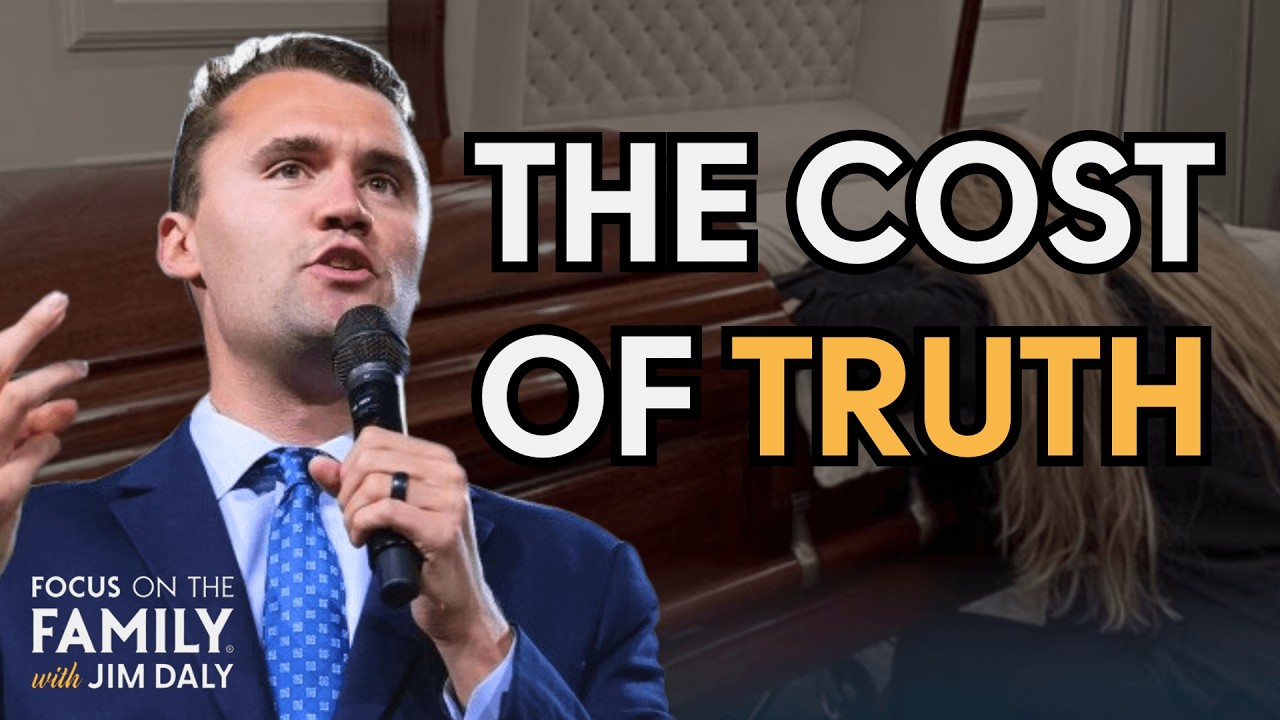
Father Josiah Trenham on Violence, National Repentance, and the Three Types of Life
Enjoying this? Share it with someone who needs to see it.
Up Next
Five Powerful Ways to Share the Gospel and Plant Seeds in Your Everyday Life
9:29
Charlie Kirk Built Turning Point USA From His Parents' Garage Into a $150 Million Movement
8:43
Tens of Thousands Gather at State Farm Stadium to Honor Charlie Kirk's Legacy and Mission
8:10
Father Josiah Trenham on Violence, National Repentance, and the Three Types of Life
Father Josiah Trenham explores the biblical roots of violence and why it represents a direct offense against God. Drawing from Genesis and the account of Noah's flood, he argues that attacking another human being, made in God's image, is among the gravest of sins. In a culture marked by decades of abortion and institutional secularism, Father Josiah examines whether genuine hope remains for America and what it would take to restore the nation's moral foundation.
If we're going to look for hope, it can't be fake. We have to assess where we are. Violence has a very special serious place as a sin. If you read the patriarchal histories in the opening books of the Bible, if you read Genesis chapter 6, this is the account of God regretting that he had made the human race. What could the human being have possibly been doing to make God regret having made us? The consequence, Moses tells us, is that God sent a worldwide universal flood.
Moses articulated the reason God did that and had to start over with Noah. In fact, God made Noah a second Adam, giving him the same commission he gave to Adam: be fruitful and multiply, fill the earth, rule it, and subdue it. Why did he do that? It says because the world had become full of violence.
When you attack another man, you attack God because every human being is made in the image of God. To attack a human is a direct divine offense. Violence is extremely serious. I'm not surprised that we have this level of violence in a culture that murders unborn children at the rate that we do and have sustained it for the decades that we have. Is any violence surprising?
The Question of Hope in a Godless Culture
Do we have hope? That's the background. That is how black it is. Do we have hope? And what's the future? I would say that without a belief that God is merciful and that he loves the human race and that there's no sin so great that if we repent of it, he will not send his love and forgiveness—without that belief, certainly we have no future.
The statistics are horrible for our country. We are so captured by an ideology that is hopeless. Atheism, strict secularism, which is running our country now, is extremely hopeless. Without a major reconsideration on the part of our people, a return to classic American virtues, a recovery of Christian faith—without that, certainly we're doomed.
But we know from Christian history that repentance is possible. In a personal sense, it's up to us to repent and to believe. In a national sense, it takes leadership—leadership that is willing to address the important things at the heart of national catastrophe.
The Need for Courageous Leadership
We have been living through national catastrophe. We have lost our faith in God. All of our institutions have been captured by strict secularism. Our law is godless. Our universities exclude God. Our country has gone down a very serious deep hole.
If we're going to get out, if we're going to have hope as a nation, we need leadership in the likes of George Washington. I think our forebears, our forebears are ashamed. My grandparents and America, they're ashamed at where we are. Our relationship to faith, our explicit commitment to God, our excluding him from everything that's important in America—we have to repent and we need someone. Give us God, someone like a King David. Give us someone like my patron saint Josiah who was the last great king of Israel who himself lived at a terrible time.
His father and his grandfather were both awful kings who had completely apostatized, abandoned the heritage of Israel, and led the people to copy the pagan practices of the surrounding nations. We're way worse than pagans. I always tell people, look, don't call the secular nonsense that's going on in America pagan. That's an insult to the pagans.
Worse Than Paganism
The pagans believed in the divine order. They believed in the gods. We don't believe that there are gods—there is one God—but the pagans at least knew they were accountable to the divine order. They were accountable to the gods and that they had to live with respect to the wishes of the gods.
To call America, which has no reference to God, pagan is a full-blown insult to pagans. Most of our leaders make no reference to God at all. They act as though they are not accountable to God's law. That's far worse than paganism.
Unless we have a leader who's going to address this directly, we need to repent and we need to recover our faith. If we do that, times of refreshing will come from God. We can be changed. A new day can arise. But it's not going to be with a little fix. It's not going to be with a little something here or a little something there.
A Radical Surge of Interest in Faith
I've been a priest for almost 33 years. I've never seen the radical interest in faith that we're seeing right now. I'll tell you, if I use my parish just as a little example, I have maybe a little more than a thousand active parishioners that are here regularly. Over the years of my ministry, I've catechized, I've instructed and prepared people for baptism. Maybe 20, 30, 40—a really great year would be 40 people. I have over 200 people in catechism right now. And this is happening all across the country.
People are moving towards God, moving towards faith. If this continues and it translates into lives that are rooted, lives where faith is important, where true repentance has happened, where this quest for just biological life as though that's somehow the sum total of value is rejected—then we have hope.
The Three Types of Life
If you study the scriptures, there's three types of life that are described. There's biological life. In Greek, it's called bios, from where we get biological. There's the life of the soul. Many Americans don't even know that exists. That's called psyche. It's the most noble part of you. Even the Greek pagans knew that the body is like a chariot and the soul is like the charioteer, leading the person in nobility, said that the body does virtue, the body does something beautiful.
If you don't think you have psyche, if you think you're just a body and you don't have a soul—which by the way is the worldview of the major tech titans of our country—this is why someone as noble as Elon Musk would stand up and speak to the protesters in England when they were saying what can we do, what's our future, and he said technology and AI. I promise you, technology is not going to save us. It is not going to save us. And to say that is so hopeless.
If we are soulless and we have greater technology, then the soulless are going to use that greater technology to oppress us. We need to affirm what all reasonable human beings in civilized countries except the modern secular West recognize: that a human being is more than his body. He has more than bios, more than biological life. He has the life of his soul, psyche.
And then there's something that's most important which is eternal life. Aionios zoe, it's called in the scriptures—eternal life. This is the life of God's kingdom. These are the three fundamental lives. Two of them we have stopped talking about for many decades and the consequences have been tragic.