Heated Debate Over Charlie Kirk DEI Comments and Valorizing Public Figures After Death
Enjoying this? Share it with someone who needs to see it.
Up Next
Charlie Kirk Debates White Privilege and DEI With College Student on Merit Versus Race-Based Policies
11:49
Charlie Kirk Confronts FSU NAACP Claims of Hate Speech Over Civil Rights Act Commentary
3:52
Charlie Kirk Debates DEI Advocate on Merit Versus Diversity in Hiring at Turning Point USA Event
17:26
Heated Debate Over Charlie Kirk DEI Comments and Valorizing Public Figures After Death
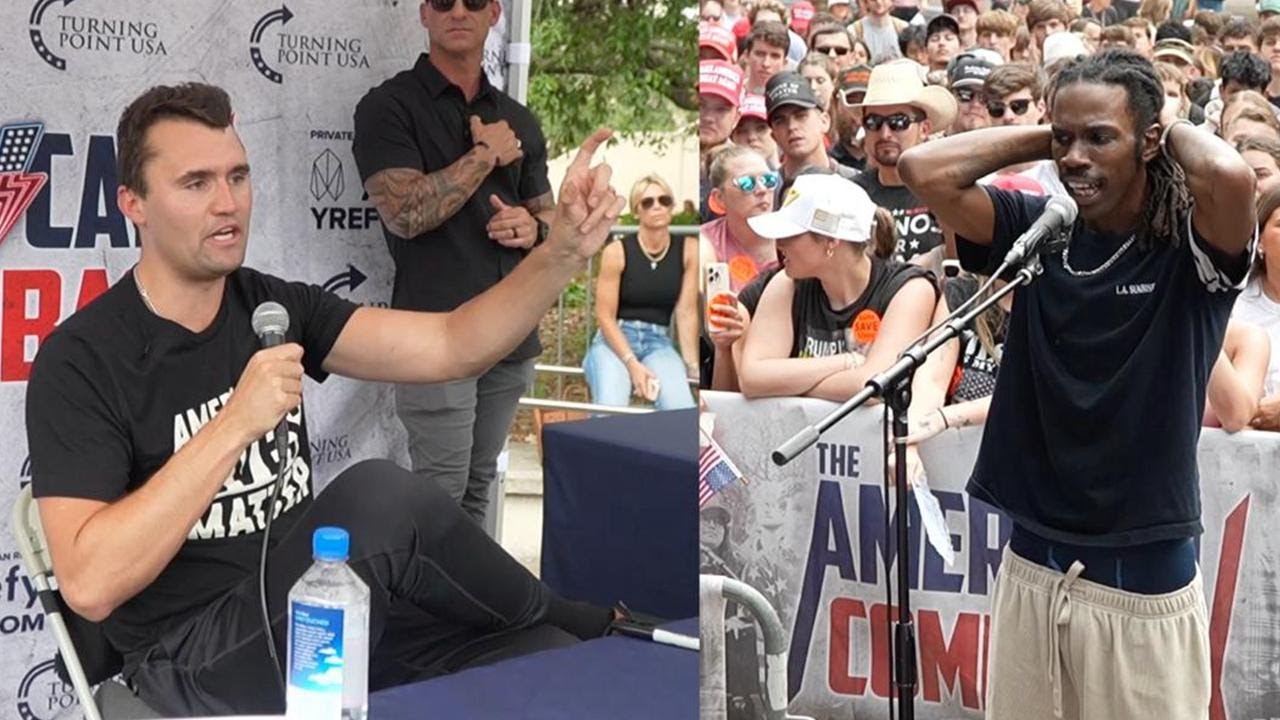
Two individuals engage in a contentious discussion about the public response to a death, specifically examining controversial statements attributed to Charlie Kirk regarding DEI programs and airline pilot hiring practices. The conversation explores whether comments about diversity initiatives constitute vile opinions or legitimate criticism of hiring systems that prioritize characteristics over merit. What begins as a discussion about disproportionate public mourning evolves into a fundamental disagreement about affirmative action, impostor syndrome among beneficiaries of DEI programs, and the tension between recruiting diverse candidates versus compromising qualification standards in the airline industry.
September 15, 2025
The Disproportionate Outpouring of Grief
The conversation begins with a reflection on recent events involving a death that generated significant public attention. One participant expresses discomfort with what they perceive as an excessive outpouring of support for someone they barely knew existed, noting that this response seems magnitudes greater than reactions to other tragedies, including legislative shootings or school shootings that occurred the same week.
The other participant counters this perspective by explaining that the support isn't necessarily about the individual person, but rather what they represent. They argue that Charlie Kirk was killed while sitting behind a table on a college campus, espousing his opinions—an activity that embodies core American values. According to this view, the widespread support comes from people across the political spectrum who recognize the importance of free expression on college campuses, regardless of whether they agree with the specific opinions being expressed.
Controversial Statements About Black Pilots
The discussion takes a sharp turn when one participant challenges the characterization of Kirk as worthy of widespread support, citing what they consider vile statements. Specifically, they reference a quote about seeing a black pilot and hoping they're qualified to fly the plane. They interpret this statement as strongly implying that every black person is incompetent and only obtained their position through diversity programs, noting there's zero evidence that black pilots are causing deaths.
The other participant requests verification of the quote before responding, emphasizing the importance of confirming whether Kirk actually made such a statement. They pull up a fact-check from Snopes that confirms the attribution: "If I see a black pilot, I'm going to be like, 'Boy, I hope he's qualified.'"
The DEI Hiring Debate
With the quote confirmed, the defender of Kirk's statement offers context. They argue that the concern isn't about black pilots being innately unqualified due to their race, but rather about distrust created by systems that intentionally hire people based on inalienable characteristics over merit. They point to United, Delta, and Southwest airlines, claiming all have DEI programs that prioritize certain characteristics in hiring decisions.
The conversation becomes increasingly contentious as they debate what DEI programs actually do. One participant insists these programs represent intentional hiring based on characteristics rather than qualifications. The other argues that diversity initiatives focus on recruiting from underrepresented pools, not on lowering qualification standards in the actual hiring process.
United Airlines as a Case Study
The discussion zeroes in on specific evidence when one participant references United Airlines' stated goal of having 50% of new pilot recruits be women or people of color. They argue this necessarily means the airline wasn't hiring the most qualified candidates, since the applicant pool likely wasn't 50% women and people of color.
The critical question becomes: does such a goal mean United was compromising on qualifications, or simply being more intentional about recruiting from diverse candidate pools? One participant insists this represents a hiring practice based on appearance rather than ability. The other maintains there's a distinction between recruiting strategies and hiring standards—that you can seek out qualified candidates from underrepresented groups without lowering your bar for competence.
The Impostor Syndrome Argument
An interesting dimension emerges when one participant claims that DEI beneficiaries themselves often experience impostor syndrome, feeling they don't belong in their positions because they were hired based on characteristics rather than merit. They specifically mention women as major beneficiaries of DEI and affirmative action who struggle with feeling unqualified for their roles.
This argument attempts to show that the harm of characteristic-based hiring extends beyond external perceptions to the psychological well-being of the hires themselves. According to this view, the existence of DEI programs creates doubt not just in others' minds but in the minds of those who benefit from such programs.
Recruiting vs. Hiring: A Semantic Battle
Much of the debate hinges on a semantic distinction that neither participant can definitively resolve: the difference between recruiting and hiring. One argues that achieving a 50% diversity goal in new hires necessarily means compromising on qualifications during the hiring decision. The other insists you can achieve such goals by recruiting more aggressively from underrepresented groups while maintaining the same qualification standards.
The debate reaches an impasse when one participant points out that neither of them has been involved in pilot hiring decisions, and therefore neither can speak with certainty about whether airlines recruit more broadly or lower standards to meet diversity goals. However, the other maintains that the airlines themselves have admitted to these practices and that DEI programs fundamentally violate the Civil Rights Act by hiring based on characteristics rather than qualifications.
The Broader Context of DEI Programs
Toward the end of the conversation, the scope expands beyond airlines to other industries. One participant mentions that Meta and other organizations have admitted to implementing DEI programs, sometimes under pressure from the previous administration. They note that many organizations have recently eliminated their DEI programs, suggesting this reflects recognition that such programs were problematic.
The fundamental disagreement remains unresolved: one participant sees DEI programs as inherently discriminatory systems that compromise merit-based hiring, while the other sees them as recruiting strategies that expand opportunity without necessarily lowering standards. Neither can provide definitive evidence for their interpretation of how these programs function in practice.