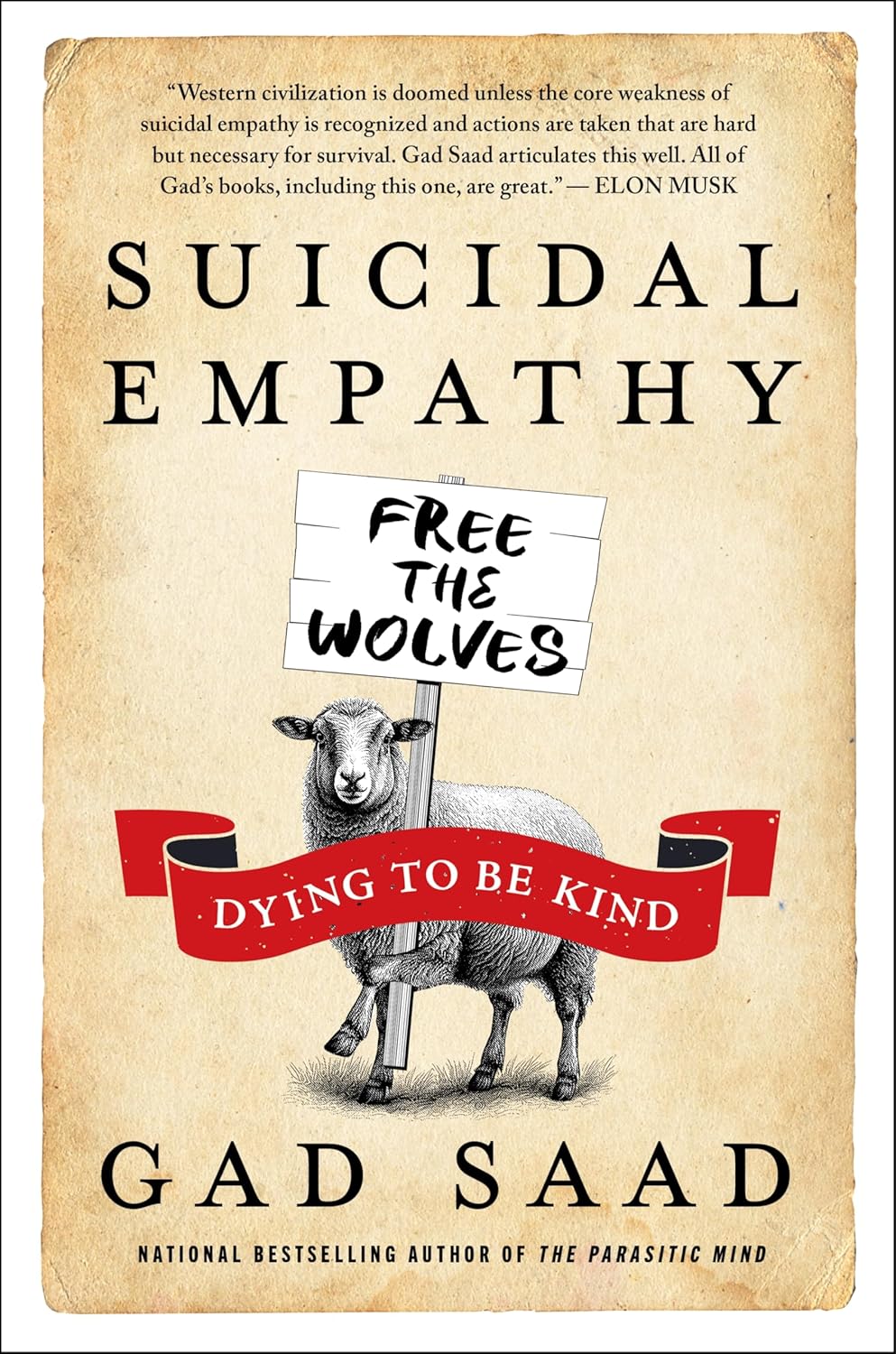
Of all of the human phenomena that I've studied in my life, which is the one that has surprised me the most about human nature, the inability of people to change their minds despite overwhelming evidence to the contrary. Why do people double down instead of changing even in the face of accelerating evidence of error? I'm in the business of, you know, defending truth and persuading people of opposing ideas, but in most of the cases, it's la. I don't want to hear it. You know, you talk about people turning a blind eye. There are none so blind as those who will not see. Paradoxically, what often happens when I expose you to contrary information, it only solidifies your position. Because while the ostrich doesn't literally bury its head in the sand, the metaphor is very apt, which is I don't want to face reality. It's blindness. It's willful blindness. [Music] Hey everybody. I had a chance today to um rekindle my relationship with Dr. Gad Sad who's a professor of marketing at Concordia University in Montreal. uh which is a funny position to hold because marketing is a very capitalist enterprise and Concordia is a very woke institution. Anyways, Gad has been a gadfly at Concordia for a substantial amount of time, not least because he applies the tenants of evolutionary psychology to the analysis of human motivation. Hence his interest in marketing because marketing is the what the study of the practical application of the analysis of motivation. Right. Gad has written a number of two in particular, a number of books, but two in particular that have struck a chord in the popular imagination. The last one was called the parasitic mind where he outlines his theory of the woke mind virus. Uh, a notion that's been propagated quite extensively by none other than Elon Musk who's quite happy about the theory, not least because it accounts for the pathology that alienated his son from him in a very tragic set of affairs or set of circumstances that's increasingly and unhappily common across families all across the West. He also wrote a book gad called the sad truth about happiness. What did we talk about today? Well, we talked about parasetism which is a very deep problem. Um there are evolutionary biological theories that sex itself evolved to help organisms stay ahead of the parasites. those organisms that utilize the resources of a host without adding to its um capa capability for survival. Quite the contrary. Well, Gad was very interested in parasitic ideas and how they spread and um the invasion, you might say, of the parasitic ideas into the university. And so that's really what we concentrated on all things considered. How do we understand and defend? How do we understand the relationship between our ability to generate storehouses of immense value on the merit side, on the accomplishment side, on the brand side? How do we defend those against the encroachment of destructive parasetism? And how do we do the same thing with the with the with our own psyches and communities? That's the topic of today's podcast. Dr. Sad, it's been a while. How are you doing? Look, you're looking sharp as always with that gorgeous three-piece suit. Hey, man. I've got a I've got a deadly suit maker, LGFG. By the way, I don't know if you know this, he they gifted me a red velvet suit, which they delivered straight to me in Montreal, which I've only worn one in public at Mara Lago. Oh, well, there you go. That's a good That's a good uh uh and rare combination of events. There you go. When were you at Mara Lago? Uh in early December. So, he had already won the elections, but he hadn't yet been inaugurated. And it was a mega event. So, make education great again. Make education great again. There's a complicated problem. Yeah, I know. Trump is at Trump in theory is at war with the universities, particularly Harvard at the moment. I guess they're locked in some legal wrangle with Harvard claiming that somehow the federal government owes them the money that they've been paying them when they used to be a university. And so they only have 53 billion of endowment. Uh uh Jordan, they need the government. There there are there are stringent restrictions on how poor Harvard can use its endowment and so they need to go cap in hand to the federal government to beg for large from the brick layers and the electricians even though they they despise them to the core. Indeed. Indeed. How do you do you remember your time at Harvard fondly or or not? Unbelievably unbelievably fondly. Yeah. Yeah. Look, for a long time, as you know, it was a pretty good deal to be a university professor at a functional institution. And in the 19, it was a great deal. Let's let's say that in the 1990s when I was there, the senior faculty, the the the smartest people I ever met in my life were the the older senior faculty at Harvard. Unbelievably well educated, you know, classically and scientifically. And then the young professors who rotate out because that's how Harvard worked, right? On about a seven-year rotation, they were hellbent on their research careers and not in the careerist manner. You know, they all had a obsess the kind of obsession that you need to have if you're a scientist. And then the graduate students were well, they were like graduate students everywhere and some of them were superb. And the undergraduates were top rate. And then the administration served all that and it was beautiful. You know, our faculty meetings, everybody tried to get them over with as fast as possible so they could get back to the lab. Lots of the professors had showers in their labs so they could work, you know, the requisite 16 hours a day that you have to work if you want to be at the top of your game. And that's what it was like. So, you know, it was a privilege to be there. Yeah. I I I came close to actually getting uh the coveted Harvard Business School position out of my PhD at Cornell. And so I had made the first round cuts and then I made what the cuts what's called the campus visits where they invite I think the top three or four candidates. And then apparently, rumor has it, I I don't have absolute confirmation, but the diversity, inclusion, equity stuff was already happening in 1993 because it came down as I hear the story between me and another person. She ovulates. I don't. And so she ended up getting the job. But I came close to being with you right there at Harvard in the ' 90s. Oh, that would wouldn't that would have been that would have been an interesting early convergence. Yeah, that's right. the world had to wait an extra few years before we met. Yeah. Well, that DEI issue, you know, you sat on many hiring committees, I presume, and it was certainly the case that really all the way back, as far as I can remember, even into the 80s, if there was a candidate who was of minority status, whatever that minority happened to be, the hiring committees, even that early, would bend over backwards to bloody well make sure that they got the job, you know. And I would say from the 80s through about 200 five 10 maybe merit was still essentially prioritized but all that other idiocy had come creeping in. And of course by 2010 you might as well just thrown up your hands in despair and headed for the hills which you know essentially I did 6 years later. And um I think it was we'd got to the point where and it's probably still like this. I think it was 70% of early applicants like early stage career applicants for junior professorships in STEM fields in California which was an excellent state system for a very long time. They they're turfed out of the competition before their research dossier is evaluated. And of course, and that's from their DEI statement. Yeah. Well, it's only gotten a lot worse since uh you left. So let me give you or for your listeners and viewers a few recent stats. So the Aristotle Foundation released a few months ago a study at Canadian universities and uh they looked at they did a content analysis of uh Canadian job openings and in 98% of the posts the postings uh there was mention of diversity, inclusion, equity. I mean, if it were 20%, it would be a disaster, but imagine where it's 98%. I think it was something like 477 out of 489 postings involved diversity, inclusion, and equity. And to that point, you know, as you probably might remember, I I held a universitywide chair for 10 years, and it finished in 2018. When I then started thinking about applying for, you know, the next term, the next five-year term, I then decided against it because I was under the requirement to provide a diversity, inclusion, and equity statement, which I wasn't willing to do. So, it has now been probably five, six years since I last had university based research funds. And so in a sense I've been forced out in my ability to pursue my research uh because of many of these ideological commitments that you have to publicly proclaim. It's it's horrifying. There's a time in every child's life when he or she realizes they stand on the precipice of adulthood. It's during this window that learning responsibility becomes crucial. We're trying to figure out how to get him through this part of his life, become a responsible adult. they don't learn how to be autonomous in your household when they're teenagers. How do you expect that they're going to be able to take care of themselves when they leave home? Be really good to get this under control. You have to sit down with your husband or wife and you have to see not only where you think things have gone wrong very concretely around specific episodes, but you have to flesh out a vision of what you would rather see instead. You're going to get push back, but better late than never. [Music] Yes. Well, and I've been watching Harvard struggle with Trump and the research community as well um bleet and beat their chest about the fact that well the only reason that the researchers ever um procri provided the requisite DEI statements was because the government had made it mandatory. It's like so I guess mandatory cowardice is an excuse for for what? for selling your soul to the devil. Yeah, it's amazing. I'll give you another amazing example. I've been I've been on leave now from Concordia, which, you know, the university was kind enough to grant it to me. Uh they were probably relieved. G I don't want to say it, but thank you for saying it. They were probably Yeah, I'm sure they were. that left-wing hell hole, that that university, that that terrible h pro- Hamas constant protesting home of the resentful and miserable, that Concordia, that that Concordia uh their five-year strategic mission is to indigenize and uh what's the other term? I can't remember the other term to indigenize the curriculum. Uh so imagine how do you indigenize number theory? How do you indigenize differential equations? How do you indigenize evolutionary? Two little, three little Indians. Is that how you do it? You're going to get me into trouble. Uh, that's me saying it, Gad. And I I've already been in plenty of trouble. Fair enough. So, you know, it's very very difficult to live in the ecosystem. I I think when I first heard that you were leaving academia, uh I I I felt a bit of tension within myself and that on the one hand I was oh no you know Paison is leaving on the other hand I felt somewhat envious of you in that while I remained in the ecosystem of infinite lunacy you were out man how you feel now that you've been out for a few years well it's worked out very fortunate for me because well for a variety of reasons. I mean, first of all, I've been on a non-stop lecture tour really since 2018, punctuated by various, you know, fits of illness. But, and so what's my alternative? I can teach 150 kids in a classroom that looks like some um sadistic architect designed it what for denisens of hell. all fluorescent lights and concrete blocks and hosable architecture. And they can sit in desks and be numbers in a 60,000 person uh what what uh monstrosity of gigantism while being lectured by the DEI mavens or I can travel around the world to speak to paid audiences about exactly what I want to talk about and do something different every night. So that's a pretty good deal. And then we set up Peterson Academy, which is thriving. I just finished teaching uh recording a new maps of meaning course. That was my cardinal course, I guess, at Harvard and the University of Toronto. And and it'll be produced at the highest possible quality and then shown to our 45,000 students and that's growing extremely rapidly. So, you know, that's the upside and there's lots more upside associated with that. But the downside is I had a pretty good research career, Gad, you know, and and that's the one thing I haven't been able to replace. Well, that in my clinical practice, you know, because I'm too evil to have a clinical practice. So, um, oh, by the way, I should tell you this. This is pretty funny. in the most darkly horrible quasi totalitarian idiot Canadian state manner. Um so you know the college of psychologists have deemed me um what would you say I need to be re-educated out of my uh climate apocalypse skepticism and my disdain for the trans activists and my belief that maybe we shouldn't cut the breasts off 13year-olds. you know, all those terrible things that that sane people know to be true deep inside of them, like the fact that there are actually men and women. You know, I was uh asked on a show about a year ago, of all of the human phenomena that I've studied in my life or I'm aware of, which is the one that has surprised me the most about human nature. And I I paused for a second and I answered the inability of people to change their minds despite overwhelming evidence to the contrary. Justin Trudeau comes in, he does a disastrous job. What do Canadians do? Reelect him. That that's not enough. Let's do it a third time. Then he steps down. Maybe this it's time now to do some autocorrection. What do Canadians do? They reelect the party that put them in the position that we're in right now. So I think that that answer that I gave, it was a British psychiatrist who was hosting me. I think it's that much more appropo today. It is almost impossible to get someone to change their opinions once it is anchored solidly into their personhood. So there you go. Hey, I've got a biblical reference that will clear that up for you. Okay, shoot. So, one of the mysteries in the story of Exodus is why it takes the Israelites three generations to cross a relatively trivial stretch of desert. So, what's the narrative explanation? So, it's twofold. Remember in the account when Moses after Moses encounters the burning bush and gets to the bottom of something and learns which is what that story means, he goes back to get the Pharaoh to change his mind. But he doubles down the pharaoh and that's the consequence of the ever accelerating sequence of plagues. And the first eight plagues destroy the present and the last plague which is the death of the firstborn destroys the future. And it isn't until the present and the future are destroyed. Heaven and earth both plus the future that the pharaoh relents. And even then he doesn't, right? Because he sends his army after the Israelites once they do depart. Right? Now the question is why do people double down instead of changing even in the face of accelerating evidence of error. Okay. So the Israelites leave, right? So now they are escaping their tyranny and their slavedom. And that's a dynamic, right? Because there's no tyrants without willing slaves and vice versa. And so the Israelites have plenty to learn too. And so the first thing that happens to them is the chaos of the Red Sea. And that's chaos in blood. Why? Because when you change your mind, the first thing that happens is things fall apart. And so, right, and then they cross the Red Sea and they managed that successfully. So that's that chaotic threshold. And then they wander in the goddamn desert for three generations, right? Why? because at least under the tyranny they knew what to do. And in the wilderness they are fractious, resentful, immature and unable to govern themselves. And it takes three generations before they recover. So, and you know I talked to Carl Fristen about this and Carl's a neuroscientist of some repute and he has an entropy theory of anxiety which is a ve and I had worked on a parallel theory in my lab in Montreal. We published a paper on it uh not too long before I departed for parts unknown. Your beliefs are game principles like game rules that bring order to complexity. And if you're wrong, you have to modify. And the consequence of modification first is an encounter with unstructured entropy. in chaos and that the apprehension of that locks people into their tyranny, self-imposed, familial, cultural, whatever. So, it's always, it's never from where you are to the promised land. It's always from where you are through the threshold of chaos into the goddamn desert and then maybe forward. So in in chapter seven of the parasitic mind where I talk about how to seek truth I open up the chapter with a long quote by Leon Festinger the pioneer of theory of cognitive dissonance and it exactly speaks to your point. So the chaos that you're talking about with the Red Sea and so on in the biblical story is the chaos that you experience internally when you are faced with a dissonant amount of evidence that is contrary to the one that you hold so dear to you. And so it is no accident that this incredible quote by uh Leon Festinger I I obviously don't have it memorized here but basically he's saying that there is no ends to which people will go to in order to maintain the coherence of their current belief system irrespective of the amount of contrary evidence that they are exposed to because then that triggers cognitive dissonance. And as a matter of fact, paradoxically, what often happens, as I'm sure you know, Jordan, when I uh expose you to contrary information, it only solidifies your position. So, you could imagine how disheartening it is, right? I'm coming at you with a mind vaccine that hopefully gets you to perhaps revisit some of your, you know, cherished beliefs. You mean like a university professor should? Like a university professor should. And what it ends up happening is exactly opposite to that. It only emboldens you in your position. It only solidifies that you were right despite the fact that I've shown you that you were perfectly wrong. And so at times it it can seem like an insurmountable struggle because I'm in the business of, you know, defending truth and persuading people of opposing ideas. But in most of the cases, it's la I don't want to hear it. And that's why I talk about ostrich parasitic syndrome in in the previous book because while the ostrich doesn't literally bury its head in the sand, the metaphor is very apt which is I don't want to face reality. It's willful blindness. It's willful blindness. And so it's a very in the Egyptian mythology the god of the state they had a god of the state Osiris. And Osiris was a great exploratory and nation founding hero in his youth. Awake and alert and curious, able to transform and to bring order. But as he ages, he becomes oified and that's sped along by the fact that he's willfully blind. That that's in the Egyptian theology. Now he has a brother, an evil brother, Seth. And Seth is the origin of the word Satan, by the way, through the Coptic Christians. And Seth is the eternal evil brother of the willfully blind king. And when Osiris is sufficiently old and sufficiently willfully blind, which means unwilling to understand the usurping motivations of his evil brother, Osiris chops him up into pieces and spreads his parts around Egypt. In fact, the Egyptians regarded each Egyptian pro province as a piece of Osiris, right? So that body would come together as an integrated state when you he can't kill Osiris because Osiris is a deity. So there's no killing him. But you can make sure everything falls to pieces. So that's the blindness of institutions once established. They oify and then they turn a blind eye to the machinations of the usurper. Right? Okay. So Osiris is now scattered all across the landscape and so things have fallen apart, right? People say that about their own life. Everything fell apart. His wife is queen of the underworld, Isis, and she rules the domain of the underworld and chaos, which is where you go when things fall apart. And she makes her appearance, right? So that's the renewal of the social order by what? the planitude and terror of nature and she finds Osiris's fallus. So the vessel of the seinal idea and she makes herself pregnant and has a son. The son is Horus. Horus is the Egyptian god with of the eye, the famous Egyptian eye with the fully open pupil. And he's also a falcon because birds of prey have the most acute vision. And Horus is willing to see and he can see evil. And so he goes back to Egypt when he grows up like King Arthur. He grows up alienated from his evil community and he goes back to fight Seth. And they have a terrible battle and Seth tears out one of his eyes. And they continue to fight. And Horus gets the eye back and he banishes Seth to the to the nether regions of the cosmos. No killing him cuz the force that usurps and parasetizes never dies. Okay, now he's got his eye back. Now you think he could just slap it in his head and then he could rule. That's not what happens. He goes to the land of the dead, back to the underworld voluntarily, and he finds Osiris, his father, languishing in the underworld, you know, in a ghostly and and desecated state. And he gives him his eye. So he provides corrupt tradition with the capacity to see. And then Osiris awakens and they unite. And it's the union of Osiris and Horus that is the proper sovereign of the state and the soul of the pharaoh. Nice. Isn't that something? That's nice. I guess that's why you love you love to study ancient themes to link them to current realities, right? Well, it's it's so brilliant. The Mesopotamians, too woripped vision, attention for exactly the same reason. It's exactly what we're talking about. You know, you talk about people turning a blind eye. There are none so blind as those who will not see. The deity of the revivocation of the corrupt state for the Egyptians was literally the open eye. Pay attention. Right? And for the Mesopotamians, it was twofold. Pay attention and speak the proper words. Free associating here. Uh, one of the greatest guests I've ever had on my show is a gentleman who when you translate his pseudonym in English is I of Mosul in in in Arabic it' be Mosul which was he was a guy who was literally documenting the atrocities that were being committed by ISIS in Mosul at great uh threat to him and he was using the the vision the eye uh symbol to to capture exactly that. uh you should go if you ever have a chance you should go and listen to our chat because when people say you know I'm too afraid to to speak on campus because of reasons x y z I usually referred them to someone like this gentleman and several other very courageous people who literally put their lives in imminent danger in order to document some of the difficult realities that people face in the Middle East. And yet most people here are too afraid to speak out because they might be unfriended by someone on Facebook. And so I always try to contextualize the dangers that people feel in the west compared to some of the dangers that freedom fighters feel. And actually I remember in do you remember our our chat uh our event that was originally cancelled at Ryerson which we subsequently held a few months later in 2017 in Toronto. Yep. Yep. I remember that in the Q&A period, someone asked each of the people on the panel, including you and I, uh, who would be some of the freedom fighters that we that we each most admire? And in my case, I gave examples of people in the Middle East who speak out at truly extraordinary great personal risk. So there you have it. Yeah. Well, you know, God, the thing about risk, it risk is a funny thing because there's the risk that you acrew by speaking out and then there's the risk that you acrew by being silent when you have something to say. Yeah. Well, that's the Jonah story, right? The the dragon from the abyss will drag you to hell if you refuse to speak when your conscience tells you to. to to your to that exact point, when people ask me, "Why is it that you speak out?" I usually tell them that when I go to bed at night and I have to put my head on the pillow, the only thing that stops me from having a bout of endless insomnia is to know that I was fully true in defending the truth. If I were to modulate my speech, if I were to regulate what I say or don't say, even though the world might not know it, I would know it. And therefore, since I'm my harshest critic, since I have a very exacting code of personal conduct, I simply can't modulate. And so, it's exactly to your point, which is uh I would feel inauthentic. I would feel fraudulent if I were to not speak when I'm tasked to speak. And I only wish more people were to do that. When my sleep is off, it felt like I couldn't show up as my best self. I spent night after night tossing and turning, waking up exhausted and making it hard to keep up with the latest headlines. That's when I found Beam's Dream Powder. Beam is proudly founded in America and run by people who share our values, hard work, integrity, and delivering results. It's a healthy nighttime blend packed with sciencebacked ingredients shown to improve sleep so you can wake up refreshed and ready to take on the day. And unlike other sleep aids, there's no next day groggginess, just great restful sleep because Dream is made with a powerful blend of all natural ingredients, rayi, magnesium, eltheanine, apagenine, and melatonin. I especially appreciate that Beam is an American company, both built and operated here. So, a purchase supports hardworking Americans committed to doing things the right way. Here's the deal. Beam is giving our listeners the ultimate patriot discount of up to 40% off. Try their bestselling dream powder and get up to 40% off for a limited time. Head over to shopbeam.com/peterson and use code peterson at checkout. That's shopbeam.com/peterson and use code peterson for up to 40% off. Sleep better, wake up stronger, and show up ready for your family, your work, and your country. Because when you're well rested, you're unstoppable. And this country needs more people like [Music] that. Yep. There's no pillow like a good conscience, as they say. Yeah. Yeah. You know the other you said that you have an exacting personal standard, but would it not I'm very curious about your response to this. Would it not be the case that you could say with equal truth that an exacting conscience has you in its grip? Yeah, that's a great question. So in in the last book in my happiness book I have an entire chapter on the inverted you which is sort of the universal law of maximal flourishing. Too little of something is not good. Too much of something is not good. And life is about finding that sweet spot which of course Aristotle had already explained to us via via his golden mean. Right. Exactly. Uh a soldier who's too cowardly is not good. a soldier who's a reckless martyr is going to die very quickly and somewhere in the middle stands the golden mean. So to your question I argue that my perfectionism which is one manifestation of perfectionism is a manifestation of my exacting standard actually puts me beyond the sweet spot. And let me give you an example. Uh when I received the galley proofs, let's say to my latest book, most authors would view that as an opportunity to celebrate. This is the last final step before the book goes out into production. To me, I go through an infinite amount of angst because this is the last time that I could ever find that misplaced, you know, comma or that typo on page 337. And so I end up spending probably five times as much time as with the typical author when they're going through the galley proof because of my exacting nature, because of my maladaptive perfectionism. So even for a trait that you would think is is is a noble trait, right? You're you're you're conscientious, you have attention to detail, even that could be in the maladaptive part of the curve. Yeah. Well, I wonder I I wonder it's a strange thing a because you have to adjudicate adaptive with a specified time frame. And time frame is a tricky matter, right? Because look, why do people go along with the horde um when when even when their conscience is suggesting the alternative? And the answer to that is I think you tell me what you think about this as a student of evolutionary biology and motivation because time frame is a crucial issue here right that's why we delay gratification that's why there's a distribution of future preference I was forgive me for interrupting you I was literally before I came here this morning I was working at the cafe on my forthcoming book I was working on a section on delay gratification but go ahead continue okay well So here's a hypothesis is that service to an exacting conscience is the longestterm game. So I was going to tell you I said I what I mentioned before we began the podcast that I wanted to tell you a a story about Abraham and maybe I can do that now if you don't mind because I I got Brett Weinstein's comments on this by the way because I'm very curious about its evolutionary significance. I think it's the antidote to the notion of the selfish gene and I think it's evolutionarily sound. So let let me tell you what let's say that as you mature let's let's start out this first is when you're immature your time frame is very short and so you're after immediate gratification. That's the case with 2-year-olds and like radically immature people. They want whatever it is it they want whatever in them is demanding to be satiated now and and they and they can't forgo that gratification for future consideration or others. And those are kind of the same thing, right? You in the future is pretty much like someone else now. It's a hypothetical, right? And so psychopaths, for example, serve their future selves very badly. They don't learn from experience and they get themselves in trouble in pursuit of immediate gratification. They're radically antisocial. It's a propagation or an extension of m im immaturity. I think that's what Marxism is too by the way. Property is theft. That's pretty damn convenient if you want what other people have sacrificed for. Okay. So Abraham I I'll try to make this brief. Abraham is dependent and immature when the story starts. He lives with his wealthy parents and he's never had to lift a finger even though he's like into his seventh decade. And then a voice comes to him and you could think about it as the voice of calling or the voice of adventure or the voice of conscience. They all work equally well. And it says to him, you have to leave your zone of comfort. You have to leave what you are accustomed to and what served you and you have to journey out into the world and have the terrible adventure of your life. And and if you do that, I will make you a covenant. This is the Abrahamic covenant. And I took it apart in we who wrestle with God. And I've been lecturing about it, thinking it through because I think there's something unbelievably profound in it. So God makes Abra God comes to Abraham as the voice that tells him to step out of his zone of comfort and to move forward radically. Okay? So that's a definition of the divine by the way in that story, right? It's not a call to belief. It's a definition of the highest calling. Okay? So here's the deal. God tells Abraham, if you do this, so let's say you follow the pathway of developmental impetus, you'll become a blessing to yourself. So that's a good deal. And that would imply that the instinct that moves us out into the world, followed properly, is the best guarantee of our future security and opportunity, which has to be the case. Those things have to line up. Okay, so that's offer one. offer to is you'll you'll your name will become renowned among those who know you for valid reasons. So you'll establish a reputation that's genuine and and deep. Number three, all your enemies will flee before you and nothing will be able to withstand your movement forward. Number four, you'll establish something of lasting permanence. In in Abraham's case, he establishes what I think is the pattern of paternal prowess that radically guarantees the multigenerational survival of his offspring. And he's he's guaranteed the to be the father of nations. And the final kicker, and this is brilliant, you'll do it in a way that brings nothing but abundance to everyone else. So imagine that this would imply that the impulse that moves us past that zone of convenience that people will tyrannically cling to that the manifestation of that spirit is the same process that brings peace and opportunity to life that guarantees reputation that makes you implacable and unopposable in the medium to long that allows you to establish something multigenerationally permanent including a biological legacy and that brings abundance to everyone else. So that speaks of an alignment with the instinct to move forward. That would be the instinct that's counter to tyranny. that tyranny we described earlier that aligns all that with the pattern that would radically increase the survival of your progeny if that pattern is duplicated as it cascades down the generations. Yeah, I mean I I don't know if I have a ready answer regarding the specific biblical story, but I can certainly incorporate an evolutionary angle to these temporal decisions, these intertemporal delaying gratification. So let me tell you about two great studies. These are not my studies but uh they're quite evolutionary in spirit. So usually there when you study intertemporal decisions, you make people go through a bunch of tasks where you set up the tension between I can give you $100 now or you can wait 7 days and I'll give you $130. And then depending on the pattern of responses that you and I give, I can calculate your lambda parameter, which basically captures how much of a delayed or immediate gratifier you are. Okay, fair enough. Now, most psychologists and certainly economists have presumed that that lambda parameter is an invariable part of your personality. So, Jordan Peterson might be an immediate gratifier. Gatsad might be a delayed gratifier and that becomes invariant. Well, it turns out that the story is a bit more complex in an evolutionarily relevant way. So, for example, if you make people drink a sugary drink or a placebo, I can get you to alter your lambda parameter. So people who are satiated, physically satiated because they had a sugary drink are more likely to delay their immediate rewards because they makes perfect sense. Sure. Now and listen to this one. So that's related to survival, right? Because I'm I'm drinking something which is a a consumatory thing. Now let's prime the mating module. If I show men and women photos of sexy opposite sex targets, that priming doesn't work for women for obvious evolutionary reasons. But for men, if you prime them with photos of scantily clad, sexy women, their lambda parameter changes such that they now want they want it now. So in other words, they become a lot more driven by immediate gratification. Even if it's in a different generalizes. Oh, that's interesting. Exactly. So, so I'm either catering to your mating module or to your survival module. And because these are evolutionarily relevant triggers, I can alter what most scientists thought was an invariant lambda parameter. And so, to your point, your intuition of asking an evolutionist about intertemporal choices, there really is an evolutionary story to that. Well, well, you know that that's also reflected in the Abrahamic story because Abraham's relationship to this voice that calls him forward is sacrificial. He has to give up something in the present that's valuable. That's why that that's why this took me a long time to figure out, Gad. I didn't know to begin with that. reason that the deepest relationship in these ancient stories is catalyzed by sacrifice was because people were trying to work through this paradoxical idea that if you give up something in the present of value and you do that properly, whatever that means, cuz that becomes a mystery, then you can stabilize the medium and long-term and also the community. And so you think about what this means. If if this is right and like it's it's evident to me from comparing multiple stories that sacrifice is the ritual of delay of gratification, right? It's it's the ritual of work, right? And work is a sacrifice because you you give up your pursuit of immediate gratification in the present to stabilize your future and to fill it with opportunity. And so and what sophisticated communities are dependent on sophisticated sacrifice. And then the question becomes sacrifice in service of what? In the Abraham story, it's in the service of the instinct that moves you adventurously forward which is a lovely way of conceptualizing it. But the fact that the sacrifice is involved. So what happens too is that Abraham pursues a sequence of expanding adventures each of which demands a more exacting sacrifice and that culminates in God's request that he'd sacrifice his son right you could say to the spirit of adventure. Of course, Abraham gets to keep his son, which is the moral of the story, I think, which is that if you're willing to sacrifice even your children to what's highest, then you'll get them back, right? And you'll win. But it's a long-term game. You know, we did experiments with that lambda technology and we showed that and this is I think very much in keeping with what you described. If you put people in a state of enhanced positive emotion, they're more likely to discount the future because that's the activation of that appetitive system. And it's also the case that extroverts are more will discount the future more heavily than introverts. And extroverts are in a state of enhanced positive emotion. And so, right, an extrovert is pursuing opportunity in the social realm pretty much all the time. And so, and the the sorry, the the capacity to delay gratification turns out to have unbelievable beneficial downstream effects, whether it be to your likelihood of success in life, whether it be to your health, whether it be to your happiness. So, let's just take a few examples. You and I sacrificed going out and partying when we were young when many of our friends did so. We probably stayed in school. I don't know when you finished your PhD. I finished my PhD in my late 20s when many of my friends would have already been earning paychecks for 5 6 8 years. But by sacrificing that, when you look at us when we're both 60, probably one would argue that I've made up for whatever I sacrificed back then. And and as you have uh the marshmallow test, which of course you're very familiar with, there is research that shows that the children who were able to, you know, pass the marshmallow test to really not take that extra uh marshmallow when the experimentter was looking. If we track those children who had that delayed gratification uh reflex later in life, they were more successful. So it applies to everything. Think about weight gain, right? When when I when I stop myself from having the immediate dopamine hit of that extra piece of chocolate cake, I am sacrificing the immediate pleasure today for making sure that in uh 10 years I'm not much overweight, which by the way I greatly failed at many years ago when I ended up being 256 lbs but not having the height of a football linebacker. And so many of our downstream either successes or failures stem from the original thing that we're talking about, which is are you able to sacrifice something today for something positive tomorrow? I mean, would you agree that it's probably one of the traits that is most positive of our future successes or failures? On May 19th, something profound began. A consecration to Jesus through St. Joseph on Hallow. What's fascinating about Joseph? He never speaks a single recorded word in scripture. Yet, his actions echo through time. This quiet carpenter accepted history's greatest responsibility, raising God's own son. This consecration journey walks you through Joseph's life, inviting you to internalize his virtues, his courage, his obedience, and his sacrificial leadership. And perfectly timed, it culminates on Pentecost when the Holy Spirit descended and the church began. In our chaotic modern world of carpools and deadlines, Hallow makes structured spiritual reflections possible. You don't need a monastery retreat. You don't need to bring sacred order into your daily disorder. Walk with Joseph. Accept the weight of responsibility. And in doing so, orient your soul toward what is truly good, truly worthy, and truly divine. The St. Joseph Consecration, May 19th, only on Hallow. Plus, right now, Hallow is offering 3 months completely free. Visit hallow.com/jordan for this exclusive offer today. Look, I don't I don't even have to agree. The literature on that is crystal clear. So the well the most the best predictor of long-term success in a complex organized society is general cognitive ability, right? And that's probably something like it it part of what that is is just speed of thought. It's that's not all of it because depth of thought, ability to juggle multiple concepts simultaneously, you know, there but it's a pretty it's a unitary phenomena, general cognitive ability, it's it's indexed with the SATs and the GREs and the MCATs, all of these tests of cognitive merit. But the next best predictor is trait conscientiousness. And conscientiousness is orderliness and industriousness. And both of those are markers of the willingness to it's complicated a gad because we looked at the relationship between trait conscientiousness and future discounting and in the future discounting task tasks we couldn't find a relationship. So whatever future discounting is indexing with regards to the ability to delay gratification is not exactly the same component of sacrificial willingness that conscientiousness indexes. You know, we probably tried 50 laboratory tasks trying to find an actual task that trait conscientiousness predicted and we couldn't find we couldn't find one. We couldn't find one. Not not a task. Self-report works, other report works. You know, you can you can derive a pretty good index of someone's suitability for a complex exacting managerial position with a big five personality inventory if people don't cheat it. But be damned if we could find an actual behavioral task that indexed it. Did you did you publish those null effects? Yes. No. No. You have you tried publishing null effects? Well, that's that that's the reason why I asked this because you know uh one of the the the great stories of you know my null effect story is back in I think the late ' 90s there was a special issue in the journal which I'm sure you've heard of cognition and emotion. uh you know a top journal where I was trying to study the relationship between dysphoria and decision-m and I wanted to see whether being in a dysphoric state would make you uh tackle a decision-m task with greater conscientiousness or lesser conscientiousness. And there were there were theories that could predict either. Right? So some people thought when you're dysphoric, you're sort of in a learned helplessness mode. Life sucks. Who cares? I'm not going to put much effort into the task. Whereas there's another research stream that argued the exact opposite, which is when I feel dysphoric, one of the ways that I can gain control and mastery over my environment is to put in more effort into the decision. And so I and so I came into the the research without any operator hypothesis precisely because I didn't have a good sense of what I should expect. I said let me just do exploratory research and see what I get. And I think I had measured something like 16 or 17 dependent variables different dependent variables and I had two groups the nondisphorics and the dysphorics. And I think on all of the measures except one I had gotten no differences between the two groups. So there was yeah let me just finish this quickly. And so I had sent the paper to a special issue of cognition and emotion that and the special issue was on the application of emotions in decision-making. So, it couldn't have been more perfectly suited. And the guest editor at the time, who's a famous psychologist who whose name you would easily know, but turned out to be an utter abject because I recently gave a talk somewhere on some, you know, some of the parasitic stuff. But he really hate he really hated me because, you know, he was of a different persuasion. He's a ardent leftist. But in any case, he said, he wrote back to me and said, "Look, I would love to accept this paper, but unfortunately, God, it is laden with nothing but null effects." To which I answered, but don't you think that the ubiquity of the null effects in this case is worthy of it being documented in the literature? And apparently, I wasn't able to convince him. So, that's what happens. Let's take that apart for a minute because I think we can I think we can probably understand why, at least in part. So if you look at the big five structure, the emotions load on extraversion and neuroticism, right? So you have extroversion, neuroticism, agreeableness, conscientiousness, and openness. Extroversion and neuroticism pretty much cover the whole domain of emotion. So extroverts, extroversion is the behavioral manifestation of either lower threshold for positive emotion or more positive emotion. And neuroticism is the behavioral expression of more negative emotion or lower threshold for negative emotion. So all the emotional phenomena load on extraversion and neuroticism. It's possible that the that the um delay discounting tasks that we were referring to are primarily modulated by emotion, right? And but the that conscientious now so remember these are orthogonal traits. So conscientiousness doesn't look emotion dependent because if it was it would load on extraversion or neuroticism. So there's some aspect we we we did one study where we found a behavioral effect of conscientiousness. That was only one breadth of attentional focus. So conscientious people could focus their attention on a smaller place. Now to some degree they sacrificed breadth of attention for that as you'd expect. Openness modulated that creativity let's say but it was focus of attention. And you can you can see that that could be quite different psychophysiologically from from the effect of emotion on modulation of delay of gratification. So maybe that's a you know that might be a rabbit hole worth wandering down. You could you could think when your attention is highly focused the disciplinary element of that is to keep all those competing motivational states out of the game right and that seems to be I think you tell me what you think that seems to be something like what we refer to when we refer to willpower it's like m maintenance of a frame of reference a narrow goal directed taskoriented frame of reference despite competing temptations and and well and again trade conscientiousness is a very good predictor of long-term success especially it's best predictor apart from IQ of wealth and security it's a pretty good predictor of longevity it it it it's a pretty good predictor of marital stability like what do they say all good things come to those who wait so if you're going to hire someone trait conscientiousness is the first thing you look at after raw intelligence, but it it doesn't look emotion dependent, which is what you discovered. That's what you showed. Yeah. Yeah. Exact. That's exactly right. Maybe I need to revive that paper because I never published it. But, uh, are you familiar with Frank Soloway's work? Do you know who that is, Jordan? Does that ring a bell? The name rings a bell. Tell me the work. Maybe I'll remember. Because you mentioned the the big five on a few occasions. So, I I I thought you might get a kick out of it and certainly your viewers and listeners. So Frank Sulloway is a historian of science but also a Freud biographer but his that's why I know him. Yes. But his real claim to fame uh brilliant book uh came out I think in 1996. The book is titled Born to Rebel. And you'll see in a second how I'm going to tie it to the big five. So Sulloway argues he he sort of flips the script on the typical uh birth order literature usually birth. That's right. That's right. That's where I know him too. So the birth order literature basically works via the differential behaviors that parents are going to bestow on their children as a function of their birth order. So the parent might behave differently to the firstborn, to the second born, and so on. Well, Soloway completely flips that upside down by arguing that no, and he actually uses an evolutionary explanation. He argues that one of the most fundamental original evolutionary problems that a child has to solve is what's called the Darwinian niche partitioning hypothesis. It's a it's a mouthful, but let me explain it. So when a child is born, all niches are unoccupied. There is the I'm a good boy niche, I'm a rebel niche, any other ones. So I've got the full litany of possible niches to occupy. But as the next child comes along, if he or she wishes to occupy a unique uncharted niche, then there is one lesser. And as you go down the sipher and fewer niches available. And therefore he decided he argued and demonstrated that when you get to the last born because they face a much more difficult problem in that all of the niches are now occupied. That forces them to become score higher on openness amongst some of the other personality traits. And because lastborn score higher on openness, he then tests the 28 most radical scientific innovations throughout history and demonstrates that for 23 out of the 28, the ones who espoused the radical scientific theory were later borns or lastborns. And the ones who were part of the orthodoxy were the firstborns. And I usually end this little lecture with, "Do you want to guess what Professor Sad's birth order is?" Are you first or last? Last. Of course. You're last. How else could I have made all those advances if I wasn't the nonorthodox thinker? But but I think what do you think of this theory? Does it does it resonate with you? Well, one of the things that came to mind for me there was the there's also, you know, a parallel literature that indicates that the more older brothers you have, the more likely you are to be gay. Well, then I'm in trouble because I've got two older brothers. No. Well, it it doesn't really kick in until you have more than that. But I I was just trying to put that together in my mind with this particular hypothesis and with the increase in openness because it is quite a marked it's a marked phenomena and and and and as far as I know it's it's valid. Um I don't know how robust the birth order literature is. I remember Galloway's book now but I like the soloway sorry. Um I I like the the niche idea. Uh it's certainly the case that that's one of the things also that typifies human beings above all. You could think about the competition with children there as their experimentation with different characterizations of themselves to garner attention. Right. And one of the things that garers attention is novelty. That's exactly right. Look, in a in a say in a nest, you have multiple hungry mouths that are opening and I want to get the attention of the parent. And in many cases, of course, as you know, there is you kill your your sibling, right? You throw them off the the nest so that now all of the attention could be garnered to you. Well, in the human case, notwithstanding some of the biblical stories where you literally kill your brother, the way that we compete, it's it's in a sense the inaugural marketing problem, right? In in marketing, you talk about segmentation and targeting a niche. Well, when I'm trying to position myself in a unique niche, visav competing for my parents' attention, that's a marketing problem. How do I position myself so that I'm in a different niche from the rest of my siblings? So, there you go. Sure. those those open beaks, they're they're they're evolutionarily primed targets. If I remember correctly, cuckoo cuckos who they they have a bigger and redder open mouth and so they're more likely to be stuffed full of food and the mother birds don't notice because they're so focused conscientiously on the target and the cuckoo throw the other chicks out of the nest. Let me let me mention this because some of your viewers and listeners may not know this. This is actually called brood paracetism. Right? This is where one species has literally evolved the the darkest of parental strategies which is I can't be bothered raising my own children. Therefore, let me paritize the parental instincts of another species. Place the egg there and those suckers will raise it. Now, by the way, that has to happen before a certain ontogenetic stage. So, if if if it happens before it, then the parents will keep feeding that chick, the the cuckoo chick, even though as it's growing up, it clearly looks morphologically different than the other ones, it will still do it. But if if you come in too late into the the the the uh the nest, then they will catch on. So, Oh, that's interesting. I see. See what I mean? And so it's just incredible. And this is what frustrates me so much, by the way, about the people who hate evolutionary theory because the amount of exquisite scientific explanations and predictions that evolution offers is so bafflingly great. And yet people accuse us of just engaging in just so storytelling. It's really gling. It's an interesting time for business with dynamic tariff and trade policies, squeeze supply chains, and cash flows tighter than ever. If your business can't adapt in real time, you're in a world of hurt. You need total visibility from global shipments to tariff impacts to real-time cash flow. That's where Netswuite by Oracle comes in. Your AI powered business management suite trusted by over 41,000 businesses worldwide. Netswuite stands as a number one cloud ERP because it brings everything together, accounting, financial management, inventory, and HR into one cohesive suite. No more jumping between systems or reconciling conflicting data. With a single source of truth, you gain visibility and control needed to make quick decisions. The real-time forecasting lets you peer into the future with actionable data, helping you stay ahead of challenges. The AI embedded throughout automates everyday tasks, allowing your team to remain strategic while helping you identify bottlenecks, understanding their costs, and pivot rapidly when circumstances demand it. In today's business environment, that kind of agility is essential. It's one system, full control. Transform complexity into clarity with Netswuite. If your revenues are at least in the seven figures, download the free ebook, Navigating Global Trade, Three Insights for Leaders, at netswuite.com/jbp. Again, that's netsweet.com/jbp. Yeah. Yeah. So, let's go down the parasitic rabbit hole for a bit. So, I'm going to make some propositions and you tell me if if you believe that they're valid. The first um ground truth I would say is that I've read uh array of evolutionary literature. This isn't the only hypothesis, but it's a good one. that sex itself emerged so that creatures who were replicating could escape the problem of parasites. So the theory goes is that par the parasitic form is simpler than the form of the host generally speaking and that can give it a reproductive speed advantage and so the parasite can overwhelm the host and the host perishes ignominiously with no offspring under those circumstances. Um, so what the host does is mix up its genes so that the parasite is stymied in its attempt to adapt to the host across generations. And the parasite problem is so deep that the host is willing to sacrifice 50% of its genes of its variable genes that which is what happens in sex rather than say parthonogenic reproduction where you just clone yourself. Um, so that's how deep the parasite problem is. So is that reasonable so far? That it is. It is. And I'm I'm trying to think whether that the theory that you just annunciated if it's not Bill Hamilton who came up with it. Does that It might be Hamilton. Yeah, I think it might be Hamilton. Yeah. Okay. So, let me add a Go on. Well, I just want to add one more layer because this this will tie it into your book and into the experiences that we've had. So, you know, there's this is a weird way of introducing this, but I'm going to do it anyways. Um, I I've sp I I spend a lot of time showing my students at the University of Toronto and Harvard the movie Pinocchio because Pinocchio is an deadly accurate representation of development and its perils. It's really remarkable, but there's weird things about it, very weird things that that are hard to explain. The fact of the bug that's the conscience. The fact that Pinocchio starts as a marionette pulled by forces that are beyond his control. Right? You know what he's tempted by? It's so funny, Gad. He's tempted to become an actor. So that's a narcissist. He's tempted to become a liar. So someone who falsifies. and he's tempted to use his hypothetical illness and victimization as a ticket to the land of the delinquents and the death of society. That's the way the narrative lays itself out. In any case, this is the odd part that's relevant to the parasite issue. Um, there's a scene in the movie where Pinocchio rescues Jeppetto from the belly of a whale and everyone swallows that. so to speak, as perfectly understandable, even though it makes no sense whatsoever. So, I've been thinking I've been thinking about this cuz I couldn't crack that. I've been thinking about it for like 30 years. What the hell is that? What does that signify? And why does it sit well with an audience given its perplexing and absurd nature? Well, okay. So, a carcass is a storehouse of value. Right. So that's why we were herders obviously or hunters. And if we hunted mammoths way back 15 25,000 years ago, we would take down a carcass that was too big for us to consume and we would store it in the bodies of our co-hunters. And that was reputation. Right. Right. our our reputation as an avid sharer made it more likely that we would live through periods of famine because we're collective hunters. Okay, so that's how a carcass might be distributed and transformed into reputation. In any case, the largest of all possible carcasses is a whale carcass. So, a whale carcass is a storehouse of value. When the spirit that gave rise to the provisioning of the carcass dies, the dead, the dying father is inside the whale. And that's why the puppet who's trying to transform has to rescue it. That's the university's CAD. So, this is what's happened as far as I'm concerned. Tell me what you think of this. Since World War II particularly, we set up a very conscientious society. It was based almost entirely on merit, you know, absent corruption from say, oh god, I don't know when, but certainly from 1945 to say 2010, 2005, something like that. And in consequence, we stacked up an awful lot of whale carcasses and the parasites moved in. Yeah. I mean uh it's I I liked sort of the metaphor uh the the explanation of how uh using the sharing mechanism because I can't consume that is literally out of uh reciprocal altruism right it's it's it's exactly and actually I was wondering because earlier we were talking about uh your time at Harvard uh Trivers got his PhD at Harvard and Eo Wilson who was also at Harvard and recently passed away. I recently read his autobiography Naturalist which I highly recommend for anyone who yeah it's beautifully written really gorgeous autobiography. EO Wilson used to say that when and you know Eo Wilson was no intellectual slouch, right? I mean he was a very bright guy and he used to say that when Bob Trivers would walk into his office in his sort of manic phase discussing all kinds of brilliant ideas. He would be so exhausted after that meeting that the day was over. He had done enough and he would just go home. that gives gives you a sense of the kind of brilliance that you might find in some of these carcasses of whales that we call universities today. And I only wish I I long for the day that we can go back to, you know, those kinds of institutions rather than my having to uh indigenize evolutionary psychology. Right. Right. Well, that's a good place to close. Well, we could imagine this, Gad, then. So, here's two types of value. There's the value of what's being stored. So that's the carcass. That would be the Harvard endowment. That would be the brand value of the IV leagues or the brand value of a PhD. All of those are carcasses. And so they can be stripped to the bone by the parasites who care nothing for the future propagation of that enterprise. They're just going to take everything and run. and the cowardly professors have turned a willfully blind eye to the invasion of the parasites, the grievance studies, the resentful mob who deprioritized the merit that built the institutions. Okay, so the carcass is one place of value. The other place of value that's more that's deeper is the spirit of the enterprise that gave rise to the storehouse of value. Right. And the universities are also attacking that. They're parasetizing the brand and they're destroying the principle upon which it was founded, which was pure, it was basically intellectual capability and conscientiousness. You know, we studied scientists uh to find out what predicted long-term research productivity. And we thought maybe it would be we knew IQ would matter because it matters about everything that's complex. Openness, which is creativity, didn't predict at all. Not above not above IQ. In fact, there was a slight negative prediction. Um, but conscientiousness was a walloping predictor. Now, you know, openness and IQ are positively correlated. So, if you're smarter, you tend to be more creative. But above and beyond intelligence, openness didn't matter. And I think that's reasonable because most diligent science isn't done by radical geniuses, right? There are some who who are revolutionary in this open manner but most of the incremental science I think the reason science is so powerful is because you can turn it into something that conscientious people can do right just by diligent pursuit. Although I think the biggest thinkers are those who have a bent towards being generalists because the biggest breakthroughs in science happen at the intersections of disciplines. Right? So yes, while while it is true that the hypers specialist is the one who does the important incremental work, the really big ideas and this goes back to I think we maybe discussed this in the past or maybe we didn't. Uh I mentioned earlier Eio Wilson. So Eio Wilson wrote in the late 1990s one of my favorite books of all time. The book was titled Consilience, right? The unity of knowledge, right? And I think both of us, you and I, in our own distinct ways, are really consilient thinkers. When you're doing your relationship between biblical narratives and linking it to contemporary realities or to psychological realities, you're engaging in an endeavor of consilience. You're building bridges between ancient stories and current truths. You're building a link between science and religion. And so you are being consilient. In my own work, I have published in many many different disciplines which people told me not to do because they thought that that's right. That's the exact way to not build an academic successful academic career. But I didn't care because I was intellectually curious. I want to go where I want to go. And so I think that while it's all great for people to be incrementalists and hyper specialists, I think the truly big guys, the ones who really stand the test of time are the big consilient thinkers. Yeah. Well, that that adds that additional element of exploration and revolutionary explanation. That's a good time, I think, God, to bring this portion of the enterprise to a close. You're working on a new book. Let's just focus on that for a minute, which I'm very interested in. Um maybe we'll talk about it on the Daily Wire side. That would be a good thing. Suicidal empathy, right? And so, um I've got some notions I would love to talk to you about in relationship to that. Um the maternal the un satiated maternal instinct gone mad. Let's talk about that. That's exactly it. The devouring mother. Let's talk about that on the Daily Wire side. Sounds good. Uh all right. Yep. Very good to see you, Gad. And so tell people just at the end here the names of your last couple of books. So, uh the the la the latest book is called The Sad Truth About Happiness: Eight Secrets for Leading the Good Life. The one prio















Comments
Be the first to comment on this video.