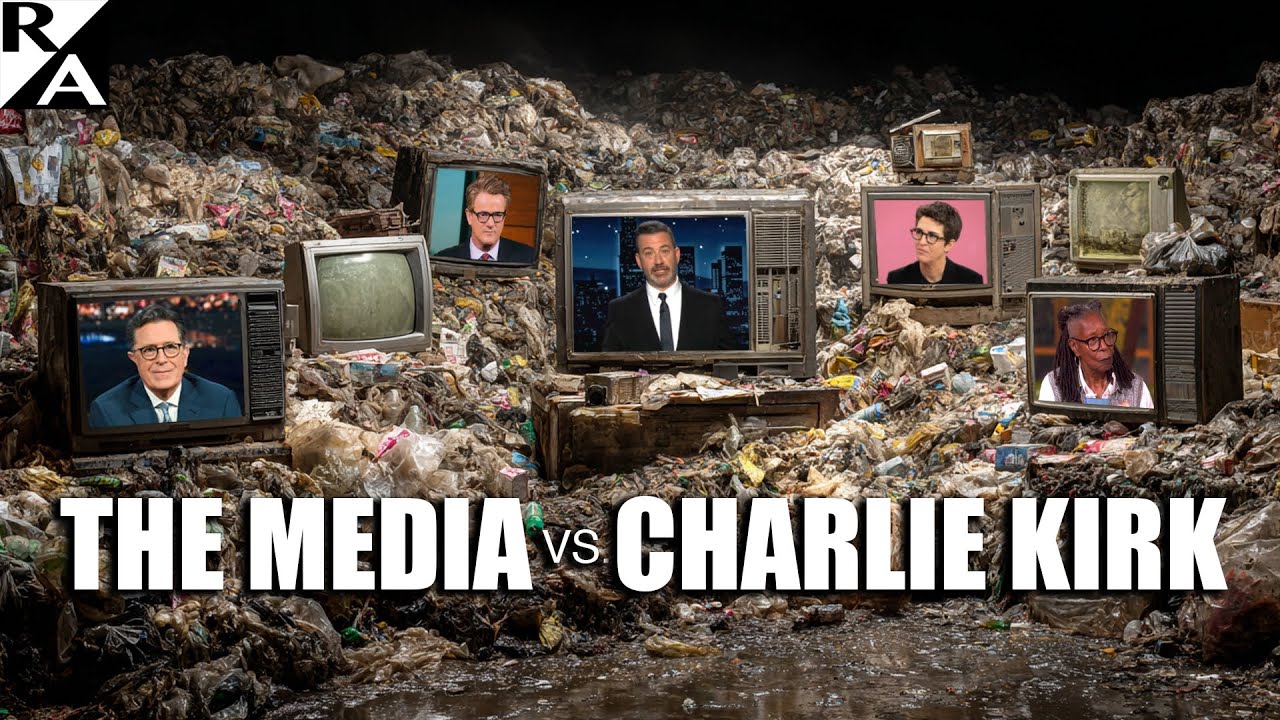
Media Response to Charlie Kirk Death Claims Exposes Ideological Bias and Dangerous Framing Tactics
Enjoying this? Share it with someone who needs to see it.
Up Next
Harvey Levin and TMZ Caught Lying About Employee Reactions to Charlie Kirk Shooting Announcement
11:12
Rainn Wilson Reveals Hollywood Liberals Celebrated Charlie Kirk's Assassination at Memorial Service
36:19
Cam Higby Presses a College Student Who Isn't Sad Charlie Kirk Was Killed Over ICE
6:41
Media Response to Charlie Kirk Death Claims Exposes Ideological Bias and Dangerous Framing Tactics
A media figure's response to reports of Charlie Kirk's death reveals calculated attempts to frame public discourse and character assassination disguised as journalism. The commentary dissects how a broadcaster immediately characterized Kirk negatively while claiming neutrality, selectively quoted his statements out of context, and projected political assassination motives before facts emerged. This analysis exposes the dangerous game of narrative control that occurs when media figures use tragic scenarios to advance ideological positions, demonstrating how selective framing and projection tactics undermine honest public discourse about prominent conservative voices.
In response to false reports circulating about Charlie Kirk's death, one media commentator's approach exposed calculated tactics used to shape public perception. The broadcaster opened by suggesting Kirk was primarily known for "getting owned by young students," immediately establishing a dismissive frame before discussing the supposed tragedy.
"I have been surprised by the scale of the response. I knew the name. I have seen some clips. I wouldn't necessarily have been able to say that is Charlie Kirk. I would have said that is the guy who I have seen getting kind of owned by young students," the commentator stated, revealing an attempt to minimize Kirk's influence and credibility from the outset.
Selective Quotation and Context Removal
The broadcaster repeatedly referenced controversial statements allegedly made by Kirk but refused to read actual quotes or provide context. Looking down at prepared notes while claiming to speak "off the top of my head," the commentator mentioned "pronouncements" regarding "homosexuality and black women's intelligence" without offering viewers the actual statements or surrounding context.
This tactic allowed for character assassination while maintaining plausible deniability. When discussing Kirk's comments about gun laws and freedom having consequences, the broadcaster's guest stripped away the fuller philosophical point Kirk was making about imperfect systems, similar to Winston Churchill's observation that "democracy is the worst form of government except for all the others."
The Projection Game
Multiple listeners called out the commentator's apparent pleasure in discussing the supposed tragedy, leading to a revealing defensive response. The broadcaster accused these listeners of "projection," suggesting they were exposing how they would feel if someone they disagreed with politically were killed.
One listener, Angela, directly challenged the approach: "If you were shot dead, presumably for your political views, would you want a right-wing American radio talk show host to ask Americans to ring in with their opinions of your views and paraphrase what you have said? It is just wrong. Stop it."
The commentator dismissed such criticism while simultaneously acknowledging the scenario as a "political assassination" despite repeatedly claiming uncertainty about motives.
The Contradictory Stance on Certainty
Throughout the discussion, the broadcaster maintained two contradictory positions: insisting that no one could know what happened or why, while simultaneously spending extensive time highlighting negative characterizations of Kirk's public statements.
"Why has this apparent assassination stopped the traffic on this side of the Atlantic and beyond?" the commentator asked, using language that revealed assumed conclusions while maintaining a facade of responsible journalism by not "drawing any conclusions."
The broadcaster criticized others for "expressing absolute certainty of what this represents" while being "bombarded from all sides by people who haven't got a Scooby-Doo what happened or who did it or why." Yet the entire program was structured around the premise of political motivation.
The Slip: Revealing True Assumptions
Despite protestations of uncertainty, the commentator eventually revealed his actual beliefs about the scenario. "Indeed, even try and turn it into some opportunity to attack the left, some of whom, the idiots, will not be offering unequivocal condemnation and sympathy for an act of political violence for a political assassination," he stated, explicitly calling it a "political assassination" after spending the entire program claiming such conclusions were premature.
Response and Call to Action
The analysis of this media response concluded with recognition that Kirk's work occurred in spaces where open discourse should be protected. "There's something very disturbing about the fact that he died on a college campus where these kind of conversations and thinking should be occurring," one observer noted.
The call to action emphasized that everyday people must step forward to continue conversations that public figures like Kirk have championed. "What we need next is for people without followings that are not public figures to step up and continue on, for the secret scholars to no longer be secret to have the conversations. If everyday people step up, they can't stop that."