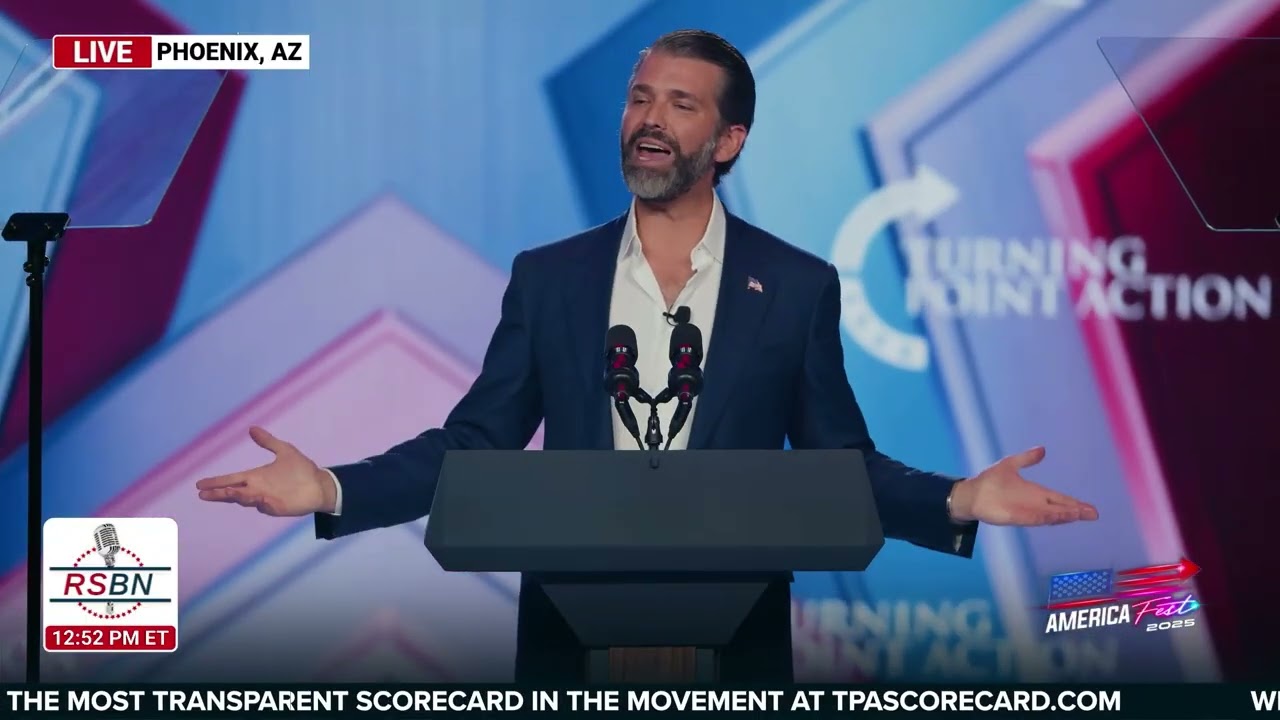
[music] [cheering] We are at Ampfest. Merry Christmas to you. [cheering] Praise the Lord. I I got to tell you, I did not anticipate being between Ben Shapiro and Tucker Carlson at a moment WHERE THAT DON'T SEEM LIKE A GOOD POSITION TO BE. OH MAN, I'M SO LUCKY THAT I'VE GOT JESUS. I'M SO BLESSED THAT I'VE GOT JESUS. I'm so glad that I'm not responsible for this myself. I'm here to love you. I'M HERE TO, AS BEST AS I CAN, IN MY CRAZY little accent, tell you that my life has been irrevocably changed, revolutionarily changed, inconceivably altered by the power of Christ Jesus. I want to share that with you. DO YOU KNOW WHY I'M HERE? [cheering] I better pray first in case I mess up. You know me, I'm done. Heavenly Father, would you guide my mouth? Would you guard my lips? Oh Lord, I bend my knee and my tongue will serve you, heavenly father, and no other. Thank you Lord for your son Jesus Christ who died that we may know eternal life but may we know eternity here in this moment Lord. There is no statute of limitations on love thy neighbor. The whole world is our neighbor. We were intended to be one family. Heavenly Father, you gave your life. You gave your blood. And may the covenant of your blood cover us all. I pray father for the eternal soul of Charlie Kirk. I thank you for his sacrifice. And I thank you Lord that we have this opportunity to be here in unity, the opportunity for true unity, the opportunity for community, the opportunity to be different. Lord, I thank you, heavenly father, for Erica Kirk's boldness and her bravery and for her example of forgiveness. And surely if she can forgive the people of the man responsible Lord for the murder of her husband. Surely this principle of forgiveness is something that we can all extend. Lord may we know your grace. May we live in your grace and particularly when it's expensive to us when it costs us something. May we enter into your kingdom, a kingdom of love. May we put aside petty squables and disputes, Lord, and may we move into a new era of grace in your glory. I pray for the kingdoms to merge. I pray for your return. I pray that we participate in making straight the paths. In the holy name of Jesus Christ, I pray. Amen. >> Hey, I WANT TO TALK TO YOU ABOUT CHANGE AND I WANT TO TALK TO YOU ABOUT AUTHORITY. I've had an unusual life. I used to be a Hollywood I don't say Hollywood movie stuff. I was starred in some movies. You know, if I'd have been between Tucker Carlson and Ben Shapiro like 10 years ago, MAN, I CAN'T IMAGINE WHAT THOSE CIRCUMSTANCES WOULD HAVE BEEN. MAYBE A DIDDY PARTY. Oh Lord, we are all compromised. We are all broken. I'm here to share with you from my position of brokenness. I'm here to share with you that I am inspired by Charlie Kirk's legacy and his example. I'm here because Charlie Kirk asked me to come here. Charlie Kirk's not with us anymore. So unless Erica Kirk asked me to do some stuff with Turning Point in the future, I'll never be at a turning point again because for me, Turning Point, if it means anything, it means turning away and it means turning in the right direction. Repentance. Repent. [applause] Turn away from the illusion of worldliness, FROM ITS FIXATIONS AND FASCINATIONS, its hypnosis. I know about carnality. I got to tell you, I lived a dumb hedonic Hollywood life. To go from a Hollywood headiness to a Bible believing Christian is a big journey. But we've got a lot of big journeys ahead of us. A lot of radical change. I didn't think it was possible to be changed in the way that I've been changed. I thought it was inconceivable, unimaginable. Before turning to Christ, I suppose the biggest change that I'd ever known was the change from well, I suppose before being a parent to becoming a parent. That's pretty radical change. Certainly, it's a radical change in terms of the person that you say you'll be as a parent before you have kids and then the person you are when your kids show up. Cuz before I had kids, this is me. I was when I have children. I'm telling you now, I will not be letting them look at screens or eat sugar or any of that stuff. And actually, parents that do do that, I'd like to judge them. I'd like to judge them and maybe even condemn them. Now I've got three children. I'm like, "Oh my god, give it an iPad in the Dr. Pepper. Will you silence these children? I've changed a lot. I used to be vegan. Now I eat meat. I everything. [cheering] Don't tell me you're more into carnivorism than the incarnation. DON'T TELL ME YOU'RE MORE INTO eating flesh than God became flesh. Don't tell ME YOU'RE MORE ENAMORED of the barbecue sauce than the holy covenant of blood. It is delicious. Man, I missed it. I was vegan for so long. I was so hungry. It was a desperate, desperate time. I can't get enough steaks now. I've tried. I'm doing nothing but devouring them continually. I want to talk to you you lot about the possibility of change and the possibility of transformation. And I was listening to Ben Shapiro and I admire Ben Shapiro a great deal for many things. I think he's an excellent man, an excellent communicator, and I think he's done phenomenal work in a lot of areas. I believe in peace. I believe that Jesus Christ is the Messiah. I believe that he came to atone for our sins, pay the debt that we could never pay. AND INDEED, IF WE'RE GOING TO BE AT A TURNING Point event, WE HAVE TO PAY HOMAGE TO THE SPIRIT of Charlie Kirk in truth and the principles of turning turning point. Unapologetically telling the truth, unapologetic, absolute attempts to understand one another, to communicate openly. And there's clearly a conversation that needs to be had in this country right now. Clearly, there is. Doubtlessly, many people are cynical and skeptical. Turning Point has performed an incredible function in ensuring that young people have access to conservative values and conservative principles. But if you've read that book, if you've read the Bible, you will know that human institutions are fallible, beyond fallible, captured. Now, I've got the Bible with me, so you should know that you're not making the terrible mistake your nation once made of listening to people with this accent, trying to tax you without representation. But there's very little point in you having that magnificent revolution and then falling once more into the traps that had been laid a thousand times. For surely those traps are multitudinous, nefarious, deceptive, and difficult to avoid. There are imprints. The counterfeit systems of centralized control are asserted again and again and again. It is the function of the world to distract you. It is the function of the world to enchant you. It is the measure and means of the evil one to create faximiles of systems of omnipotence, omniscience, and omnipresence. And I tell you this as a proud Englishman from a country where they're introducing facial recognition technology, digital ID, ending trial by jury, incarcerating people for free speech. The United Kingdom is in trouble and we look to you for an example and that example must be transcendent of the political. In short, I can't collapse my love and devotion to Christ Jesus into support of one or any political party. I know that Turning Point's here to advocate primarily for Republicanism. I'm not suggesting they change what they're doing. They're a brilliant organization. I'm telling you that I love Jesus. Jesus. that unless people are following Christ, they will fail you and they will let you down. Now, I happen to think that Trump's performed near miracles in office, as a matter of fact, near miracles because I think he happens to be a pretty obstinate, anomalous, and unique individual. That's what I happen to believe about Donald Trump. Authentic and open, a stumbling block for global imperialism that was on the precipice of total domination. >> [applause] >> But when Donald Trump makes um a post like he made about Rob Reiner, God bless and God rest Rob Reiner's eternal soul, I would say that's further evidence of Trump's lack of filter. Trump makes mistakes. He says things that are regrettable. There's no chance of that with your former president because I don't suppose that all OP pen could handle making exposts. [applause and cheering] Frankly, I'M SURPRISED THAT BIDEN COULD KEEP HOLD OF THAT AUTO pen with Hunter Biden in the household. Surprised he didn't sell it for crack or just directly use it to smoke crack. >> [cheering] >> I see things differently from Ben Shapiro. I GOT TO TELL YOU, whilst I respect him, I respect his faith and I respect that we worship and praise the same God. I recognize that. But I believe it's important and vital to have conversations with people that oppose difficult opinions and opposing opinions. I've spoken to Nick Fuentes. I've spoken to Candace Owens. They're Christians like you and like me. And were they not? They're broken human beings like you, like me, like Ben Shapiro, like Tucker Carlson. No one's better than anyone else. We're all on our knees, shoulder tosh shoulder, under the blood of Christ. And what I would advocate for is supreme compassion for Erica Kirk as a human being, as a woman, as a mother that's lost her husband, as a woman who has to have like I left my kids to come here today, man. Like my little boy who's two. My little boy whose carved heart led me by the hand to Christ. That little boy that I handed over to anthetist. An Hold on a minute. I can do this. Aniththesist. An Someone here with your accent. Aniththeists. An people that Oh, let's just cut this bit. It's not being streamed live, is it? No one cares about this. Everyone's just like, "DID YOU SEE WHAT BEN SHAPIRO SAID ABOUT TUCKER?" And then And THEN TUCKER'S GOING TO OH MY GOD, MAN. OH, MAN. WELL, HONESTLY, I can't believe that Tucker Carlson would have an interview with somebody and not grab them by the throat. Frankly, we're children of God. No one knows anything. You're broken. I'm broken. Ben Shapiro's broken. We're all wrecked and ruined. The reason I love that man, Charlie Cook. I learned to love him more postuously. When I met him a couple of times, I didn't understand what he was. Frankly, he was so bloody tall. I just thought he was a kind of right-wing rain man. But when I told him I was reading Romans, he told me it's the Christian Constitution. And I've returned to that book many times since his sad death with those words in mind. What does he want from us, our Lord? Can Jesus Christ help us to manage the complexity of a domestic culture that sometimes feels like it's on the precipice of ruin, fragmentation, incessant conflration? Of course he can. Can Christ resolve the complexity of the issues in the Middle East? Is it possible to love Jesus Christ? To believe that Israel has a right to a homeland, but to be deeply concerned about events in Gaza and the deaths and the power AND THE MISMATCH? I BELIEVE UNDER CHRIST it is possible. IS IT POSSIBLE TO BE CYNICAL AND HAVE DOUBTS ABOUT THE DEEP STATE? IS IT POSSIBLE TO HAVE QUESTIONS ABOUT PERMANENT GOVERNMENT, GLOBAL BUREAUCRACIES THAT SEEK TO EMULATE God while telling you God's not real? Of course, it's possible. The old model will not work. We are waiting for a new kingdom. The systems will fail you because they are human systems. EVEN ADVANCED TECHNOLOGY will only emulate the counterfeit systems of the fallen one. Indeed, what is Lucifer but an attempt to set up your own kingdom, your own circuit, to not accept the supreme sovereignty of our Lord God? What is it? Now, I didn't just bring this Bible for show. I've actually marked out passages to read you. And I'm going to do that now. Look, I've put little bookmarks in there. Aren't I adorable? Now, just listen to this because I thought a lot about what I wanted to say to you today and why indeed you would listen to me because I'm a person that doesn't like authority. I'm a person that maybe like you woke up to the depth, breadth, and insidiousness of corruption during the COVID pandemic period. I believe many of us recognized that was an attempt to subdue us, to subjugate us, to make us dependent on the state. You can have dependency only on one entity, one deity, one God. I thank the Lord, man, that even before I was saved, my rejection of worldliness as a natural rebel meant I never took that vaccine, not once. >> [applause] >> They played it wrong for me. If they'd really wanted me to take that vaccine, a little bit of reverse psychology probably would have been the best way. The main reason I didn't take it is cuz they told me to. The main reason is is I already know. Don't trust the government. Don't trust big farmer. I know that already from life. I DON'T TRUST THE PEOPLE THAT INDUCE AN opioid crisis when they tell me that it's necessary to take injections. I DON'T TRUST SYSTEMS that require us to be mentally sick, malnourished, dependent on bad food, and bad ideas. I don't trust those systems. If they'd really wanted me to take those vaccines, all they had to do was hide a couple of syringes somewhere in my house and say, "Listen, there's some syringes in here. Under no circumstances are you to touch them or take them." I'LL BE LIKE NINE BOOSTER SHOTS IN WITHIN A WEEK. PERICARDITIS, MYOCARDITIS. JUST HIT ME, BABY. HIT ME. NATURAL IMMUNITY. THE DIVINE POWER of the body. No. The divine power of fizer, the divine power of Merc, the divine power of Madna. And I'm telling you now, I speak to as a visitor and a guest in your magnificent country with the reminder that it was none other than Charlie Kirk that said, "Your constitution was written, he believes, to be practiced by a Christian nation." That if you don't have Christianity as an accompaniment to the Constitution, you'll get corruption. But don't take my word for it. Here we go. First up, Luke 4:6. The world is run by dark, nefarious forces. You know, when we I've not been Christian very long, but what's been so exciting about it, this is my first Christian Christmas as I had one last year, but this year I feel it, man. I feel the advent. I feel him. I feel the coming of the light. I know that in the dark, low places of your life, in the manger of your life, that is where the king will come. If you're suffering now, if you're suffering today, if you feel at a loss, if you feel broken, if you feel that all around you is Babylon babel, brokenness and fallen, fragmented communication, I'm here to tell you that he is coming. He is coming in your life. He is here now. We worship the living God. The gift of the Holy Spirit, the down payment is in us now. I feel it in this room. I'm not pretending. Christ is real. The Holy Spirit is real. Yield to no human power. Yield to no human power. Don't trust them. Get used to disobeying authority. Man, even before I found the Lord or the Lord found me. Or is such subjectivity even possible in the transcendent ahistoric a manifest world of our holy one? Who knows? Not me. But I'll tell you, I never like being told what to do. I've never trusted authority. It makes me a bad driver. I'll tell you that. cuz I think you know like all right for example stop signs or traffic lights these are perfectly reasonable systems in the event of an evident contra flow of traffic if there's a red traffic light and there's a car coming he wins I get the game I get red the color of blood the color of fire I get it but in the event that it's the middle of the night and there's a red traffic light I'M TAKING MY FREEDOM AS AN AMERICAN Because the world has been captured by evil and they're training you to be obedient. Anarchist calisthenics. I call it anarchist calisthenics. Break rules every day just to remind yourself you can bow down to the only true authority. Not to made up phony authorities turn up here telling us what to do. Because here, this is Luke 4. Luke 4:6. The temptations of our Lord and Savior Christ Jesus. This is the devil talking right now. I mean, when I read it, not me. I am saved. Although, this shirt's pretty diabolical, baby. Hey, my wife got me this shirt. I love my wife. Oh, man. My ex-wife's parents are here. They're Christians and I love them. I love Mary Perry. God bless you. Thank you for bringing the message to me. I got to say though, look, Katy Perry, I was married to her. I love her still, and I'm glad that her mom's in the room hearing me say this. But look, I was okay with Orlando Bloom. But Justin Trudeau, come on, man. DON'T PUT ME IN A CATEGORY WITH THAT GUY. that globalist stoogge. All right. Praise Jesus. Come on, kids. God's real, right? So, listen. This is the second temptation as Luke renders it. And what does Satan, the tempter, say to our Lord? Check this stuff. I will give you Oh, man. Oh, no. This is really good actually. Check this out for a moment. Like the Christ I love is the psychedelic Christ. The transcendent yet imminent Christ. The Christ that's beyond reason. The Christ beyond what's able to be known or understood. When they say you will know a peace that passeth all understanding, it doesn't mean a really complex or a really big bit of peace. It means it's beyond the rational mind. It's beyond enlightenment values. It takes humankind and puts us in our rightful place. We are subjects. We are agents. We are not the principle. We are not gods. We are not kings. As soon as people start using reason to determine morality, guess what they reason? They reason their right. That's what they reason. A peace that passes all understanding means you will know great peace when you transcend the realm of that which can be measured. He is beyond that. And note in Luke, the devil led him up to a high place, an absolute pinnacle. I see that as and showed him in an instant all the kingdoms of the world. In an instant, it was outside of time. It was ate temporal. Of course, a battle between good and evil personified will take place outside of time. And he said to him, I will give you authority over all the kingdoms of the world, all of their splendor. It has been given to me and I can give it to anyone I want to. If you worship me, it will be yours. Now, our Lord Jesus doesn't say, "You're not in charge of the world." That's ridiculous. He says, "Yeah, I get it, Matt. We don't I'm not going to paraphrase Jesus. I'm not there yet." But Jesus answered, "It is written, worship the Lord your God and serve him only." He recognized that the prince of this world is the fallen one. Next time you're asking yourself, why is the world like this? Why is there so much confusion and miscommunication and doubt and war and hatred and pain and suffering? It's because the evil one is in charge. Luke 10:18. Now, I love this because when you found the Lord and when the Lord finds you, you might get a little bit lit up. You can see it in me, can you? I'm all excited. But in the past, I had a tendency to make it about myself. You know, I used to think I was quite important. I'm not important. It's irrelevant. It's irrelevant. There's nothing to attain but him, his glory, his grace. Now after our Lord has given them the commission to go out and heal, this happens. Luke 10:17, the 72 disciples, you know, cuz it was the whole crew returned with joy and said, "Lord, even the demons submit to us in your name." Jesus replies, "I saw Satan fall like lightning from heaven. I have given you authority to trample on snakes and scorpions and to overcome all the power of the enemy. Nothing will harm you. However, do not rejoice that the spirits submit to you, but rejoice that your names are written in heaven. Why does our Lord mention seeing the fall of Satan in a moment of hubristic glee of the returning disciples? I'd be pretty excited if I just cast out demons. I'd be pretty excited if I conducted miraculous healing. And precisely this excitement, this personalized egoic to use a contemporaneous word, individualized sense of pride is what our Lord strongly counsels against. Because as an amporal being that was there when the spirit passed over the water, the word, the logos, the word made flesh was there when Satan fell. And what is Satan's sin? He wants his own kingdom. He wants his own principality. I bid you turning point American fest this Christmas to consider the neurological corollery the circuitry in the sinapses when you're trapped in self only he can break you out of the false garden only he may return us to the new merged kingdom he saw the inception of the tendency to individuate your will to replace God's will with your own will [laughter] and in with a beautiful synchronous glorious symphonic and educating moment for me. It says here, please transition to questions with Job Bob. Now, in the absence of actual Jesus Christ in the incarnate form, if you get a message saying bring Joob on the stage, and you've just said you believe in Jesus, then you better bloody well bring Joob on the stage cuz otherwise you're caught in self-will. Now, allow me just to say this one more thing. There are two quotes I want to give you. One is from the British writer GK Chester and who is credited with bringing CS Lewis, that other great British writer to the Lord. He said, "Christianity has not been tried and found wanting. It has been found difficult and left untried. We have not yet tried to create the Christian nation that America may yet become. As an Englishman, as a visitor, I pray that you're able to do it. I pray that you can build a Christian America to be a shining city on a hill, an exemplar for the rest of the world. I pray that in the name of the son, the father, and the holy spirit. And [cheering and applause] if Chesterton IS TOO HIGH FOR lutin for you, let me quote that great American Rocky Balboa [cheering] played by the immeasurably beautiful and brilliant Sylvester Stallone who in Ricky not Ricky for I nearly cursed it in the first time. who at the end of Rocky 4 says, "If I can change and you can change, maybe the whole world can change. Somewhere between Chesterton and Rocky are our solutions." Thank you for having me, Amfest. AND PLEASE WELCOME TO THE STAGE, JOE. [cheering and applause] [music] OH, NO. You're good. >> All right. What is going on, Amfest? [cheering] >> Guys, Russell Brand is right here. We can do better than that. What is going on, AMFEST? >> SO, if you don't know who I am, my name is Joe Bob. I'm a comedian. I also host the show Turning Point Tonight on Real America's Voice. Uh, I actually got to do, I'm not sure if you know this, I got to tour the better part of the last three years with Charlie as an opening act. And a lot of people didn't quite understand why Charlie was bringing a comedian on the road with him. But I think it's because Charlie understood the power of humor in the mind in changing the minds, the hearts and minds of especially young people. Um, and so with that they, this is either a good or bad idea. They let me curate some questions from our students as a comedian. My first response to your point about humor is CS Lewis says that the connection between the holy and humility is humor. We must be able to laugh. Otherwise, how I'm English. How am I going to cope with the embarrassment of knowing, you know, I know Candace Owens. I believe her to be a good person. Erica Kirk deserves love and respect and reverence as a grieving widow and endless compassion. I know Tucker Carson. He's my friend. I love him. Ben Shapiro, I respect him a great deal. I don't know him like super well. But I'm English. I could explode with embarrassment without a sense of humor just from the stuff that's happened in this room already tonight. And what we have to find is a kind of unity not only among conservative pundits, but between Americans everywhere, Republicans and Democrats. These phony false labels, these fake taxonomies have to be put aside if you are going to save your country and the world. And one way to do that might be by laughing about it. I hope so. Otherwise, I'm out of a job. >> Well, this this question is for me cuz you you had brought it up. Uh, your ex-wife is now dating a guy who should be deported, Justin Trudeau. Do you think the way that you've turned out, she actually might be the catalyst for people becoming superbased? You think that Katy Perry, well, she's a Firstly, I would say this. Her mother is in the room and I've remained good friends with her father and Katy Perry. Yes, Mary Perry. Praise Jesus. Uh, I got nothing but good things to say about Katy Perry or indeed anybody. Justin Trudeau on the other hand. Oh man. Like look, we the biggest threat to our society are political leaders that have no authentic power that seem to be operating on behalf of global bureaucracies that seem to get kind of auditioned into political power. We have it in my country. We have it in France. We have it everywhere. We know these are not real political leaders and real political figures. You can see it by looking at them. They are working. They are it's the operatives of deeper interest, shall we say, whether that's the WEF or the WHO or something more occult that I don't understand. All I've noticed about what I will say, look, I'd like to be positive and forgiving and loving. It is a message of forgiveness and loving that that I'm here to share. And I will say he's got a nice haircut. >> Black up less, black up less, hairdressers more. So, our first student create curated question and I I'm kind of hoping this doesn't take the whole time because I do think it's interesting. >> Got to talk quick. >> No, no, no. I can speak quicker than this. I'm slowing myself down. >> Because I do think it's it's fun and interesting. Uh Mark had asked, >> "Do you think Jesus had a sense of humor?" >> Yeah, he does. He look how he treats them idiots like you know the disciples. Oh my god, have you NOT UNDERSTOOD YET? WAKE UP. WHY ARE YOU GOING TO SLEEP FOR? I only told you to keep watch for an hour. No, you can't be foreign secretary and home secretary of heaven. It doesn't work like that. John and James, he's double patient with them idiots, you know. And every single one of them become saints. That's why I love him. He's here now. But they were like, like, now listen, I used to want to like the reason I couldn't worship Jesus before is cuz I wanted to be him. Now I accept the ridiculousness of that. I can't even cope with looking after my own pets and children. But no, no, I'm still going to go for John the Baptist or St. Paul or one of the lesser disciples, not Judas. That guy, he was out of control. >> So, obviously, you're you're an artist and you've been in the creative world for your entire working career. Uh, conservatives have unfortunately lost a lot of ground in the creative space. Uh, this this question came from Lee at Florida GF Coast. How do conservatives reclaim the arts, movie, TV? Uh, realistically, the question I think says, how does realism reclaim the arts? >> Well, you know, I mean, I should answer this is Jordan Peterson. It isn't obvious to me at all that there's such a thing as conservative art, buckho. I would say um what I would say is the the values of conservatism, preservation, traditionalism, individual freedom, family, these are beautiful values. I would not myself claim to be a conservative person. I believe in freedom. I believe in your freedom. I believe in my freedom. And I believe that art rightly undertaken is a way of worshiping, revering and demonstrating God's glory. As Eric Little, the Scottish runner said, "When I run, I feel God's joy." Now, we should be in all of our endeavors, whatever we do, doing it with love, not just creativity, painting pictures, singing songs, all of that. I know people that are working in sort of industries of engineering and mechanics. I'm thinking of my neighbor chance when he mends things, when he repairs things, there's such reverence and love for God in the way that he works. Do everything for God. Like brother Lawrence, the 16th century French monk. And bearing in mind this guy's French, so come on. I'm English so I'm allowed to dislike and indeed do No, I love the French. How can you dislike anyone? He says, "I flip my little omelette in the pan for you, Lord." And he says, "I live as if only you and I were the only things in the world." As if God and you are the only things in the world. That means every encounter you have, every conversation you have is an encounter with God. Me and Joe, Bob, the Lord talking to the Lord. So conservative values are secondary to me to Christian values. And I cannot collapse my Christianity into anything other than devotion to Christ Jesus. [applause] This one's comes from Bod at Montana State. >> You look lovely, by the way, and you're doing a good job. I like your earrings. I love your haircut. And I see why Charlie liked you. You're a good man. Lovely nashes. Good set of teeth. Lovely railings. We'd say in the UK. Lovely set of railings. You're gorgeous. You're a married man. Are you? >> Yes, sir. >> Yeah. Me, too. I wasn't coming on here. I steady. >> I was going to say I I'd like to think the fact that Charlie liked me, not for my looks necessarily, >> may not have been the looks. Yeah, I don't think he was tuned into that sort of thing, was he? Like what I mostly he liked loggers. That's what I remember when I last spoke to Charlie Kirk. A time that I now cherish. Of course, he seemed so in his brilliant intellect, so brilliant in the word, so compassionate in his conversations with people that were different is astonishing that anyone could muster up hatred for him. But this is the world that we live in now. um to move on. Bod from Montana State says, "Over the last year, have you seen any positive changes in Hollywood and in your profession with actors who are more open as you've become?" Mate, I've got to tell you, I'm not in Hollywood. I couldn't be further from Hollywood. I'll never be in Hollywood again. I'm not interested in the arts of deception and false illusion and false idols and celebrity. I'm not in Hollywood. I'm not judging people that are like, you know, someone like Chris Pratt who's all magnificent and able to share the word so beautifully. I'm just saying that for me, the experiences I've had. I I can't do it. I can't be around all that because not because I think that I'm a good person, but because I know how fallen and how broken I am. I'm not good with too much stimulation, too much temptation, too much invitation into object objectifying people or worshiping money. I'm too weak. I'm too vulnerable. Unless the Lord is in me, I'm in serious trouble. Hey, but I will tell you that um this week I'm 23 years clean and sober from drugs and alcohol, one day at a time. [cheering] [applause] And when you unplug from addiction, whatever that addiction is, you have the opportunity to plug into the true source of all power. It took me 20 years. I'm a slow learner. But like once you unplug from addiction or selfobsession, although you know I still have that a bit of course. I you are able to receive the true grace, the living water, the holy flow like golden honey pouring forth from your belly. Living springs of wonder and glory in all of us. in all of us, in you. Especially you, Joe Bob. I reckon that's what old Charlie Kirk likes about you. The flowing golden honey from the midriff. >> I can promise you that is not the case. [laughter] >> I'm speaking metaphorically. Joe Bob. Well, I guess to kind of follow up on that personally, what are some practical advice that you might have to somebody who is struggling not necessarily in the realm of Hollywood, but with, you know, addiction and all of this sort of stuff that you've been able to overcome? >> So, glad you asked me that. I know the answer to this. If you are suffering from addiction, it means that it's some things. It is a form of force idolatry. You are blessed. If you are addicted to drugs or alcohol, you are blessed because it's it initiates abstinence. And once you understand abstinence, cutting off from drugs and alcohol, which is difficult and you won't be able to do it without support, the support of other human beings and the support of initially a god of your understanding. But my prayer would be that that would ultimately become Jesus Christ. You once you begin to realize that what you've been doing is worshiping. It is worship. You worship yourself like as like like the verse I cited when Satan falls from heaven he wants to establish his own circuit. Drugs and alcohol are an attempt to sort of foreclose against reality. Is a kind of a peculiar form of self- worship. Now when you stop drinking and taking drugs it is anguish, it is agony and it is despair. But in that despair and anguish, you can, as I said with the Christmas story, when you are down among the animals, when you are broken, when you are lost, that is when you will find him. That is when he will come to you. You are blessed if you have an addiction issue. You need to get the support of 12step fellowships that are remarkable and incredible. And it's the one thing actually, Joe, Bob, even though I've spoken for quite a long time now, that I actually can help people with. So, if you do have addiction issues, tell me. Find me on the way out. I'll baptize you right now on the way out of here and I'll help you one day at a time to find the support that you need. I can do that for you. I'll sit somewhere. Will I or will I be like trying to stop Ben Shapiro and Tucker Carlson having a nerd fight. Now listen, I will give you such a duff. Oh my god. Honestly, like uh Jake Paul, Anthony Joshua, pay-per-view, Ben Shapiro, Tucker Carson. Oh man. Yeah. If you're a drug addict or an alcoholic, I can uh by his grace, I can help you the way I was helped. the way I was helped. >> You know, as a guy that makes his living being able to say what he wants to say, in your opinion, what is the biggest threat to free speech right now, in the talking space, but also in the entertainment and arts space? Well, I suppose the reason I'm grateful for Ben Shapiro this evening is because one of the great threats is that people don't have the courage and confidence to disagree with one another openly and plainly. That is a great threat. But the single greatest threat to all of our freedom is that there is indeed a global agenda to centralize authority and control. Now whether or not there are occultist dimensions to that is difficult to corroborate but you can observe the trend and the trend is to induce successive crisis to legitimize government overreach. That's the trend. It began with the Patriot Act in your country I think or at least it was exaggerated. The 2008 crash didn't help us none and the sad demise of the Occupy movement that could have been a kind of cross party alliance. What I would say is the biggest threat to free speech is people using compassion to legitimize control. This is what happens when you extract Christ's kindness from the public conversation. You somehow have to embolden some phony state to practice compassion. The government cannot be at the heart of our culture. The government are merely administrators. The church is the heart of our culture. The church is the heart of our community. >> [applause] >> So the biggest threat of globalism and a globally centralized media which is collapsing but there will be attempts to manage and manipulate independent media. We're already in that phase >> out of curiosity when you look at the Bible what are you reading right now? >> Right now I'm looking at Romans because of that time because this is to honor Charlie Kirk this whole thing isn't it? That's why we're here. And I really want to honor him by being funny and by being silly. Um like cuz when I met that time at the RNC Milwaukee, which is the time when he said Romans is the Christian Constitution, I was where with Dan Bonino. Whatever happened to that guy? I was there with Dan Bonino and uh and God bless you Dan Bonino. I was here with um I was with Dan Bonino and Charlie Kirk and I was sort of teasing Charlie Kirk and I couldn't tell whether or not that he if he knew that when I torment people, it's my way of sort of showing love. And I was fascinated by his intelligence. And I've become subsequently obviously more fascinated by his vast abilities, his ability to render complex information, to align Christian principles with American political. I mean, what a skill set. What an unbelievable man he was. God rest his eternal soul. The reason what I'm looking at at the moment right now is this from Romans. Cuz I was thinking, you know, you're coming here, you're coming to Amfest, you're going to be talking a bunch. You'll be putting out fires between Nick Fuentes and Candace Owens and Ben Shapiro and Tucker Carlson. You'll be advocating for love everywhere you go. What have you got in Romans? What Charlie Kirk told you to look at that's going to be of any use. And it says this, this is Romans 13:11. Now, earlier in Romans 13, there does seem to be advocacy for human governmental authority, right? But I will remind you that Paul wrote that while in prison. So, if he was super into human governmental authority, what what was he doing in jail? Just a quick, you know, just something to consider cuz I'll tell you why I say that. Cuz I don't like the idea that we're meant to sub submit to human authority unless it's backed by the Lord. Cuz I don't trust human authority. I don't trust them. I'll never trust them. That's part of my little message. Anyway, it says here, "And do this understanding the present time, the hour has already come for you to wake up from your slumber, because our salvation is nearer now than when we first believed. The night is nearly over. The day is almost here. So, let us put aside the deeds of darkness and put on the armor of light. Let us behave decently as in the daytime, not in carusing and drunkenness, not in sexual immorality and debauchery, not in dissension and jealousy. Rather, clothe yourself with the Lord Jesus Christ and do not think about how to gratify the desires of the flesh. I like that we must awaken now. That's what I like [applause and cheering] in kind of the the brief remaining time. What where do you see the culture going forward from here? >> Well, the truth is I don't see anything because I'm very very limited. But what I would suggest is that if we do not embrace the principles of decentralization and subsidiarity, we're going to encounter extraordinary trouble. the trend due to technology as Breitbart said who's let's face it a person who understands culture that and as uh Ben Shapiro has said many times politics is downstream of culture but all of this phenomena are downstream of technology now the only thing that's upstream of any of that is our divine and holy omnipotent creator the technology empowers and facilitates mass decentralization a few years ago 5 years ago 10 years ago you wouldn't have whether you like them or not a Nick Fuentes or a Candace Owens or a Russell Brand or a Charlie Kirk because the technology facilitated mass communication. It's my strong belief that centralized authority who were attempting to use this very technology for surveillance and control didn't anticipate the degree to which it will be used to create mass-free speech and fragmenting and fracturing political movements. There was a legitimate reason when your country was established to have strong centralized government that was representative. That need becomes less and less with every passing day. The principle should be maximum individual sovereignty, maximum family sovereignty, maximum community democracy. Wherever possible, people should be in control of their own resources, their own lives under God. We should eat food that we have grown, reared, or hunted that's near to where we live. And we should at once oppose ourselves against these centralized and centralizing industries. Big food, big farmer, big agriculture before the advent of AI, that dark beast slouching towards Bethlehem, is used to facilitate centralization to a terrifying degree. The very technology that may enslave us could liberate us. If only, as it says in Romans, we are willing to awaken. If you, in particular, the United States of America, are willing to do the hard work of having the difficult conversations that are necessary, of affording a place at the table for your enemies, of breaking bread with people you disagree with, whether I've been glib and flippant about Justin Trudeau. He's a child of God. He deserves love and he deserves respect and he deserves happiness. And I pray for that for him. I pray for it for all of you. As long as we're picking favorites, we're not acting like our Lord, for he has no favorites. He loves us all. We are fearfully and wonderfully made from the womb, from the moment of inception. God loves us. God loves us. We must love him as he has loved us. If that means to the point of death, then it must be to the point of death. And my admiration for Charlie Kirk, in spite of the myriad ways that I could pick out of the air to disagree with the man, God rest his eternal soul, is that I strongly believe that Charlie Kirk, had he known that doing what he did for a living and for a vocation, would cost him his life and leave his beautiful wife Erica a widow, I believe he would have done it anyway. And it is that that I admire above all else. And it is that that I would seek to emulate. And all of us are capable of learning from his example and emulating him. >> Ladies and gentlemen, Russell Brand. Let's hear for him. Oh, sweet. Thank you. Thank you. Appreciate it.