Senator Markwayne Mullin on How Charlie Kirk Changed Gen Z and Transformed Republican Politics Forever
Enjoying this? Share it with someone who needs to see it.
Up Next
Congressional Tribute to Charlie Kirk After Tragic Death Delivered on House Floor by Mike Johnson
7:17
Tulsi Gabbard Honors Charlie Kirk After Assassination: A Champion of Freedom Who Lived What He Preached
7:31
High School Senior Gregory Honors Charlie Kirk's Legacy After Conservative Leader's Tragic Death
6:10
Senator Markwayne Mullin on How Charlie Kirk Changed Gen Z and Transformed Republican Politics Forever
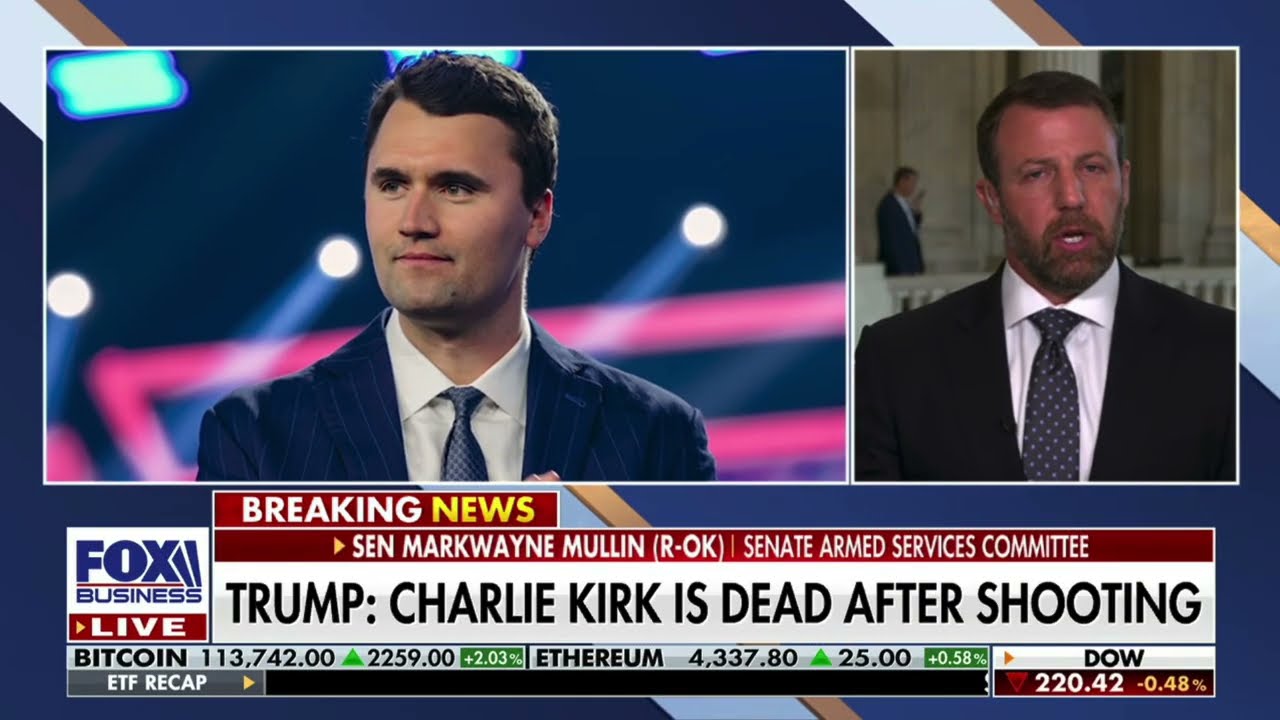
Senator Markwayne Mullin reflects on Charlie Kirk's profound impact on American politics and faith. Kirk started Turning Point USA at 18 and spent just 31 years changing how an entire generation thinks about Christian values, political debate, and civic engagement. Mullin explains how Kirk brought respectful conversation to hostile college campuses, intertwined evangelical Christianity with the Republican party, and inspired dozens of senators and cabinet members. Speaking from Kirk's memorial service at Cardinal Stadium, Mullin addresses the sharp political divide revealed when 118 Democrats refused to support a resolution condemning Kirk's assassination.
Senator Markwayne Mullin of Oklahoma shared a powerful perspective on Charlie Kirk's legacy, recalling a text message from his own mother that captured the essence of Kirk's brief but transformative life. "His spirit must have known he had a short time in life because he only had 31 years," she wrote. "And the impact he made."
That impact began when Kirk was just 18 years old, founding Turning Point USA and embarking on a mission that would reshape American politics. By his early twenties, Kirk had become a figure that dozens of senators, members of Congress, and cabinet secretaries would credit with launching their political careers.
Taking the Conversation Where Politicians Wouldn't Go
What made Kirk unique, according to Mullin, was his willingness to combine Christian faith, traditional values, and political views, then take that message directly to college campuses where politicians typically feared to tread. "He changed the mindset," Mullin explained. "He let people think about, hey, it's okay to be a Christian. It's okay to support those values. It's okay to speak about it. It's okay to have differences. And it's okay to have open debate."
Kirk ventured into spaces where he wasn't welcome, engaging in respectful, thoughtful, aggressive debate without being disagreeable. He didn't rely on violence, hatred, or catchy phrases designed to rile people up. Instead, he spoke with knowledge, belief, and compassion about topics he deeply understood—from the Constitution and the Federalist Papers to the Christian faith of America's founding fathers.
The Republican Party and Evangelical Christianity Fully Intertwined
The memorial service itself demonstrated Kirk's lasting influence on American political culture. Mullin described the scene at Cardinal Stadium as unprecedented: "You have cabinet members. You have the vice president. You have the president. You have no telling how many members of Congress. You have the entire cabinet here. And yet we're having praise and worship going on."
This fusion of political power and Christian worship represented something new in American politics. "The Republican party and now the evangelical Christian community are now fully intertwined," Mullin observed. "And Charlie's the one that brought it together. I truly do believe that. Charlie's the one that actually started talking openly about it" at just 25 or 26 years old—though he had begun his work even earlier, at 18.
Changing Future Generations, Not Just Current Politicians
Mullin argued that Kirk's true legacy wasn't necessarily in changing current elected officials, but in transforming future politicians and entire generations. "Gen Z has changed because of Charlie Kirk. Gen X has changed because of Charlie Kirk. Campuses, school campuses, college campuses have changed. London is starting to change. South Korea is starting to change because Charlie Kirk brought conversation."
Kirk won over hearts and minds through articulation and passion rather than manipulation or inflammatory rhetoric. He spoke biblical truth, love, compassion, and the history of American founding principles in ways that resonated with young people searching for meaning and direction.
The Political Divide Revealed
The memorial service took place amid compressed time and flattened history, with comparisons being made to the assassination of Martin Luther King, the murder of George Floyd, and the Me Too movement. But perhaps the most revealing moment came in the political response to Kirk's death.
Mullin pointed to a stark contrast in congressional responses. When Minnesota state representative Melissa Hortman was assassinated, every Republican voted for a resolution condemning the act. When Republicans introduced an identical resolution for Charlie Kirk, the response was dramatically different. "You had 58 Democrats vote no. You had 38 vote present and 22 refuse to vote," Mullin reported. "That means you basically had 118 Democrats vote no."
For Mullin, this wasn't a failure on the Republican side to reach across the aisle—it was evidence of a fundamental problem on the other side. "I'm sorry. They got a problem. We don't. And I mean that sincerely. They've got a problem when they still can't recognize it."
A Call for Conversation Over Violence
Despite the political tensions, Mullin emphasized that Kirk's approach had always been about dialogue. "I can agree to disagree with anybody," Mullin said. "I have been in very interesting situations that when the fight's over, we can still be friends. That's why I have friends on both sides of the aisle, but they have to be willing to come to the table."
The challenge now, Mullin suggested, is for others to adopt Kirk's willingness to engage in good faith. Kirk was silenced not because he spread hate, but because "he spoke the truth. He spoke the biblical truth. He spoke about the love. He spoke about compassion."
We Are All Charlie
Throughout the interview, signs reading "We Are All Charlie" were visible in the crowd. The sentiment captured why thousands had traveled to Cardinal Stadium, with twice as many people outside as inside, forcing even US senators to walk nearly a mile to reach the venue.
People felt that Kirk had given them a voice and served as their champion. The service itself, described by Mullin as something that "should be in my church right now," represented a cultural moment where faith, politics, and collective grief intersected in ways rarely seen in American public life.
As Mullin concluded, he suspected the memorial would focus not on anger but on love—a fitting tribute to someone who had spent his short life demonstrating that conviction and compassion could coexist, and that respectful debate could change minds and hearts across generations and even around the world.