
Subjective Opinions vs. Objective Truth and Abortion
The debate began with a fundamental question about the nature of truth and opinion:
"One thing I want to start off with is why does your opinion trump over any other people's opinion? Do you believe that there is a truth out there?"
Kirk responded: "Everything is subjective, but there is a right or wrong morally, especially when you're in a cultured society that is based off a set of standards and norms that we act on."
When challenged on whether everything is subjective, Kirk pointed out: "Is it objectively true you and I are having a conversation right now? Yes. So that's not subjective then. So not everything is subjective."
The conversation quickly shifted to abortion, with Kirk asking, "Is murder wrong?" When the student agreed it was, Kirk replied, "Well then abortion should be [wrong]."
This led to a debate about what constitutes a human. The student defined a human as "someone with a consciousness who is alive in this world," while Kirk argued that humanity begins at "the creation of DNA that will never exist again and a soul goes into that moment."
When questioned about race and privilege, Kirk challenged the relevance of race to truth: "What does being black have to do with truth?" He went on to discuss affirmative action, which he described as "racism against white people and Asians as well."
On abortion statistics, Kirk claimed: "There are over a million abortions every year and there's twice as many people on the adoption waiting list." He argued that "there's really no such thing currently... of an unwanted child."
When asked if he considered abortion to be murder, Kirk replied: "Oh of course, 100%." However, he expressed a nuanced view about legal consequences, stating: "The women are victims... they are not given what is called informed consent... they should not be penalized."
Kirk described abortion in graphic terms, claiming babies "fight," "struggle," and "dodge" during the procedure, and argued that women are not properly informed about what happens during an abortion.
Race, Racism, and Crime
A significant portion of the debate focused on race relations and systemic racism in America.
When asked about the relationship between race and truth, Kirk redirected to discussing the work of Thomas Sowell, saying: "Thomas Soul's great... he's done the best research in the 1940s, 1950s, and 60s black community and essentially his argument is that black America was experiencing a Renaissance in the 50s and 60s despite discrimination."
Kirk identified a turning point: "When Democrat Lyndon Baines Johnson came in and destroyed the black nuclear family... that was unjust and that has to be undone."
A military veteran challenged Kirk: "What is it about conservatives in this whole racism thing? Like you guys are always just saying that it's either not a thing or it's not in any of the institutions or the police department, but it seems that over the past 18 years we've had several race riots."
Kirk responded by asking: "What do you think is a bigger problem facing America, single fatherhood or racism?" When the veteran answered "racism by far," Kirk disagreed, suggesting the breakdown of families was more significant.
The veteran defined racism as "a system of oppression used by a certain group using prejudice, institutional power, and it's situated by the media, government, and all these other institutions."
Kirk challenged him to provide examples: "Give me an example of one thing you as a black man cannot do that I as a white man can do in America." The veteran described an incident at a political rally where he felt he was treated differently because of his race.
Kirk dismissed this as "an abstract conspiracy theory" and argued: "If we were a racist country, you'd say Charlie, I can't go in a convenience store, Charlie I can't go into school. No, we actually live in such an amazingly decent country..."
The discussion became heated when Kirk mentioned the 2020 protests, describing them as "blacks decide to start burning down Wendy's and stealing stuff," which he called "criminality" rather than evidence of racism.
Church and State, Life, and Economic Systems
The debate shifted to separation of church and state, with Kirk arguing: "First Amendment... says Congress shall make no law establishing religion or prohibiting the exercise thereof. Where does it say that the church can't get involved in the state?"
A student who identified as a church musician asked about when life begins, suggesting it begins at "first breath." Kirk strongly disagreed: "At conception, of course."
Kirk cited biblical references: "In Jeremiah it says very clearly, 'I knew you before you were in the womb,'" and "Psalm 139:13-16, 'For you formed my inward parts, it says you wove me in my mother's womb.'"
When the student maintained life begins at first breath, Kirk responded: "I'm going to say this as nicely as I possibly can. You're a drummer at a church, you should probably reconsider that because you are advocating for the most horrific and brutal eugenic non-Christian abortion policies that I could possibly imagine."
The final exchange came from a self-identified Marxist seeking common ground: "Your critiques of the monopolistic tendencies of multinational corporations align very closely with my beliefs as viewing the world through a class lens as being the major axis of inequality in this country."
Kirk acknowledged some alignment: "The Marxists, their fascination with class is not wrong, and there is a place where class warfare is legitimate and ugly and cruel and that powerful people are trying to stamp, stomp on people that don't have as much as they have."
However, he distinguished his approach from Marxism: "I think we can both agree though crony capitalism or cronyism is awful and wrong and that entrepreneurial bottom-up focused solutions is a beautiful thing."
Kirk concluded by finding common ground with the Marxist student on breaking up Google, to which they both agreed.
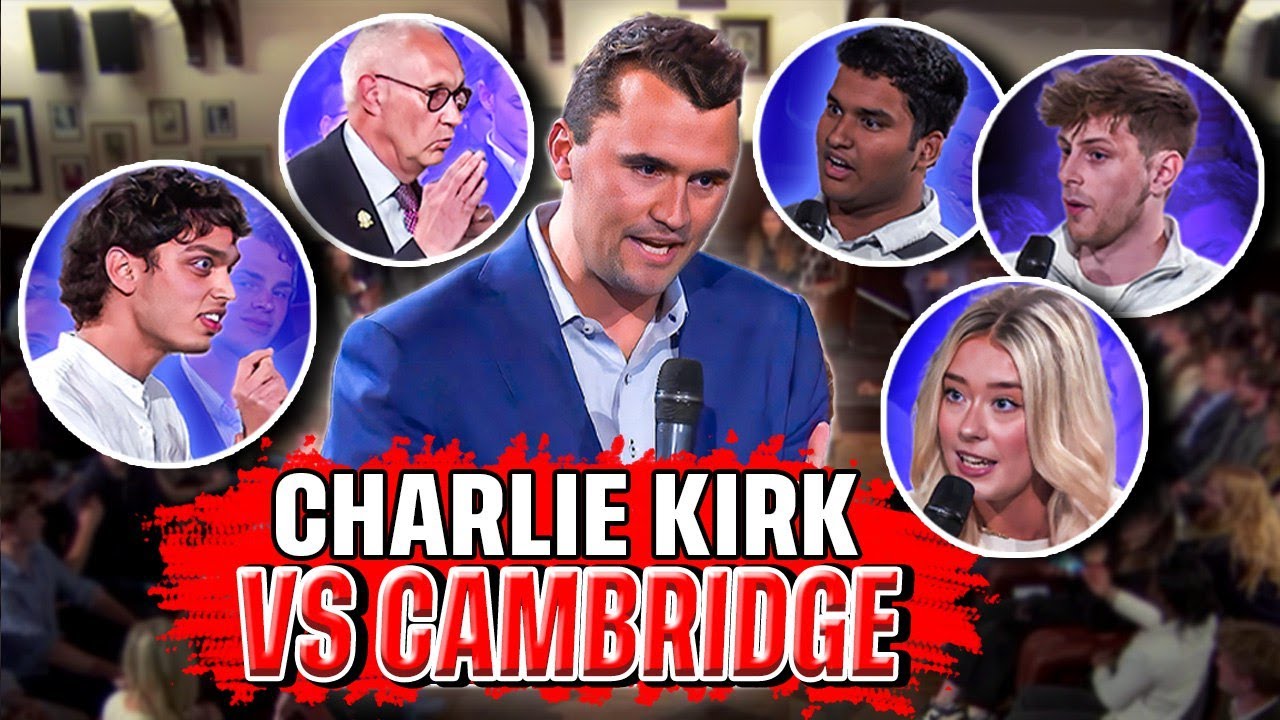
The debate format showcased a variety of perspectives on contentious topics like abortion, race relations, and economic systems. While Kirk maintained his conservative positions, the exchange allowed students with different viewpoints to challenge him directly. The conversation, though heated at times, demonstrated how open dialogue can highlight both fundamental disagreements and occasional points of common ground across ideological divides.




Comments
Be the first to comment on this video.