Charlie Kirk Challenges Student on Moral Relativism: Is There Objective Right and Wrong?
Enjoying this? Share it with someone who needs to see it.
Up Next
Charlie Kirk Confronts LSU Student on Native American Land Claims and American Exceptionalism
2:23
Charlie Kirk's Advice on Navigating Political Conversations with Liberal Family and Friends at Cal State Fullerton
2:54
Charlie Kirk Explains Critical Race Theory From Herbert Marcuse to Modern Wokism in Universities
2:50
Charlie Kirk Challenges Student on Moral Relativism: Is There Objective Right and Wrong?
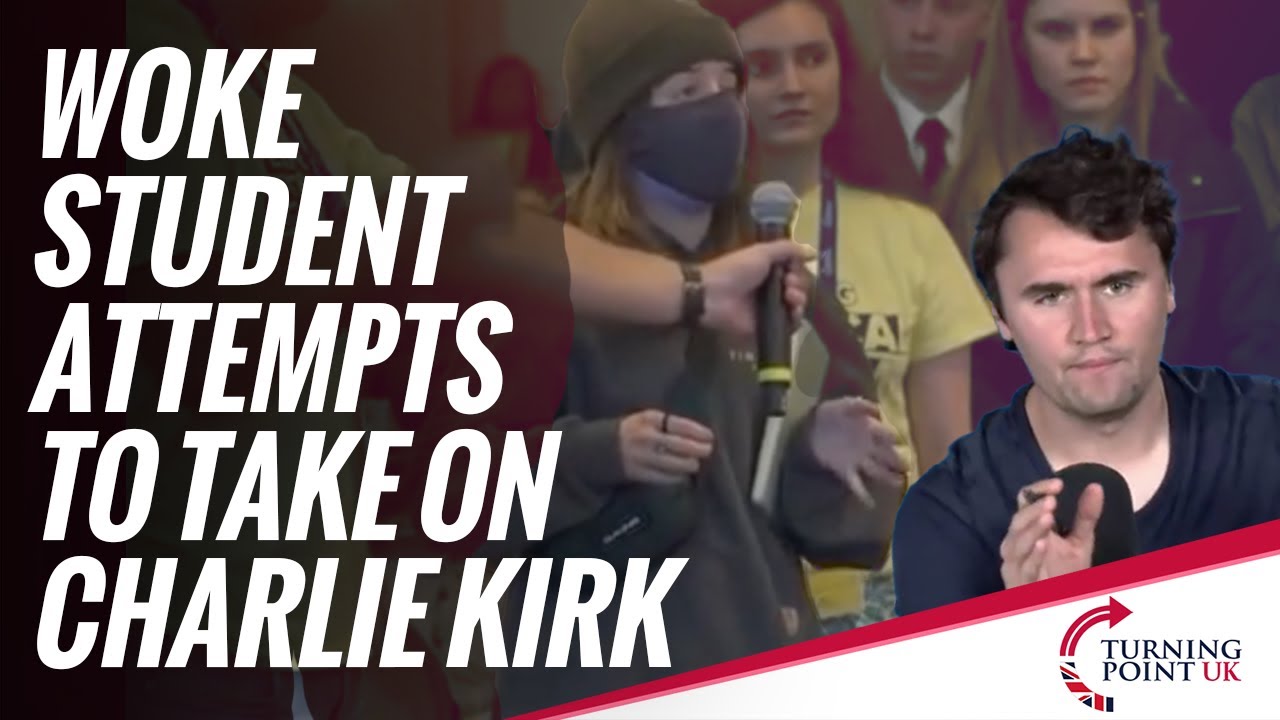
Charlie Kirk engages in a pointed exchange with a college student who claims morality is subjective and community-based. When pressed on whether the Taliban's atrocities or Nazi Germany's concentration camps were objectively wrong, the student struggles to defend his relativistic worldview. Kirk demonstrates the dangerous consequences of abandoning objective moral truth, arguing that without standards beyond ourselves, societies inevitably descend into justifying evil. The conversation exposes the intellectual bankruptcy of moral relativism when confronted with real-world evil.
Charlie Kirk confronted a college student with one of philosophy's most pressing questions: Is there such a thing as objective morality, or is right and wrong simply a matter of personal opinion and cultural context?
The student initially argued from a relativistic position, claiming that the Taliban's heinous acts against children might be wrong "to me" but right "to themselves." This position suggests that morality is merely subjective preference with no anchor in objective truth.
Testing Relativism Against Reality
Kirk didn't let this claim stand unchallenged. He pressed the student with a direct question about sexual assault on campus: "When somebody goes and rapes a woman here on campus are they wrong?"
The student answered affirmatively: "Yes, why? Because that is something you should not do."
But Kirk immediately caught the inconsistency. The student had just made an objective moral claim—a "should statement"—about campus assault while refusing to make the same objective claim about the Taliban's abuse of children. Kirk pointed out this glaring contradiction: "You didn't do a should statement with the Taliban with little boys. What are you comparing should to?"
The Narcissism of Subjective Morality
Pressed further, the student revealed the ultimate foundation of his moral framework: "Myself though. It's your morality that triumphs over any objective law. It's my world. What I think is good is why I think it's good."
Kirk identified this position for what it was: "That's one of the most narcissistic things."
Rather than retreat, the student doubled down: "I'm a narcissist."
The Community Cannot Save Us
Recognizing the weakness of pure subjectivism, the student pivoted to another common defense: reliance on community standards. He claimed that "none of this matters if we don't first acknowledge something outside of ourselves needs to exist to have a good and free Society. I rely on the community around me."
But Kirk had already anticipated this move and delivered a devastating counterpoint: "If you rely in the community then in Nazi Germany you'd be running trains to the concentration camps right? That's what people were doing."
The student could only respond: "That was wrong."
Kirk pressed: "It was okay?"
The exchange revealed the fundamental problem with community-based morality: communities can be spectacularly wrong. If the community is the highest moral authority, then there is no basis to condemn Nazi Germany, Stalinist Russia, or any other society that collectively agreed to commit atrocities.
The Question That Demands an Answer
Kirk posed the ultimate question: "What's going to prevent us from doing that again?"
This is the question that moral relativism cannot answer. Without objective standards that transcend individual preference and community consensus, there is no logical basis to prevent future genocides, no foundation to declare that certain acts are wrong regardless of who commits them or how popular they might be.
Standards Worth Striving For
The conversation concluded with a discussion about whether objective standards are possible or even necessary. Kirk suggested that standards exist for us "to strive as close as possible to," even if perfect adherence is impossible.
The student, having been walked through the logical consequences of his own worldview, conceded: "I mean honestly yeah, it's a good idea."
This exchange demonstrates why the question of objective morality matters. It's not merely an academic exercise for philosophy classrooms. The existence or absence of moral truth has real consequences for how we build societies, protect the vulnerable, and prevent the repetition of history's greatest evils.
Without acknowledging something beyond ourselves—a standard of right and wrong that exists independent of personal preference or cultural consensus—we have no foundation to condemn evil when it appears, and no protection against becoming perpetrators ourselves when the community shifts in a dark direction.