Charlie Kirk Defends Change My Mind Debates Against Claims of Unfair Advantage at Montana Campus
Enjoying this? Share it with someone who needs to see it.
Up Next
Charlie Kirk Debates Abortion, Immigration, and Western Values at Boise State University Campus Tour
51:34
Charlie Kirk Confronts Immigration, Social Work, and Veganism Debates with College Students at University of Pittsburgh
19:58
Charlie Kirk on Trump's Deportation Blitz and the Battle Tested Team Rolling Back Biden's Open Border Policies
10:23
Charlie Kirk Defends Change My Mind Debates Against Claims of Unfair Advantage at Montana Campus
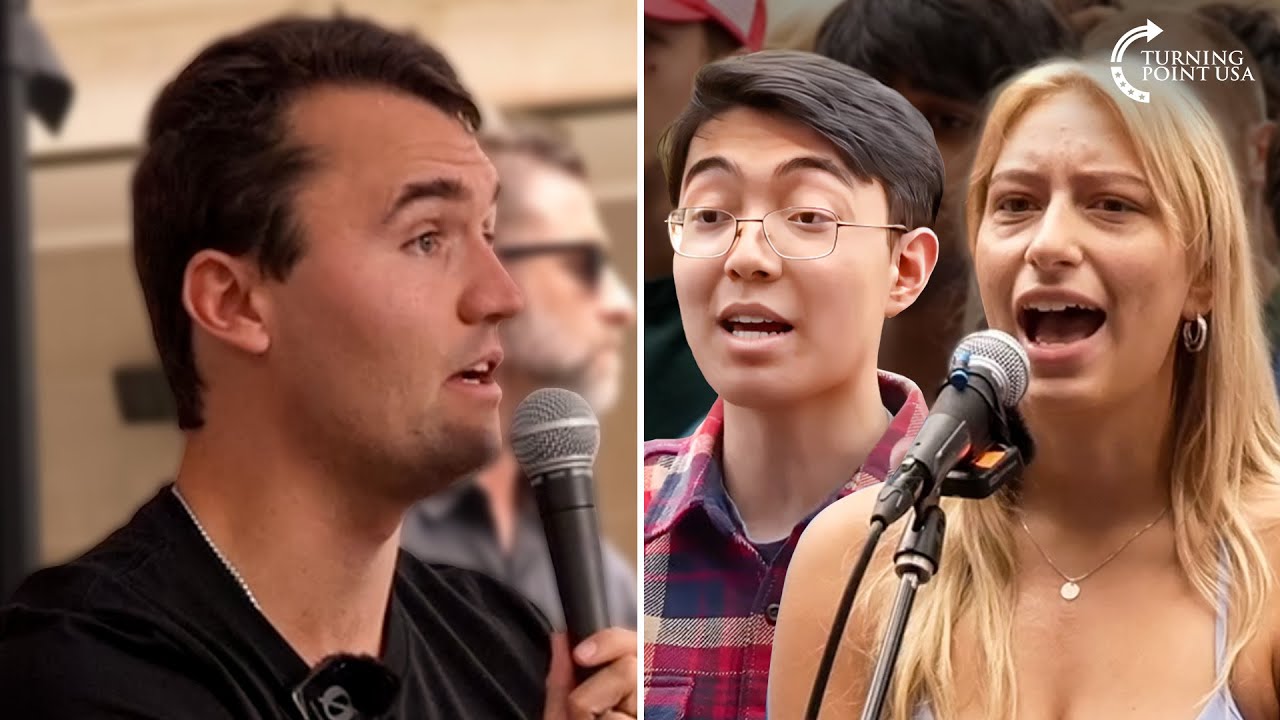
Charlie Kirk faces intense questioning at a Montana college campus during a Turning Point USA event. Students challenge him on everything from the ethics of his debate format to immigration policy, veganism versus abortion rights, and the root causes of crime in Black communities. Kirk defends his approach, arguing that college students are voters who will shape America's future and deserve direct engagement. The heated exchanges reveal deep divisions on citizenship, moral worth, and government obligations. Kirk maintains his positions on mass deportation, prioritizing American citizens over immigrants, and rejecting excuses for criminal behavior while students push back on his reasoning.
A student opens by questioning Kirk's approach to campus debates, suggesting it's unfair for a professional political commentator with resources, PR teams, and security to debate college freshmen. The student characterizes it as wanting to "dunk on the libs" and calls it a potential grift.
Kirk pushes back firmly against this framing. He argues he's not talking down to college kids but engaging with voters who will determine America's future. He points out he has no notes during these exchanges and invites students to bring professors or multiple friends to debate him together. Kirk emphasizes he didn't even attend college himself, graduating only from high school, making it far from an unfair fight.
When the student notes that Kirk's text messages advertised it as a debate and his sign says "prove me wrong," Kirk reframes the entire exercise around free speech principles. He argues that more speech, not less, benefits a free society. He mentions recently debating 25 college students simultaneously and stresses that this generation might be drafted into a world war and shouldn't be treated as children. Kirk insists he's there to talk to the next generation, not talk down to them, while also supporting the local Turning Point chapter and Tim Sheehy's Senate campaign against Jon Tester.
The Veganism and Abortion Debate
A student named Adam brings up veganism and vegetarianism, quickly pivoting to what he sees as a contradiction in Kirk's views. He argues that Kirk supports banning abortion in most situations while opposing veganism, despite many animals being more intelligent than fetuses and small infants.
Kirk responds by establishing fundamental differences between humans and animals. He argues that if you leave a cow for five years, it will never talk, but a fetus will develop the capacity for speech and reason. When the student compares this to mute humans, Kirk clarifies he's not just talking about speech but about reason, soul, and being an elevated being worthy of protection.
The exchange becomes more philosophical as Kirk explains that human beings can discern right from wrong, while animals can only distinguish between pleasure and pain. Animals can feel but cannot reason, he argues, which creates an objective moral difference. From a Western religious perspective, Kirk adds, humans have souls while animals do not. He describes the soul as something beyond the five senses, an ability to withdraw from immediate sensory experience.
When pressed on why it's acceptable to kill animals, Kirk maintains that humans and animals are not morally equivalent. He supports treating animals humanely and minimizing suffering when they're used for food. The student brings up dairy production, arguing that cows must be forcibly inseminated to produce milk, which he characterizes as a form of violation.
Kirk rejects any comparison between extracting milk from cows and human violation. He argues that whatever allows human beings to flourish is the proper concern, and access to meat, beef, and dairy serves that purpose. When the student persists about animal suffering, Kirk questions whether this logic extends to insects and mosquitoes. The student admits he doesn't believe in intentionally killing insects either.
Kirk challenges this position by asking about spraying for disease-carrying mosquitoes. The student calls that self-defense but maintains that cows are innocent. Kirk counters that cows feed human beings and notes that the World Health Organization has declared vegan diets completely healthy. The student agrees but Kirk responds that society needs to increase testosterone rates through meat consumption, not decrease them through soy-based diets.
The debate concludes with Kirk defending the right to eat steak and joking that "keep steak legal" should be his new shirt slogan, commenting that the American left wonders why they're losing young men.
Immigration, Citizenship, and Government Obligations
The conversation shifts dramatically to immigration when a student challenges Kirk's statement that 5% of Haiti's population has been brought into the United States. The student doesn't see a problem with allowing immigrants seeking refuge into America, suggesting it aligns with the foundation of organizations like Turning Point USA.
Kirk firmly establishes his position: America is the best country, and therefore citizens should come first, not foreigners. The obligation is to Americans, not to making the pathway to citizenship easier. When asked directly, Kirk says he would deport all illegal foreigners back to their home countries.
He provides specific examples of what he sees as the problem. In Springfield, Ohio, English as a second language speakers in one high school went from 250 to 1,500 kids in two years. In Aurora, Colorado, entire apartment complexes are being run by Venezuelan gangs. Kirk recounts cases of American citizens killed, mentioning Laken Riley and Rachel Morin by name, along with 11-year-olds killed in DUI accidents involving illegal immigrants.
Kirk invokes the founding fathers' belief that a government failing to fulfill obligations to its own people first is not legitimate. He describes the current situation as an inversion where foreigners receive taxpayer-funded cell phones, hotel rooms, benefits, airplane rides, and cash while Americans get nothing. A Venezuelan crossing the southern border gets a phone, a flight to any city, a luxury hotel in New York City, and taxpayer-funded healthcare, while American citizens requesting the same would be laughed at.
When the student suggests this means the government should support veterans and citizens with better healthcare and social programs, Kirk clarifies his position. Government shouldn't be giving free phones to anybody. Citizens should come first by not having to compete against foreigners for jobs.
The student challenges whether this competition is actually happening, citing Aurora Police statements that the apartment complexes are not overrun. Kirk dares the student to go to those three apartment complexes right then and knock on doors, saying they'll be extorted for cash because America has become "a country open for looting."
Kirk emphasizes the scale of the issue: over 118 countries have sent people across the southern border, at least 99 people on the terrorist watch list have crossed, including people from Turkmenistan, Uzbekistan, Iran, and Pakistan who mean harm to the United States. Beyond security concerns, Kirk argues, the fundamental meaning of citizenship is breaking down. A citizen should be put first above anybody else, or the government isn't fulfilling its basic obligation.
When the student suggests using resources to improve the third world so people don't have to emigrate, Kirk flatly rejects this as the role of American government. He doesn't care about Central American politics when Americans are suffering. The student points out that billions spent on Central American aid has been effective at slowing sex trafficking rates.
Kirk disputes this entirely, characterizing such spending as bribing governments who then tell cartel leaders to send 20,000 people one month instead of 40,000. More people are crossing the Darién Gap than ever before, and they're also entering through the CBP One app into every state. Kirk argues you cannot maintain a country while importing the unfamiliar third world this quickly.
On immigration policy, Kirk advocates for a complete shutdown of all immigration until every Gen Z person can afford a home. When asked about H-1B visas that stimulate the economy, particularly for students studying computer science, Kirk says they should be eliminated too. American students shouldn't have to compete with foreigners for jobs. When the student suggests colleges should better prepare students, Kirk calls college a scam and says computer science students don't need college—they can take a 60-day coding class and get hired by companies like Google.
Kirk concludes his immigration position by stating that a country failing to secure its sovereignty and prioritize its own people over foreigners ceases to be a country—it becomes a colony. American generosity is being taken advantage of. While he supports American charities working in Central America, the government's role is different. If the border is closed and people are told to go back to Nicaragua to make their own country great, that's appropriate.
Kirk rejects spending trillions trying to solve third world problems, calling it money that would be laundered and ineffective. He points to El Salvador as an example, where President Bukele made the country safe not primarily through American aid but by locking up 40,000 criminals. El Salvador went from the murder capital of the world to safer than America, while Americans are afraid to walk the streets of Denver, Los Angeles, or San Francisco at night.
Confronting Stereotypes and Defending Deportation
A student who identifies as the granddaughter of immigrants confronts Kirk about stereotypes placed on Hispanic and Latino communities, particularly the portrayal of immigrants as criminals and drug dealers. She reveals she's a first-generation college student, third-generation American on her mother's side, and second-generation on her father's side.
Kirk asks whether her grandparents entered legally. Her mother was born in the United States, but her grandfather on her father's side entered illegally. Kirk clarifies he's not insulting her grandfather but emphasizes that the immigration Americans support is when people follow the rules and come on our terms, not breaking in uninvited.
The student explains her grandfather left Mexico because of the political state, especially in the 1970s and 1980s, when the government wasn't supportive and drug problems meant their only choice was to move. Kirk sympathizes but firmly rejects that it's ever the only choice to commit a crime. He argues this is an insult to immigrants from Vietnam, Laos, and Pakistan who wait decades in line.
Being clear about this principle, Kirk states that anyone entering uninvited has committed a crime and is a criminal who should be punished by being sent back. The student pushes back, asking if Kirk calls it a luxury to leave a country with political tyranny for one with opportunity. Kirk responds that living in Mexico with the ability to go 100 miles north and break into America is indeed a luxury compared to people in Pakistan who would give anything to be on that border.
Kirk challenges the premise that anyone has a right to immigrate to America. When the student asks if it's a privilege to have access to clean water, food, and air, Kirk says yes, absolutely—these things must be fought for. The student questions whether her grandfather had less right to a good life because Kirk's ancestors came in 1620.
Kirk explains his ancestors fought in the Revolutionary War, Civil War, and world wars. Her grandfather can fill out paperwork and wait in line like everyone else, and then America can decide whether it's in the national interest to allow him in. When asked if the American government should prioritize citizens over foreigners, the student agrees but argues this doesn't mean closing borders.
Kirk points out that this generation is the first in American history to be worse off than their parents. Given that social contract is breaking down, shouldn't the government prioritize younger generation Americans before those in other nations? The student acknowledges current approaches are wrong and that a clear path to citizenship would create opportunities, but she believes Americans are required to have the rights they possess.
Kirk reframes this: helping people in other countries live a good life is a nice benefit, but the government doesn't exist to improve the lives of foreign citizens. When the country's own house is in order, then it can be open to accepting others. But right now, America is in chaos—the most depressed, suicidal, anxious generation in history, with collapsing birth rates, unaffordable homes, crushing debt, and competition with foreigners for jobs.
He articulates a simple moral statement: when bringing people in makes life worse for people already here, it should stop. The student challenges whether illegal immigrants actually make things worse. Kirk points to daily DUI deaths caused by illegal immigrants. When she responds that Americans commit DUIs too, Kirk draws a crucial distinction: Americans are invited guests in their own country, while foreigners broke in and shouldn't be here. American-committed crimes are part of society; immigrant-committed crimes are chosen and preventable.
When Americans are murdered by illegal immigrants, Kirk argues, it's because the country has decided it's okay with them being here and accepts that they might kill people. The student admits she's not okay with deporting every illegal person because some are working hard for the life they want. Kirk dismisses the relevance of their work ethic—the question is what the punishment should be for breaking into a country.
The student says punishment depends on crimes committed after breaking in. Kirk uses an analogy: if someone breaks into a dorm room uninvited but does the dishes and laundry, can they stay? The student jokes that if they're doing her dishes, sure. Kirk points out that many illegal immigrants are killing Americans.
The student objects to characterizing "they" as if all illegal immigrants kill people. Kirk maintains that many do, and the punishment for breaking into a nation should match what it is in Switzerland, Israel, and Hungary: every person who breaks in uninvited goes back to their country of origin, period. When asked if there's emphasis on the southern border, Kirk confirms most illegal entry happens there.
The student argues that categorizing all illegal immigrants under the same umbrella as sex traffickers and drug dealers, and saying all must be deported, implies all are doing terrible things rather than a small percentage. Kirk returns to definitions: if you come into a country uninvited, you are definitionally a criminal. When the student asks what defines a criminal, Kirk answers that a criminal is someone who breaks the law. Someone crossing the southern border broke federal law, therefore they are a criminal.
Crime, Poverty, and the Black Family
In the final exchange, a student brings up systemic racism and the absence of fathers in the black community, arguing that black men are more likely to be in prison because of systemic factors. When Kirk asks why people go to prison, the student says often it's because they're in poverty with no other options, and society should make excuses for crimes committed out of necessity.
Kirk expresses surprise at this worldview, asking if the student thinks most crimes in the black community are crimes of necessity. He notes something happened to Black America since 1965. The student attributes this to the War on Drugs. Kirk points out that to go to jail for drug offenses, you have to be dealing drugs or caught with drugs.
The student argues that in poverty-stricken areas with no jobs, drug dealing becomes one of the main available jobs, so people will trade drugs as their only option. Kirk identifies this as a fundamental difference in worldview—he doesn't believe in making excuses for people doing obviously destructive things.
He argues that the biggest problem in Black America isn't racism but the lack of fathers. When dads are around, kids flourish. The student counters that systemic racism creates family problems by taking black people away from their families, leading to broken families. Kirk questions how they're being taken away when they're actually leaving.
The student mentions that staying single as a mother leads to federal subsidies, essentially incentivizing broken families. Kirk agrees this is a problem and asks if the student can at least agree that if the nuclear family in Black America was stronger, that would be a good thing. The student concedes that in a lot of cases, yes, it would be.