Charlie Kirk Debates College Students Who Call Him Uneducated, Challenge His Economic Views and Marxism Stance
Enjoying this? Share it with someone who needs to see it.
Up Next
Charlie Kirk Shares Life Advice for Young Americans: Building Character, Courage, and Success Without College
17:38
Charlie Kirk Debates Kansas University Students on College as a Scam and Marxism Versus Fascism
42:32
Charlie Kirk Confronts Student Challenging His College Credentials and Economic Expertise at Campus Event
7:10
Charlie Kirk Debates College Students Who Call Him Uneducated, Challenge His Economic Views and Marxism Stance
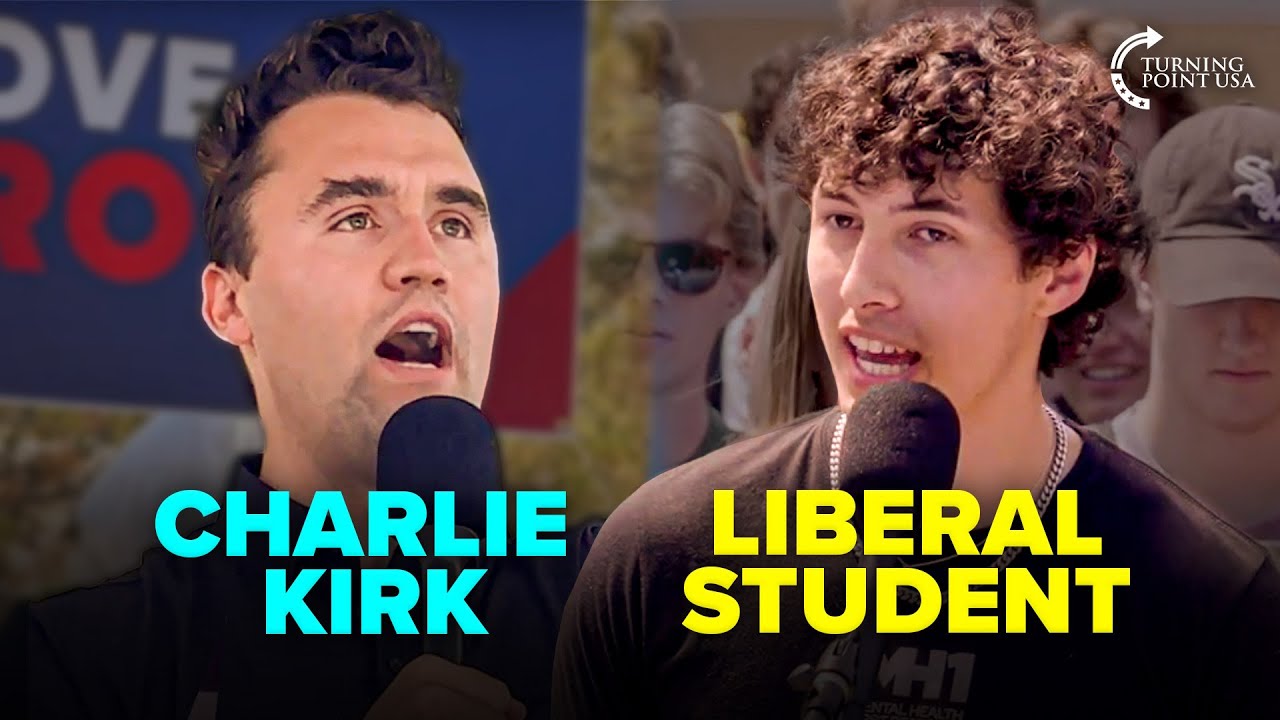
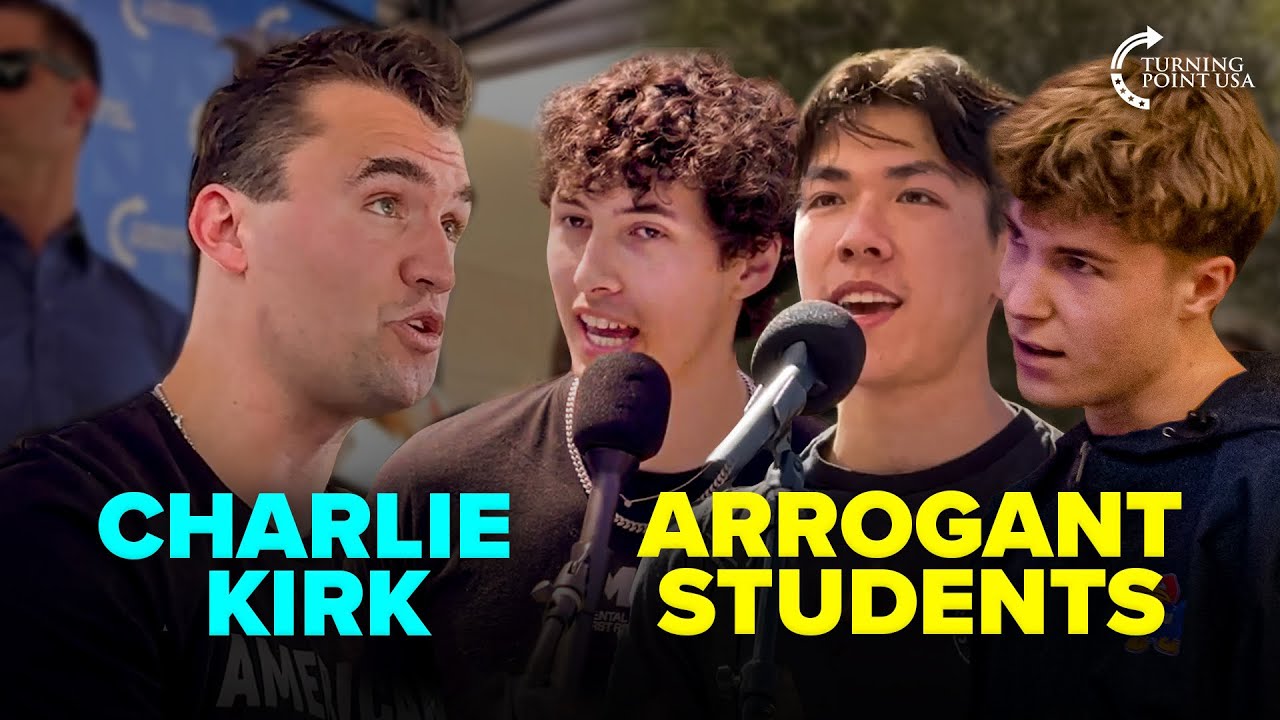
Charlie Kirk faces off with college students at the University of Kansas who question his credentials, challenge his views on education, and attempt to corner him on fascism and Marxism. One student opens by insulting Kirk's high school education and accusing him of "word vomit," but struggles to name a single false statistic. Another self-described Marxist demands Kirk denounce fascism while refusing to condemn Marxism's 100+ million death toll. Kirk turns the tables, exposing gaps in students' knowledge of basic economic thinkers like Thomas Sowell, Milton Friedman, and Friedrich Hayek, while their curriculum teaches John Maynard Keynes. The exchanges reveal both the hostility Kirk faces on campuses and his argument that universities offer ideological indoctrination rather than balanced education.
Student Insults Kirk's Education, Fails to Back Up Claims
The first exchange begins with a student asking Kirk how someone with "so little education beyond high school" became such a confident public speaker. The student then pivots to an accusation, claiming Kirk engages in "word vomit" and offers only "confirmation bias" rather than genuine debate. When Kirk invites the student to debate him on the spot, the student declines, saying he's "just here to insult."
Kirk challenges the student to name one statistic he cited incorrectly. The student mentions "11 million jobs" and "50% of Blue Collar work," but Kirk immediately defends these numbers, citing Mike Rowe, three independent studies, and the Department of Labor. When pressed for a second and third incorrect stat, the student fumbles and eventually admits he came unprepared. Kirk points out the smugness of the approach and emphasizes that the student couldn't identify a single factual error despite his confident opening.
Kirk concludes by telling the student, "My friend, you are why we are going to beat you guys historically, because you are afraid to have a debate." The audience applauds as Kirk highlights the unwillingness of critics to engage with actual facts or arguments.
Fascism, Marxism, and the Refusal to Condemn Ideology
Another student approaches, explaining he was protesting outside with a sign reading "Tear the Fascist Down" when he was called a slur by individuals who openly identified as fascists attending Kirk's event. The student clarifies he is not calling Kirk a fascist or Nazi sympathizer but asks if Kirk will denounce fascism, defined as an ideology including racial nationalism and authoritarianism.
Kirk immediately agrees but counters by asking the student, who identifies as a Marxist, to denounce Marxism as "the greatest killer of human beings in the last 100 years." When the student hesitates, Kirk presses him to define Marxism. The student eventually describes it as the ideology employed by Mao Zedong, Joseph Stalin, Vladimir Lenin, and Pol Pot, acknowledging it led to the deaths of millions.
Despite this acknowledgment, the student struggles to denounce Marxism outright. He argues that what occurred under these regimes was not "true Marxism" because workers did not own the means of production—only the government did. Kirk challenges this, pointing out that over 100 attempts at Marxism across every continent—from Zimbabwe to Venezuela to China—have resulted in famine, poverty, and death. The student attributes these failures to external factors like sanctions and military intervention rather than the ideology itself.
Kirk responds by explaining that Marxism inherently leads to dictatorship because human nature is self-interested, making it impossible for workers to truly share ownership. He argues that only someone with "an infant understanding of human nature" can believe communism works. Kirk emphasizes that Marxism has killed between 100 and 120 million people—far more than fascism's 10 to 15 million—and presses the student one final time to denounce it. The student declines.
Kirk concludes by noting the "pathological fascination with fascism" while Marxism, the deadlier ideology, is ignored or even celebrated on college campuses.
College as a Scam: The Value Proposition Debate
A third student asks Kirk to clarify what he means when he says "college is a scam." Kirk explains that the value proposition students receive is not worth the time or money invested. He notes that the majority of college graduates end up in jobs that do not require a college degree, raising the question of why they attended in the first place.
The student, a communications major, counters by arguing that students who pursue advanced degrees—master's and doctorates—often secure high-paying research positions earning $100,000 to $200,000 per year. Kirk acknowledges this possibility but points out that master's and doctoral programs are expensive, often requiring $150,000 to $200,000 in debt. He reiterates that 11 million job openings in America pay $80,000 or more without requiring a college degree, yet young people are not informed of these opportunities.
Kirk also highlights a troubling statistic: 41% of students who enter college do not graduate. He argues this indicates something is deeply wrong with the system. The student suggests the problem lies not with college itself but with individuals making poor decisions. Kirk counters that students drop out because they don't see the value and that half the audience will eventually work in jobs that never required their degree or debt in the first place.
In the final exchange, a student studying economics challenges Kirk's stance on college, citing a Hamilton Institute study showing that people with bachelor's degrees earn over $1 million more over their lifetime than those without. The student also argues that college fosters a balanced society by producing artists, architects, engineers, and writers.
Kirk responds by asking if the best writers learn to write in college, suggesting that gifted writers develop their craft by writing, not by attending classes. He then asks the economics student if he has studied Thomas Sowell. The student admits he likes Sowell and even bought his book "Basic Economics," but says Sowell is not taught at the University of Kansas. Kirk seizes on this, arguing it proves his point that students are receiving indoctrination, not education.
Kirk proceeds to ask about other prominent economists:
Milton Friedman – Student is aware of him but not taught
Ludwig von Mises – Student is aware but not taught
Murray Rothbard – Student is not familiar
Friedrich Hayek – Student is not familiar
Frédéric Bastiat – Student is not familiar
However, when Kirk asks about John Maynard Keynes, the student confirms they studied him in class. Kirk argues this imbalance demonstrates that students receive only demand-side, Keynesian economic theory while being denied exposure to supply-side, free-market economists. He calls this selective teaching a form of indoctrination that alters students' worldviews rather than broadening them.
Kirk also addresses the student's point about lifetime earnings, clarifying that earnings depend entirely on what students study. He references a recent study showing the 16 lowest-paid majors are among the most popular, particularly liberal arts degrees. He concludes that students pursuing these fields are "filled with all of the woke rubbish that is infecting our society" and are not receiving an education worth the debt.
The Core Argument: Indoctrination Over Education
Throughout these exchanges, Kirk consistently emphasizes two themes: the financial scam of overpriced degrees that lead to low-paying jobs or no jobs at all, and the ideological scam of one-sided curricula that indoctrinate rather than educate. He challenges students to defend their positions with facts and logic, often revealing gaps in their knowledge or preparedness. His willingness to engage directly and demand intellectual rigor underscores his broader critique of modern academia as a system that fails young people both economically and intellectually.