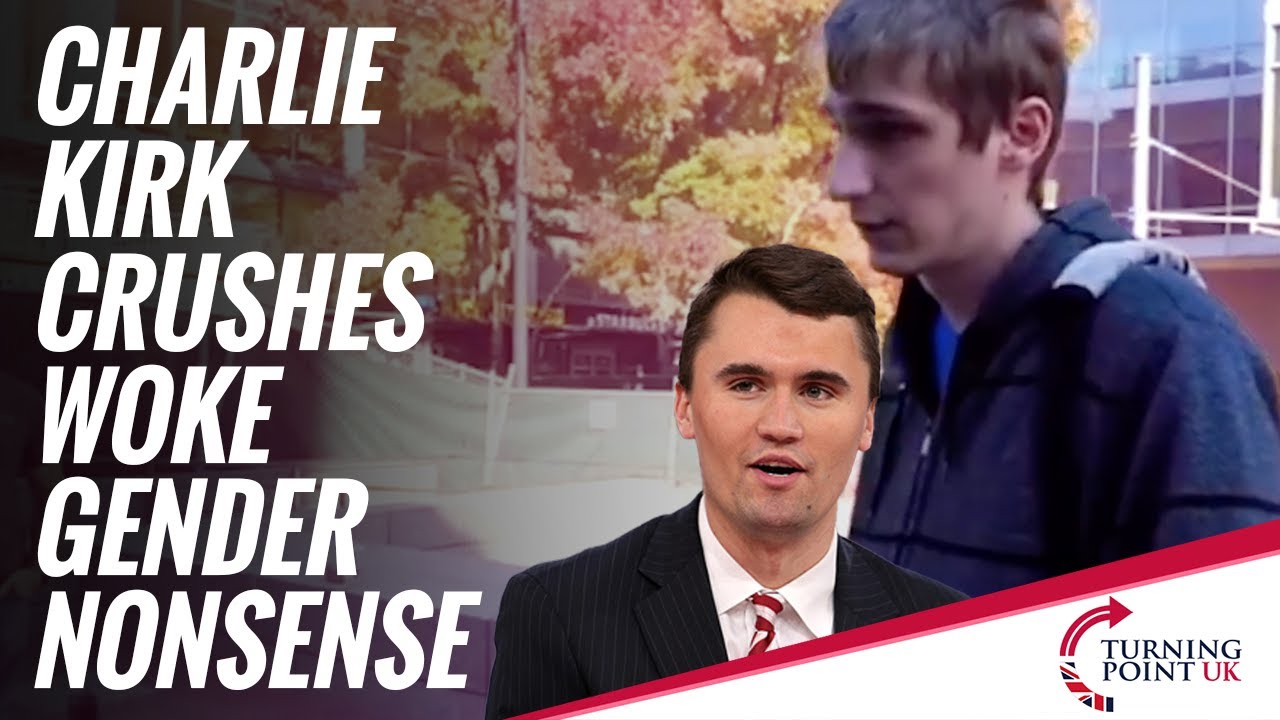
Charlie Kirk Debates Taxpayer-Funded Gender Reassignment Surgery and Healthcare Policy in Oregon
Enjoying this? Share it with someone who needs to see it.
Up Next
Charlie Kirk on Gender Ideology in California Schools and the Future of American Education
3:30
Charlie Kirk and Riley Gaines Confront Hostile Heckler at Campus Event in Tense Exchange
6:48
Charlie Kirk Debates Trans Activist on Gender Identity, Women's Sports, and Refusing to Lie
3:53
Charlie Kirk Debates Taxpayer-Funded Gender Reassignment Surgery and Healthcare Policy in Oregon
Charlie Kirk engages in a heated exchange about the boundaries of taxpayer-funded healthcare, specifically addressing Oregon's policy on gender reassignment surgery for minors. The conversation tackles fundamental questions about government-funded medical procedures, parental consent, and where society should draw the line on what constitutes essential healthcare. Kirk challenges the classification of certain procedures as "life-saving" while his debate opponent defends their personal experience with taxpayer-funded gender reassignment surgery. The exchange highlights the deep philosophical divide over healthcare policy, individual liberty, and the role of government in funding medical procedures.
The conversation begins with a crucial acknowledgment about the nature of productive dialogue. Kirk emphasizes that his willingness to engage in civil discourse demonstrates his true character, countering assumptions about his intentions. He stresses that if he were the extremist some perceive him to be, he wouldn't allow open disagreement or facilitate conversations with those who hold opposing views. This sets the stage for a discussion about how meaningful dialogue happens when people continue talking rather than resorting to other means of expression.
Kirk references recent tensions and violence in the city, attributing it to hatred on both sides and people becoming overly worked up. His approach prioritizes continued conversation as a mechanism for de-escalation and mutual understanding, even when disagreements remain unresolved.
Oregon's Gender Reassignment Surgery Policy
The discussion quickly moves to specific policy concerns, with Kirk raising the issue of taxpayer-funded gender reassignment surgery for 15-year-olds without parental consent in Oregon. He frames this as a concrete example of policy implications that concern him, challenging the state law that permits such procedures to be government-funded for minors.
His debate opponent, who identifies as someone who underwent taxpayer-funded gender reassignment surgery in Oregon as an adult, pushes back on Kirk's characterization. They question whether the procedures Kirk describes actually happen in practice, distinguishing between what state law permits and what doctors and insurance actually provide. However, Kirk maintains his position that the state law does indeed fund these procedures with taxpayer dollars.
The Question of Life-Saving Healthcare
A central tension emerges around the classification of gender reassignment surgery as "life-saving." Kirk's opponent frames their procedure as exactly that—a life-saving intervention that they couldn't have afforded without government assistance. They pose a direct challenge: should they have continued living in misery simply because they lacked the financial resources Kirk possesses?
Kirk pushes back on what he considers a subjective use of the term "life-saving," questioning where the boundaries should be drawn. He introduces a comparison with LASIK eye surgery, asking whether vision correction should also be taxpayer-funded if people need it. His opponent responds negatively to LASIK but affirms their belief in universal healthcare where everyone can access the care they need.
Healthcare Policy and Taxpayer Responsibility
The conversation expands to broader healthcare policy questions. Kirk's opponent advocates for universal healthcare, arguing that healthcare is a genuine need and that people die without access to it. When pressed, they confirm this includes abortion, which Kirk identifies as a fundamental point of disagreement.
Kirk repeatedly returns to his core principle: "Don't make me pay for it." He distinguishes between respecting how someone feels about their own medical needs and being compelled to fund those procedures through taxation. This represents the philosophical divide at the heart of the debate—the relationship between individual liberty, collective responsibility, and the proper scope of government-funded healthcare.
Welfare Reform and Incentive Structures
Kirk briefly touches on welfare policy reform, suggesting that current policies create perverse incentives by rewarding people for having more children out of wedlock. This tangent reinforces his broader concern about how government policies shape behavior and how taxpayer dollars are allocated across various social programs.
Where Healthcare Begins and Ends
The fundamental question underlying the entire exchange is definitional: what constitutes healthcare? Kirk explicitly states that he doesn't consider gender reassignment surgery to be healthcare, while his opponent argues from lived experience that it absolutely is. This definitional disagreement prevents any resolution, as the two participants operate from incompatible frameworks about the nature and purpose of medical intervention.
The conversation illustrates how policy debates often hinge on these foundational definitional questions. Without agreement on whether a procedure is healthcare, cosmetic, elective, or life-saving, participants cannot reach consensus on whether taxpayers should fund it. Kirk's position emphasizes taxpayer choice and limited government intervention in funding medical procedures, while his opponent prioritizes access to care regardless of individual financial capacity.