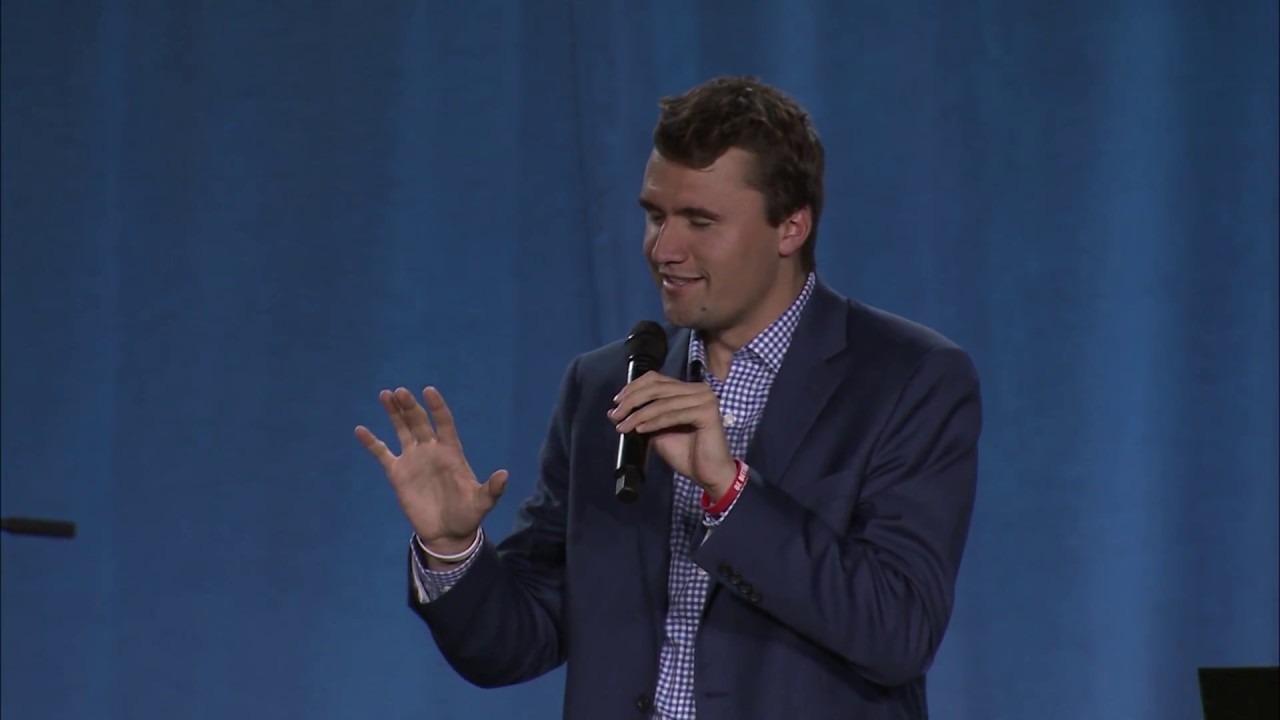
Charlie Kirk Exposes the Greatest Failure of Modern Education and How Christians Can Fix It
Enjoying this? Share it with someone who needs to see it.
Up Next
Charlie Kirk Reveals Why Elon Musk's Twitter Takeover Terrifies the Left and What It Means for Free Speech
1:28:23
Charlie Kirk Reveals the Greatest Failure of Modern Education and How Christians Fall Into the Trap
44:33
Charlie Kirk Unveils Bold Vision for Conservative Movement at Turning Point USA Event
17:08
Charlie Kirk Exposes the Greatest Failure of Modern Education and How Christians Can Fix It
Charlie Kirk addresses a pressing issue facing Christian education: the myth of values-neutral schooling. Speaking at a Turning Point event, Kirk argues that the idea of teaching skills without values is itself a value statement, and this vacuum has allowed ideologies like DEI and CRT to infiltrate schools. He emphasizes that Christian educators must boldly address controversial topics through a biblical lens, teaching young people not just how to get to heaven, but why they're here on earth. Kirk challenges both Christian schools and churches to equip students with the knowledge and conviction to stand firm against secular ideologies, warning that without this foundation, Christian youth become vulnerable to deconstructionist worldviews that ultimately undermine their faith. His message is clear: education must answer three fundamental questions, how did I get here, why am I here, and where am I going, with Scripture at the center.
Charlie Kirk identifies what he considers the greatest failure of modern education: the false premise that schools can provide skills without instilling values. This approach, which has penetrated many institutions including some Christian schools, claims to offer reading, writing, and arithmetic without imposing specific moral frameworks. Kirk points out the inherent contradiction in this philosophy.
"Saying that you will not teach values is a statement of value," Kirk explains. "There is no such thing as a valueless statement. Everything has values laced into it. So to say that we're not going to do morality or ethics is basically saying that itself is a statement of morality and ethics."
Kirk uses practical examples to illustrate his point. In any fourth-grade classroom, when a student steals a pencil or bullies another child, teachers must make moral judgments. Schools across the country run anti-bullying campaigns while simultaneously claiming education is only about academic skills. This disconnect reveals the impossibility of truly neutral education.
How Ideology Fills the Vacuum
The consequences of attempting values-neutral education have been significant. Kirk argues that when Christian and Western values are removed from schools in the name of neutrality, that vacuum doesn't remain empty. Other ideologies quickly fill the space.
"We have successfully pushed back on the left and the secular movement on DEI and wokeism and transgenderism mainly because when you create a vacuum, when you get rid of God, Christianity, biblical truth, Western values and you say we're just going to be a value agnostic education system, that's how you get DEI and you get CRT because some viewpoint is going to fill that vacuum. Nature abhors a vacuum," Kirk states.
He traces this problem to modernist thinking where God becomes merely "a guess," judgment is considered the greatest sin, and self becomes god. This worldview fundamentally conflicts with biblical Christian teaching, which asserts clear standards of right and wrong, good and evil.
The Purpose of Education
Kirk challenges the modern reluctance to provide moral instruction to children. The purpose of education, he insists, is not merely to transfer knowledge but to shape character and provide moral guidance.
"Who are you to tell a fourth grader how to act? That is the purpose of education, which is to tell a fourth grader how to act. It's not a byproduct. It is the mission statement. It is the primary thing," Kirk asserts.
The current system produces what Kirk calls "skilled graduates with no values"—people who can write AI code but have no character, who know what they can do but not why they're here or what ethical implications their actions carry. This represents a fundamental failure of education.
Three Essential Questions
Kirk presents three questions that should form the foundation of Christian education:
How did I get here?
Why am I here?
Where am I going?
"If you accomplish those three questions, it doesn't matter if they are struggling to be able to do the quadratic equation. It's fine. We could teach them that eventually. But if they know how did I get here, why am I here, and where am I going, you have done a phenomenal job as an instructor, as a parent," Kirk explains.
The secular world has attempted to answer only the middle question while ignoring the first and third. Even then, the answers provided lack grounding. When secularists say people are here "to do good," they cannot define what "good" means or by what standard it should be measured.
Christianity provides clear answers to all three questions: We are created in the image of God (how we got here), we are here to love God and love people, create disciples of all nations, to know Jesus and make Him known (why we are here), and we know where we are going through faith in Christ.
The Balance Between Heaven and Earth
Kirk offers what he calls a "good faith critique" of modern evangelicalism: it focuses too heavily on the third question (where am I going) at the expense of the second (why am I here).
"If you're only heaven focused and not earth focused, then you're actually not fulfilling what Jesus told us to do," Kirk states. "Separately, if you're only earth focused and not heaven focused, that is not at all what Jesus wants us to do because his kingdom is not of this world."
This imbalance has practical consequences. Kirk notes that Catholics operate more primary schools than evangelicals, partly because Catholic theology addresses the second question more thoroughly. Evangelical focus on the afterlife, while important, can lead to neglecting the building of lasting institutions and engagement with immediate earthly concerns.
Kirk shares his own ministry focus: "My life's work is mostly in the second question, not the third. I talk about the third a lot. I'm bringing people to Jesus. By the way, just this morning, we had over 25 students give their life to the Lord during the worship and praise concert this morning."
He positions himself firmly: "I'm going to be on the welcoming committee, not the planning committee. I am here to love God, love people, know Jesus, and to make him known. That is my life's work."
How Wokeism Infiltrated Christian Institutions
The disproportionate focus on heaven at the expense of earthly engagement has created an opening for liberal ideology to infiltrate Christian institutions. While conservatives were heaven-focused, liberals in Christianity became earth-focused, emphasizing social justice and political activism.
"While the conservatives we are heaven focused, the liberals in Christianity are earth focused. So we're like, 'Yeah, yeah, yeah. You're taking over my school. No, no. I'm so focused on what's coming next.' When all of a sudden we look around at some of our once great Christian colleges, one by one have become liberal," Kirk observes.
The liberal branch of Christianity has filled the vacuum by claiming the mission is social justice, ending racism, or promoting egalitarianism. Some have even undermined biblical authority, portraying Jesus as primarily a political activist or social teacher rather than the savior of the world.
The Call to Christian Educators
Kirk issues a challenge to Christian educators: reject the lie of values-neutral education and don't be afraid to address the nation, America, liberty, and freedom.
He expresses disappointment that many Christian students complete their education without understanding the preciousness of their country, what a constitutional republic is, or American history. This leaves them vulnerable to liberalism when they enter the broader world, or results in a "national agnostic Christianity" that doesn't engage with civic concerns.
"This is where Turning Point education comes in and it's so critically important, which is that we are Jesus focused and then second liberty focused, America focused, citizen focused, because God calls us to care about our nation. And that combination, I'll be honest, is very, very hard to find right now in the education space," Kirk states.
Equipping Christian Youth for the Real World
Kirk warns that failing to equip Christian youth with knowledge of why they are here and what they are fighting for leaves them vulnerable when they encounter secular ideology in their twenties and thirties.
"If you don't equip your Christian youth to know why they are here and what they are fighting for, it might be when they're 20 or when they're 25 or when they're 30 and they might be living in Atlanta or Philadelphia or New York and you send them out into the world, are they prepared to respond to a friend or a colleague or a boss that all of a sudden says, 'Well, yeah, why don't you go march in the BLM parade?'"
He argues that Christian youth need to understand the rise of new paganism in environmentalism and the cult of anti-racism, recognizing these as counterfeit gods replicating ancient biblical idolatry.
The tragic result of inadequate preparation is evident in how many people raised in Christian environments become liberal and atheistic. Kirk attributes this partly to an ill-equipped Christian population that gets "torpedoed by secular leftwing persuasion" without having developed "antibodies to this virus."
Politics as a Gateway to Undermining Faith
Kirk describes a pattern where secular ideology uses political issues as entry points to ultimately undermine Christian faith. Young Christians unprepared to address immigration, homosexuality, or abortion from a biblical perspective become vulnerable to arguments that twist Scripture.
"Once you kind of go down that and that sequencing of deconstructionism begins, the end point is complete and total nihilism. Once you undermine the authority of scripture and you do that via politics," Kirk explains.
He identifies this as a satanic strategy: "Satan is using politics as a way to get into Christian youth to then get them to not be Christian. All because we were told that if we talk about politics, they wouldn't be Christian. Turns out the exact opposite was actually true."
The irony is profound. Christian educators avoided controversial topics believing it would protect faith, but this avoidance actually left young people defenseless against ideologies that ultimately destroyed their faith.
The Solution: Biblical Engagement with Controversial Issues
Kirk's solution is straightforward: "You lean in to every controversial issue as it's age appropriate through a biblical lens."
Christian education should address what the Bible says about pornography, abortion, immigration, and other contentious topics. When students understand biblical teaching on these issues, they develop the intellectual and spiritual antibodies needed to resist deconstructionist arguments.
He provides a practical example: "Then in the back of their head when they're 26 years old and their accountant at Deloitte in Cleveland, Ohio, all of a sudden someone says, 'You know, Jesus never talked about homosexuality.' Actually, you know, there's a rootedness because you leaned into the controversial, you leaned into the topical, you leaned into the immediate."
Kirk notes that Jesus did address sexual immorality in Mark 7:2, using the Greek word "porna," which encompasses sexual degeneracy.
A Challenge to Pastors
Kirk extends his message beyond educators to pastors, noting that people are leaving liberal churches for conservative ones like those led by Jack Hibbs because they want their pastors to help them make sense of the world.
"They long term they don't need the same repurposed sermon. They say hey I'm confused. Tell me what to think," Kirk observes.
He calls it a failure when a mother approaches a pastor about a child struggling with gender dysphoria and the pastor either refuses to address it or worse, suggests affirmation in the name of love. These issues aren't going away, and avoiding them leaves congregations vulnerable.
"Yes, we're temporarily winning the culture war, everybody. But you better believe it will roar back at some point. And it's not going to be the secular world that will save us. It has to be Christian youth, Christian kids, biblical principles," Kirk warns.
The Law as a Teacher
Kirk concludes by discussing the role of biblical law, referencing Galatians 3, which describes the law as a schoolteacher, guard, and caretaker pointing people to Jesus Christ.
He identifies three types of law in Scripture:
Ceremonial law (studied but not binding)
Moral law (still applicable)
Civil law (considered for application in government as appropriate)
Kirk notes that pastors often discuss how moral law points to Jesus—showing people they cannot perfectly follow it and therefore need a savior. However, they rarely discuss how civil law can also lead people to Christ.
"Notice the pastors never talk about how civil law can lead you to Jesus. It's like, hey, the Bible had a lot to say in the 613 laws of Moses about how to run your government, about borders, about boundaries, about desecration of the divine. But we're told that we can't be political," Kirk states.
His final distinction is crucial: "Everybody, I don't want you to be political. I want you to be biblical."