
Up Next

Charlie Kirk and Pastor Steve Smotherman Expose the Great Reset and What Christians Must Do
1:29:16

Charlie Kirk Advises Ole Miss Student Forced Into CRT Training by Kappa Kappa Gamma Sorority
2:14

Charlie Kirk Tells College Student Why Character Matters More Than Grades When Professors Shut You Down
3:56
Related Books
Browse Conservative Books





Charlie Kirk on Fighting CRT in College While Pursuing Addiction Recovery Career and Faith
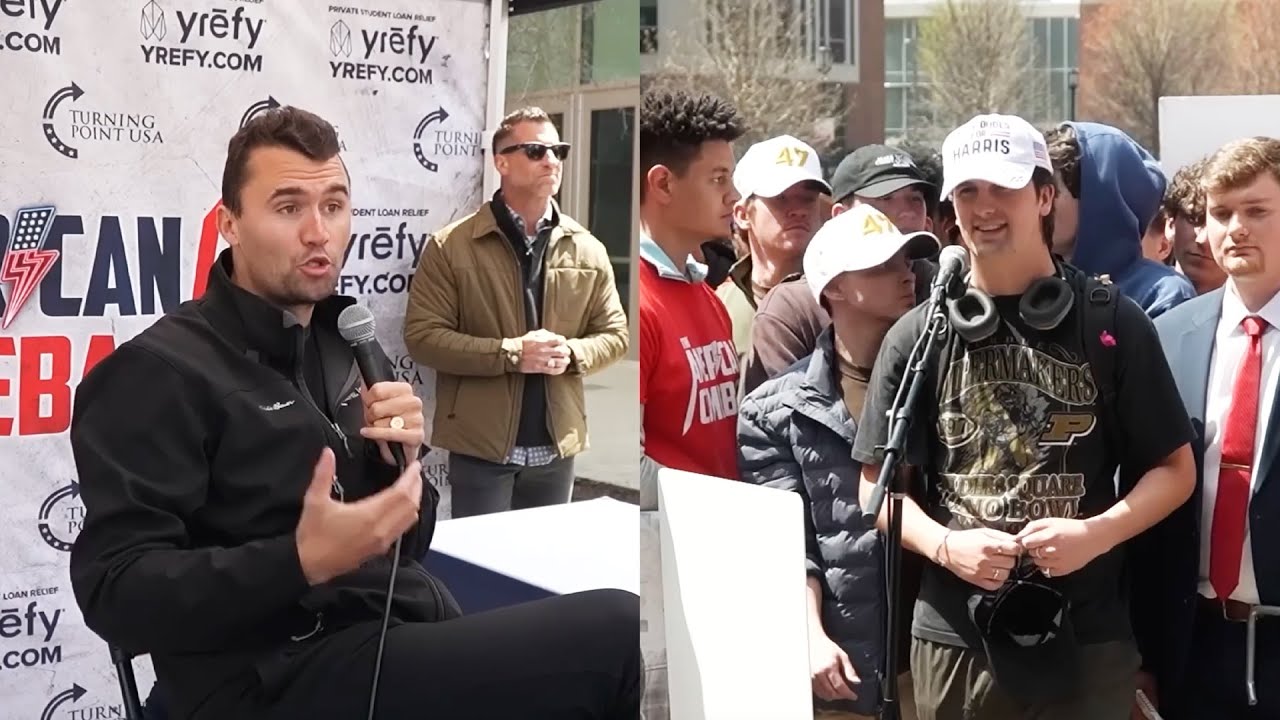
A student returning to college after eight years to pursue a career in alcohol and drug recovery confronts a challenging dilemma: how to maintain faith and truth while being taught critical race theory that blames addiction on racial oppression and removes God from the equation. Charlie Kirk offers encouragement on the student's sobriety journey and provides practical advice on navigating hostile academic environments. Drawing from his own experience visiting college campuses, Kirk shares a powerful strategy rooted in the teaching methods of Jesus himself, asking questions rather than making statements to expose flawed ideologies and stand firm in truth.
Celebrating Sobriety and a New Mission
Charlie Kirk begins by congratulating the questioner on their sobriety, acknowledging what a significant accomplishment this represents. He uses alcoholism as an example when speaking to young people about the true nature of freedom. When young people tell him that liberty means being able to do whatever they want whenever they want, Kirk points them to alcoholics and asks if they're truly free. The paradox, he explains, is that alcoholics become free when they stop doing what they want to do when they want to do it. This is a critical message that must be communicated to children and young people.
Debunking the Racial Narrative Around Addiction
Kirk directly challenges the professors' apparent claim that alcohol and drug addiction is primarily something that impacts Native American or Hispanic communities. He encourages them to get in a car and drive through states like Kansas, Oklahoma, Missouri, and Iowa to see the reality. The addiction crisis impacts every community across America.
In fact, Kirk points to statistics showing that the opioid epidemic disproportionately hurts white working-class communities, particularly due to manual labor jobs in the Northeast. He specifically mentions lobstermen and others in similar positions who suffer back injuries and become dependent on pain medication. The implication that addiction is primarily a racial issue is itself racist, Kirk argues. The drug epidemic and fentanyl crisis are colorblind, impacting all communities equally.
Navigating Hostile Academic Environments
Kirk acknowledges that the student faces a real challenge to their faith and their walk with God. However, he emphasizes that remaining close to God's word and God's promises throughout this experience will actually make the student stronger. Being in classes where professors are teaching ideologies contrary to the truth will force difficult decisions.
The student will need to decide whether to contest what they know to be true or remain silent. Kirk suggests that sometimes saying nothing might be the right choice, particularly if the goal is to get good grades in order to eventually get a job where ministry can happen. However, he believes that through deep prayer, God will open up opportunities at the perfect time to insert truth into the conversation—particularly on topics the student knows well and where what's being taught is clearly untrue.
The Power of Asking Questions
Kirk shares his key strategy for communicating in hostile environments: ask questions rather than telling people things. As a student, the questioner can ask something like, "Why is it that the opioid epidemic is also present in a lot of white-dominant states like Vermont, New Hampshire, and Montana if it's all about structural racism?" These states have huge opioid problems too. This type of question exposes the weakness in the professor's argument without creating direct confrontation.
Kirk emphasizes that this is an effective approach because the professors won't know how to answer these questions. He deals with hostile environments all the time during his college campus visits, so the student doesn't have to figure this out alone.
Following the Example of Jesus
Kirk reveals where he learned this questioning technique: from Jesus himself. When Jesus went to talk to the Sadducees and the Pharisees, it was always through the dialectic of questioning. Jesus asked questions and more questions, using this method to reveal truth and expose false teachings.
Kirk closes with encouragement, acknowledging that the student will face difficult moments ahead. But he promises that their spiritual muscles will grow stronger the more they push back against the darkness they encounter in their academic environment.
Video Transcript
[00:00] hi so i recently decided to go back to
[00:02] school after eight years to obtain a
[00:04] career in alcohol and drug recovery
[00:07] since it is a big issue here and i also
[00:09] had similar issues
[00:10] with the grace of god his word in this
[00:12] church i was able to seek my sobriety
[00:15] but now that i am in college courses
[00:18] thank you
[00:19] now that i'm taking college courses i'm
[00:22] really being fed a lot of crt and they
[00:24] basically blame all these issues on
[00:27] racial oppression
[00:28] since my goal is to reach people with
[00:30] the word of god
[00:32] and to impact their lives with the word
[00:34] of god how do you suggest i do this with
[00:37] the college system that removes god's
[00:38] glory and basically makes us a victim to
[00:41] anti-american society well first of all
[00:44] i just want to encourage you
[00:45] congratulations on your sobriety that's
[00:46] a big deal and
[00:51] i i use the example of alcoholism to
[00:54] young people a lot because young people
[00:56] say charlie liberty is being able to do
[00:59] whatever i want to do whenever i want to
[01:00] do it i say go meet an alcoholic and
[01:02] tell me if they're free or not
[01:04] they become free when they stop doing
[01:06] what they want to do when they want to
[01:08] do it right it's a message we must
[01:10] communicate to our children let me just
[01:12] make one side comment um just to kind of
[01:14] debunk your professors if they think
[01:17] that alcohol and drug addiction is
[01:19] solely something that impacts native
[01:21] american or hispanic communities i
[01:23] encourage them to get in the car and
[01:24] drive through kansas or oklahoma
[01:26] missouri iowa um it impacts every
[01:28] community in fact there is there are
[01:30] some statistics that the opioid epidemic
[01:32] disproportionately hurts white
[01:33] working-class communities only because
[01:36] of manual labor that happens in the
[01:38] northeast especially lobstermen you know
[01:40] all these sorts of different um
[01:42] positions that they get back injuries
[01:44] and it really impacts them so it's it's
[01:47] racist to imply otherwise the drug
[01:49] epidemic fentanyl impacts all
[01:51] communities right it is colorblind
[01:53] through and through but how do you fight
[01:54] back against it this is going to be a
[01:55] real challenging of your faith and a
[01:58] challenging of your walk you will become
[01:59] stronger if you remain close to god's
[02:02] word and god's promises throughout this
[02:04] but
[02:05] this is this is important because you're
[02:07] going to be in classes where they're
[02:08] spewing all this nonsense right and
[02:10] you'll have to make a decision like do i
[02:12] contest for what i know to be true
[02:14] or do i kind of just say nothing maybe
[02:16] saying nothing's the right choice
[02:18] because maybe you're like i got to get
[02:20] good grades because i want to go get a
[02:21] job and maybe that maybe you'll be able
[02:22] to minister there but i think that if
[02:25] you pray deeply about it god will open
[02:27] up an opportunity for a topic that you
[02:29] know really well
[02:30] for something that they're saying that's
[02:32] untrue for you at that perfect time to
[02:34] insert yourself with truth and you might
[02:36] say charlie how do i do that the best
[02:38] way to communicate in hostile
[02:39] environments is to ask questions
[02:42] don't tell people things ask questions
[02:45] so you as a student can say hey you know
[02:48] why is it that the opioid epidemic is
[02:50] also in a lot of white dominant states
[02:52] as well
[02:53] like the white estate in the country
[02:55] vermont or new hampshire and montana
[02:57] they all have huge opioid problems too
[02:59] why is that the case if it's all about
[03:00] structural racism that's a good question
[03:02] they won't know how to answer right and
[03:05] so look i deal in hostile environments
[03:07] all the time i visit college campuses so
[03:09] you don't have to asking questions
[03:12] and by the way you might say charlie
[03:13] where'd you get that from jesus
[03:15] when jesus went in to go talk to the
[03:18] sadducees and the pharisees it was
[03:20] always the dialectic of questioning
[03:22] it's asking questions asking questions
[03:24] and so i just want to encourage you
[03:26] you're going to have some difficult
[03:27] moments there but you'll be your your
[03:29] spiritual muscles will grow stronger the
[03:32] more that you push back against all that
[03:34] darkness


Comments
Be the first to comment on this video.