Dennis Prager and Charlie Kirk Discuss Student Loan Crisis, Campus Activism, and America's Future
Enjoying this? Share it with someone who needs to see it.
Up Next
Charlie Kirk Explains How Washington DC Created the Student Loan Crisis Trapping Young Americans
2:00
Conservatives Will Always Be the Ideological Minority on Campus and Why That's Okay
2:02
Charlie Kirk Exposes Cornell's Social Justice Roundtable Comparing GOP to ISIS While Silencing Conservative Speech
3:25
Dennis Prager and Charlie Kirk Discuss Student Loan Crisis, Campus Activism, and America's Future
Dennis Prager interviews Charlie Kirk, the 22-year-old founder of Turning Point USA, about his work on a thousand college and high school campuses across America. Kirk shares his perspective on the manufactured student loan crisis, the changing dynamics of campus culture, and why young people are increasingly open to conservative ideas. The conversation explores how the left has become the establishment they once rebelled against, the $1.3 trillion student debt burden, and the dangerous trend of young Americans replacing religious faith with government dependence. Kirk argues that the truth doesn't need indoctrination, it just needs to be presented clearly, and young people are hungry for an alternative to the conformity they're experiencing on campus.
Dennis Prager opens by addressing his listeners about the nature of fighting for what's right, regardless of whether one feels optimistic or pessimistic about the outcome. He challenges the notion that only optimists should fight, pointing to the soldiers who stormed Normandy Beach on D-Day. Those men fought despite facing almost certain death, with many of them terrified as they waited in boats for the Nazi machine guns at Omaha Beach. The point is clear: you fight whether you're pessimistic or optimistic.
Charlie Kirk and Turning Point USA
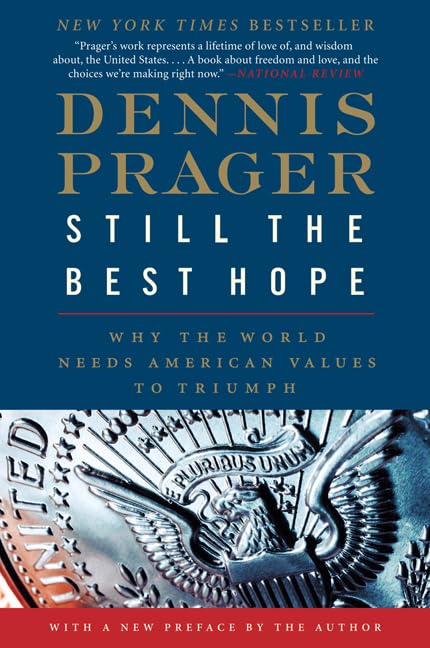
Prager introduces his guest, Charlie Kirk, the 22-year-old founder and executive director of Turning Point USA. The organization is now active on a thousand college and high school campuses across the country, promoting conservative values in what has traditionally been hostile territory. When Prager asks Kirk what college he attended, Kirk responds that he went to none—his only education came from Prager University.
Prager sees this as a positive development, noting that once Prager University has enough courses available, it could suffice for anyone not pursuing a specific skill like physics or medicine. The most important thing to have is wisdom, Prager argues, and there is none in colleges. They have become anti-wisdom places.
The Work on Campus
Kirk explains that Turning Point USA conducts clipboard and tent-style work on campuses, starting chapters, growing groups, and registering voters who agree with freedom and liberty. The organization finds like-minded students who are fed up with the culture that has been propagated on these campuses. Kirk emphasizes that people wouldn't believe how many young people are looking for an alternative point of view.
According to Kirk, the left has made a critical mistake: they have become the academic establishment they used to fight against. The left's rise to power in the 1960s and 1970s was all about raging against the machine, but now they have actually become that machine. Young people in college today are being indoctrinated and steered toward a point of view that runs contrary to the spirit of being young—conformity, one-size-fits-all thinking, and top-down power.
Kirk argues that if you look at what it really means to be a college or high school student in America, there's a spirit of rebellion inherent in being young. Turning Point USA is starting to channel that rebellion around the ideas of free markets and limited government. There's a growing undercurrent among the nation's youth to be involved in an activist-type organization that can actually start to move the ball forward on college campuses and across the country.
Campus Protests and Professional Agitators
When Prager asks about the average student's view of the demands being made at places like the University of Missouri and Yale—demands for more diversity administrators and enforcement of political correctness—Kirk reveals that the average student couldn't care less about how many diversity officers there are or about free speech codes.
Kirk explains that many of the protests at Missouri and Yale are actually being stirred up by professional protesters and agitators brought onto these campuses to create controversy. The average student is largely indifferent to these issues. It's a narrative being painted by a very loud contingent of entitled students who are in such prime positions in their lives that they have nothing better to worry about than what will offend them next. There's a group of college students waiting to be offended, and they're using free speech codes and zones as a way to suppress alternative points of view.
Young People Are Open to Truth
Prager expresses optimism based on his own experiences visiting colleges and from the data at Prager University, which has received 40 million views in a year, with the largest demographic being under 35 years of age. Young people have been indoctrinated, but as soon as they hear something rational, they respond positively.
Kirk agrees completely. He is often asked why conservatives don't indoctrinate young people the same way the left has indoctrinated current students with liberal views. His response: the good thing about the truth is you don't indoctrinate people to it—you enlighten them. You just open the box and let it be free. When you go through the process of reasoned thinking and challenging the status quo, young people are starving for a different point of view.
On a college campus right now, Kirk explains, students go from their soft social science department to their economics department to their humanities classes, and it's all this one-size-fits-all common philosophy: America is bad, capitalism is evil, we need a revolution to overthrow the ruling class, and the only solution is more government and less freedom. But when there's a point of view that says free people making free decisions in a free society not only works morally and ethically but also pragmatically, when you talk about constitutional liberty and how people can make their own decisions in a free society—that's not just an ideology, that's a philosophy young people can and will buy into. They just have to be exposed to it.
The Game of Loans: Manufacturing the Student Debt Crisis
The conversation turns to Kirk's video for Prager University called "The Game of Loans," which addresses the student loan crisis. Prager notes that it's worse than a Ponzi scheme because nobody's paying for it—it's just being paid for by the citizens of the United States. The system encourages more people to vote Democrat by offering free lunch, free breakfast, free tuition, free medical care—everything is free, just vote Democrat.
Kirk agrees, explaining that the best way to create future Democratic voters is to first prop up and manufacture a crisis. Big government Democrats and some Republicans have manufactured the student loan crisis over the last 30 to 40 years. They've injected trillions of dollars of cheap money into higher education and gone after students with predatory practices to solicit cheap student loans, making them take out these loans to study degrees that may or may not have any relevance in the job market once they graduate.
Then these students are completely destitute with choices and options, and the only salvation they can think of is government forgiveness in the form of voting for politicians who promise free stuff. Democrats wake up every single day with the mission of getting more people dependent on the federal government. Kirk firmly believes that the way they have planned and strategized to get more young people dependent on the government is through the student loan crisis.
It is the most dangerous financial issue facing young people today, and we've never seen anything quite like it in modern economic or generational history. The aggregate student loan debt is $1.3 trillion, with about $28,000 per borrower. Kirk emphasizes that this is per borrower, not per graduate. Over half of all the student loan debt held in this country is being held by people who never graduated—they got no return on the debt they took on. It's like getting a huge loan on your house and getting no house.
Even the ones who do graduate often have degrees in communications or other fields with limited job market relevance. Kirk argues that the left has been strategic in planning this. Not only do they want more young people to go to college because they can get them dependent on the federal government, but college is also how they are instilling their value system. They know that if they can get a young person to walk into a freshman humanities class, more times than not they will walk away with anti-American, anti-capitalistic, anti-freedom viewpoints and will be a liberal voter for life.
Prager adds that he was thinking about student loans and the fact that some campuses now cost $60,000 a year. He notes that at Yale, you have to go to a $1,000-a-night Pacific island resort to duplicate what a student gets in terms of amenities—swimming pools, saunas, special hammocks outside their dorms.
The Religious Question and Rise of Statism
Prager raises a concern about Kirk's generation: how many list themselves religiously as "none." Even with a commitment to the Constitution and reason, this country was not founded on those things alone. Prager worries about how much progress is being made on this front.
Kirk agrees and offers an important insight: when most people say they're not religious, they do in fact have a religion—that religion is statism. The state in many aspects is taking the place of what the church used to be, whether that's a synagogue or a local community organization. People are looking not to religious officials or institutions for moral clarity or answers; instead, they're looking to elected officials and leaders.
Kirk shares that he is an Evangelical Christian who attends church regularly. When he sees his peers and colleagues try to separate the religious component and the moral component and foundation of their livelihood and of this country, it's very dangerous. That's how you get the rise of the state. As the country becomes more secular, people will look toward government for more answers, direction, and leadership. When you have that paradigm completely switched, then the state will then target and attack the religious institutions—which is exactly where we are today.
Prager expresses happiness at learning Kirk is religious, noting that he thinks the libertarian appeal to young people, which he fully understands and in many ways supports, is insufficient because it is overwhelmingly secular. He wishes Kirk great luck and great success in his work.