
Up Next

Charlie Kirk Hosts Josh Hammer and Dave Smith Debate: Israel, Foreign Policy, and American Influence
1:19:58
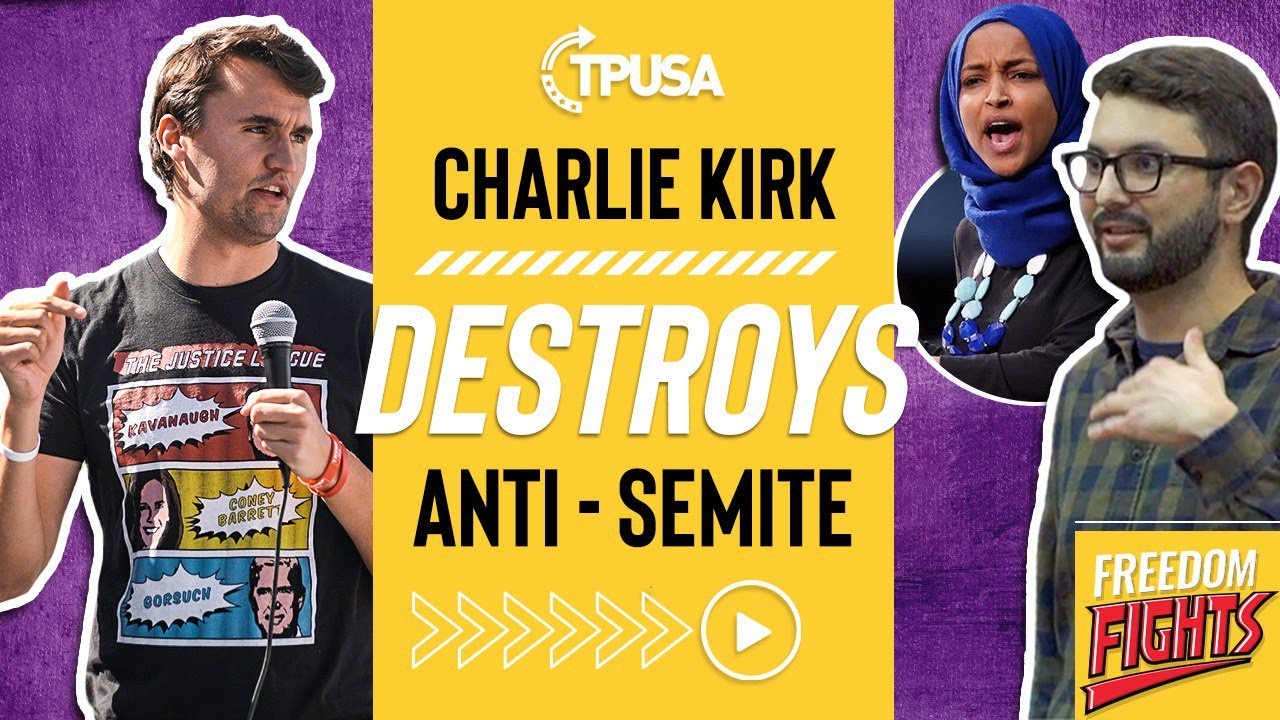
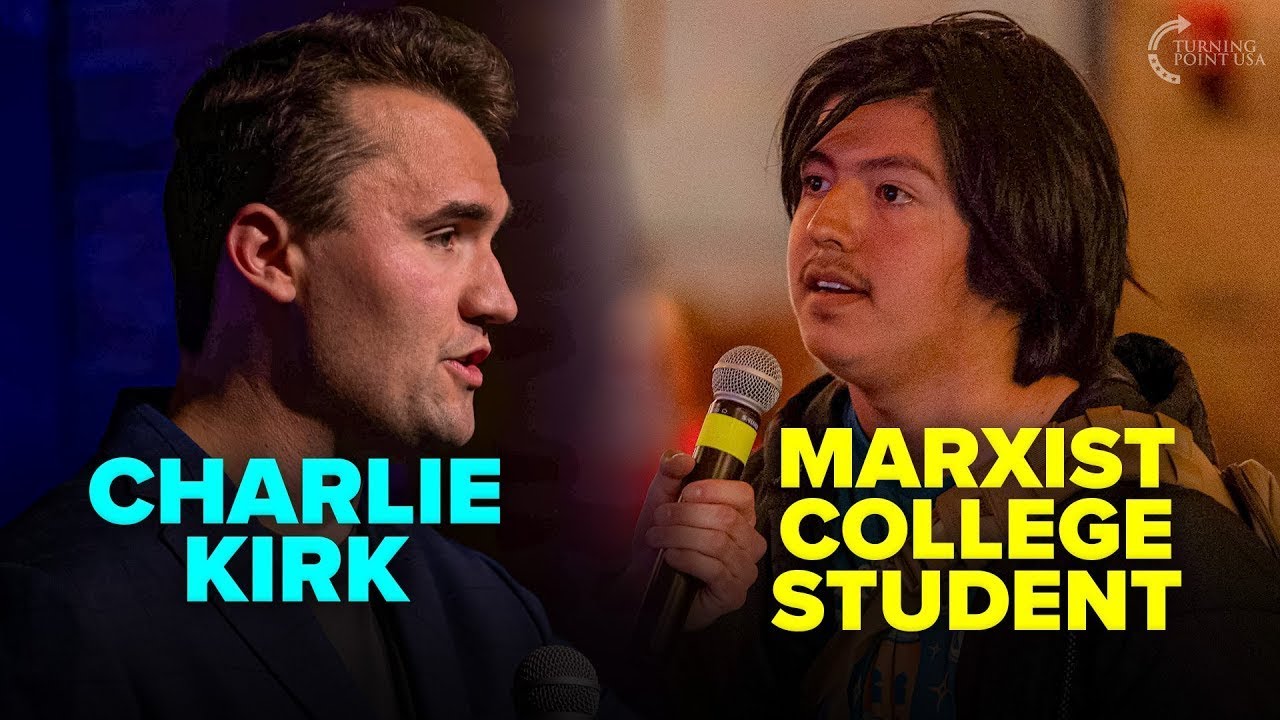
Charlie Kirk Confronts Liberal Student Defending Ilhan Omar's Israel Remarks at Campus Event
7:49

Charlie Kirk Exposes Socialism's Threat to College Campuses and America's Future Generation
15:34
Related Books
View All



Charlie Kirk and Candace Owens Launch Turning Point UK Amid Protesters and Free Speech Crisis
Charlie Kirk and Candace Owens bring their conservative movement to the United Kingdom, launching Turning Point UK in a country they describe as facing a severe free speech crisis. After encountering protesters outside their London event, Owens engaged them directly, discovering their opposition stemmed not from racism but from disliking Trump. Kirk and Owens, joined by UK activists George Farmer and Joel, discuss the Democrat Party's hold on black voters, the breakdown of the nuclear family, socialism's failures, free market principles, and why they believe the UK's deplatforming culture poses a greater threat to open dialogue than what they've experienced in America. The event featured spirited debate on healthcare, government intervention, and foreign policy, embodying their commitment to welcoming disagreement rather than silencing it.
Confronting Protesters and the Purpose of Free Speech
Charlie Kirk and Candace Owens opened their London event by addressing protesters gathered outside. Owens recounted inviting them inside, explaining that Turning Point USA believes in free speech and welcomes ideological debate. She spoke with the protesters, who held signs claiming to oppose racism despite the event being headlined by a black woman. Upon deeper conversation, Owens discovered their real objection was simply that they dislike Trump.
Owens argued this reveals how progressives use racism as a shield to attack political opponents rather than genuinely caring about black people or racism. If they truly cared about the black community, she said, they would engage in conversation rather than protest outside. The inflammatory tactic of calling everything racist allows them to be hateful while claiming moral superiority and acting as fascists who oppose free speech.
Kirk emphasized that Turning Point's policy at all events allows anyone who disagrees to cut to the front of the question line. They want disagreement, discussion, and debate. He noted that protesters are often shadowboxing against a figment of their imagination rather than engaging with what's actually being said inside, which prevents any possibility of changing minds.
The UK's Free Speech Crisis
Kirk described experiencing what he calls a severe free speech crisis in the UK, claiming it's worse than in America. While on the campus of SOAS in London with a sign reading "Socialism is Evil - Change My Mind," someone stole the sign within twenty minutes. When Kirk asked about pressing charges, he was told that's not done there. He noted the irony that if he had stolen a leftist sign promoting feminism, he would likely be in prison.
Throughout their UK visit, the venue for their event kept changing because they were repeatedly deplatformed. Kirk expressed alarm at this trend, stating that in ten years there will be singular political thought in the UK if this continues. He emphasized that conservatives never want to kick people out or silence opponents, and that even socialists should have the right to be publicly wrong. The ability to debate all topics without violence is a core tenet of a free society.
Turning Point USA's Origins and Mission
Kirk explained that he started Turning Point USA at age 18 in Chicago to fight for free markets, limited government, the Constitution, individual rights, and free speech. Six and a half years later, the organization has grown to 1,400 high school and college campuses across America with thousands of members. A year and a half before this UK event, Kirk met Owens at an event in Palm Beach, Florida, where she told him she wanted to lead the black revolution against the Democrat Party. Kirk was struck by her conviction, charisma, and courage.
The Democrat Party, similar to the UK's Labour Party, has moved increasingly leftward. Kirk joked that they now seem to hate four things: airplanes, babies, Jews, and cars. The party has maintained a monopoly on black voters in America, and anyone who dares question that monopoly faces severe pushback. Owens's willingness to challenge this monopoly inspired Kirk to bring her on board.
Candace Owens's Journey to Conservatism
Owens shared that she came from a poor family and started life $150,000 in student loan debt. Like many blue-collar families burdened by financial problems, she didn't have time to pay attention to politics. When Donald Trump announced his presidential run, her initial reaction was negative—she thought it was too gimmicky and disrespectful to the severity of politics, though she never thought he was racist, sexist, or misogynistic.
What changed her perspective was watching the media instantly turn on Trump after loving him for years. They began using black people as props, claiming Trump was racist to control black voters through fear. Owens recognized this as a control mechanism designed to turn black people into single-issue voters. She launched a YouTube channel discussing conservative principles, and despite still not being necessarily pro-Trump initially, she faced devastating attacks on her reputation simply for saying she didn't think he was racist.
The racist attacks from the left made her dig deeper into conservative thought, ultimately making her perhaps the most conservative and definitely the most influential black conservative in the world, as she stated. She emphasized how the left uses fear tactics to control people, particularly black Americans, by exploiting the deep-seated fear of returning to slavery, Jim Crow, and segregation.
The Weaponization of Racism and Identity Politics
Kirk made two crucial points about how racism is used as a political weapon. First, how could someone be not racist the day before announcing for president and racist the day they announce? This suggests the label is a tool and mechanism rather than a reflection of reality. Second, when everything becomes racist, nothing becomes racist. While real racists with deep-seated hate exist, using racism as a daily and common attack against people without such prejudice cheapens the term and allows real racists to get away with their hatred more easily.
Both Kirk and Owens reject identity politics and hatred across the spectrum, but they argue the left's flippant and casual use of terms like Nazi, white supremacist, racist, sexist, and misogynist means nothing holds meaning anymore. There's very little thought or data to support these claims, which has destroyed meaningful dialogue.
Owens also strongly opposes feminism, calling it another mechanism to control people, particularly women. She argues that telling men they shouldn't "just be boys" and promoting the idea that men should act like women and vice versa is leading to a breakdown of the family unit and society at large. Society needs strong men, she insists, and the current attack on masculinity is destructive.
The Nuclear Family Under Attack
Kirk recounted a stunning moment at SOAS when he said the nuclear family is critical to any functioning society and that rebuilding it should be a priority. A young leftist responded by calling this statement misogynistic and horrible, with others agreeing. She argued that the nuclear family is a misogynistic enterprise that must be deconstructed and destroyed. When Kirk asked who would replace the family, she said the government.
Kirk argued that when families break down, single motherhood rates increase, poverty increases, and gang membership increases. He had thought rebuilding the family was something everyone could agree on, like saying racism is bad. He later refined his response to the question of whether government should be like family: churches should be churches, families should be families, communities should be communities, and government should be none of those things.
Owens provided statistics showing that in the black community, the single motherhood rate was 23% in the 1960s but is now 74%. This contributes to the prison population, as boys growing up without paternal structure and a strong father turn to the streets and culture. She criticized Democrats for no longer even having conversations with the black community, instead throwing Jay-Z and Beyoncé concerts because they think black people are stupid enough to be manipulated emotionally.
Government Intervention and the Great Society
Kirk discussed how government attempts to fix problems often make them worse. In the 1960s, some Republicans supported the Great Society under Lyndon Baines Johnson because they agreed single motherhood was a problem and thought government could help. Instead, single motherhood skyrocketed because single mothers received government checks, but the checks went away if they got married. This incentivized bad behavior by rewarding women for not marrying.
Owens added historical context: the black community was actually outpacing the white community economically under Jim Crow laws. After the government intervened, things got worse. Lyndon Baines Johnson was an avowed racist president concerned about black people gaining the right to vote. He wanted to create a system to control the black vote. The welfare system gives just a little bit and keeps people coming back. It incentivized single motherhood by offering more money if the father wasn't in the home, and the government actually employs a division that inspects homes to verify this.
The key point both made is that government is run by human beings, not perfect machines or robots. A corrupt human being who couldn't fix something within a home won't suddenly be able to fix it because they work for the government.
George Farmer and Joel Join the Panel
Kirk introduced Joel as one of their UK influencers, and Owens introduced George Farmer, describing him as a close friend. Farmer shared that his conservatism came from his father, who sits in the House of Lords. His father grew up in a slum, lost his father at age four and his mother in his early twenties, lived in absolute poverty, started his first job as a count clerk for five pounds a week, and became a very successful businessman thanks to the opportunities provided by the Thatcher government.
Farmer emphasized that Thatcher enabled people like his father to succeed through free markets and low taxation. In the 1970s under Labour, taxes on some investments reached 103%, meaning people had to pay to invest because they received no money back. When Trump confronted European leaders at the G20 about tariffs, Merkel and Macron claimed to support free markets, but when Trump suggested no tariffs and no subsidies either, the Europeans dissolved because their economy revolves around subsidies.
Farmer gave the example of the British in India incentivizing Indians to kill snakes by paying for each one killed. Indians responded with entrepreneurial genius by creating snake farms to kill thousands of snakes for money. This is exactly what subsidies do in Europe. The free market as a concept is under attack by people who have no comprehension of what it actually is.
Joel shared that he's from Stoke-on-Trent and grew up watching people vote Labour for hundreds of years at every election while simultaneously complaining about roads, schools, and everything the government was supposed to be doing. One party offered handouts ensuring people would have just enough but never allowing them to aspire higher. His parents grew up in Africa where if you didn't work, you didn't eat—no healthcare, no education. Contrasting that valley of hard work with Labour's promise of "just a little bit" baffled him.
Joel realized around age seventeen or eighteen that he believed in the free market because businesses should compete to satisfy consumers, with individuals in control rather than businesses dictating terms with government support. He believes in limited government taking less money and telling people less about what to do because individuals are responsible and smart enough to make their own decisions.
Question and Answer: Free Markets and Tucker Carlson
An audience member asked about industrial towns where industries like steel and coal died, and people couldn't just move to cities or learn to code. They questioned whether the free market should be treated dogmatically when it doesn't work. Kirk responded by discussing his debate with Tucker Carlson, who argued government should be more like family. Kirk's refined answer: churches should be churches, families should be families, communities should be communities, and government should be none of those things.
Kirk argued that while we shouldn't dogmatically believe in anything, we should look at data, facts, and reality. The free market has brought tremendous prosperity. Tucker wants to push the limits of whether government can fix issues, but every time government has tried, it has exacerbated the problems it tried to fix, as demonstrated by the Great Society example.
Owens reinforced that government is run by human beings, not perfect structures like Autobots. People disassociate and think of government as a perfect system, but it's run by corrupt humans. The welfare system gives a little bit and keeps people coming back, incentivizing bad behavior.
Defining Free Markets
Kirk explained that a free market essentially empowers individuals to buy what they want and sell what they want without intrusive government interference. It empowers entrepreneurs, allowing good ideas to thrive and strive toward better products and services through competition. Collectivism disempowers entrepreneurs while free markets empower them to take risks and start businesses.
Everyone benefits from free markets, Kirk argued—even those who hate capitalism benefit from vaccines, medicine, Uber, Starbucks, abundant food, and lighting. All of this exists thanks to free markets. As proof, he pointed to Venezuela, where the entire country is in pitch-black darkness and babies are dying in hospitals because they have no power. This is socialism destroying what was the second richest economy in the world sixty years ago with the most natural gas reserves of any country. Only collectivism could destroy a country with such bountiful natural resources.
Farmer added the example of the UK massively subsidizing green energy. His uncle in Devon put a water mill in streams on his property to generate electricity to sell back to the grid. The more he produces, the more the government pays him, so he runs all heaters and lights on full all the time, making the house extremely hot. This is how subsidies work—creating massive energy inefficiency and a bigger carbon footprint. The free market would never do that.
Farmer acknowledged that greed drives the free market and there need to be checks and balances on humanity, but generally the free market has been a force for good. The UK rail system is not a free market—if you live in the southwest you can only catch the southwestern line, in the south only the southern line, in the southeast only the southeastern rail. That's a monopoly, not a free market, yet Labour continually tells people free markets have ruined the rail network.
Healthcare: UK NHS vs US System
An audience member asked about healthcare, noting the UK runs the NHS as a single-payer collective system while the US is market-based. Kirk challenged the premise that the US has a totally private healthcare system. America has Medicaid covering over 37 million Americans, Medicare covering over 40 million elderly Americans, and the Veterans Administration running totally government hospitals similar to the NHS, which is a total disaster.
The US healthcare system is the best in the world if you can afford it—highest likelihood to beat cancer, beat diabetes, most medical advancements, most medical patents. The problem is most people can't afford it because it's not actually a free market but a crony system. When you deregulate and allow competition, prices go down and quality goes up, but the US doesn't have transparency in pricing. When Kirk and Owens went to emergency rooms, no one could tell them what anything cost. A true market would demand pricing transparency.
Kirk explained that in the US, insurance runs everything. Obamacare was health insurance takeover, not healthcare reform. It mandated everyone buy health insurance. Most Americans get health insurance from their employer as part of their job, which is a crazy system that should be decentralized because it makes people less likely to quit jobs. Insurance companies collude with each other, and it's illegal to buy health insurance across state lines, unlike auto insurance, flood insurance, or life insurance, where prices have gone down and quality has gone up.
Kirk provided the example of LASIK eye surgery, considered cosmetic and not covered by insurance. It's a cash-only business, creating direct negotiation between consumers and providers. Ten years ago it cost $20,000 per eye; now you can get it for $750 per eye due to market competition and entrepreneurship. This demonstrates how markets could solve healthcare issues. The UK benefits from US research and development, as the US private sector spends hundreds of billions on cancer drugs and technology improvements.
Farmer addressed the NHS, noting it's frequently used to attack Conservatives despite no mainstream conservative politician wanting to privatize it. Parts of the NHS have become lifestyle choices rather than health services, citing Josie Cunningham who had 21 cosmetic surgery operations on the NHS and tweeted that taxpayers will always foot her bill. The NHS is also widely known for health tourism. Every government department faces scrutiny except the Department of Health and NHS.
Joel conducted a straw poll asking who would care if private companies ran healthcare delivery as long as it remained free at point of use. Almost no one objected. He argued that Jeremy Corbyn confuses privatization with paying for service. No mainstream conservative suggests people should pay money for health service at point of use, but private companies might run it more efficiently. The UK spent £114 billion on health and £50 billion on preventative services last year—more on treatment and less on prevention. The debate should focus on what kind of health service the country wants and can afford, not on privatization fearmongering.
Universal Suffrage and Democracy
An audience member raised questions about universal suffrage and whether democracy inevitably moves left, referencing "The Fate of Empires" thesis comparing America to the fall of Rome and Greece. Kirk responded that he believes in universal suffrage and that even felons should have the right to vote, as voting is a fundamental right. He explained that America is a constitutional republic with a democratic mechanism—not a pure democracy where 51% can overturn anything, but a system where natural rights cannot be overturned even by majority vote.
Farmer referenced Scottish political philosopher Alexander Fraser Tytler, who wrote that democracy will always vote itself more largesse until it collapses under the burden and authoritarianism takes over. However, Farmer argued this hasn't happened despite running the experiment for a long time. The fact that the audience is politically engaged enough to debate socialism versus capitalism shows the population is clever enough to realize democracy allows this system to develop and benefit society.
There comes a point where the majority who are net contributors say "enough," as happened in 1979 with Thatcher when people were taxed out of existence, faced a three-day week and rolling blackouts, and Arthur Scargill ran the country from union power. It's happening in Venezuela now with Maduro—rolling blackouts, no food in supermarkets, death squads murdering political opponents. Eventually people say enough, as happened with Soviet Russia. Free market capitalism and democratic societies keep forming because people wake up and realize socialism doesn't work.
Heated Exchange on Foreign Policy
The event concluded with a contentious exchange when an audience member challenged Kirk and Owens's support for Trump while claiming to favor limited government. The questioner noted drone strikes increased by over 400% under Trump and questioned troops in Afghanistan, Iraq, and Syria. Kirk responded that there are fewer troops in Afghanistan and Syria today than under Obama, that Trump announced withdrawal from Syria, and that ISIS is destroyed largely thanks to American advanced weaponry, fighters, and missiles.
The questioner disagreed, crediting Iran and France, and asked if Kirk supports drone strikes. Kirk said he supports targeted drone strikes against terrorists, loves the MOAB dropped on a Taliban outpost in eastern Afghanistan, and supports killing terrorists. When asked if he supports assassinating people without charge or trial, Kirk clarified that his definition of limited government includes national defense—protecting citizens against adversarial threats overseas, particularly ISIS.
The questioner cited the CIA claiming drone strikes increase the terror threat and criticized Trump's relationship with Saudi Arabia regarding Yemen. Kirk noted Trump has been a critic of the Iraq and Afghanistan wars and is preventing nuclear war with Iran, unlike Obama who sent billions in airplanes and wanted to give Iran nuclear weapons. The exchange grew more heated when Kirk asked if the questioner was friendly toward Iran, which funds Hamas and Hezbollah. The questioner said both Saudi Arabia and Iran are enemies of the west but seemed reluctant to fully condemn Iran. Kirk called Iran the number one terrorist state, while the questioner argued that Palestinian and Lebanese people have the right to defend themselves, and that Hamas and Hezbollah's terrorism pales in comparison to terrorism carried out by Israel and the United States.



Comments
Be the first to comment on this video.