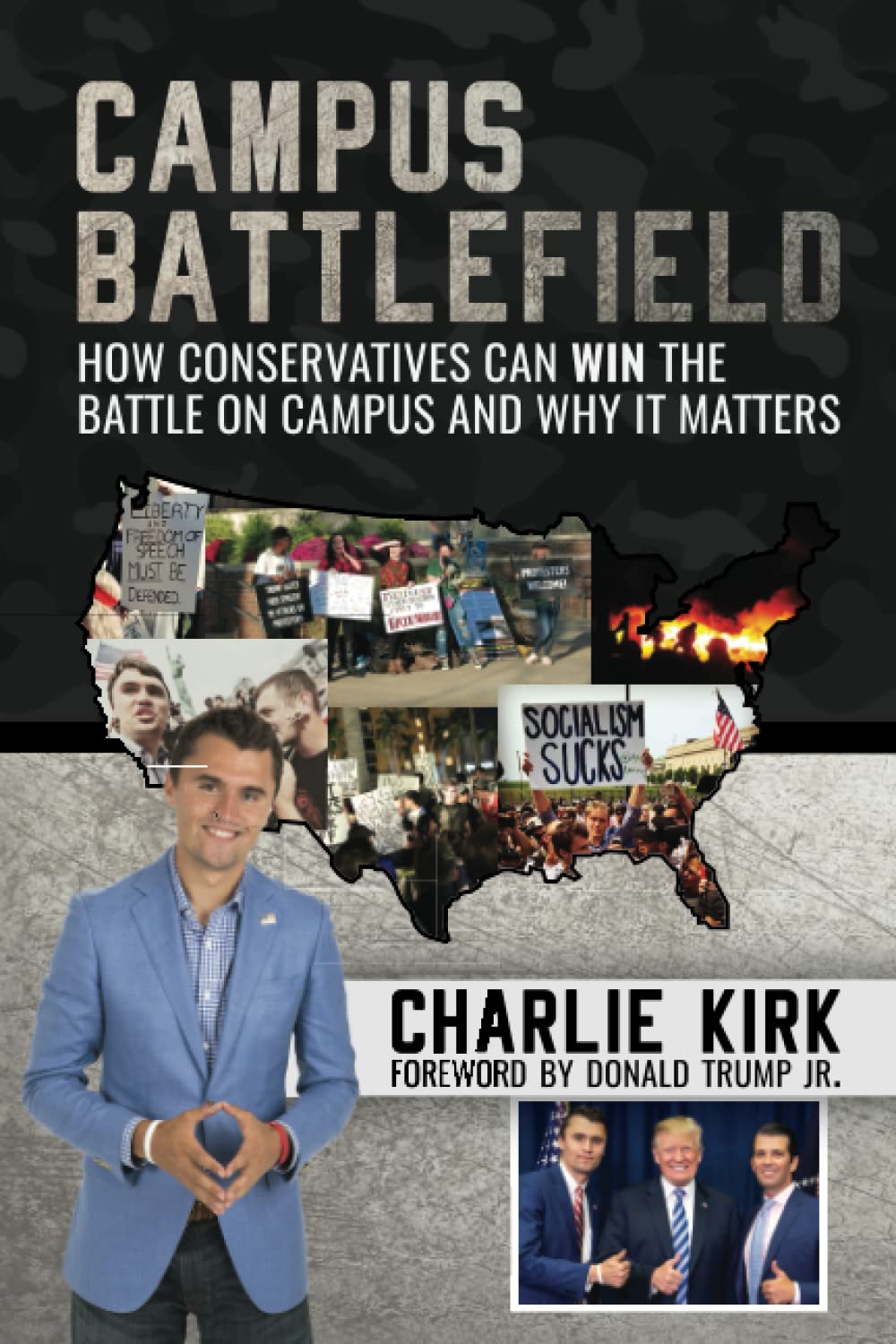
Charlie Kirk Reveals How Turning Point USA Fights Liberal Dominance on College Campuses Nationwide
Enjoying this? Share it with someone who needs to see it.
Up Next
Charlie Kirk Exposes Socialism's Threat to College Campuses and America's Future Generation
15:34
Charlie Kirk Hosts Josh Hammer and Dave Smith Debate: Israel, Foreign Policy, and American Influence
1:19:58
Charlie Kirk Explains How a Single Ohio State Football Game Sparked Turning Point USA's Nationwide Movement
1:35
Charlie Kirk Reveals How Turning Point USA Fights Liberal Dominance on College Campuses Nationwide
Charlie Kirk describes the mission behind Turning Point USA and its countercultural movement empowering students to challenge the liberal collectivist dominance in higher education. Through grassroots organizing, innovative cultural engagement, and targeted campus activism, the organization trains young people to effectively debate professors, push back against indoctrination, and advocate for free market principles. Kirk explains why the organization avoids social issues to focus on economic freedom and limited government, how they're building a farm team through high school conferences, and why he believes big government is the greatest threat to his generation's prosperity and freedom.
A Countercultural Movement Rising on College Campuses
Charlie Kirk describes what he sees as an almost countercultural, counter-institutional grassroots movement of students rising up and fighting back against what has become a liberal collectivist dominance of higher education and the younger generation. He views it as a very exciting development and considers Turning Point USA fortunate to be part of what he believes will be a historic rising up of the millennial generation against governmental power.
The Need for Cultural Relevance Over Data Points
Kirk has always felt that in order to engage young people, organizations must be more innovative and culturally relevant. During the first couple months of Turning Point USA, when he attended youth engagement seminars or policy briefings, he observed very substantive, factual arguments around charts and data about issues like Medicare going bankrupt in eight years. His response was blunt: he didn't care. He wanted to know how organizations were going to keep his attention span for more than a minute and how they were going to win the argument culturally beyond that.
Kirk emphasizes that conservatives won't win on just better charts and better think tanks, even though organizations like the American Enterprise Institute and Heritage Foundation are excellent. The problem is that they're talking with a generation, many of whom don't know the difference between Medicare and Medicaid—it's all just a bunch of words to them. However, young people can understand skepticism of big government and connect it with cultural beliefs or ideas they already hold.
Kirk advocates for relating these principles through things that young people have already experienced in a very personal manner, whether it be skepticism of big power by relating it to The Hunger Games, the corruption inherently held in the governmental system in House of Cards, or the feudalistic type power struggle that goes on in Game of Thrones. The left has been incredibly effective at this, he notes, using Avatar as an example—arguably the most effective vehicle for the message of climate change in the last five years, used as curriculum and seen by billions of people worldwide.
Why Big Government Sucks
When asked about one of the signs at a Turning Point USA event that read "Big Government Sucks," Kirk defends the language despite pushback from some people. He speaks in plain terms: big government is the number one threat towards his generation's prosperity and freedom in the future. He believes his generation has incredible potential to be the most innovative, entrepreneurial, and successful generation, but time and time again he sees government regulation, bureaucracy, and unfair rules written for people who can afford a platoon of lobbyists getting in the way of that prosperity.
Kirk points to an exploding national debt that represents taxation of tomorrow, and departments that people don't even know what they do—Department of Commerce, Department of this, Department of that—with exploding platoons of bureaucrats that come after small businessmen and women trying to advance the betterment of their business, their community, or their family's life. Beyond all the cliches, he sees firsthand a generation of young entrepreneurs, business people, and graduates who want to live a better life, but burdensome bureaucracy and bad policy and the growth of government remain the number one barrier to that future.
The Culture of Intolerance on Campus
Kirk addresses the culture of campuses where mattress girl protests, triggering issues, microaggressions, and ideological warfare are common, with silencing of conservative voices. He observes that liberal professors on campus are very tolerant as long as you hold their beliefs. He has never seen a cohort of people in power have such intolerance to constitutional, American, patriotic, free market, capitalistic beliefs. Though he's only lived for 21 years, he is alarmed not just by the power these professors wield but by the influence they demonstrate and how they are able to affect young minds for the worse.
The problem isn't just teaching propaganda and indoctrinating young people—that's one thing. The doctrine they're teaching is that if someone holds a belief differently than you, if someone believes capitalism is a good thing or that America is truly the best country in the history of the world, they're not just wrong, they're evil. Kirk sees this as completely different from the indoctrination of old in the '70s and '80s, which would allow a free flow of ideas and eventually lead young people to say they love the world and therefore are Democrats. Now young people are led to the conclusion that they love the world, therefore they hate Republicans and conservatives, and everything that stands in the way of progress is because conservatives are in power.
Fighting Back: How to Debate Your Teacher
Turning Point USA has membership across the country with over 220 of its own chapters, and with alliance partners and staff, they're on over a thousand campuses nationwide. One of their initiatives empowers young people to effectively debate and push back against these professors and teachers. They have a booklet and campaign called "How to Debate Your Teacher," which—for whatever reason—teachers don't like. Kirk says he's still trying to figure out why.
They published another online resource called "Indoctrination Prevention: 10 Ways College Professors Indoctrinate Our Youth and How to Fight Back Against It." This campaign dives into the real 10 steps professors take over a couple semesters to get young people away from the traditional American values they were raised around. Very quickly, professors make young people feel skeptical of their upbringing, ashamed of being an American, and compelled for redefinition. They argue that what America has right now is really bad, looking at very small minute issues in what Kirk sees as the tapestry of wonder of America, and they say because of this we must have a revolution, we must have complete social redefinition of classes and economic status.
Young people in their youthful exuberance say yes, and of course, the last and final thing is that these professors hold incredible influence not just through grade leveraging but also because they're doctors, they publish, they speak with such authority. For a young 18 or 19-year-old coming into that environment from a high school environment that was much different, indoctrination is almost too easy for these very liberal professors, deans, and institutions that are not teaching students how to think but really what to think and how to reject people that think differently.
Dealing With Campus Hostility
When Turning Point USA chapters face hostility, they have several strategies. At Broward College in Southern Florida, they had a cop try to arrest them for doing voter registration, which they recorded and it went national. Not every college meets them with hostility—some have good student governments—but many are incredibly antagonistic not just towards their belief structure and organization but towards any organization that comes on campus that might differentiate from the university president and their team that controls the agenda on campus.
To fight back, they try to use public airwaves. Websites like The Daily Caller, Campus Reform, and Drudge Report have been wonderful at exposing these incidents. Often, the administration will back away when they find their name or their college on a national website and they're getting calls and emails and very heated inquiries about why Turning Point USA is not allowed to have a booth or table or chapter on campus. Kirk believes the birth of digital media has really offered a safer environment for them to expose the intolerance of liberals on campus.
Stop Funding Your Alma Mater
Kirk is amazed by how many alumni who agree with constitutional and free market beliefs still write huge checks to universities even though the professors are teaching doctrine that is antithetical towards the beliefs and values they express on a daily basis and towards the entire belief system they use in growing their business or enterprise. His message is blunt: stop giving money to your alma mater unless you went to Hillsdale or Grove City or King's College in New York City. He says that somewhat kiddingly, but if people are in the position to give generously, they should charter a professor they have picked.
He suggests that alumni get together—for example, if you went to University of Michigan, gather with 10 of your graduates who want to donate generously and say all 10 of them are going to commission a free enterprise school, pick the professor, and oversee it. The Koch brothers are doing a lot of this type of work effectively. If people write blank checks to universities, it's just going to go to the endowment, which uses leverage to continue an agenda controlled by liberals and collectivists. Kirk believes the funding structure, if you can at least put a dent in it, will create free market pressure for universities to not continue this indoctrination propaganda stream.
Why Turning Point USA Avoids Social Issues
Since its founding, Turning Point USA has completely avoided social issues—they don't talk about gay marriage or abortion or any of that. Kirk explains that when he wanted to start the organization, cursory polling from his high school political science department showed that almost 70 or 80 percent of his high school graduating class said they supported same-sex marriage. When he talked to these young people, many of whom took the poll, they identified politically as Democrats because they believed in gay marriage and abortion. Kirk pointed out there are about 15 other issues that are very important to the broader scheme of governance and lifestyle in general, but they only looked at politics through the prism of those two issues.
Turning Point USA had what Kirk calls a crazy idea—though not unique, as many organizations and political enterprises do it: what if they removed those issues from the conversation? They acknowledge those issues are important but don't engage in that conversation. Instead, they talk about free markets, limiting government, skepticism of big governmental power, and fiscal responsibility. They saw broad-based appeal and acceptance of those ideas and values, a more receptive audience, because they could engage a generation that otherwise would have identified as liberal or Democrat and say there are about 20 other issues to talk about, and they guarantee about 16 of them resonate with young people. That would be the first time they ever heard that because they were told that if they believe in gay marriage, they must be a Democrat, no other issue matters.
Liberals have been able to win over a lot of people based on that, but they don't win the argument on taxes, on limiting government, on well-run government, on balancing budgets, on creating jobs—that's not an argument they want to have. Turning Point USA goes where they think the liberals are weakest, which is economic freedom, limiting government, and balancing budgets.
National Security and the National Debt
When asked about national security, Kirk acknowledges it's an incredibly important issue. Turning Point USA focuses on targeted change and thinks the fiscal realm is where they can be most effective. However, Kirk makes a compelling argument that the national debt is one of America's greatest foreign policy liabilities and national security liabilities. As the national debt accumulates, America becomes susceptible to leverage by foreign governments and entities, losing autonomy, national liberty, and freedom to make decisions because a large part of the debt is obligated to another government or entity.
Regarding ISIS and other foreign policy matters, Kirk notes that to a lot of young people, number one, they don't really care—unfortunately. The ones that do care don't understand it completely, and the ones that do care and sort of understand it don't really see the whole picture. He feels it's such a complex and intricate issue and there aren't as clearly defined lines as there used to be of what stance is here and what stance is there. But take an issue like economic freedom or balancing the budget—it's so clear to see the conservative policy stance and which states are doing well under conservative governance and policies versus liberal governance, whereas national security and foreign policy is incredibly intricate and complex. Especially to their audience, who are trying to win the soundbite war in the Twitter sphere of 140 characters or less, they see success in staying to those types of issues.
What Makes America Exceptional
Kirk has done a lot of thinking about what makes America exceptional. He loves that he gets to travel the country and meet incredible entrepreneurs and business people and learn their stories. From Mary and Dick Cabela, who started their enterprise in Sidney, Nebraska—a small town of 2,000 people in southwest Nebraska—and grew that little hardware store into over 180 megaplexes nationwide, to Bernie Marcus, who was a rugged entrepreneur who never really made it big until he hit 51 or 52 and came up with this crazy idea for distribution plants, then grew Home Depot into a multinational idea that has improved the lives of millions of people.
From what Kirk has seen firsthand, what makes America exceptional is that people can succeed greater here than in any other country nationwide. But also, from the founding and chartering documents and philosophy, Americans do not get their rights or idea of existence from a bureaucracy or from a government or an elected official but from God. That's truly the core existence of why we're here and what we believe. Every one of America's laws and legislation, at least from an early standpoint, reflected that, though the country has drifted away because the new power dominance is trying to create something that is getting farther and farther away from that belief that we do not have to succumb to government for our existence but can handle that directly through God, through family, and through personal and individual liberty.
Kirk has traveled to Europe and seen the difference of what a European entrepreneur has to go through—the taxes, regulation, and almost pessimistic outlook they have towards their country, their environment, and their success. In America, that optimism still exists. It's still a great country. People are very pessimistic, Kirk admits, but he thinks there's a lot to be excited about and proud of, and in his opinion, it's very much worth fighting for.
The Competition for Hearts and Minds
On the left, MoveOn.org has an incredible atmosphere and network on college campuses through a lot of their offshoot and alliance organizations, whether it be the Sierra Club, Planned Parenthood, or various others. Kirk has seen an incredible expansion amongst Hillary for America, which has hundreds of full-time field organizers that have flooded the campuses and are occupying them, doing voter registration, collecting immense amounts of data, and handing out what Kirk likes to call pro-Hillary propaganda—and he insists it really is propaganda.
Summer Initiatives: Boot Camps for Activists
Turning Point USA has many exciting initiatives planned, including their Young Women's Leadership Summit, Young Latino Liberty Summit, and High School Activist Conference, as well as staff training. These three conferences are not really conferences but boot camps and activist type trainings that have never been done in a demographic-specific way in the movement.
The Young Women's Leadership Summit brings together the top 125 to 150 young women campus organizers from across the country, representing almost 37 different states. Kirk is doing this conference because, quite frankly, their best organizers and best members and chapter leaders on campus are usually young women. He has observed that the Republican conservative atmosphere is incredibly difficult for an 18 or 19-year-old young female to break into—it's very male-dominated. There have not been conferences or networks for them to be able to get grassroots type training, education, or to become more effective organizers on campus. The liberals have Emily's List and Organizing for Action and other training seminars just for young women, but what are conservatives doing for theirs to train them and give them reinforcement?
The Young Latino Leadership Summit brings together the top 60, hopefully up to 75, bilingual Latino surname campus organizers from across the country. This is a demographic that conservatives talk about constantly—Kirk goes everywhere to tea party meetings and Republican events and hears "we've got to do something to engage Latinos." He was tired of hearing it, so he wanted to do something actively about it.
The High School Activist Conference is designed around what Kirk thought would have benefited him when he was a junior in high school: an activist conference focused solely on how to better defend your beliefs in a high school atmosphere, how to start a high school group, and what steps to take once you get into college. The conference is designed around the idea that a farm team needs to be developed—using a baseball analogy—to start growing the bench so that when these students hit their freshman year in college, it's not their first year of activism, it's their third or fourth year. When they're a sophomore in college, they already know how to run a group, how to grow it, how to have influence, register voters, collect data, and things of that nature.
Turning Point USA is also adding 28 people to their full-time staff, which will bring them to 40 full-time campus organizers who will service a region or a certain amount of schools—15 to 20 schools in some areas—where they wake up every single day and do the work of clipboard and tennis shoes type engagement that is needed to be successful.
How People Can Help
If young people want to get involved or engaged with the work Turning Point USA is doing, they can visit turningpointusa.net where there are eight or nine different buttons they can push to get actively involved. They'll get an email within 24 hours, some of the quickest turnaround time in the movement, even on weekends. If people are in the position of supporting financially, Turning Point USA is a 501(c)(3), and as everyone knows, money makes this all go around. They can contribute to the efforts.
The Vision for the Next Five Years
Turning Point USA has only been around for three years, but Kirk hopes to continue playing a role in re-energizing, reorganizing, and re-enchanting a generation around these ideas. Bigger, broader, and better are the three words he uses. They're always improving their outreach mechanisms. They have a big, very enthusiastic belief in grassroots organizing. Kirk feels that over the last couple years there has been a heavy focus on TV ads, digital media, billboards, and all these sorts of things, but not as much focus on grassroots community organizing, which is what Obama for America, MoveOn.org, Organizing for Action, and the DNC have done very well.
The void Turning Point USA is trying to fill is how to get better at the clipboard and tennis shoes type of work—the voter registration, the data collection, that sort of arena. Over the next five years, they're just going to continue to perfect that model and get more and more young people to go through the process of grassroots type organizing and then be able to amplify their voice beyond that. Kirk believes it's going to be an exciting journey.