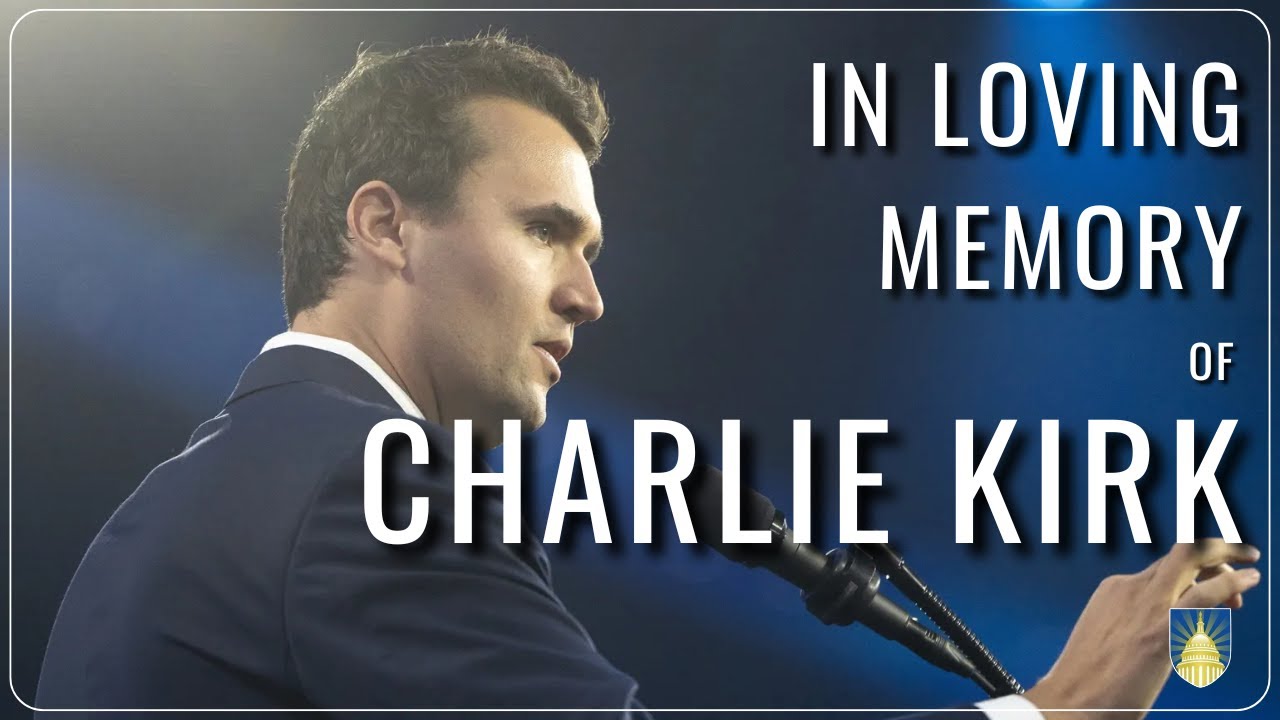
Charlie Kirk, who dedicated his life to debate and who died with a mic, not a knife, in his hand, one of these things. Charlie personified, I think, that innate American love of liberty. Ladies and gentlemen, we at UATX stand with Charlie in the sense that we stand for liberty and we stand for truth. Happy constitution day or to be precise happy constitution and citizenship day. That's the full name. It was on this day, as you all know, in 1787, 238 years ago, that the delegates to the constitutional convention signed the republic's foundational document in Philadelphia. So, Congress designated September 17th as Constitution Day and Citizenship Day in 1952, but that was the culmination of a campaign that had begun in World War I, 1917, when the Sons of the American Revolution formed a committee whose members included future President Calvin Culage to promote Constitution Day. In 1939, on the eve of another world war, the day was rebranded as I am an American day, complete with a song of that name by Gray Gordon and his tick- tock rhythm. You see, there's nothing new under the sun. The chorus uh hook line of this song was I am an Americ won't attempt to sing it. You can you can hear it on YouTube. I was eating tacos earlier listening to it uh downstairs. I am an American. I'm proud of my liberty. Uh so it was essentially Lee Greenwood uh for the big band era. In March 1941, Representative Tad Vasilvki with apologies to those of Polish heritage of Wisconsin recognized Mrs. Clariva who is a Hungarian immigrant as the founder of citizenship day which had then become a celebration of quote all those who by coming of age or naturalization have attained the status of citizenship. Now since learning that I uh must say as a naturalized American citizen I regard today in a new light. It's a reminder of the vital importance in American history of the legal path to citizenship and the dangers which have become so glaringly apparent in recent years of blurring the distinctions between illegal residents, lawful residents and full citizens. In 2005, it was enacted that each year on this day, all publicly funded educational institutions and all federal agencies should provide educational programming on the history of the constitution. So that presumably has been going on all day today at institutions all over the land. Judging by the experience of the two decades since that was instituted, a single day's instruction on this vital subject is not enough. Well, we don't need that kind of a government mandate here at the University of Austin. We don't just think about the Constitution once a year. We think about it literally every day for the simple reason that our own governing document is deliberately modeled on it. I literally copied and pasted sections of the US Constitution into our Constitution when I began the process of drafting it. And that's the reason, if you hadn't already figured it out, why we have a legislative branch, which is the board of trustees who met today, an executive branch, which is the president, uh, as well as the other academic officers, and a judicial branch, the adjudicative panel. That's the reason that we have a bill of rights. A bill that spells out as the constitution does nationally what our freedoms are here and also what our responsibilities are. We adopted this system of governance because we believed that the collapse of academic freedom and academic standards that we beheld in nearly all the established universities over the decade or so before our foundation had its roots at least in part in defective structures of university governance. Now, like the US Constitution, ours, as has been mentioned, has already been amended several times, as we've learned by experience. But I believe experience has already revealed that it's a functioning document confirming that there are real checks and balances on the executive branch and therefore real protections for the rights of professors and students. But this afternoon I want to address a broader question about the relationship between our startup upstart university and the republic under whose laws we operate. It must be the case that even the most perfectly constituted university would be unable to uphold the pursuit of truth and of academic excellence if it were located in a country with an illiberal political system. We're far from the first academic institution in history to adopt Emanuel Kant's Sappare Audi dare to think as a tagline. It was in fact the motto of the Moscow Institute of Physics and Technology which was established under Joseph Stalin. And I think we can be fairly confident that its faculty and students were very careful indeed about what they dared to think. The top German universities in the 1920s were universally regarded as the world's best. They dominated the lists of the Nobel Prize winners in the sciences. And yet their excellence did not protect them after Hitler came to power in Germany in 1933. Indeed, and I argued this in a previous talk here at UATX, German professors and students at institutions such as Marberg, Tubingan, H Highleberg enthusiastically embraced national socialism before and after 1933. Their fouian pact with Hitler's illiberal ideology has been mirrored in our own time by the readiness of a generation of academics and academic administrators to make a similar pact with such illiberal ideologies as the various schools of grievance studies as Peter Beosian christened them. deliberately terminating the teaching of Western civilization in an orgy of so-called decolonization that culminated in the toxic celebrations of barbarism on so many American campuses after October the 7th, 2023. But what what some of our critics now say if the republic itself is in danger of a fate similar to that which Germany suffered in the 1930s. A recurrent fear in liberal America as well as abroad has been of a fascist America or at least of a transition from a republican to an imperial order. I think this is how a republic dies. My old friend Andrew Sullivan wrote last month, "Is Trump a dictator?" asked the London Guardian on September 1st, answering the question you'll be amazed to hear in the affirmative. My old friend Lionel Barber, former editor of the Financial Times, recently called President Trump, quote, "A dictator in waiting." The murder of Charlie Kirk at Utah Valley University has unquestionably turned the heat up further in this whole debate. And I want to honor Charlie's memory this afternoon and remind you that it was a week ago that that horrible crime was committed on a university campus. As the founder of Turning Point USA, Charlie was an inddehaticable advocate not just for Trumpian conservatism, but for free speech who worked tirelessly and always cheerfully to counter the woke progressive consensus on college campuses around the country. I met Charlie at a dinner in Los Angeles last May and I was I was really won over by his obvious sincerity and integrity, his commitment to Christian faith as much as to conservative politics. His assassination has sent a shock wave through the generation of young predominantly but not exclusively male conservatives whom he inspired. I want to quote from an email uh one such young conservative sent me just after the news of of Charlie's murder. Classical liberalism and moderate conservatism in America definitively kicked the bucket yesterday. He wrote that was Thursday morning. Charlie Kirk did everything the right way and was truly earnest in engaging his opponents in good faith. He was a genuine believer in everything we've been told since youth about how politics works and was our happy warrior in the marketplace of ideas. My young friend continued, "None of that mattered. The left blew out his jugular in front of his wife and kids. A political martyrdom livereamed in 4K. Charlie spent his whole life preaching and living the moderate option, yet the left murdered him as an extremist. Anyways, I cannot understate, my friend went on, just how important this development is. America has indeed breached a turning point. I fear that from Charlie's blood sprang 10,000 Franco yesterday. The left swed the years of lead. They will reap the storm of steel. Well, I pray that he is wrong about that last prophecy. In a nationwide television address that I imagine many of you watched, President Trump himself hailed Charlie as a patriot and a martyr for truth and freedom. For years, the president said, those on the radical left have compared wonderful Americans like Charlie to Nazis. This kind of rhetoric is directly responsible for the terrorism that we're seeing in our country today. Yet, it was predictable that the left once stayed tired of gloating hideously over Charlie's murder and then claiming without a shred of evidence that his assassin was in fact to the right of him politically would immediately turn Trump's argument on its head, accusing him of instrumentalizing the event as Hitler used the February 1933 Reichag fire to move the country a step closer to dictatorship. Ladies and gentlemen, on Constitution Day, we all obliged to remember Benjamin Franklin's reply to the lady who asked him on this very day in 1787, "Well, doctor, what have we got? A republic or a monarchy?" a republic, Franklin replied, and you can all join in. If you can keep it. Now, the source of this famous quotation is actually the journal of James Mckenry, who was an Irishborn Maryland delegate to the constitutional convention, who'd served under Lafayette at the battle of Yorktown and later served as secretary of war under presidents Washington and Adams. So this is one of these historical quotations that turns out to be real. And the woman who asked Franklin the question was Elizabeth Willing Powell of Philadelphia whose father, brother, and husband all served as mayors of that city. Well, can we keep it? Are we losing it? My benchmark ever since Trump emerged as a plausible presidential candidate 10 years ago is Buzz Windrup. Now, who here raise a hand has read it can't happen here? Okay. where you need to. It was published in 1935 and it's Sinclair Lewis's dystopian vision of a fascist America. In the book, a bombastic Democrat, he's actually a Democratic senator. Barazilius Buzz Windrip, who was, I think, modeled partly on Huie Long, the Louisiana governor, is elected president, overthrows the constitution, and institutes something a lot like an American Nazi regime, complete with paralitary uh paramilitary thugs, the minute men. There's a gerbleslike sidekick and corpo economics. Resistance comes only from a mly band of conservative Republicans li and libertarians like the Vermont newspaper editor Dormus Jessup who's the book's unlikely hero. Now American literature has definitely produced better written fascist dystopias than it can't happen here. Margaret Atwoods, The Handmaid's Tale, 1985, and Philip Roth's Plot Against America, which was published 2004, to name just two. And then you also have the early Cold War dystopia of a Stalinist America in something like Ray Bradbury's uh Fahrenheit 451. That's the world, the America where the books are all uh burned. Uh, but you see, Donald Trump is the Buzz Windrip of the liberal nightmare. Andrew Sullivan likens him to, I'm going to quote here, a wild boar, psychologically incapable of understanding anything but dominance and revenge with no knowledge of history, crashing obliviously and malevolently through the ruined landscape of our constitutional democracy. because he cannot tolerate any system where he does not have total control. So Trump didn't go fool Windrip in his first term. Sullivan concedes that. But in his second term he argues the buzz windrip has been unleashed. So he he can and he does here I'm just going to paraphrase Andrew Sullivan's argument go after domestic opponents from law firms to bureaucrats to journalists to judges. He's already declared states of emergency more than 30 times to justify extraordinary measures. He imposes tariffs with quote zero constitutional or legal authority. He has pardoned violent writers, insurrectionists, and corrupt polls on the take. Again, a quotation, assaulted the autonomy of universities, ended free speech protections for non-citizens, and mobilized quote, armed masked anonymous men and women to round up and deport suspected illegal immigrants. There's plenty more in this vein you can find if you read say the Guardian newspaper or for that matter at the New York Times and specific incidents the FBI raid on the home of John Bolton, President Trump's former national security adviser turned critic or the replacement of the Bureau of Labor Statistics Commissioner or the attempt to fire uh Federal Reserve Governor Lisa Cook. All of these events are gristed to the mill of the critics. And yet, ladies and gentlemen, there's a danger of impressionism in much of this commentary. This week, this was the Guardian on September the 1st. A giant banner was draped over the Department of Labor building showing Trump glaring out over Washington DC. above the slogan American workers first. Hang on. Banners equate to fascism. Or does Lionel Barber recoiling from the $200 million state ballroom which Trump has ordered to be constructed on the ground occupied by the East Wing of the White House. But where where in the Constitution does it say no ballrooms? Everyone suffering from what I'll call windrip syndrome just needs a reminder of what fascism was. In Italy following the murder of the socialist deputy Jakoma Matiotei in 1924 which was almost certainly ordered by Mussolini. Political opposition was banned. The likes of the Leninist Antonio Gsky were consigned to prison. Henceforth, the fascist party brooked no competitors. Newspaper editors were required to be fascists teachers to swear an oath of loyalty to Ilduche. Parliaments and even trade unions, although they continued to exist, were sham entities entirely subordinated to Mussolini's dictatorship. Or take the case of German national socialism that emerged from the depression as opposed to the sustained expansion the United States has experienced in the past decade. It was explicitly revolutionary. The stated goal was to overthrow the VHimar system and create a racially pure folks shaft. Party agencies like the SAT systematically used violence against opponents. Soon after Hitler came to power in 1933, the new regime began exerting direct control over the civil service, the media, the police, and the military. Rearmament became a goal, in fact, the goal of economic policy, and war the goal of foreign policy. From the outset, anti-semitism was a core feature. Above all, the Third Reich was from the outset a lawless regime. Just think of the arrests without trial. 26,000 people were already in so-called protective custody as early as July 1933 or of the summary executions beginning with the night of the long knives in June 1934 when between 85 and 200 people were murdered in cold blood. Let me give you another historical reminder. The imperial presidency, the expanding executive branch, long predates Donald Trump. Franklin Roosevelt's critics saw the New Deal as a power grab by the executive branch. Peter Teal reminded us of that last uh year in his lectures uh on the Antichrist. Richard Nixon's Democratic critics, notably Arthur Schlesinger Jr., made very similar arguments in 1973. As my friend Jack Goldsmith of Harvard and the Hoover Institution has argued, there has been a sustained, I'll use his phrase, escalation of power grabs by the presidency throughout this century, aided by quote, substantial delegations of power from Congress and an approving Supreme Court. George W. Bush greatly enlarged the power of the US national security state after the 9/11 attacks 24 years ago this month. Barack Obama used executive orders for quote largecale and sometimes legally dubious policy initiatives, asserted broad non-inforcement discretion in cases involving immigration, marijuana, and Obamacare, and used quote legally dubious threats to yank federal funds from universities to force changes to their rules on sexual assault and harassment. changes that had many malign consequences. Joe Biden not only abused the presidential power of pardon for the benefit of his own errant son, amongst others, he extended the Supreme Court's unitary executive case law to fire the statutoily protected commissioner of the Social Security Administration. He purged Trump appointees from arts and honorary institutions, the Administrative Conference of the United States and the Department of Homeland Security Advisory Council. And of course, the Biden administration had no qualms about waging or encouraging lawfare against political opponents, not least Trump himself. In recent months, as you may have noticed, there's been a crescendo of complaint about the Trump administration's alleged undermining of the Federal Reserve's independence. But as Treasury Secretary Scott Besson argued in a very important article published earlier this month, it's the Fed that has been overreaching in the years since the global financial crisis. what Bessant called a gain of function monetary policy experiment. Quantitative easing boosted wealth inequality much more than growth and then caused a nasty bounce of inflation in 2022 and may end up costing taxpayers billions. The Fed has overreached on regulation two and its politicization, judging by the political donations of Federal Reserve Bank directors, dates back 10 years. Yes. Since his in uh second inauguration, Trump has cited emergency powers in around three dozen orders and memoranda. But both Obama and Biden did exactly the same thing. They just did it more slowly. In any case, the law courts are currently grappling with 400 cases involving the Trump administration. 404 to be precise according to the website Just. Of the 404, none has been closed in favor of the plaintiff. 28 have been blocked. 82 temporarily blocked. 19 blocked pending appeal. 20 temporarily blocked in part. 48 have had a temporary block denied in part or wholly. 33 are pending appeal. 162 are awaiting a court ruling. 23 have been closed. Two have been transferred. and just seven have been closed or dismissed in favor of the government. This is Trump's fifth year in government. I can assure you that was not how German law courts worked in 1938, the fifth year of Hitler's regime. Representative Steve Cohen, who's a Democrat from Tennessee, has a website that tracks what he calls the Trump administration's harmful executive actions. From the closure of USA to uh aid to the sending of threatening emails to federal workers. The problem here is that Cohen conflates actions that are open to legal challenge and actions that are matters of policy that he doesn't like. Jack Goldmith estimates that in around four dozen cases, the Trump administration has simply accepted court rulings against it, either by not appealing them in the first place or by not pushing further after losing in the Court of Appeals. again 1930s Germany. This ain't Jed Rubenfeld just published in the Free Press an interesting uh piece arguing that the cases heading to the Supreme Court are doing so precisely because they're far from open and shut. Take the case of the International Emergency Economic Powers Act. That may not be a secure basis for President Trump's reciprocal tariffs as it confers on the president the power to regulate imports, not the power to tax them. That was certainly the view of the Court of Appeals for the Federal Circuit. But section 338 of the tariff act of 1930, this the infamous Smoot Holly Act, empowers the president to impose tariffs of up to 50% on any country that is placing quote any burden or disadvantage on US commerce. So it's possible the Supreme Court may side with Trump. The Supremes may rule against Trump. In the case of Lisa Cook, I think it's unlikely the majority of justices will accept the unproven allegations of mortgage fraud as sufficient cause uh for Trump to fire her from the Fed. And I think they may rule that the administration was acting illegally when it sank a boat the other day, allegedly carrying drug smuggling members of the Venezuelan gang trend Aragua, or when it deported gang members on the basis of the Alien Enemies Act. But the justices may back Trump on his right to send the National Guard to Los Angeles, Chicago, and Washington DC because there are precedents for sending in the military to protect government officials carrying out their duties. In this case, agents of US immigration and customs enforcement. As Harvard's Noah Feldman has pointed out, sooner or later, the Supreme Court will have to make up its mind on these difficult cases. Only if it calls every one of them in the administration's favor will we need to start worrying that the separation of powers has stopped working. And I'll be amazed if it does that. In the same way, it's too early to write Congress off as a mere rubber stamp for the White House. The Republican majorities in Senate and House alike are wafer thin. The economy is palpably slowing. Look at the labor market, partly because of tariffs, partly because of the drastic decline in immigration, and inflation still above the Fed's 2% target. Voters are thermostatic. They wanted immigration restriction back in November, but they're squeamish about deportations now that they see employees and neighbors rounded up and expelled. Despite the Democrats tanking approval and tanking voter registrations, the GOP could still lose the House in the midterms in November next year. And there are informal checks and presidential power, too. The chief executives of some of the biggest tech companies do seem embarrassingly eager to kiss the president's ring in return for minimal AI and crypto regulation, but not everyone's so sick of Trump has plenty of vocal critics on both Wall Street and Main Street. The same is true of the media. It's hard to shut up the US press corps and the internet's made the media even more unruly than in the past. I got into a Twitter argument with Vice President Vance earlier this year and as you can see I'm not yet in protective custody. American generals also seem unlikely to support a US monarchy or dictatorship as there remains a very strong culture of military loyalty to the Constitution. As for the 1.3 million practicing lawyers in the United States, they all have a vested interest in preserving the rule of law. It's their livelihood. And I'm quite sure our excellent general counsel, if he's here, would agree, right, Adam? It's what you do. The prelude to dictatorship is often historically civil war or anarchy. Now, Americans may be polarized, but they're not at war with one another. I say this even after recent events that seem calculated to increase the risk of civil war. Not only the assassination of Charlie Kirk, but also the fatal stabbing of Arena Zerutska, a 23-year-old Ukrainian refugee in Charlotte, North Carolina on August 22nd. The man accused of killing her, an African-American named D. Carlos Brown Jr. had previously been arrested multiple times and convicted of robbery with a dangerous weapon, breaking and entering, and larseny. After the attack, he said simply, "I got that white girl. I got that white girl." If a hostile foreign power intended to destabilize the United States, and I can think of at least three who do, the killings of Charlie and Arena would be perfectly crafted to that end. One crime exacerbating political division, the other racial mistrust. Ladies and gentlemen, as in the 1930s when Sinclair Lewis dreamt up Buzz Windrip, there are many people in the 2020s who are emotionally overinvested in the idea of an American descent into fascism. Now, it'd be naive to dismiss the fear that, especially in the febral atmosphere occasioned by two such shocking murders, the presidency will grow yet more powerful relative to the other branches of government. But the serious student of history knows that the United States today is a very long way away from Italy in 1927 or Germany in 1938. And now as then, it seems much more likely from a geopolitical standpoint that the United States will end up in conflict with the truly authoritarian regimes than fighting alongside them. Now, I say this with some feeling, having just seen what a real fascist government is capable of in the streets of Keev, where I was last weekend, by a bitter irony, the street where I saw an apartment building destroyed by a Russian cruise missile, which killed 23 innocent Ukrainian men, women, and children, was me was named Vaslav Harvel Boulevard. Harvel personified, the spirit of freedom that ultimately freed central Europe from Soviet tyranny. We should all remember his injunction written when he was a dissident in Prague shortly before he was sentenced to 5 years in jail to live in truth. Ever since that time, that phrase live in truth has been engraved in my mind. As events after Pearl Harbor showed, there's nothing like fighting real fascists and real imperialists to rekindle that American love of liberty that Gray Gordon cruned about. Events in the world today remind us that freedom is under threat not just at home from illiberal ideologies and their proponents, but also abroad. from the axis of authoritarians, China, Russia, Iran, and North Korea, which pose together lethal threats to democracy, not only in Ukraine, but also in Israel, also in Taiwan. I really find it hard to believe that we Americans will stand idly by if the authoritarians look likely to snuff out freedom in any one of those embattled countries. Charlie Kirk who dedicated his life to debate and who died with a mic not a knife in his hand. One of these things Charlie personified, I think, that innate American love of liberty. Ladies and gentlemen, we at UATX stand with Charlie in the sense that we stand for liberty and we stand for truth. In our own small way, we are trying to do what the men of 1787 achieved so magnificently. And they were all men, I'm afraid, even though it took a woman to ask Ben Franklin the crucial question. We're daring not just to think, but to build. And we're building in the belief that with the right system of governance, with the right operating system, if you like, what we're building can endure just as the United States has endured. Next year, we'll celebrate the passage of a quarter of a millennium since the Declaration of Independence. It will also be, I hesitate to draw the comparison, five years since our own declaration of academic independence which was back in November 2021 when we announced that we were going to create a new university here in Austin. I hope that it's now clear to you that we can't possibly flourish if the American republic and for that matter the state of Texas do not flourish too. The constitution of academic liberty depends for its survival on the constitution of liberty at the federal as well as state levels. There's no doubt in my mind, none at all, that the constitutional order is threatened by malevolent adversaries both at home and abroad. It's also threatened, I must say, by those on the right who sometimes in the heat of the moment forget that the First Amendment protects hate speech too, no matter how much you hate it. But all that was true in 1787, too. That was why Franklin used those words, "A republic if you can keep it." We've created a free university dedicated not to the imposition of egalitarianism, as our president rightly said at our convocation in a brilliant speech, but to the preservation of liberty and to the fearless pursuit of truth on the basis of that liberty. In short, a university of liberty if you can keep it. Thank you very much indeed. [Applause] And now let the games begin. as my son likes to say, questions. Um, hello. It's nice to see you again. Good to see you, too. Um, so when the Constitution was changed this summer, we weren't really notified. We kind of figured it out on ourselves. Um, and it seems that for a constitution to be a constitution, it needs to be a public document that publicly changes. um especially since we as students don't and I'm not making any uh value judgment on if we should or not but we don't have uh kind of any elected authority or any kind of authority. What is our relationship with this document? Well, it is very clearly uh not a document that requires plebbeitterary ratification by the students. Uh it's a document as the constitution makes clear uh that the trustees have uh the right to modify to amend and uh we have made some uh amendments in the light of problems that surfaced as was inevitable when we tried to put into practice things that uh we had imported from the US constitution that turned out not to to be practical. or indeed compatible uh with the laws of the state of Texas and the federal laws governing a private university. Uh in that sense, I think you need to recognize uh the nature of this constitutional order. You you're not the citizens of of a democratic republic. On the contrary, your students at a constitutionally governed university. The experiment with uh academic democracy has been tried. Interestingly in Germany uh as well as in other European countries after the 1968 uh disturbances or risings if you want to dignify them with that that name uh many German universities gave considerable power to students after that point in their governance. I think one of the lessons of uh these experiments is that they don't work well and they don't work well for many reasons. uh one of which is that that students are students. Uh they're students who spend three or four years depending on the system at an institution and then pass on. They're not in that sense analogous with citizens of a republic. So we designed the constitution with minimal student representation quite deliberately uh because we'd observed that experiments with student representation in in universities elsewhere either produced as they did in Germany very bad outcomes or were a sham and I've certainly seen in more than one institution phony student representation bodies in students are represented that essentially are nothing more than talking shops. So Emma, that is my answer to your question and I thank you for asking it and I hope you appreciate my candid reply. Thank you. [Applause] You've made a very compelling case that President Trump has not consolidated power as effectively as his critics allege. But from a 10,000 foot point of view, it still seems very clear that the administration's language and self-standing is more authoritarian. That maybe we could even call it the predominant strain among young right-wingers is incredibly authoritarian, whether you call it integralism or vitalism or whatever other strain you're referencing. And from an even bigger point of view, you've also got China as a bit of a mimemetic example that seems to be influencing how people in the US think about security. You know, the Chinese surveillance state seems to have been very effective at reducing crime. Do you really think that 10 to 20 years from now, our constitution isn't going to be substantially more centralized and how it distributes power and the degree to which this country is authoritarian? Thanks. It's a it's a great question. It's possible that it will be even more centralized and the presidency will be even more powerful because that's the trend and you can trace it back to the the 2000s, you can trace it back to the 1970s or you can trace it back to the 1930s that the trend has been uh towards an imperial presidency. Uh my objection is to the claim that this is only a feature of President Trump's uh administrations, whereas it's clearly been a feature of multiple administrations, both Republican and Democratic. But one thing that I'm reminded of uh when I study the 1970s is what happened to Nixon's imperial presidency. As I mentioned, Arthur Schlesinger Jr. writes the Imperial Presidency at the height of Nixon's power. It's published in 1973, the year after Nixon had won a landslide re-election uh victory in which he'd won every state but won. And he was gone, forced out of office uh before the end of 1974 because of Watergate. And what did Watergate reveal? Watergate revealed that there were very real checks on the imperial presidency if the judicial branch and the legislative branch exercised their powers, which of course they did. From Nixon's perspective, it also revealed the power of non-constitutional forces, the press, uh the liberal elite. But that seems to me not to have changed so very much that a scenario is inconceivable in which some similar fate could befall President Trump. I've often pointed out that he's Richard Nixon's revenge on Harvard and the New York Times and the Department of Justice and the bureaucracy and that's the way we should really think about President Trump. Uh but it's a dangerous thing to take Richard Nixon as your role model considering what happened to him. So, I think the lesson of of American history is not that the continuum is a completely uninterrupted one towards an imperial presidency, but rather that we can see moments of of of punctuation. I've just been reading uh Phil Tobman's biography of George Schulz. And it's worth being reminded of just how completely the Reagan presidency nearly fell apart over Iran Contra uh which once again saw the legislative branch and the judicial branch exercising power to restrain to to restrain the executive branch. So I think we can't be certain that the direction of travel is only in in one possible direction. Finally, you mentioned the the I think very dangerous notion that we should somehow mimic Chinese state capitalism. This has become something of a talking point uh in Washington. The lesson of the first cold war is surely that the greatest danger to the United States in a cold war is to become like the enemy. uh the convergence theory which I suppose reached its peak in 19 uh in the 1970s was that the US and Soviet systems were converging and becoming more and more alike and people worried that the US national security state was beginning to take on aspects of the Soviet national security state. Looking back, that all seems wildly overblown because the differences between the two systems remained vast. As anybody from the Soviet system could explain, when Soljan Nitsen came to the United States, he was kind of incandescent that anybody could make this category error. So I I think although I can't be certain, nobody can be certain about what's going to happen, I think there's a plausible case to be made that this all ends quite badly for the imperial presidency. After all, one consequence of our political economy these days is an unsustainable fiscal burden. Uh, and there comes a point at which when you're spending more on interest payments than on defense, you're you're really in a situation of grave overstretch. And I think that collectively all three branches of government have led the United States into an extremely precarious position. If it comes to a collision with the authoritarians, and this was a key point of my talk this evening, we're much more likely to end up in collision with China than somehow joining forces with it. Then I think we'll rapidly rediscover the love of of liberty. If I can just ask one quick followup. It seems like you're like you're basically saying, okay, the imperial presidency might be ripped under by the same things that brought down Nixon, almost brought down Reagan, which is the security state or elements of the security state sabotaging Nixon with Watergates. Maybe Nixon also at some level doing that. And then with Iran Contra sabotaging Reagan on some level with Iran Contra. But if something like that were to happen a third time or a second time depending on how you count Iran Contra like it seems either that that succeeds and that sense of like this paradox for either that creates an incentive for the Trump administration to root out the security straight all the more strongly which means that it consolidates power at the end or in turn to be destroyed by the security state in which case the right becomes inevitably more authoritarian. Isn't there some kind of paradox there which forces the US to become more authoritarian in the long term if the options are either consolidating power on the president to stop the security state or the security of state threatening the presidency? Well, you'll you'll remember in the class that we did uh back in the spring on the philosophy of history with uh Brandon Deadman, we discussed the the nature of of of republican constitution that combines a democratic uh and aristocratic and monarchical elements. The founding fathers designed a system that is bound to produce conflict between the different branches. that that was part of the design and they also knew that there was a risk a very familiar risk from history that one part would become too powerful. So any republic that is a mixed constitution like the United States can go too democratic and end up in a state of of anarchy. That would be the kind of vhimar nightmare or or it can become too monarchical and then up end up being a tyranny. to the founding fathers. That was just obvious that that's what Franklin meant when he said, "If you can keep it, the the Republican order is inherently precarious because it's a three-body problem." Those of you who've read Lucy Shin uh will remember that the the problem of the the three bodies that the different gravitational forces make Tricolaris almost uninhabitable. The American constitution is a three-body problem. So is UATX. And there are people who complain to me, "Oh, well, the president's too powerful." Well, yeah. So is the president of the United States. There has to be power or you end up being Switzerland. Do we want to be Switzerland? I mean, I've been to Switzerland. It's very nice. But you know what? It only stays Switzerland by offering moneyaundering services to dictatorships in times of conflict. And that is not a business model that I find ultimately very congenial. So this is the nature of republican order. It's the nature of the constitution of liberty. In the end, it's only as good as the citizens themselves love liberty. If we all decide collectively to acquies in a Trumpian monarchy, then history has just provided another illustration of the extreme difficulty of sustaining republican government. But I think I pointed out to that class that Americans have been worrying about this almost from the outset that we are Rome, that we're the republic, and at some point somebody will be will be Augustus. I'll bet against it being Donald Trump, and I'll bet against it being JD Vance. I'll just bet against that Roman outcome, and I'll certainly bet against a kind of German 1930s outcome. Now there's quite a line that has formed here and I'm conscious that time is not limitless. So I'm now going to switch to shorter answers. Um you talked about Constitution Day and how any federally funded educational institution that wants to continue receiving that funding now has to have Constitution Day programming on September 17th. Is the university now or will it ever pursue federal funding? It is not and I do not believe that it ever will. That is that is one of the most important ways in which we can uphold our liberty because as I said it wasn't President Trump who first started to flex the power that the federal government has of the purse. Barack Obama uh started that. So no, I think we we are increasingly of the view that that can't be something we do. Thank you for asking. [Applause] Thank you for giving us all an excuse to procrastinate our prodigious course load that you've assigned us. Um, I wanted per your own methodology to run a counterfactual by you. Say in an alternate 2024 election, a candidate is elected who doesn't have the same reverence for the Bill of Rights in the Constitution and somehow there's a scenario in which this has changed. uh to what degree is the univers the University of Austin willing to stand against a government that might jeopardize its accredited uh accreditation status or otherwise ability to operate? Uh how committed are we to the truth more than the constitution might be? Well, as uh Harvard is discovering, it's quite hard to win a fight with the federal government even if you're the richest university in the land. And I think that uh one obvious lesson of history is that in any fight between a willful central government uh it's the the central government that will likely win over the plucky little university. There are exceptions to the rule and I talked about one at our first principles summit uh back uh earlier in the year. Uh and that was the the great fight uh in the 1680s between my old Oxford College Mlin uh and King James II. Uh King James II tried to impose a Roman Catholic president and the fellows of Mlin weren't having it. And uh it became really very fraught because not only uh did their president get imposed on them but they were all expelled. So the fellows were expelled from the college and that might have been the end of the story except that as the historians tell us this was one of many overreaches on James II's part and uh it was one of the things that contributed to uh his undoing and what we call the glorious revolution. So in that case uh the academic institution actually won against the tyrant and uh it's a cause for celebration each year at Mlin there's a restoration feast uh at which magnificent uh uh food is served but that's the exception as they say that proves the rule uh that the list of universities that have been crushed by powerful executives powerful governments is a very long uh indeed. So I think in the scenario that you suggest uh we would do our best uh to abide by our own constitution uh to run our university according to the rules that we have adopted and since we don't and don't intend to accept federal funds, we would be quite hard uh to bully into changing our ways. And it's not entirely clear to me what the posited authoritarian regime would ask of us. Uh but that's the that's the best historical answer I can give you. As I said earlier, I think this is a a relatively low probability scenario. And I think that the case of uh of Germany illustrates that even the best universities in the world uh folded in the face of of Hitler's dictatorship. It's just that they mostly folded willingly. I don't think in this institution were I detect a strong libertarian spirit, I don't think that there would be many people who would celebrate the advent of a monarchy or a dictatorship in uh the United States. And I hope that uh the spirit of Vaselval would be alive in this building if that scenario, that nightmare scenario were to eventuate. I don't know. I I wasn't put to that test. I had the good fortune to be in Western Europe, not in Eastern Europe, uh during the Cold War. Uh but I do know that uh the most inspiring texts that you can read uh and I know that some of them are assigned in some of the courses uh that you're studying are the texts of the dissident, those who stood up against the Soviet uh tyranny. And if we do our job well as teachers, we'll instill in you that Havl principle of living in truth. And one can live in truth as Havl argued even under a dictatorship no matter what demands it may make on the institution where you're employed. Thank you. [Applause] Hello, Sir Neil Ferguson. I have the question that you you make the mention of of the of that we are a republic, Franklin's notion that we are a republic if you can keep it. And so I wanted to to extend this question onto you. How important do you think it is for the American Constitution and especially for our Constitution as a school to make sure that the changes to these documents are documented and and kept knowledgeable to the people who need to know them? Do I infer from your question you would like a redlinined version of the Constitution in which the amendments can clearly be discerned? Not quite. But in the American Constitution, which our Constitution is based off of, the amendments are clearly added on and the original Constitution is kept intact. And so, not necessarily a redlinined constitution, but should there not be some kind of addendum in which you can see each amendment that is made? Yes, I think you're probably right about that. I've often thought about it. I can't um entirely express how extraordinarily difficult it was uh to navigate some of the difficulties that we created for ourselves with the initial draft of the constitution and it may have been an error of uh haste on our part that we amended it without uh making the amendments explicit additions. Uh I have to tell you that they wouldn't make for very pleasant reading since they're mostly very technical uh unlike the quite exciting amendments that you find at the end of the US Constitution. So I'm not against uh publishing uh a kind of amended version, an original version with the amendments, but I just want to forewarn you that it's mostly very technical stuff about the adjudicative panel and how it should proceed. Uh, I mean, I'm not surprised that that proved tricky because it was entirely new to create a judicial branch and those don't exist at any other university. There simply isn't anything like this anywhere else. And so, we were innovating in in terms of how uh we would we would restrain ourselves. That was the tricky bit. I'm not against publishing those amendments explicitly, but I don't want you to get your hopes up. I think you'll find them extremely tedious and dry when you see them in black and white. I I hope so. Thank you very much, Sir Neil Ferguson. Uh hi, I thank you very much for your talk. My question has to do with uh your point that people are overreacting to the uh the threat that the current government faces or at least we face in the future. It seems you say that the a republic is only good as good as its citizens and it seems to me that both the illiberal left and the illiberal right are growing and so it seems to me that the trend is towards a more autocratic state. So I just wanted to hear your thoughts about that. I said to Andrew Sullivan when we did a podcast together, two days a week I wake up thinking maybe this is how it felt in the late republic. But the other five I think the the founders got it right. Uh and and that's I think the healthy state of mind to be in. I think it would be wrong seven days a week to be whistling uh past the graveyard where other republics lie buried. Uh I once said uh in a very different context uh that old phrase eternal vigilance is the price of liberty and it's true. One can't simply be complacent. Uh in that sense I think it's important that we have these debates. It's the reason that I uh debated Andrew Sullivan. It's the reason I I gave this talk and have have written articles along these lines. We've got to have this argument and we got to show that it's bad history to make uh analogies with uh 1930s Germany. As I hope I've persuaded you, that's just a wild category error. The issue that's real is that there's a tendency for the executive branch to acquire power. But why is that? And I think Jack Goldsmith put it right. The the truth is that the Congress has been seeding power not only to the presidency but to an administrative state since the 1970s. And that is a bigger problem in my view than the appetites of successive presidents for more power. uh so we need to be vigilant. I think on the other side, if one looks at at the judicial branch, what's impressive to me is that during a period when the drift to the left appeared to be the dominant trend in every academic institution, that was much less true in uh law schools. And that was partly because of the extraordinary success and and work of the Federalist Society. uh and and that's that's an important illustration of the the the role of the the voluntary association in our system. When Toquefield visited the United States, you all know this because at some point you'll read uh democracy in America if you haven't already. What impressed Tokfield was not the Constitution. He he doesn't think that's the key at all. He thinks the key is voluntary associations and the American habit of doing things for themselves as well as the role of of of religion and that that's important in my view. I I did the reef lectures more than 10 years ago now and published a book called the great degeneration and a point that I made in that book was that if our associational life dies away then we become like Tokfield's France where in the case of any problem people simply turn to the central government for a solution. I used to joke when I gave those lectures that if Tokfield came alive and wandered around the United States today and heard about the powers of the central government and the central uh bureaucracy in Washington, he would ask when when did France conquer the United States? When was that? Which historical event led to this extraordinary change? So I think and maybe I should have made it more abundant in this more apparent in this talk. I think if we aren't creating autonomous societies, then liberty is much less likely to to flourish. And that of course is part of what lay behind our founding of this university, an entirely private institution that, as we've said tonight, will take no money from the federal government. That's actually in Tokville's sense the correct American response to any problem is solve it yourself, create something new. That's the American spirit and I hope that we we embody that. Thank you. Pass, a quick followup. Do you think there's any path to Congress regaining some of their power? Absolutely. It's there. It's there for the taking. The the mistake that I think has been made in the past is to believe the only way is to reenact Watergate. Therefore, the only way is through impeachment. Uh but I I mean it seems to me that any legislative body that gives up uh powers of the purse uh that loses its power say to impose tariffs has only itself to blame if it finds itself at some point in something more like a monarchy. So I I think as with the fall of the Roman Republic, it's not the appetites of Caesar you need to worry about. It's the decadence of the senatorial elite. That's the real Achilles heel of a republic. Thank you. [Applause] We are all here because we believe that something is wrong with higher education and we believe that the University of Austin is better. In a podcast released a couple years ago with Adam Grant, you two got into a conversation, your teaching style versus his, and a competition was proposed. We, your students, go against the University of Pennsylvania to discover who is better. So, what would it take and would you be on board with us creating that competition to prove once and for all that the University of Austin is in fact better than the IVs? Oh, yeah. Yeah. Bring that on. I I have no doubt uh that uh you would win in any uh competition with uh an Ivy League institution. In fact, it was Peter Teal who said to me uh after he delivered his lectures here that the questions asked of him were far superior to the questions he'd been asked after he gave the same lectures in Harvard and Oxford. So, we're already on the way. We're already I think there. Uh the question is what form this competition should take. There used to be and still is a a television series in the UK called University Challenge, which is a quiz show in which teams representing universities compete. Uh, and and it's still uh popular because it's always great fun when the plucky underdogs from York or Glasgow beat some puny Cambridge College. Um, so it might be that we need to revive or Americanize university challenge. Or maybe you have a different uh structure in mind. It's kind of intellectual hunger games we're really looking for here, isn't it? I would be delighted. I I I'm sure I'll win any bet that I made with Adam Grant. Thank you. Hello. Do you intend at any point to publish drafts or your correspondences with the other founders of the school relating to the UATX constitution of like your rationale? I I feel like that could be like a valuable document for the future. I certainly hadn't thought about it until uh this evening because I tend to think of my correspondence as deeply uninteresting uh and historically inconsequential. But perhaps uh at some future date there will be an interest. I I'm I'm a historian and one thing I've learned is that you can't know at the moment you write it the historical significance of any document. But you should preserve your correspondence because it may turn out it may turn out to matter if we succeed when I was about to set a deadline. If we succeed so that 30 years from now, not only are we beating the Ivy Leagues in quizball, but we are pree the preeminent educational institution not just in the United States but the world, the one that people compete to come to. If we are able to do as uh say the University of Chicago did from its inception in the early 1890s until its extraordinary position of influence in the 20th century, then it might well be worth looking back and asking how did they arrive at such a successful governing document? But if we fail, no one's going to care. And so this this publication's hypothetical. it'll be worth doing if we've succeeded. And if anybody wants to, they'll find the correspondence preserved uh amongst a great much a great many other things in in my in my papers. But, you know, if if the republic if Franklin's republic had failed, if the United States had been snuffed out as the French Republic uh was snuffed out, another revolutionary republic that very swiftly descended into Napoleon's tyranny, then I think that the likelihood of Franklin's papers, Madison's papers, the likelihood of any of the founders being revered as they are today would have been vanishingly small. So we have to succeed and we can only succeed if you succeed. Ultimately I won't live to see the success of this institution. You will. You will because you will still be around 30 years from now. And if you're successful, as successful as I believe you will be, starting with the first graduating class of 2028, and then in your success, you give back so we can grow this university without a penny of government money. Then you will see it succeed. And that to me is a wonderful thought. I won't be around but you will and you will be able to say we did this. We the first two classes paid we played the key role because the key role is your success. The key is your success. And that's why you have to study harder than them. That's why your courses have to be tougher than theirs. That's why you all have to hold yourselves to much higher standards than the Harvard and Yale and Princeton kids who are currently uh picking the softball courses that they know they can get A's in and gaming the system and getting AI to write their assignments. If you hold yourself to the highest standards of your generation, which we want you to do, which we are going to encourage you to do, you will crush them. I promise you, you will have the superpower in your generation of critical thinking. You will have the superpower of being able to read war and peace. You'll have the superpower of understanding the origins of the republic and the why and the way the constitution works. You'll have those superpowers and they won't cuz chat GPT will have done their assignments. So that's the key. The success is in your hands or rather it's in your heads. Make the most of this and then triumph over your contemporaries after you graduate and this will be the greatest university in the world 30 years from now. It's that easy. It's that hard. Thank you. [Applause] U asking out of pure curiosity, what were the circumstances in which you gain your title as sir? I I was kned by uh King Charles for services to literature and that just means I've written a lot of books. 16. I don't know if there's somebody who counts the books. When you get to 16, calls up the king. I have no idea. Uh but that's what it says. Services to literature. And that's just about all I've really done with my life. So, fair enough. Thanks for asking. Thank you. [Applause] Hello. Uh the way I see it after these recent murders, um America has two paths, right? General paths. Um, we could become more politically divisive or we could and like you know that probably isn't necessarily what you want or we could um try come closer together because the murders could shock us into perhaps changing our attitude. Which do you think is more likely? H well I have been saying ever since this argument surfaced that a civil war is a highly unlikely scenario. Uh and that's because if you study civil wars, a a vital part of a civil war is there has to be really clear geographical segmentation and then the armed forces have to split because you can't have a civil war if there isn't a reasonably fair allocation of firearms. And uh that's just not the case in the United States today. We're we're a thousand miles from there because there's a fractal geometry to American polarization. It it isn't regional. It goes through families as we've just seen. You know, the perpetrator of that crime, the murder of Charlie Kirk, came from a conservative family, but for reasons that will doubtless become apparent, drifted into a radical leftist millure. So, there's no civil war possible if the dividing lines are everywhere. I think uh this is this is in some ways the comforting thought. Part of what we're dealing with here is a generational division. I wrote in a book called The Cash Nexus, that the politics of the 21st century, this is published in 2001, would be more about generational division than about class division or ethnic division. And I think that's proved to be correct. But I never heard of a civil war between the generations. Uh, and it would be a very tough one for the young to win because you're completely outnumbered. Uh so I'm not too concerned about that scenario. I think and this was an argument in the square in the tower that the the way the network platforms evolved their monetization uh system uh gave rise to a technological process of polarization uh that greatly worsened an already uh existing partisan division. I'm conscious that we're almost out of time and I'm not going to get to all the questions. I'm going to going to make this the last one unless uh uh well actually have to because I've got to catch a plane. Okay. Um so this is an important point that I want to conclude with. I grew up in Glasgow in Scotland and as some of you know because we did a little seminar on Billy Conny's crucifixion sketch. This is one of the highlights of my teaching career actually talking about a city in which there are two sects, two tribes, two communities completely separated and filled with hostility to one another. In Glasgow, Protestants and Catholics, everything maps onto that division. Football, politics, everything. And I fear that politics in America is taking on a sectarian character where Republicans and Democrats like the Catholics and Protestants of of my youth don't date, don't marry one another, don't spend time with one another, don't talk to one another, and in fact relate only to one another with hostility and and violence. We must fight against the tendency for partisan affiliation to become sectarian loyalty. The only way we can do that is to keep explaining to our fellow citizens that it's only politics. It's only politics. I have a friend who has not spoken to me since last October because of an article that I wrote about the election to which she took exception. A friend I have known for at least 30 years. And I can't make her see that neither of us can have such high confidence in the consequences of the election of November 2024 that it should end our friendship. You can't know. Politics is just conjectural. We don't know. Maybe Donald Trump is a very bad person and maybe the checks and balances will break down. Maybe this is the the late republic. We don't know. We can't be certain about the future. The future future history is under a cloud of uncertainty. If you learn nothing else from four years here, learn that there are no laws of history beyond the law of unintended consequences and of course Ferguson's law. And in that sense, it's not worth turning your political allegiance into a sectarian commitment. It's not religion. It's not a matter of faith. We just are taking guesses about which policy combination will likely work the best. Lowering everybody's certainty, making everybody a little less sure of their political prognostications would greatly help. A final thought, I always liked the line, the business of America is business. I've always liked that line. Is it Calvin Kulage? He came up earlier as one of the founders of the of the idea of a of a constitution day before he became president. I think it's very important for us to remember that the business of America is business first and foremost. It's not politics. Politics should not matter more than business. I understand that a significant number of you aspire to found companies. I would think a relatively small number of you aspire to have found political parties. Good. Because I know countries where is the other way around. So let's try to make part of our culture a relegation of politics from where it seems to currently occupy from the position it currently occupies in our national debate to somewhere further down below sports ideally. I think certainly below business and below below sports that would be good for all of us and I think it would be it would be good for the republic and I think it would be good for our university. We should study politics here but we should not engage in it. We should not be political. The thing that really destroyed the IVD institutions, the elite universities, was the belief of a growing proportion of professors that they were in fact engaged in an activist political profession that they had a political mission and that led inexraably to their becoming political institutions and therefore political targets. Let's let's learn from that. Let's learn from that lesson. A free university, a university that pursues truth on the basis of liberty isn't a political project. In fact, it's an un political project. That's my that's my solution to this problem of polarization. try to persuade everybody in these bitter arguments that rage online that it's really not a matter of life and death, that politics should never be a matter of life and death. Ladies and gentlemen, you've patiently listened to me talk. I've loved the questions. I wish I'd got through all of them, but we must uh stop when we said we'd stop. It only remains for me to say have a fantastic term. Enjoy the opportunity that you have here. It's a unique one. There's only one university like this in the whole world and you are part of building it. Thank you for putting your trust in us, betting four years of your life on this. Enjoy it. It's a unique opportunity and 30 years from now you will have bragging rights like no bragging rights in America. Thank you very much indeed.










Comments
Be the first to comment on this video.