Ben Shapiro Dissects George Floyd Autopsy, Israel–Qatar Strike, Hamas Hostages, and Lions vs. Scavengers
Enjoying this? Share it with someone who needs to see it.
Up Next
Ben Shapiro Breaks Down Israel's Strike on Qatar and the Battle Against Civilization's Scavengers
17:51
Charlie Kirk on Trump's Middle East Ceasefire Deal Brokered Before Taking Office
14:35
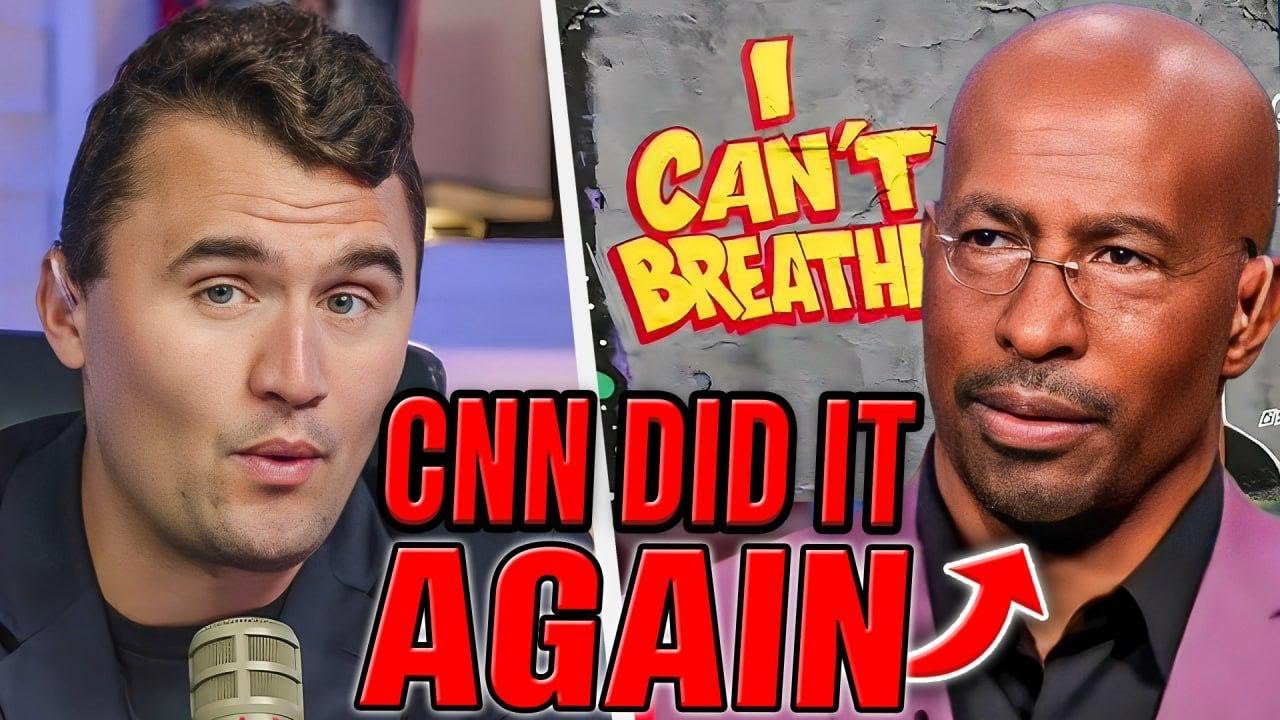
Charlie Kirk Confronts Van Jones on CNN Over Media Double Standards and Crime Statistics
11:08
Ben Shapiro Dissects George Floyd Autopsy, Israel–Qatar Strike, Hamas Hostages, and Lions vs. Scavengers
Charlie Kirk opened with breaking news on the Charlotte light-rail murder of Ukrainian refugee Iryna Zarutska, then welcomed Ben Shapiro to unpack the George Floyd autopsy (drugs, enlarged heart, no proven racial animus), Israel's strike on Hamas leadership in Qatar, and what it means for hostages, Gaza City, and the endgame. They rebutted "genocide" and "ethnic cleansing" claims, called out legacy-media bias, and previewed Shapiro's new book Lions and Scavengers, a blueprint for defending Western civilization from the envy-driven scavengers who would tear it down.
Charlie Kirk opened the show with a brief tax-advisory segment from Tax Network USA, highlighting IRS crackdowns and penalties of up to 25% for late filing. He then transitioned to breaking news: Iryna Zarutska, a 23-year-old Ukrainian refugee who fled war only to be murdered on a Charlotte light-rail train, killed by a stranger with a pocket knife. Police confirmed the 34-year-old suspect, captured on camera in a red sweatshirt, had a violent criminal history including a five-year prison sentence.
President Trump condemned the attack in stark terms: "I just give my love and hope to the family of the young woman…stabbed…by a madman, a lunatic. Just got up and started…viciously stabbed. She's just sitting there. So there are evil people. We have to be able [to handle that]—if we don't handle that, we don't have a country."
Hillsdale College and Guest Introduction
Kirk urged viewers to explore Hillsdale College's free online courses at CharlieForHillsdale.com, including an eight-lecture series on whether freedom was worth fighting for. He then introduced Ben Shapiro, best-selling author and host, to discuss George Floyd, Israel, and Shapiro's new book Lions and Scavengers: The True Story of America.
George Floyd Autopsy: Drugs, Enlarged Heart, and No Proven Racial Motive
Kirk noted he had recently countered Van Jones on CNN, specifically Jones's claim that Derek Chauvin racially murdered George Floyd. Shapiro began by walking through the Floyd autopsy report: Floyd had a massively enlarged heart, extraordinary quantities of fentanyl and other drugs in his system—enough to kill a normal person multiple times over—and the original coroner indicated that had Floyd been found dead elsewhere they would have assumed a drug overdose.
Shapiro emphasized that Floyd said "I can't breathe" well before being placed on the ground, that he was removed from the squad car at his own request, and that the medical evidence revealed no damage to Floyd's trachea or throat. Instead, the autopsy suggested Floyd died of excited delirium—an elevated heart rate caused by drugs, his enlarged heart, and the stress of arrest—rather than asphyxiation from Derek Chauvin's knee on his neck.
Turning to the question of race, Shapiro noted that even Keith Ellison, then Minnesota attorney general, rejected the claim that race played a role in Floyd's death. The federal civil-rights charge against Chauvin did not even allege that his actions were motivated by racism. Shapiro concluded that the best available criminal case would have been low-degree manslaughter for negligence, but zero evidence supported the narrative that Chauvin killed Floyd because of George Floyd's race.
Israel's Strike on Hamas Leadership in Qatar
Kirk shifted gears to breaking international news: Israel had bombed Doha, Qatar, targeting top Hamas officials living in five-star hotels there. He asked Shapiro to clarify what happened and whether it endangered U.S. interests in the Middle East.
Shapiro explained that Qatar had been playing both sides for years—providing billions in material support to Hamas, hosting its leadership, and pressing Hamas priorities in negotiations without putting serious pressure on the terror group to release hostages or end the war. As Israel neared the final phase of operations in Gaza City, the Trump administration put forward a deal: Hamas would release the remaining forty-eight hostages, and the United States would guarantee an honest brokerage of a war-ending arrangement that disarmed Hamas, installed some form of coalition or regional government, and began rebuilding the Gaza Strip.
Hamas rejected that offer—a fact, Shapiro noted, that went largely unreported by mainstream media. Shortly after, Israel struck Hamas leaders in Doha. Shapiro argued it would have been logistically impossible for Israeli F-16s to fly all the way across the Middle East and hit a specific terror target in Qatar without U.S. knowledge—and indeed contemporaneous reporting confirmed that the United States was given a heads-up moments before the strike. He added that it was not wildly improbable that Qatar itself knew the strike was coming, since Qatar had failed to deliver on its mediation role.
Unconditional Surrender and the Endgame in Gaza
Kirk raised the analogy of Japan's unconditional surrender after the atomic bombings, asking what ultimate success looked like for Israel in Gaza. Shapiro stated that Netanyahu's government had set two goals from the outset: free as many hostages as humanly possible, and win the war. Those goals were in some tension, because winning decisively required rapid ground movement that could endanger the hostages Hamas was using as human shields.
Shapiro's main critique of the Netanyahu administration was that Israel should have moved faster—a drawn-out, nearly two-year campaign was detrimental to public support. He noted that Americans prefer fast, decisive victories (the three- to five-week operation against Hezbollah, the twelve-day Iran strikes) over long occupations. He argued that Israel's likely endgame includes a continued military occupation of large swaths of Gaza, the creation of humanitarian zones—particularly along the coast and in Rafah—and facilitation of an exit pathway for Gazans who want to leave. The Trump administration was working to allow those who wished to leave to do so and to bring humanitarian aid and investment into cleared areas, paving the way for Hamas-free rebuilding.
Shapiro added that the last major untouched area was Gaza City. Israel already controlled roughly 40 to 50 percent of it, had been warning civilians to evacuate for weeks, and Hamas had been stopping people at checkpoints, turning them back into the city to serve as human shields.
Conduct and PR: Why Long Wars Lose Support
Kirk asked what mistakes, if any, Israel made—operationally or in public relations. Shapiro acknowledged that no war is perfect and that ugly, terrible things inevitably happen in any conflict. But he underscored that Israel maintained complete air superiority over Gaza; had it wished to level the Strip on October 8, it had the military capability to do so. Instead, it chose to go house to house, sacrificing roughly a thousand Israeli soldiers killed and thousands more wounded for life, in an attempt to minimize civilian casualties.
Israel was shipping in 4,400 calories per person per day into the Gaza Strip—much of which was stolen by Hamas. Shapiro stated that the charge that Israel was indiscriminate in its use of force was absurd on its face; the war had been conducted in as meticulous a manner as any urban campaign in history. But he conceded that Israel's main mistake was misunderstanding how public relations works: they couldn't have presented the war in a "kinder" way that would have won hearts and minds, but they could have won faster. Americans do not like long, drawn-out occupations—true in Iraq, Afghanistan, Ukraine, and now Gaza. Fast victories sustain support; protracted conflicts, even when meticulously executed, erode it.
"Genocide" and "Ethnic Cleansing" Claims Rebutted
Kirk noted that a common accusation on campus was that Israel was committing genocide. Shapiro responded that there is literally no definition of genocide by which Israel's actions qualify. Genocide requires the targeted killing of the vast majority of a population or at least an attempt to do so. No genocide in world history involved shipping in more food than the average American consumes daily, leafleting warnings, or going house to house to reduce civilian casualties. Total population loss in Gaza thus far was about 3 percent; by comparison, the Holocaust killed 50 percent of European Jews, and the Rwandan genocide significantly more than 3 percent of its target population.
Shapiro pointed out that every Israeli family must send their eighteen-year-old son or daughter into military service with the real possibility of being blown up in Gaza—not something any Israeli, right, left, or center, wants. The question is whether the accusations are accurate, and by any stretch of the imagination they are not.
On the charge of ethnic cleansing, Shapiro argued that moving people out of heavily urbanized, terrorist-honeycombed areas is not the same as forced expulsion. The Israeli government's stated policy was that if people wanted to leave they could, but no one was being forcibly removed. He noted that Gaza was the only conflict on earth in which outside countries actively prevented people who wished to leave from doing so; the Trump administration was trying to reverse that.
Legacy-Media Bias and the Need for Skepticism
Kirk observed that Americans had been conditioned over COVID, lockdowns, Ukraine, and the border to question mainstream-media narratives—so why not apply that same skepticism to Israel coverage? Shapiro agreed, noting that legacy media outlets are radically anti-Israel overall. The New York Times, the Associated Press (which had worked hand in glove with Hamas for years), and Reuters could in no way be accused of being pro-Israel. Yet when it came to Gaza reporting, some on the right seemed to suspend the critical thinking they applied elsewhere.
Shapiro dismissed the notion that "Jews own the media" and therefore media coverage favored Israel—pointing out that The DailyWire+ itself employed hosts like Matt Walsh who radically disagreed with Shapiro on foreign policy. Shapiro stated plainly that he was an overtly pro-Israel Zionist and made no bones about it, but to suggest that an atheistic Jewish person by birth owning the New York Times meant the Times was pro-Israel ignored literally every bit of coverage they had ever done in his lifetime.
"Can't Be MAGA if You're Anti-Israel": Parsing Bibi's Statement
Kirk raised a comment from Israeli Prime Minister Benjamin Netanyahu: "You can't be MAGA if you're anti-Israel." Kirk said he didn't like it, for a couple of reasons, and asked Shapiro how he analyzed that statement.
Shapiro offered both an ungenerous and a generous interpretation. The ungenerous reading would be that you must hold a particular position on every Israeli governmental activity to be MAGA—which is plainly false; you can disagree with Bibi's policies from the right or the left and still be plenty MAGA. The generous reading, Shapiro said, is that if you are taking Hamas's side against Israel in a conflict, it is very difficult to align that with the stated positions of the Trump administration or what President Trump himself was doing. You can have disagreements on Israel and still be MAGA, Shapiro concluded, but if you're pro-Hamas, "you're something darker, and we shouldn't put up with that."
Lions and Scavengers: Envy vs. Builders
Kirk turned to Shapiro's new book. Shapiro explained that Lions and Scavengers explores the dual nature inside every human heart, going back to the Book of Genesis: one part is dutiful, rational, moral—you get up every morning to build something, be kind and giving, defend your civilization, and strengthen the social fabric. The other part is driven by envy, immediately attributes all problems to shadowy outside forces beyond your control, and tries to rip down the very systems that provide prosperity—tearing down the lions out of pure envy and resentment.
Shapiro argued that this dynamic exists not only within individuals but also at the civilizational level. He pointed to the agglomeration of causes on college campuses last year: one day protesting Trump on immigration, the next day Israel, the next day LGBT issues—yet the same exact people marching together. What they had in common was not a coherent ideology but a deep hatred of Western civilization, believing its fundamental basis to be evil and needing to be torn out by the root.
Shapiro cited "Queers for Palestine" as a puzzle: queer activists in Palestine would be thrown off buildings. The answer, he said, is that the radical LGBTQ group and the pro-Hamas group don't have much in common except they both really, really hate the West and believe traditional values must be destroyed for them to live more fulfilling lives.
Is Islam Compatible with Western Civilization?
Kirk asked whether Islam belongs in the lion category or the scavenger category and whether Islamic civilization was compatible with the West. Shapiro said it was very hard to see how contemporary Islamic civilization on the globe fits the lion category. That doesn't mean there aren't individual Muslims who fit, or that there can't be an interpreted version of Islam aligned with a God-given world of duties, creative power, and biblical morality. But the proof is in the pudding: there are very few Islamic countries on earth right now that live by freedom of mind, private property, equal rule of law for all citizens, and traditional virtue.
What the West Must Do: Stand on Our Hind Legs
Kirk asked what was missing for Westerners to stand up against these forces. Shapiro argued that good people tend to be polite and self-critical, while bad people grind your face into the dust without hesitation because they come from shame cultures—where the most important thing is not to feel shame and to shame others. Those of us in Western civilization, Shapiro said, need to recognize that constant self-abnegation and a misguided sense of humility in the face of people happy to destroy our civilization from within and without is a gigantic mistake. It is totally fine to say to people who wish to destroy our civilization: "No, your values are inferior, and they don't belong here."
Roots of Resentment: Gratitude vs. Envy
Kirk asked where all the resentment comes from. Shapiro said it arises from a wide variety of places but generally from a feeling of frustration and a sense of entitlement. You see it in people who believe they have been marginalized, people who believe they deserve more—university students, for instance, who think they deserve a $250,000 salary for a gender-studies degree because they've been taught they should be getting more. When they don't get it they become angry at their parents, rebel against everything they've been taught—or haven't been taught.
Shapiro also pointed to a bored, secure population that grew up without any sense of external threat. They think everything good in life is the baseline, that it's just normal, and that you can tear away the foundations without the baseline falling away. That is false. Gratitude, Shapiro said, has to be cultivated—you have to teach your kids to say thank you. Envy, on the other hand, is totally natural and easy. You don't have to teach kids to say no or to envy each other.
Close: Where to Get the Book and Hour Two Tease
Kirk thanked Shapiro for his time and for walking through the very important topics of the day. He encouraged viewers to pick up Lions and Scavengers and to subscribe to the Charlie Kirk Show podcast. The segment concluded with a tease of Hour Two, coming up next.