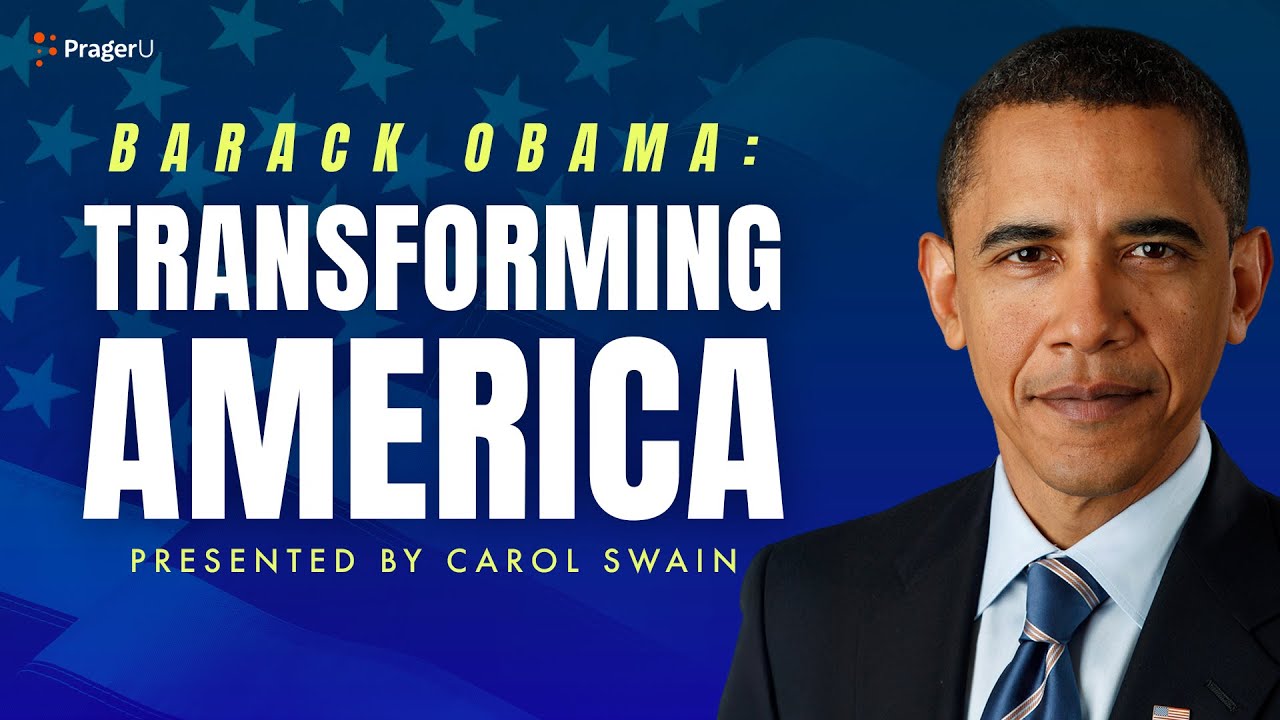
Carol Swain Examines How Barack Obama Fundamentally Transformed The United States of America
Enjoying this? Share it with someone who needs to see it.
Up Next
Jason Edwards Reveals How Rutherford B Hayes Became America's Most Disputed President in History
5:49
How Barack Obama Fundamentally Transformed America Through Race Relations, Healthcare, and Foreign Policy
5:57
How Dwight Eisenhower Rose From Obscurity to Command D-Day and Become America's 34th President
5:45
Carol Swain Examines How Barack Obama Fundamentally Transformed The United States of America
Carol Swain traces Barack Obama's path from his eclectic childhood in Hawaii and Indonesia to becoming the 44th President of the United States. Despite entering office with unprecedented goodwill as America's first black president, Obama's own words reveal a different vision for the nation. From his early identity struggles as "Barry Soetoro" to his declaration of fundamentally transforming America, Swain explores the contradictions between Obama's rhetoric of unity and the reality of his beliefs about American greatness.
No American president entered the White House with more goodwill than Barack Obama. Even those who had opposed the new 44th president during the 2008 election received him with pride. The nation had elected its first black president—a historic event. As Obama said in his victory speech, "If there is anyone out there who still doubts that America is a place where all things are possible, who still wonders if the dream of our founders is alive in our time, tonight is your answer."
Ironically, throughout his two terms as president, Obama disavowed the sentiment he had so eloquently expressed. The man whose triumph testified to America's greatness rejected America's greatness.
An Eclectic Childhood Between Continents
Barack Hussein Obama was born on August 4th, 1961 in Honolulu, Hawaii. To say his background was eclectic would be an understatement. His mother, Anne Dunham, was married to Barack Obama senior, an exchange student from Kenya. They divorced three years later. In 1965, she would marry another exchange student, Lolo Soetoro. Mother and son went with him to Indonesia where he was known as Barry Soetoro. At the time, he attended both Catholic and Muslim schools in Jakarta.
His mother, unimpressed by the education he was getting in Indonesia, sent him back to Hawaii to live with her parents. In 1979, he moved to the mainland where he enrolled in Occidental College in Los Angeles.
The Transformation From Barry to Barack
It was at Occidental that the identity question emerged. Who was he? He didn't feel comfortable identifying as white or black. As he later wrote, "I hadn't grown up in Compton or Watts." Restless, he transferred to Columbia University in New York. While at Columbia, he apparently resolved his racial conflict. He would identify as African American even though he barely knew his father and had been raised primarily by his white grandparents. He was now Barack. Barry was gone.
From Community Organizer to Harvard Law
In 1985, he took a job as a community organizer on the south side of Chicago, but this too tried his patience. The incremental improvements to tenant rights or job training programs seemed trivial. He wanted to make big changes. This would require a whole different level of power and influence, and no place could propel him to that level like Harvard Law School.
There, Obama thrived. In 1990, he made history as the first black president of the Harvard Law Review. Upon graduation, he could have worked for any law firm in the country, but he had another plan. This took him back to Chicago and into politics.
A Political Rise Built on Fortunate Circumstances
In 1996, he ran for the state senate. The problem was that his opponent, Alice Palmer, had much more political clout than he did. He couldn't beat her in a straight-up fight. He had to find another way to win. Probing her filing documents, he found enough questionable signatures to challenge her candidacy. Palmer was disqualified and the seat was his.
In 2004, he ran for the U.S. Senate. It figured to be a close race, but Obama again got lucky. The Chicago Tribune published his Republican opponent's sealed divorce records, which included salacious accusations that he had asked his wife to accompany him to sex clubs. The contest at that point was over. Obama coasted to an easy win.
So easy that the Democratic Party gave him a prime slot at that year's national convention in a speech that rocked the delegates. He declared, "There's not a black America and a white America. There's the United States of America." This was a message to build a presidential campaign on.
The Quick Leap to Presidential Ambitions
That campaign wouldn't be long in coming. Obama's restlessness quickly manifested itself in the Senate. Being a member of that exclusive club bored him. Getting things done took forever. After only two years, Obama made it clear he was going for the top job: the presidency in 2008.
His biggest competition was no less than former first lady and New York Senator Hillary Clinton. She could match him with historic first. If Obama could be the first black president, Hillary could be the first female president. They battled it out for five months, but the result was never really in doubt. Obama was just too fresh, too charismatic, too exciting, and too chosen. His support from young people was overwhelming. They flocked to his message of hope and change. In the end, Hillary seemed like old news.
So did the Republican nominee, Arizona Senator and Vietnam War hero John McCain. Obama ran away with the popular vote 53% to 46% and the electoral college 365 to 173.
The Real Agenda Revealed
But did Americans know the man they had just elected? Aside from the catchy slogans and the soaring rhetoric, what did Obama really believe? The answer for the few who chose to look deeper is found in a speech he gave in Columbia, Missouri on the eve of the election: "We are five days away from fundamentally transforming the United States of America."