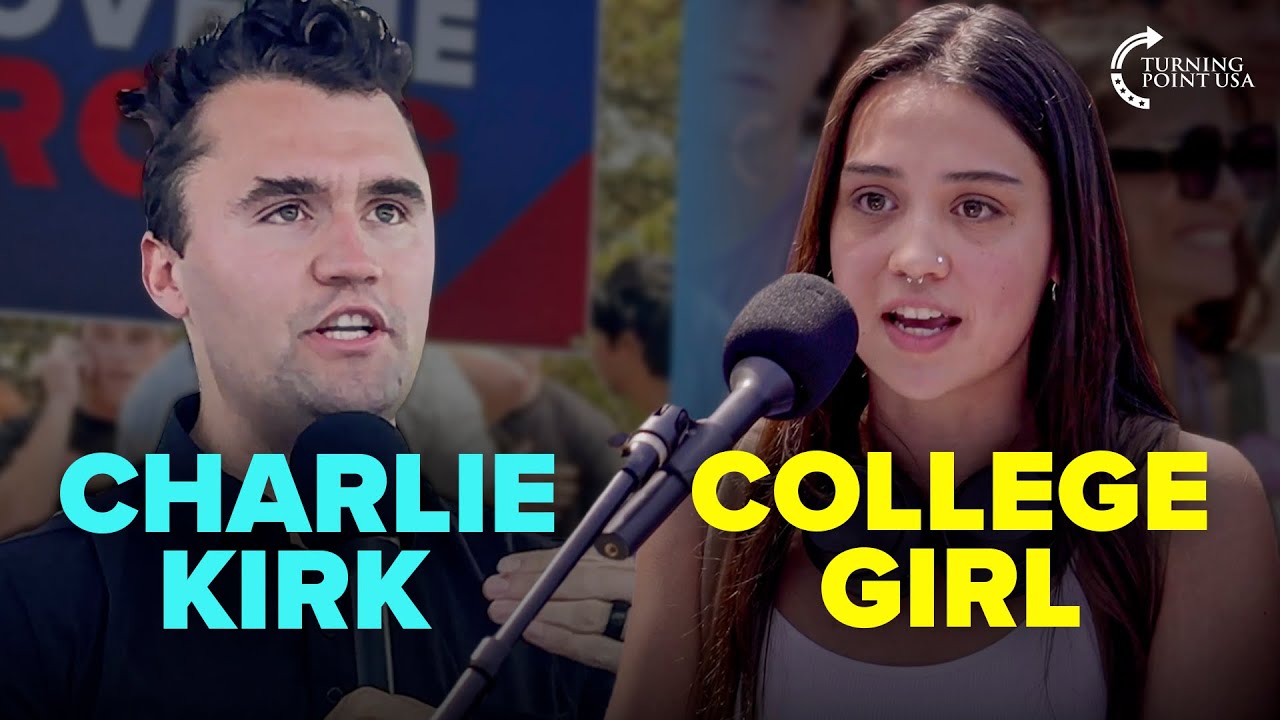
Charlie Kirk Addresses Family Division, Academia's Decline, and Rising Left-Wing Violence at UC Davis Event
Enjoying this? Share it with someone who needs to see it.
Up Next
Charlie Kirk Confronts Cal Poly Student Journalist on Division, Immigration, and Media Narratives
3:55
Charlie Kirk Explains Why America Is So Divided at Washington State University Event
4:59
Charlie Kirk Explains Why Democracy Is Not an American Value and Defends His Critique of Higher Education
5:04
Charlie Kirk Addresses Family Division, Academia's Decline, and Rising Left-Wing Violence at UC Davis Event
Charlie Kirk confronts a hostile crowd at UC Davis, addressing questions on maintaining family relationships across political divides, the challenges of reclaiming academia from ideological capture, and the rise of domestic extremism. Kirk defends his characterization of violent protesters as terrorists while fielding questions on healthcare, immigration reform, drug policy, and the moral foundations of conservatism. The event, marked by broken windows and police protection, highlights the growing threat to free speech on American college campuses and the urgent need to preserve civil discourse in an increasingly polarized nation.
Charlie Kirk opens by addressing a question about maintaining dialogue with family members who hold opposing political views. Kirk emphasizes the biblical commandment to honor your mother and father, arguing that 99.9% of people have no legitimate excuse to abandon this principle. He explains that the ability to honor earthly parents serves as preparation for honoring the divine father, making it a spiritual imperative beyond mere family harmony.
Kirk points to a disturbing trend where divisive politics destroys family bonds, with many audience members raising their hands when asked if liberal family members refuse to speak to them due to politics. He insists conservatives have a moral obligation to maintain relationships despite worldview differences, even when the other party refuses reciprocity. Breaking family ties over politics, Kirk argues, is cruel and only furthers national division.
The commandment to honor parents is unique among the Ten Commandments, Kirk notes, because it includes a promise about the nation: "Honor your mother and father so that you may live long in the land." He connects America's current struggles to the breakdown of this principle, warning that a nation teaching children to disrespect their parents creates moral chaos where teenagers believe themselves wiser than their elders and do what is right in their own eyes.
The Battle for Academia and Higher Education
When asked about reclaiming academia from ideological capture, Kirk expresses skepticism about saving existing institutions. He points to the experience of a seven-year veteran of academic debate who was expelled from a tournament at Arizona State University merely for quoting Jordan Peterson. This example illustrates how deeply entrenched the ideological control has become.
Kirk advocates for building new institutions rather than attempting to reform captured ones, citing Jordan Peterson's work with the University of Austin as a model. He acknowledges the difficulty conservatives face entering academia, as liberals protect their own and continue dominating hiring decisions. His greatest concern is that woke ideology now infiltrates even fields once thought immune, including engineering, mathematics, and the hard sciences.
Contrasting the degraded state of most universities with Hillsdale College, Kirk describes visiting classes where students study Aristotle's ethics, Augustine, and Aquinas's Summa Theologica. He expresses pain at seeing what education could be while witnessing the steady diet of critical race theory fed to most students through Robin DiAngelo, Ibram X. Kendi, and postmodern theorists like Michel Foucault and Jacques Derrida. Kirk's recommendation is clear: support good institutions, build new ones, and abandon those captured by ideologues.
Confronting Healthcare and Big Pharma
A self-described Medicare-for-all proponent challenges Kirk on healthcare, leading to a nuanced discussion that reveals Kirk's evolving position. While opposing single-payer systems, Kirk acknowledges serious problems with the current healthcare system driven by both excessive profit-seeking and bad regulation. He points to mandatory price transparency as an area of potential agreement, arguing that consumers deserve to know costs just as they see calorie counts at restaurants.
Kirk surprises some by expressing willingness to partner with progressives in crushing Big Pharma's power, noting that pharmaceutical companies have demonstrated deceitful and treacherous behavior, especially during the pandemic. He goes further, stating he now supports government negotiation of drug prices, a position he wouldn't have held five years ago. While acknowledging government would likely mishandle implementation, Kirk questions how it could be worse than the current system.
The free market success story Kirk champions is LASIK eye surgery, which transformed from a fringe procedure to the most performed eye surgery in America with decreasing prices and increasing quality, precisely because insurance doesn't cover it and entrepreneurs entered the market. This example illustrates his general philosophy: properly functioning markets serve people well, but the current healthcare system fails this test in multiple ways.
Immigration Reform and Economic Nationalism
Kirk articulates a populist economic vision that breaks from traditional Republican orthodoxy. He argues that vital products including vitamin C and penicillin should be manufactured in America, enforced through tariffs and sanctions. American college graduates should receive preference for jobs at American companies over foreign workers through H-1B system reform, fulfilling a moral obligation to citizens over non-citizens.
When challenged that this represents government expansion, Kirk distinguishes between a "small but strong government" that serves core national interests versus bureaucratic bloat. He wants more Border Patrol agents and fewer IRS agents, prioritizing government functions that maintain borders, sovereignty, and culture while ensuring citizens can work hard, own homes, and see rising wages.
Kirk challenges the notion that leftist policies support the middle class, pointing out that traditionally blue-collar states like Ohio have shifted right as the Republican Party embraces economic populism. He contrasts this with the left's "neoliberal shills" who talk about helping workers while supporting endless foreign wars, open borders, and globalist trade policies that harm American workers.
Drug Policy Reversal and Cartel Power
In a candid admission, Kirk reveals he completely reversed his position on drug legalization. He previously believed legalizing marijuana would weaken cartels and reduce incarceration, but evidence proved every assumption wrong. As states legalized marijuana, violent crime increased rather than decreased, cartels grew wealthier and more powerful, and marijuana proved to be the gateway drug critics always claimed.
The decriminalization of marijuana didn't reduce harder drug use among youth but instead created pathways to fentanyl addiction. Kirk explains that cartels simply shifted business models from marijuana cultivation to human trafficking at $5,000 per person and fentanyl distribution, which is far more profitable and deadly. A grain-sized amount of fentanyl can kill almost instantaneously, and 70,000 Americans died from fentanyl overdoses in a single year.
When pressed on why alcohol remains legal while marijuana faces criticism, Kirk surprises by arguing that alcohol consumption creates massive problems in America, contributing to 140,000 deaths annually through DUIs, violent crime, and domestic assault. While politically unpopular, Kirk argues someone must have the courage to state that American drinking culture makes the nation deeply unhappy, even if prohibition isn't the answer.
Defining Terrorism and Defending Free Speech
A contentious exchange occurs when an audience member challenges Kirk's characterization of protesters as terrorists. Kirk provides the definition: a person who uses unlawful violence and intimidation, especially against civilians, in pursuit of political aims. He catalogs the activities outside: broken windows, assaults on police officers, spray-painted death threats, violent intimidation, and graffiti throughout the week leading to the event.
The questioner attempts to distinguish between peaceful protesters and violent actors, but Kirk refuses this framing, noting the black bloc tactics, anonymized identities, and coordinated network suggesting sophisticated organization and funding. He points out the hypocrisy of calling January 6th participants terrorists for taking selfies while excusing actual violence, property destruction, and death threats directed at him.
Kirk connects the UC Davis protests to broader antifa activity, including an employee sent to the hospital after a Sacramento assault and the recent arson attack on a police training facility in Georgia. The vice president of the Turning Point USA chapter confirms that protesters wheat-pasted flyers across campus with her name, face, phone number, and email, calling her a homophobic fascist and declaring her unwelcome, which clearly meets the definition of unlawful intimidation for political purposes.
Gun Rights and Liberty's Price
When questioned about the seeming contradiction between gun rights and drug policy, Kirk clarifies his Second Amendment position. The primary purpose isn't recreation or even self-defense against criminals, but protection against potentially tyrannical government. Anyone denying this possibility ignores twentieth-century history and the atrocities committed by governments against disarmed populations.
Kirk forthrightly acknowledges that gun ownership comes with costs, including gun deaths that won't be reduced to zero. This represents the price of liberty, comparable to the 50,000 annual traffic fatalities accepted as a cost of transportation freedom. The difference between guns and drugs, Kirk explains, is that he sees clear moral good in private firearm ownership while finding no comparable benefit to marijuana legalization.
The evidence on marijuana legalization proved the opposite of promised outcomes. Rather than reducing youth drug use, commercialization and normalization led to increased consumption, with national surveys showing 50% of children aged 10-13 testing positive for cannabis or marijuana. The substance is now stronger than ever and frequently laced with dangerous additives, contradicting assurances that legalization would protect young people.
Conservative Vision for the Future
Kirk articulates a substantive vision beyond mere opposition to leftist policies. Three basic commitments should define the social compact for the next generation: it should be easy and celebrated to get married, have children, and own property. These anchors of responsibility have become harder than ever, with inflation making homeownership difficult while cultural messaging discourages marriage and portrays children as potential climate threats.
This explains why the current generation experiences unprecedented levels of depression, suicide, anxiety, alcohol addiction, and medication dependence. Kirk advocates for a country that prioritizes American borders over foreign borders, manufactures critical products domestically, increases church attendance, reduces pornography addiction, encourages outdoor activity, and decreases phone dependency.
Kirk proposes considering a national day of rest, a modern Sabbath where society slows down. Despite unprecedented ease in accessing food, medication, and services, Americans grow more miserable. A weekly day without ubereats, without constant connectivity, spent with loved ones and perhaps cooking at home could restore purpose and community. This vision emphasizes the local over the corporate, family over abstract ideology, fighting for these values while opponents engage in destructive nonsense.
Banking Crisis and Economic Reform
Addressing the Silicon Valley Bank collapse, Kirk notes the board's focus on woke agenda rather than sound banking practices. He supports Senator Josh Hawley's call to reinstate Glass-Steagall, the law that separated commercial and investment banking before its repeal allowed dangerous consolidation. Kirk demands that heads must metaphorically roll for the failure, questioning where regulators were and why media remains so scared to criticize banks.
Kirk expresses deep concern about the fragility of the American banking system, hoping his fears prove wrong but seeing reinstatement of Glass-Steagall as only a first step. He also advocates repealing Dodd-Frank, which he argues has been unfair to small and local banks while benefiting large institutions. Kirk suspects the next move will be eliminating mid-sized banks entirely to hyper-corporatize the industry around JPMorgan, Citibank, and Wells Fargo, similar to telecom consolidation.
Safety Concerns and the State of Free Speech
Kirk concludes with a sobering safety warning, instructing attendees not to engage with the mob outside and to seek help from police or staff if they feel unsafe. He emphasizes the protesters' history of violence, especially during event exits, and urges everyone to remain peaceful regardless of provocation.
His final reflection captures the disturbing state of campus discourse: "I do not want to live in a country where I have to have this much police support and I have to have my send-off message of be safe on an American college campus because you might have a baseball bat thrown at you." This statement encapsulates the event's broader significance, fighting for the moral goodness and decency of speech in an environment where expressing ideas requires heavy security and carries genuine physical danger.
Video Transcript
years those of whom which they may not be able to disagree with politically speaking and this how can they establish a dialogue and conversation like being able to talk about anything like politics covet or events without feeling like they feel like they're gonna have to force it upon them yeah that makes sense yeah for family members especially or yeah um especially yes yeah so look I this is this is a tough thing right let's let's first talk with your parents about your parents I'm a big believer in the biblical commandment of honoring your mother and father 99.9 of the people in this room have no excuse not to honor your parents I don't care if they don't share your politics I don't care if they were nasty to you if they were legitimately abusive in a very serious way then yes okay but 99 of the time people say well I just don't get along with them I don't like them if you cannot honor your parents here on Earth then you will not be able to honor the Eternal and divine father of which is much more important by the way it is it is a step and intermediary to that secondly um with honoring your parents it is the only one of the Ten Commandments that involves your nation and a promise honor your mother and father so that you may live long in the land of which you are in one of the reasons why America is falling apart is because we have decided to break this commandment and we are teaching children to no longer honor their parents a nation that no longer honors their parents you have a bunch of 17 year olds that think their parents are dumb and stupid and they do what they think is right in their own eyes and that creates a morally chaotic miserable country very quickly so I'll just talk about that on the parents do everything you possibly can to not allow divisive politics or different ideas to get in the way of your family relationships or your close relationships you need to do that now how many people here have family or close friends on the left that won't talk to you because your politics raise your hand a lot of hands go up that's unfortunate that's tragic never do that with a leftist you as a conservative have a moral obligation to even keep a relationship neutral or warm in one way despite the difference in world view a world view is not an excuse to sever a relationship they might do that to you you should never do that to them that is cruel it is wrong and it only further divides America okay if they do that to you ask them to reconsider and try to find common values I I know it happens very often I do not like when people say well I'm a conservative father and I refuse to talk to my daughter because she's a liberal you have a moral obligation to stay in touch with your child to be truthful to your child don't change your views be very honest about how you think they have aired in their step but the left or the people that wish to divide the country would love nothing more than to create silence between family members that have shared experience and bonds just because they have different World Views thank you so much I appreciate it hey Charlie as the vice president of the Turning Point chapter at Sacramento State University the Rival to UC Davis I'd like to just thank you real quick for creating an organization that has enrich my college experience greatly thank you thank you all right now to the question so a quick anecdote I'll make it very brief but I am a seven year veteran of academic speech and debate in high school and college I have competed at a high level in fact last year I was top 32 in the country at my children's event but it is so entrenched by the left in fact I am an acquaintance named Michael Moreno who had a tournament at Arizona State University was tossed from around for quoting a piece of evidence from Dr Jordan Peterson yeah so my question to you is how do we start to take Academia back what is the best route to achieve that well that's a great question thank you for the enthusiasm and the fact that Turning Point USA has positively impacted your life makes the last decade of work worth it so thank you that really that touches me and for those of you that support Turning Point USA you're changing lives every single day secondly um to take Academia back look it's I'm not convinced it's possible in certain areas I think we have to build new colleges and new institutions Jordan is doing that with the University of Austin and many other places um but you have to do what we're doing here tonight you have to try to show up start turning point USA groups in California it's hard because the Board of Regents is just you know completely and totally lost and out of control and that's that's just too bad and it's a shame but look the problem with Academia is conservatives don't want to go into it for good reason and liberals just continue to or left Wingers continue to protect their own my my big fear is that this woke ideology is now infiltrating the social sciences it's also infiltrating engineering and Mathematics the things that you thought would be immune to the kind of racial preference you know world view is now totally and completely infiltrated and so I wrote a whole book called The College scam so I'm not exactly big on saving higher education but I do think there is a place for higher education and it pains me because I go and I visit to Hillsdale College quite often Hillsdale College is America's greatest College by the way they do a fabulous job and it pains me because I see how good education could be I sit down in these classes at Hillsdale College and they're studying Aristotle's ethics they're studying you know Augustine they're studying the Summa theologica by Aquinas now I'll just Venture a guess that many of you have probably not spent more than maybe a week or a month or a semester thinking about Socrates Plato and Aristotle and what they had to offer if you guys are then I'll stand corrected on them or talking about why Western Civilization is the greatest the most excellent experiment in self-government in human history why is that the case right and so education can be great the pro and there is a place for students to learn classically and read the great books and to have dialogue and discussion that's not what's happening on University campuses instead you get a steady diet of Robin D'Angelo and ibram X Kendy and of Gene stefanic and of intro to critical race Theory and Herbert marcusa and Michelle Foucault and Jacques derida and post-modernism and post-structuralism that really these ideas could be under retained for a short while it's a really bad idea to build a world view around them in fact it's a great way to burn everything around you if you actually do that so how do we reclaim it I think it's time to support the good institutions and build new ones and then get out of the ones that are captured by the ideologues thank you so much I appreciate it thank you oh hello Charlie Kirk um I I've watched I've been a long time viewer um uh I don't always agree with you um but certainly on this particular issue um so I'm a proponent of universal healthcare uh physically Medicare for all I imagine I mean I know you're not you believe in the value of the for-profit Healthcare System so I guess my question is like your argument is that the for-profit Health Care System um uh I guess serves as a you know for Innovation I want to know like what Innovation does the healthcare does the health and Private for-profit health insurance provide to Medical so I just want to make sure I understand your position are you arguing for a Single Payer or for the government ownership and running of the healthcare industry single pair I guess Medicare for all got it everyone else yeah that is that's a gateway to eventually getting to the government-run Health Care System but your critique is probably not wrong I have plenty of problems with our current health care System right some are driven solely by profit some are driven by just bad regulation and honestly not enough profit drive so I'll give you a great example of a fruit of the free market of the last 10 or 15 years okay Lasik Lasik eye surgery used to be considered a fringe idea that many people considered to be unfounded and not proven Insurance largely does not cover Lasik entrepreneurs got into the industry and Lasik is now the most performed eye surgery in America with great results and great benefits the price has gone down and the quality has gone up now that's one example of many right and you'd be able to counter you'd say well Charlie why is it that you know you you go to a hospital and they charge you way too much and for like a Tylenol 35 for a Tylenol now here's where I can agree with the spirit of the single-payer people which is we need to crush the hospital Lobby in this country it is wrong the way these hospitals operate they need trans we need to mandate transparency and pricing if I have to go to Chipotle to see how many burrito calories are in a burrito I want to see how much everything costs at a hospital the minute I walk into that hospital every consumer has a right to know what things cost right and so at times I'm willing to yield on price transparency I'm even willing to say that in certain regards that there has been some some major issues with me I am no fan for example of Pfizer AstraZeneca moderna Johnson and Johnson and so I'm actually more of a moderate on it where I will hesitate to say though the Medicare for all system what it will do is it will turn the American Health Care System into a major college campus where nobody is actually paying for the good that they're getting one of the reasons why college is so wildly overpriced and why the quality has decreased is because we have single will payer higher education many of you take out loans that the federal government is subsidizing and that you're not even directly invested in for a little while scholarships grants and all that but I think the spirit of what you're saying is smart and I will also be happy partners with you to crush big Pharma I think they have way too much power in this country and I think they actually make people super sick and not always healthy your final thoughts um so I guess a follow-up question is uh would you be in favor to uh to have the government negotiate drug prices I think there might be a role for that I do and I wouldn't have said that five years ago the government would probably screw it up but how could it be any worse than it is now I mean again I believe that Pfizer AstraZeneca moderna and Johnson and Johnson have done such deceitful and treacherous things especially in the last couple of years I am open and willing to use power of the state to start to make sure we're no longer owned by these pharmaceutical companies thank you I've got to get to the next question thank you though hi Charlie um I want to say by starting off I was told by your wonderful assistant over here that I should tell you that I disagree with almost everything obviously we've not had a two hour almost so like who knows who knows maybe we get a few beers we agree on something but I'll have a lot of water you can have whatever all I've heard is stuff that I'm just like what um first I want to say that I guess as the first two hours of speech was you complaining about kind of these leftists and kind of this but I've never heard any policy positions when I go to something like a Senator Sanders convention or someone on the left they're gonna talk about health care inequality inflation uh growth but you guys all seen a lot of talk about is how the left does this or the left does that but no policies on how to fix anything so I guess that kind of goes with my first question is what is the gop's actual position when it comes to fixing inflation well let me look a couple things first of all I'm not a senator nor am I aspiring to be one number two yes I was mildly distracted by the windows being broken and the terrorists outside I fully acknowledge that okay so that was a little policy shallow tonight and a little bit terrorist deep okay I'll fully I I will I will admit that um third I'll say this I don't speak for the GOP right I have my own ideas and I actually think the GOP does a terrible job but let me give you some ideas that I think you might agree with okay I think that vital products should be made in America not in China and we should use tariffs and sanctions to get it done vitamin C penicillin critical infrastructure should be manufactured here I think American college graduates should be given preference to go work for American companies above foreign workers and that means reform in the H-1B system and actually giving you the American college educated kids a preference because we have a moral obligation to our own citizens over the citizens of another country I think we should fully close the United States Southern border I think we should not allow illegal I just want to interrupt you sorry you were saying you're for a government program that puts American college students like you know reforming the immigration system right so that big companies like Facebook don't do quasi-indentured servitude to bring foreign workers in and be able to complete the government that'll be a government program that would do well yeah the government program actually already exists okay so you're actually conservative who's for increasing the government size not for you well no I want a small but strong government so I want things that are smart for example I'd love that more border patrol agents and less IRS agents so where it makes sense to increase the volume of government agents as long as it is pursuing a couple things that are core to My Philosophy a strong country that has borders sovereignty culture and maintains a moral commitment to its citizens that you should be able to work hard play by the rules be able to have a family own a home and see Rising income and wages those are very basic things in a social contract Why is the increasing IRS agents which are taxes that belong to us they help pay for things like roads GPS infrastructure basic things that you and yourself need to get here yeah why would that be against why would that be so bad having everyone pay their fair share of taxes so we can have a government that functions correctly obviously government does work for everything but we all benefit from government services every day I'm sorry no one in this room is going to benefit from 87 000 new IRS agents and so those 87 000 new IRS agents are going to be deployed against small business owners but I could keep on going with policy examples I can keep on building it out but let me just say this I love markets but I'm willing to critique markets when I think they're not serving people and they're not serving the nation I think are over indulgence in free trade fanaticism has been a major mistake over the last 20 or 30 years I don't worship corporations but I do think that entrepreneurs and private property rights and people taking risks are a general good for society and not only does history show this but Common Sense logic and you know material reality shows all this I can give you more and more examples if you want policy stuff that's less actually interesting the reason I don't go through policy stuff is again whoa whoa is that I'm not running for office right I don't represent the Republican party but if I can build out a world view that you can agree with then the policy answers will come naturally right so if you understand morals and values then you can answer the next 1000 policy question I care a lot more about policy than what people say like like what government does is a lot more important to me that's why I was confused why your speech was not about because again I'm not running for office one more question um I guess for us there used to be a thing called the middle class or the idea of a growing and strong middle class yeah and I feel like for the past 10 years especially on the right maybe on the left too for the more neoliberal left but the right that idea is kind of shrunken I don't think there's a lot of talk in middle class do you view income inequality as a problem I totally disagree with the body I want to say income equality being the difference let me ask you though and I mean I have a question why is it that the wealthiest counties in America all vote on the left because that's where all the how money works now capitalism works is how all where all the wealth is where all the people want to be like so Silicon Valley is all the jobs why do they vote liberal then if the left what in what ways they vote liberal not on taxes not on things Pelosi they're so she left but they're not economic left believe me I've if you go to the Bay Area they are very economically right Dianne Feinstein is not left in my opinion so it's it made me laugh socially but I don't think they're left in my point of view yeah but so then let me ask you then why is it that the muscular class in America has shifted right over the last seven years not according to the midterms I mean you guys you guys tanked on the midterms you keep on saying you guys I don't represent the Republican Party apologies but I just I just want to critique one of your misguided premises which is that somehow the right is not representing middle class voters it's the opposite actually states that were treated are traditionally blue-collar muscular class middle class states are now solid red States look at Ohio Ohio is a state that used to be far left and now it's more in the right direction so what is the right actually doing about it to answer your question a couple things we're rejecting neoliberalism like how about this we shouldn't send 200 billion dollars to Ukraine and we should instead represent our own people and close our own border that's number one number two number two is that we should be unafraid to use tariffs and sanctions to say that critical infrastructure and things that matter should be made here in America whether the delusion on the left and I just want to challenge you on this is that the left has a bunch of people that talk a good game AOC and Bernie Sanders and Joe Biden but when it really matters they're nothing more than neo-liberal shills that are willing to invade other countries invite them into our country and then lie to their voters under the veneer of social liberalism the populist movement in America that represents real people muscular class teachers police officers and firefighters it lives on the American right because we listen to our constituents and we're willing to fight for ideas like tariffs sanctions closed border and no more money to Ukraine the left is Shilling for all those things thank you for being here tonight I appreciate it getting the next one thank you so let us ask is is the definitely even mean a medium 50 people in line thank you is that income inequality is a big issue which is exactly why I support the things that I set next question okay my question's short should America be a more isolationist Nation to Aid in the interests of the American people depends on the situation give me an example um wars in the Middle East Wars with Iran Wars in Ukraine Wars in Yemen I would limit funding all across the board on those yeah what was that I I think that our role should be limited in all those especially with Ukraine we shouldn't give a dime to what's happening in Ukraine especially as our own border remains wide open what was that was that especially as our own border remains completely and totally wide open and 5 000 people are entering illegally every day I find it silly that DC gets really mad that Ukraine's border gets invaded and our border gets invaded every day but sorry do you have a follow-up thought nope that was it thank you and by the way if you disagree you're welcome to come to front of the line the staff will help you let it be known the evil fascist Charlie Kirk wants people who hate him to come to the front of the line next hi Charlie my name is Cole um I think I agree with you I just wanted to ask uh with how much our school systems have changed since even when I was a kid I'm only 20. what is the best way to Shield our younger children from falling into the uh mindset that they're trying to teach the very uh I get the question a lot thank you if you're able to homeschool I'm a big fan of homeschooling I am and I know that's very difficult and then I think you have to find good private schools if not that and if you have to send them the government schools you have to fight for better schools and better school boards and stay involved in those school districts at every possible way you can and so um there's no easy answer but you know what the most important time is it's not the time in the classroom it's the time that your kids have with you at home turn off all the devices on the weekend and talk about the Constitution talk about the founding talk about the Civil War become your child's teacher regardless of where you send them to school homeschooling is not just doing it Monday through Friday homeschooling is a 24 7 365 operation where you're constantly educating your children about American values hopefully you know jedale Christian values as well so that'll be my advice to you thank you God bless you uh hi I know you're generally in favor of uh smaller governments uh my question can you make sure you go right into the microphone I'm sorry I'm having a trouble hearing you yeah oh yeah uh I know you're in favor in small government for a lot of issues um I know that uh drugs are a big issue in America I was wondering what was your perspective on recreational drugs in general the legalization of drugs um and just what your perspective on that was sure the mass legalization of drugs has been a major mistake in our country I used to be for it and I've had 180 degree reversal and I'll tell you why I believe in a small but strong government with prudent and effective and let's just say Common Sense loss I used to be one of those guys that was a conservative that said if we really want to reduce government and make the cartels weaker let's legalize weed and that will really make the cartels weaker and then we'll have less people in prison everything I believed was completely incorrect let me tell you why as we've legalized wheat especially in the American southwest we've seen more violent crime not less the cartels are wealthier and stronger than ever before one of the arguments was while kids now are going to be able to not do harder drugs that's not true kids are now getting into Fentanyl and harder drugs earlier because whether or not we want to admit it marijuana is a gateway drug that is a true fact kids don't just start with fentanyl they start with marijuana and it goes to other drugs and we see that happen time and time again so actually I believe that CR the decriminalization of weed has been something that actually makes government bigger we now need more social workers we now need more services we're now giving more people things on welfare money on welfare and so while I understand the spirit and potentially the principality you know the principle of you know you know legalizing or decriminalizing drugs we have to look at the evidence and the evidence is that we live in a sadder Society a more depressed Society a more anxious Society a more violent Society the more that drug use has gone up over the last decade can I ask a follow-up question uh I was wondering if um in what ways you said that the cartel has become stronger with the legalization of marijuana I was just wondering like what what are the reasons for that yeah so they're no longer in the business of growing weed in the sinola region so now they traffic Fentanyl and people much more profitable and much more dangerous and murderous so we basically told the cartel stop trafficking the thing that actually wasn't as bad it's bad okay and now they've gotten into really rich business where they get five thousand dollars ahead when they traffic them across the Rio Grande Valley and they're doing 5 000 a day or they get fentanyl trafficked in from China that this much of fentanyl like a salt grain of fentanyl will kill your grandkid almost instantaneously and so now the fentanyl is the the cartels are bigger and stronger than ever before they're more Brazen and bold than ever before they're kidnapping and killing Americans they're controlling the entire Mexican government the border is now completely controlled by the cartel and we were told that drug legalization would make the cartels irrelevant the same way that the legalization of alcohol made the mob less powerful in the 30s that was a lie by the way the mob just went into a different business okay it's not like they stopped committing violent crime and it's just not true the cartels are running the entire southwestern part of the border and many parts of the southwestern United States that uh the legalization of marijuana has increased drug drug use and has increased the demand for things like Fentanyl and heroin and stuff I was wondering I guess like why is um making out things like alcohol illegal but making things like marijuana illegal why is alcohol more acceptable than marijuana for example I mean look I I'm ex not exactly a big fan of alcohol I actually think alcohol is a really bad drug and we overly glamorize alcohol in our society I think we do some good to actually limit alcohol intake I think would actually make people's lives better and I think we've waived or socialized drinking drinking in our country now that's a separate argument though because that's making something that's currently legal illegal we're talking about making something that's illegal legal right so those are two separate things but if you were to say wave a magic wand and people would drink less in America I'd say sign me up for that because I mean if you look at the amount of DUIs violent crime if you look at if you look at domestic assault alcohol is almost always involved almost always so I would say this right now the question is on marijuana and it has been proven right now to have massive externalities that are negative over 70 000 people died of fentanyl overdoses last year right and over 140 000 people die from the effects of alcohol every single year now I'll be the most unpopular public commentator on the planet to argue for a ban or an abolition of alcohol but let me just say this someone needs to have the courage to say the amount we drink in our country is bad for us and it's making us deeply unhappy thank you I appreciate it thank you thank you hi uh so as someone who who claims to be such a Bastion of uh freedom of speech why do you call the protesters outside terrorists um outside of say one broken window well it's more than one Broken Window assaulting cops spray painting the death threats that they throw at me the violent intimidation the graffiti but that's not don't you think it's bigoted to call all protesters who are outside as terrorists when a handful of minority might be representing um some why would it be bigoted they're mostly white liberals about jobs sorry why is it bigoted they're mostly white liberals without jobs but it's called you're calling all protesters terrorists I'm calling antifa out there that are anonymizing their identity sending death threats to my family smashing windows and spray painting the campus the entire week leading up to this terrorist yes I absolutely stand by that but so so that that wouldn't that wouldn't a lot of them are just college students who don't agree with the point of view that you're propagating maybe they should have come to the front of the line and asked a question like you and not acted like somebody in a third in a third world country where we settle our dip where they settle their differences with gang violence but just to be sure those people who are there to register their protest aren't terrorists okay the terrorist definition is a person who uses unlawful violence and intimidation especially against civilians in the pursuit of political aims did they do that [Applause] I I don't think I don't think so wait hold on a person who unlawfully violent window smashing graffiti assault against police officers not all of them hold on a second the leaders they cover for themselves and by the way we only a small of them are isolated and they're all in one big black block and don't don't try to you know don't try to Gaslight the people here or the people watching online there's hundreds of them they're working in a coordinated network with coordinated tactics and these are not just quote-unquote college kids there's obviously somebody behind this with funding and sophistication with quasi-paramilitary tactics and let me ask you a question why is it that when people go into the United States capital and take a selfie they're called terrorists by our government but when you start to terrorize and smash windows and put violent threats and death threats to me it's somehow bigoted to call them terrorists so first of all it's not it wasn't a coordinated effort as someone who was there um I didn't I just knew that there was this event happening and that there would be a protest to um in order to register um our our point of view I I was not part of any coordinated effort and neither a lot of the other who are there we don't appreciate the label of being there especially a lot of us some countries where you shouldn't appreciate them the label or the activity why don't you come here and say you know I'm pretty damn embarrassed the people that agree with me resort to violence instead of going up here and trying to lecture me about calling them terrorists absolutely but this isn't about you're making a fool of yourself why don't you go out and talk to your buddies and tell them to stop trying to shut down our event so I don't know why your response is always of what about ISM and I'm just asking you I'm asking questions you can't answer ism what I've I've answered each of your questions I'm just saying let me ask you a question let me ask you a question will you will you publicly condemn the violence done in the political Spirit outside by the people that you were protesting alongside well you do that right now it depends what you're referring to smashing the windows breaking Windows is a good idea assaulting police officers police officers no one assaulted police that's why that's not true throwing eggs and objects at police officers is a legal definition of assault no matter how much you try to Gaslight to spin it if I can just without without resorting to what about ISM using your definition of terrorism if the police users unjust violence against civilians should that also count as terrorism absolutely not but first of all your Definition of unjust I'm just taking your definition no no let me read this again unlawful violence and intimidation especially against civilians in the pursuit of political aims antifa doesn't just do this here they did this in Sacramento and assaulted one of our Turning Point USA employees and sent one of them to the hospital antifa oh by the way the same Buddies the same tactics the same coordination the same wardrobe the same language the same signs you know what they did two weeks ago they arson and firebombed an entire police training headquarters in Georgia in massive coordinated fashion and so right now what we are seeing is the rise of left-wing domestic violent extremism and the failure to acknowledge or admit it means that you are blinded by ideology thank you for being here tonight we'll get to the next one but uh hello Charlie wait uh I just want to say uh I don't exactly agree with you on everything but it was a great speech and I did like hearing your points and there are some things that we did agree on for example big Pharma I totally agree with you on that but my question isn't related to that so uh well first I want to ask you what so what is your stance on guns in terms of like gun control I think I know but I mean I'm very pro-second Amendment right okay so you know against gun control right making guns legal yeah no um so so you believe I'm assuming that like by making guns uh illegal uh criminals are still going to get their hands on guns correct yes but let me tell you let me tell you my position okay the Second Amendment is there to protect all the other amendments against a potentially tyrannical government if we act as if that does not happen in history we're not even reading our 20th century history I fully acknowledge and admit when you allow gun ownership you're going to have gun deaths there is a cost to Liberty anybody who if you if you argue for second amendment rights and say that you're going to get gun deaths to zero that that is that is a falsehood that is also why I support driving I think driving is a moral good but you're going to have 50 000 people a year that die in Auto fatalities Liberty comes at a price and so I believe that yes there will be costs and consequence of having firearm ownership but the positives far outweigh the negatives please ask your question though yeah so it's it's actually kind of to do with um so using that same logic right if like criminals will get their hands on the guns anyway there's no point in Banning them then by that same logic should we not legalized marijuana because won't the kids get their hands on it anyway from either like people who are older or criminals like just using that same logic would it make sense to then also ban marijuana yeah so two things so I didn't actually use the criminals who get their hands on anyway it happens to be true but the other part is that the evidence shows the opposite that kids are doing more weed than ever before it's now laced with things that was not laced with a couple decades ago it's stronger than ever before and we were told that well if it's accessible and it's commercialized kids will be less likely to do weed the use the usership of kids under 12. 50 in a national survey of kids 10 to 13 have tested with some form of cannabis or marijuana that's a bad thing for the country it's not good and that's the more we legalized it the more we glamorize it the more we normalize it the more we have kids doing marijuana and I here's the other thing I don't see a moral good for marijuana I do see a moral good for private citizen firearm ownership so the the equivalent is not one-to-one well I understand uh thank you thank you appreciate it thanks we'll do a couple more and if you disagree tell our staff and coming up hi Charlie um so I just first wanted to comment quickly on the guy who was defending the protesters outside um so I'm the vice president of the UC Davis Turning Point chapter and and the same people who organize those protests outside have put my name on flyers in my face on Flyers through my social media put it all over campus wheat pasted it so it's glued to the wall and they've called me a homophobic fascist a bigot they've said I'm not welcome on this campus and they've published my phone number and email so that people could be able to harass me so if um unlawful intimidation in the pursuit of political aims is the definition of terrorism I'd say even that probably falls into the definition that's exactly right that alone is Terrorism right thank you for your courage what's your question yeah so then the other point I had um I had a question for you um probably an easier one than a few of the other ones but um so the left as we can see has really serious positions for the future they have really serious opinions and hopes and Visions for the future of the US um serious enough that they're willing to organize into groups of hundreds and break things and burn things down and we on the right that gives us lots of time to talk about it and make fun of it and you know make compilations and whatnot and that's all good and funny and entertaining and that sort of roped me in at some point but um what is our vision for the future what are we willing to get that passionate it's a great question so three really basic things that I think should be a commitment to the Next Generation it should be easy and celebrated to get married have children and be able to own property in this country it should be a moral guarantee to the Next Generation to be able to do those three things it's good for everybody it anchors you in responsibility right right now it is harder than ever to buy a home in America thanks to inflation and thanks to all this nonsense that's happening we are telling young people not to get married and we're saying that if you have children it could be an existential threat to the climate and we wonder why this is the most depressed suicidal anxious alcohol-addicted and medicated generation in history those three things should be a core social compact I could go I could go through list by list though right I want a country that cares more about our borders than the borders of a foreign country I want a country that makes stuff that is critical to our national sovereignty and our future such as Vitamin C penicillin actually made here in America and finally well not finally but in addition I'll say this I want to see Church attendance go up I want to see less kids addicted to pornography I want to see more people outside I want to see people spending less time on their phones I think we should we should entertain at least the spirit of a national week day of rest I call it the Sabbath you can call whatever you want I think we should have a day where we slow down I think that we're able to get ubereats quicker than ever before we're able to get medication we want we have more ease and convenience that we're more miserable than ever before why don't we actually tolerate we don't have to do laws even though laws might be a good idea but we just rest for a day we used to call these blue laws where everything kind of slows down we spend time with loved ones you don't look at the phone all day long maybe your favorite restaurant isn't open that day maybe you actually have to cook for yourself I want that country I want a country that actually is purposeful in our action in our community that is more local than it is Corporate that focuses more on the family than some abstract ideology that's what I think we as conservatives need to fight for and fight for vigorously while they do all the nonsense that they do we got to get to the next one I'm sorry thank you uh thanks so much for taking time out to come to California even though you might hate it here um I guess you could say I take the scenic route to conservatism um second generation college student I went to an HBCU actually in Washington DC doing some work now in the public sector for the government so I'd like to get your take on how someone that might look like me or come from my socioeconomic background can find a home in conservatism or if not conservatism where can someone who might find themselves in the gray area go if they don't fall into one camp or the other well let me tell you have a home in the conservative movement if I have anything to say about it so and I'll be honest the other thing I don't want to live in a country where I care about People's race it doesn't mean anything to me I care about that you're a sweet person and that you're trying to do better in your life I care about your values and your actions your melanin content is irrelevant to me and it should be irrelevant to everybody else I want to live in that country and so conservatism if I have anything to say about it will be values based and ideas based and merit-based not race-based not melanin based and so look you're working for the government in the public sector you know I don't know if you're a religious person or not or you believe in God but I would I just encourage you to pray if your God is using you for your greatest and highest purpose but I can tell you right now if God answers your prayer and you say get in the fight for Freedom we need people right now on the front lines working for Turning Point USA working for churches that are engaged in active like Greg farrington's church I think some folks from his church are here and thank you guys by the way fabulous church and so there is a place in conservatism for you and but it might not look for working for Turning Point USA it might be hey I'm gonna you know work for this local committee or whatever it might be but if you're passionate about these ideas we need you we need you badly God bless you and thank you for being here tonight thank you two more questions hey Charlie uh 18 year old activist out of Sacramento sophomore year college student and proud member of the X recall Gavin Newsom team by the way so as you know there's a Democrat super majority in our state legislature and a committee in our state legislature State Assembly did something or state senate did something ridiculous today they passed a bill that would put women's menstrual products in men's restrooms in government facilities and not a single Republican on the committee voted against the bill or spoke out against the bill they decided to abstain so it passed easily my question is how do we get our representatives to fight against this crap yeah I mean stop worrying about being offended all the time I mean this is one of my big complaints of conservatives in general which is fight for what is true and who cares the names they call you I mean you're trying to tell me not a single Republican voted against that in committee I mean I am telling you that not a single Republican in that committee had a backbone to vote against that bill and that is what disappoints me the disillusions mean they're afraid of people like Scott Weiner and all these other people exactly yeah I was going to say that Scott container Twitter disputes with Scott weiner right and um yeah he's uh he's not he's not well at all well yeah I mean I could tell from his uh tweet yesterday where he said that um there's a bill now in our state legislature proposed by a republican that would allow a parent to know if their child is transitioning socially within schools and Scott weiner came out and said that this is a Ron DeSantis style bill that is oppressive to the lgbtq community so yeah of course he did I mean I I gotten a whole Twitter dispute with Scott weiner because he said that I'm the one that was inciting hatred against him because I decided tweet about those perverted bills that he's pushing in the legislature and he says I'm a victim I'm all these things like okay Scott weiner how about you defend the bills actually of why you creepily think kids should be taught the most graphic personal things without parental consent but he won't answer that question look you have to fight and he I am I love California conservatives I think there's so much fight left and so much of what you guys are doing um but it's going to be it's going to be a long-term project right and you've got to find the fighters you got to support the fighters and you have to support the ones of the backbone and honestly the ones that don't ask them why is it why are you not standing for what is right in the legislature the bill is going to pass anyway why wouldn't you stand for what is right so God bless you for your activism and thank you final question hi Charlie I'm gladly not an 18 year old student here at Davis but I'm a I'm an older Millennial student who work with and attend the TP USA meetings here and I also work with larouche pack who God bless them are a real true unsung heroes I would say um so Silicon Valley Bank which I'm sure you heard just one kaputs now it's a fact that their bored are all about or their agenda is wokeism yep right so so Christ chased the money changers out of the Temple and now my question is with Josh Hawley just just publicly backed up and and is saying calling for the reinstatement of glass do you go thankfully a good idea and and my my question is simply is what is your position on it will you support it and the fact that we need to absolutely rather than fund uh you know Wall Street yeah right we need a fun we need to fund the rebuilding of America yeah so just so everyone knows glass-steagall was the repealing or it was the instituting I always get confused it basically allowed commercial Banks and investment Banks to become one this would make it separate look I think I think heads need to metaphorically roll okay metaphorically for what happened at Silicon Valley Bank The Regulators the people involved it's it's wrong on multiple multiple levels and is it an interesting how scared people are to actually criticize the banks right now especially in the media it's just terrible and what the heck was the government doing where were the Regulators that are supposed to do their job that are supposed to be checking in on this and I'm very afraid of the fragility of the American banking system right now and um I hope I'm wrong I hope that there's the full faith and credit behind it reinstituting glass-steagall would be the first step of many in my opinion but I think we need to repeal Dodd-Frank Dodd-Frank has been really unfair to small and local banks which I think is actually their next Focus they're going to try to get rid of mid and local banks and try to to hyper corporatize JPMorgan Citibank and Wells Fargo as kind of the big three like almost like the telecom companies really quick yeah great yeah why I brought up larouche pack is because they endorse Trump and they're the ones who fought for glass-steagall since really 2000 I'm not familiar with it but thank you for bringing that up so thanks for being here tonight thank you all right I want to summarize this a very important announcement um there is a fear that the mob might again they're not terrorists they might actually try to be violent towards you okay do not engage with them all right stay peaceful if you feel unsafe you know ask a police officer ask one of our staff we want all of you to get home safely but this is what they do especially on the exiting of events these people can be really nasty especially with the experience I've had with them over the last couple years so please be peaceful don't do anything with them they're the ones that are you know uh on doing uncalled for things so please keep that in mind and um it's a good thing this event happened tonight but it's I just want to remind I do not want to live in a country where I have to have this much police support and I have to have my send-off message of be safe on an American college campus Because you might have a baseball bat thrown at you we are fighting for the moral goodness and decency of speech tonight speech one please be vigilant on your way out and stay peaceful thank you for supporting Turning Point USA and God bless you