Up Next

Charlie Kirk Explains Why Armed Guards in Schools Matter More Than Stricter Gun Laws

Charlie Kirk Explains Why Armed Guards in Schools Matter More Than Stricter Gun Laws

4:09

Charlie Kirk Debates Education Major on Second Amendment Rights and Gun Control Statistics

Charlie Kirk Debates Education Major on Second Amendment Rights and Gun Control Statistics

10:57

Charlie Kirk Explains Why America Must Limit Green Cards and Prioritize American Students First

Charlie Kirk Explains Why America Must Limit Green Cards and Prioritize American Students First

4:00

Charlie Kirk banner
2,252 videos 1,362,053,989 views US Joined Aug 30, 2018

Charlie Kirk is the Founder and President of Turning Point USA, the largest and fastest growing conservative youth activist organization in the country with over 250,000 student members, over 150 full-time staff, and a presence on over 2,000 high school and college campuses nationwide. Charlie is also the Chairman of Students for Trump, which aims to activate one million new college voters on campuses in battleground states in the lead up to the 2020 presidential election. His social media reaches over 100 million people per month and according to Axios, he is one of the "top 10 most engaged" Twitter handles in the world. He is also the host of “The Charlie Kirk Show,” which regularly ranks among the top news shows on Apple podcast charts.

Charlie Kirk Debates Gun Control and Immigration with Kansas State University Students in Manhattan

September 21, 2024

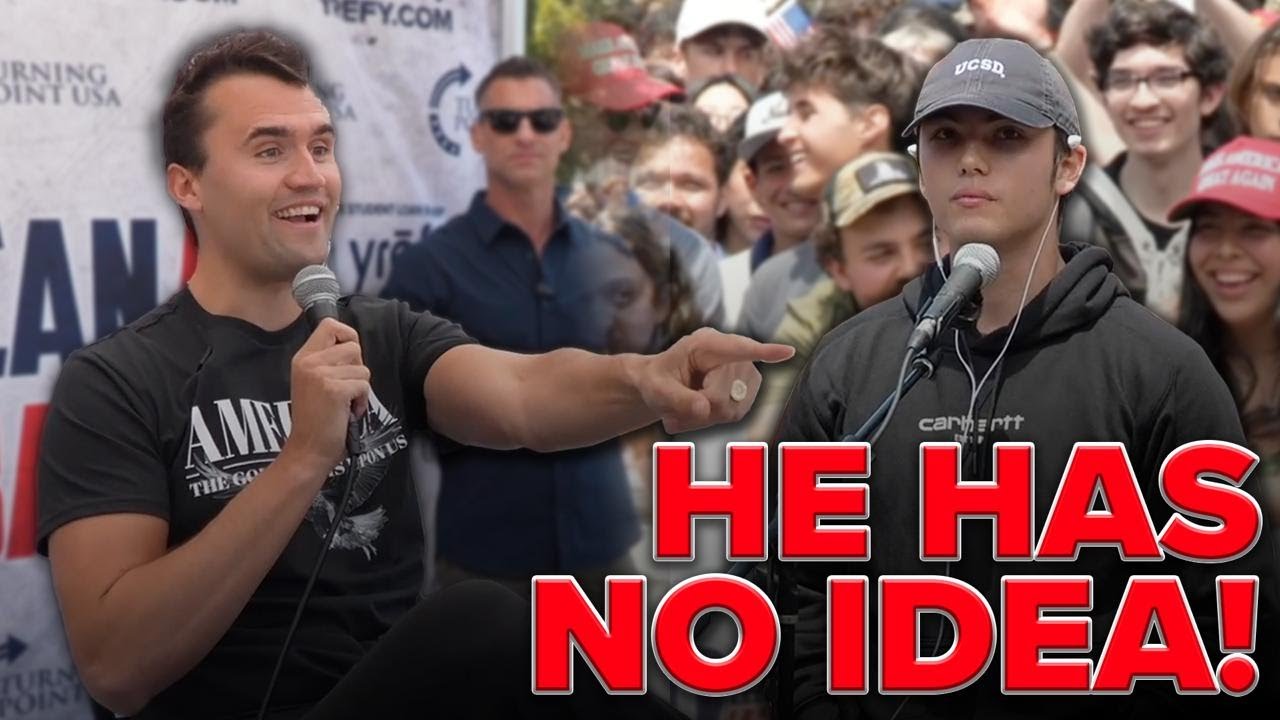
Charlie Kirk engages in direct conversations with Kansas State University students on gun control and immigration policy during a campus event in Manhattan, Kansas. In an unscripted exchange, Kirk challenges students advocating for gun confiscation by questioning consistency in safety arguments, referencing car fatalities and other causes of death. He also debates immigration policy with a student whose parents immigrated from Peru, exploring the tension between border security and the American immigration system. The exchanges showcase Kirk's approach to campus dialogue, emphasizing individual liberty, the Second Amendment, and the principle that government should prioritize its own citizens.

Impromptu Campus Dialogue on Gun Control

During a campus event at Kansas State University in Manhattan, Kansas, Charlie Kirk moved into the crowd for unscripted conversations with students. Two local students, both natives of Manhattan, Kansas, approached Kirk to discuss gun violence and gun control. One student expressed disappointment at seeing people she grew up with attending Kirk's event, characterizing his views as "very conservative" and stating that when someone goes against her rights and beliefs, she considers them a bad person.

When asked about gun violence, the students initially claimed that thousands of kids die every year from gun violence. Kirk corrected this assertion, clarifying that approximately 30,000 total people die annually from gun violence, with 23,000 of those being suicides and the majority of the remainder being urban violence. He challenged the students to remain consistent in their logic, asking whether they would support banning all pistols to prevent gang violence in cities like Kansas City, Chicago, and Houston.

The Gun Confiscation Debate

Both students agreed they would support removing all guns from Americans. When Kirk pressed them on how they would accomplish confiscating the approximately 380 million guns currently in the country, they initially struggled to provide an answer beyond background checks. Kirk pointed out that background checks wouldn't address guns already owned, prompting one student to suggest incentives like buyback programs and confiscation.

The students confirmed they would support repealing the Second Amendment because "children are dying." Kirk then challenged their consistency by pointing out that approximately 55,000 people die from auto fatalities each year—nearly double the gun deaths—and asked whether they would support banning cars as well. The students resisted this comparison, claiming cars were "different," but Kirk pressed the point that if saving lives was the paramount concern, cars would have to go as well.

Liberty Versus Safety

Kirk explained his philosophical framework: "When you have liberty, you have bad things that happen." He used driving as an example, noting that society accepts 55,000 deaths per year from drunk driving and traffic accidents because people value the freedom to drive. Similarly, he argued, guns provide significant benefits including protection against home invasion.

One student countered that nine times out of ten, if you have a gun in your home, it's more likely to be used against you. Kirk clarified that this statistic primarily applies to people with suicidal ideation and mental health problems, and that when the gun is "used against you," the data is only referencing self-harm, not other means.

Kirk emphasized that guns serve as an equalizer, particularly for young women on campus. When he learned both students were Kansas State students, he suggested they should own guns for protection, noting that "knife and pepper spray won't do anything if a guy really wants to attack you." The students confirmed they do not own guns.

The Consistency Challenge

Kirk pressed the students to remain consistent in their logic: if the goal is to stop killing and ensure safety, then many things beyond guns would need to be banned, including baseball bats and knives, which also cause numerous deaths. He argued that America's government wasn't built on the principle of safety but on liberty.

When one student asked why the government isn't built on safety and protecting people, Kirk explained that this isn't part of the American "birth certificate." The founding principle is that citizens can do as they see fit, which will sometimes result in amazing things and sometimes in negative things. When negative things happen, Americans rally as a people, but that's part of the human condition.

Armed Guards in Schools

When Kirk suggested that school shootings could be prevented with school resource officers, the students initially resisted the idea of armed guards in every school. Kirk then revealed that one of the students had been in a school shooting during her senior year of high school, and an armed guard had saved her life. She confirmed this was true.

Kirk asked whether, given that an armed guard saved her life, having more armed guards in schools would be beneficial. She agreed it would be. Kirk then highlighted what he sees as an inconsistency in American priorities: "We protect our money with guns, we protect our airplanes with guns, we protect our sporting events with guns, but we don't protect our kids with guns." When he asked the students if they thought there should be armed guards at the football game that night, they said no, despite their stated concerns about gun violence.

College Degree Requirements and Certification

After the gun control discussion, Kirk moved to another question about college degrees and state certification requirements. A student asked about situations where state agencies require college degrees for jobs that don't necessarily need them, using funeral directors as an example.

Kirk agreed this is a problem and suggested that state agencies should no longer require college degrees for many certifications. He noted this reform would need to come through the state legislature and governor, though he added that Kansas has "a terrible governor," prompting laughter from the crowd.

Immigration Policy and National Priorities

Kirk then engaged with a student whose parents immigrated from Peru. The student, who identified as having indigenous ties to the Indian region of Peru rather than Lima, asked Kirk about immigration and whether immigrants can contribute to America. Kirk readily agreed they can, citing Elon Musk as an example.

When asked whether immigrants could potentially harm a nation, Kirk agreed that the border situation is "pretty bad" right now. The student shared that his parents had to wait ten years to get a visa to come to America to work, and expressed his belief that the system needs improvement to allow immigrants who aren't criminals or bad people to come work in the United States.

Government's Primary Obligation

Kirk then asked a fundamental question: Should American citizens be prioritized ahead of immigrants? The student responded that it's "a bit of a mixed bag." Kirk pressed the issue, asking whether the government exists first to protect and provide for its own people before non-citizens.

The student attempted to question the definition of an American citizen. Kirk provided a clear answer: passport holders and those born in America. He asked again whether the government should put American citizens first above non-citizens. The student responded "yes and no," beginning to explain the "no" by discussing how many Americans have diverse ancestries from different nations.

Kirk acknowledged the student's perspective but wanted to ensure his core point was understood: that government has a primary obligation to its own citizens. The student acknowledged he understood Kirk's position, and they concluded their exchange respectfully.

Comments

Be the first to comment on this video.

Video Transcript

[00:00] why don't we do this why don't we go out

[00:01] into the crowd so I don't have to yell

[00:03] as much all right is that okay guys we

[00:05] can kind of do a circle out there um all

[00:07] right I I'll answer your question out

[00:08] there okay all right like I he coming

[00:10] right

[00:15] here would you both like to have a

[00:17] conversation can you both stand here

[00:18] please is it just and face this way is

[00:21] it okay if we film it okay great just

[00:23] can you face what's the best way to do

[00:25] this guys why don't you both go here is

[00:27] that okay sorry we're doing this on the

[00:29] Fly oh you're good okay okay so my hi

[00:33] what's your name I'm nice to meet you

[00:35] what's your name Anna nice to meet you

[00:37] and we're both Manhattan Kansas natives

[00:39] which is why I honestly feel extremely

[00:42] disappointed that I see people here that

[00:44] I've grown up with and knew my entire

[00:46] life it honestly feels pretty sh

[00:49] honestly but what I want to know is your

[00:52] opinion on gun violence and gun control

[00:55] well first uh why do you why does it

[00:56] make you feel so bad that they're here

[00:58] because I know that we grew up a

[01:00] different way you were you grew up a

[01:02] different way yes what what way do you

[01:04] think I espouse um very conservative

[01:07] very does that make me like a bad person

[01:09] like um when you go against my rights

[01:12] and my beliefs yes I think so but to my

[01:16] question okay about gun violence what in

[01:19] particular like the shootings that are

[01:21] going on in America that thousands of

[01:23] kids are dying well thousands of kids

[01:25] aren't dying every year but a lot of

[01:26] kids are dying you're right um um it's

[01:27] actually 30,000 kids die a year due to

[01:30] 30,000 kids do not die 30,000 total

[01:32] people die due to gun violence 23 of

[01:34] which are suicide and the majority are

[01:35] urban violence you guys can fact check

[01:37] me on this at Anytime by the way 30,000

[01:39] kids do not die of gun violence a year

[01:40] so in order to be consistent because you

[01:42] care about gun violence yes should we

[01:44] take all the pistols away so that no

[01:46] gang violence can happen in Kansas City

[01:47] Chicago Houston Etc yeah so all pistols

[01:50] should be taken okay so so so Americans

[01:53] should not have any guns at all I don't

[01:55] think so no do you agree I do agree so

[01:57] no guns at all so we have about 300 80

[02:00] million guns in this country how do you

[02:02] suggest getting them um I think we

[02:05] should just do background checks on

[02:08] every no no we already own them right so

[02:09] how do we take the guns away I mean I

[02:11] don't think there's any real physical

[02:13] way we can take away the guns but how

[02:14] can we prevent this in the future right

[02:17] but but that's important since we can't

[02:18] get rid of 380 million guns what what

[02:20] are we going to do there has to be some

[02:21] form incentive to get people to give up

[02:23] their guns in order so like like like

[02:26] BuyBacks and confiscation yeah got it so

[02:29] do you would get rid of the Second

[02:31] Amendment yeah okay um why because

[02:36] children are dying got it so 30 so

[02:38] 30,000 people got it 30,000 people die

[02:41] of gun violence year right 30,000 55,000

[02:45] people die from autof fatalities every

[02:47] year should we get rid of cars is that

[02:48] what we're talking about yes it is no

[02:49] you said 30,000 that's a lot of people

[02:51] but a lot more people di because of cars

[02:53] so we should get rid of them right I

[02:55] don't think so that's different no it's

[02:57] not different it's more people we care

[02:58] about people right so we should try to

[02:59] make America safer get rid of Liberty so

[03:02] cars got to go yeah so well but I

[03:05] thought we'll save lives we'll save

[03:05] 55,000 lives a year yeah

[03:11] and when you have Liberty you have bad

[03:13] things that happen so for example when

[03:14] you have driving we all love the drive

[03:16] you have 55,000 people a year that are

[03:17] they drive drunk or going ahead in

[03:19] traffic but we accept the cost for the

[03:21] freedom with guns there are a lot of

[03:24] benefits to have guns a lot what you can

[03:26] protect yourself against home invasion

[03:28] um n times out of 10 if you have a gun

[03:30] in your home it is more likely to be

[03:31] used against you yeah if you have

[03:33] suicidal ideation and mental health

[03:35] problems that's true if someone breaks

[03:36] into my house and steals my gun that

[03:38] means I have suicide the stat you're

[03:40] referencing is if the gun is used

[03:42] against you is only true if you're if

[03:44] it's talking about selfharm it's not

[03:46] true in other means so you as young

[03:49] ladies on campus here you I don't know

[03:50] if you go to KSU or not yeah but you

[03:53] have a gun you can protect yourself

[03:55] against someone trying to attack

[03:56] you I also have a knife pepper spray

[03:59] that I'm going to say right now knife

[04:00] and pepper spray won't do anything if a

[04:01] guy really wants to attack you so a gun

[04:03] is an equalizer so I hope you guys own

[04:05] guns both of you we do not why I mean I

[04:08] guess I guess you're just that's fine

[04:10] that's you're right you could choose own

[04:11] or not but I guess the question is you

[04:14] must be consistent if we want to stop

[04:16] the killing then there's a lot of things

[04:18] we got to get rid of we got to go to

[04:19] baseball bats a lot of people die with

[04:21] baseball bats domestic abuse got to get

[04:22] rid of knives by the way a lot of people

[04:23] die with knives right cuz if it's about

[04:26] stopping the killing and ensuring safety

[04:28] there's a lot of things we have to get

[04:29] rid of but we don't have a government

[04:31] that's built on safety we have a

[04:32] government that's built on Liberty so

[04:33] why don't we have a government that's

[04:35] built on safety and protecting the

[04:36] people that they are no that's an

[04:38] important question because why don't we

[04:40] have a government built on safety that's

[04:41] not the American birth certificate our

[04:43] birth certificate is that you guys can

[04:45] do as you see fit and there will

[04:47] sometimes be amazing things and negative

[04:49] things that happen and when the negative

[04:51] things happen we're going to Rally as a

[04:52] people but that's part of the human

[04:53] condition so school school shootings are

[04:56] a part of the human condition well

[04:58] school shootings are a choice because we

[04:59] should have school resource officers do

[05:01] you think we should have armed guard not

[05:02] every school do you think we should have

[05:04] armed guards at every school in

[05:08] America I don't think so what's keeping

[05:10] those arm guards so so do you think we

[05:13] should have armed guards at the football

[05:14] game

[05:15] tonight I don't think we need to you

[05:17] don't need to I thought we're worried

[05:18] about gun violence so no armed guards at

[05:21] the at this football game should we have

[05:22] armed guards in front of banks I was in

[05:25] a school shooting my senior year of high

[05:26] school and an arm guard saved my life an

[05:28] arm guard saved your life M so if we had

[05:30] more armed guards in schools would it be

[05:32] a better thing

[05:35] absolutely but I what I'm getting at is

[05:37] we protect our money with guns we

[05:39] protect our airplanes with guns we

[05:40] protect our sporting events with guns

[05:42] but we don't protect protect our kids

[05:43] with guns why is that yeah why is that

[05:46] thank you

[05:47] both I had a question okay thank you

[05:49] both for your dialogue who needs a hat I

[05:52] need a

[05:57] hat there we go all right we

[06:07] there we go you really want all right

[06:10] okay can you hear me okay on the audio

[06:11] is that okay yeah okay so to answer your

[06:13] question uh we need more state agencies

[06:16] to no longer require a college degree

[06:18] when they're actually hiring people so

[06:20] I'm sorry guys I'm not going to talk

[06:21] loud on this I'm losing my voice I got

[06:23] to do an event with Tucker so yeah so

[06:25] I'm sorry it's I'm not going to I'm not

[06:27] going to yell and lose my voice that's

[06:29] that's bad for every body um but to

[06:30] answer your question we need more State

[06:32] agencies to no longer require a college

[06:33] degree when it comes to it and now

[06:35] you're talking about the certification

[06:37] is that right yeah like you can't they

[06:38] won't certify you to be able to be like

[06:40] a funeral director for example you have

[06:42] to go funeral director needs a college

[06:44] degree college degree that that is a

[06:46] great point that is a great place to try

[06:47] to reform in the state agencies try to

[06:49] say that we will no longer like require

[06:52] a college degree when it comes to um

[06:54] certification so would that be through

[06:56] your state legislature or legisl and

[06:57] Governor the governor can definitely

[06:59] push that but you have a terrible

[07:00] Governor God bless you thank you all

[07:02] right yeah okay yeah

[07:05] great yeah one second can I drop my

[07:07] backs they around 50 to 40 lbs and I've

[07:10] been wearing them for almost hour

[07:12] [Music]

[07:20] now

[07:23] okay hang

[07:25] on all right hello my name is marar nice

[07:28] to meet you pleasure to meet yeah thank

[07:30] you thank you how are you um you guys

[07:32] can see okay okay great so I have a

[07:35] question about something uhhuh what's

[07:38] your opinion on Springfield hel right

[07:40] now oh I mean it's terrible what's

[07:42] happening there they're eating the cats

[07:43] and they're eating the

[07:46] geese okay so I have a question do you

[07:51] think that immigration or like people

[07:54] cannot contribute somehow to Amica yeah

[07:57] they have and they can yeah Elon Musk

[07:58] has contributed a lot

[08:01] yeah

[08:03] so do you do you agree that immigrants

[08:05] could potentially harm a

[08:07] nation so what I agree on is that the

[08:10] border right now how it's situated right

[08:12] now is pretty bad okay we agree because

[08:16] sorry guys I believe

[08:21] that I believe that the system right now

[08:24] is UN very unfair because immigrants

[08:27] that are even trying to even though

[08:29] they're breaking a law and we all know

[08:31] that that's pretty bad I'm glad you agre

[08:33] that

[08:34] like like the 10 years is pretty long my

[08:37] parents have to wait that long right are

[08:41] you allergic I am very I'm definitely

[08:42] allergic to something yes the trees yeah

[08:46] you know like sh call sorry

[08:49] um so my parents are actually not from

[08:53] here what country Peru okay do you know

[08:56] where Peru is at I do know Peru yeah

[08:58] it's in South America there never been

[09:00] to Peru beautiful country good food is

[09:03] that Kito uh no Kito is Ecuador that's

[09:07] eador though it has some uh cultural

[09:09] similarities with Peru and Chile and

[09:12] Bolivia yeah Lima no my parents were

[09:14] actually located from the Indian region

[09:16] they're they're they had a history of

[09:19] you know they're indigenously tied to

[09:21] that region but they had to wait 10

[09:23] years before they can get a visa to come

[09:25] here to work and I believe that we need

[09:28] to you know work on like making the

[09:33] system better so that immigrants who

[09:34] really want to work who are not

[09:36] criminals or bad people to come here and

[09:39] so that but do you agree that the

[09:41] American citizens should be put first

[09:43] ahead of

[09:45] immigrants who should be prioritized and

[09:47] no it's a bit of a mixed back there's

[09:50] always like there's always okay but

[09:53] doesn't a government doesn't a

[09:55] government exist first to protect and to

[09:58] provide for own people oh I stopped

[10:01] recording that's okay I just wanted to

[10:04] show this video to my sister no problem

[10:09] hello really quick I'm going to get to

[10:11] another question but just just can you

[10:12] answer it okay don't you think that the

[10:15] government exists to First provide

[10:17] services and protection to its own

[10:20] citizens before non-citizens let me tell

[10:22] you one thing so who exactly is an

[10:24] American citizen well I am American

[10:27] passport holders I'm an American uh

[10:31] American citizen as well my parents were

[10:33] raised me here in Kansas even though

[10:36] it's far away from per right I'm aorn so

[10:39] shouldn't the government put us first

[10:40] above someone who's not here yes and no

[10:44] but what's the no the no

[10:46] is look all right how many people here

[10:50] from different nations or different have

[10:53] pure ancestries I don't think people can

[10:55] hear you that's okay I want to get to

[10:56] somebody else but but do you see where

[10:58] I'm coming from yes okay all right thank

[11:00] you very much God bless you

Link copied to clipboard!