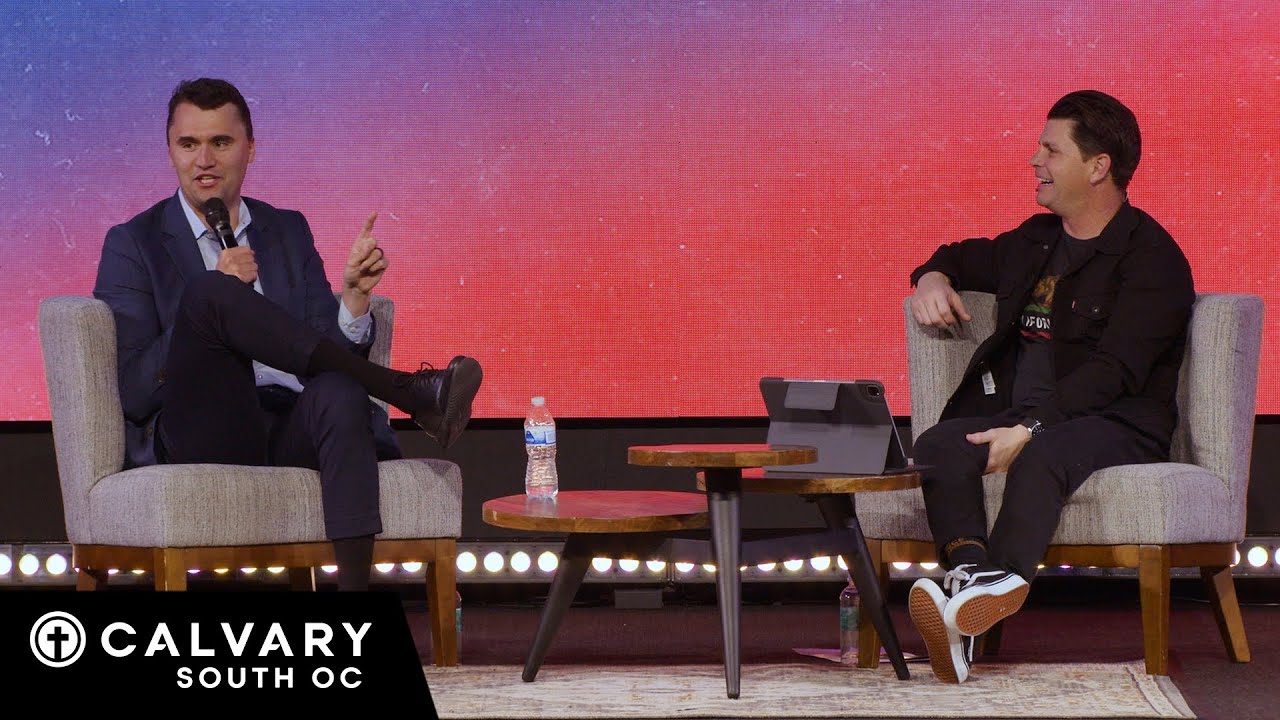
It's been another great week here at RFA Church. Exciting week. We've got um Night Line uh with us today. And here's what I want us to do. I know there's an adversarial relationship at times between evangelicals and the press. We want to be nice to them, sweet to them, kind to them, welcome them so that they'll all get born again and baptized in the Holy Ghost with the initial evidence of speaking in tongues. All right. So, but it is good to have them today. And uh then this past week, we made the front page of the Raleigh News and Observer. Woohoo. Yeah. Okay. Charlie Kirk, I know you've been on Fox News numerous times. Have you ever made the front page of the Raleigh News and Observer? Nope. I don't think so. So, we're all right. Now, listen. Let me just share this really quickly because folks have been asking, why this season have we been so engaged with the whole political mess going on? And I want you to remember three things. Okay? And you'll write this down as members because people going to ask you, "Why is your pastor so involved in this stuff?" And so I want you to write it down. If you don't have a pen, this is so important. Use lipstick. Okay? And ladies, that goes for you, too. All right? So, write this down. Number one, this abortion issue, it pushed me over the edge. The the the game has changed. When Cuomo did what he did, and then Governor Ralph Northam was asked, "What happens if a baby who is supposed to be aborted is born alive? What do we do?" Well, we let the mother and the doctor discuss the options. Everything changed for me with that. Second issue for me is religious freedom. And I'm actually late to the game in this with the whole equality act and all this mess going on. I did not realize how jeopardized our religious freedoms were. And so the whole thing of religious freedom, you know, people ask me, "Well, pastor, you know, what about the separation of church and state?" Yeah, I'm trying to keep the state out of my church. I'm all into the separation of church and state. Third issue that really is resonating with me is the whole racial issue. We've got Latino and African-American brothers and sisters here, and I'm seeing movements and policies that are antithetical to their well-beings. And I really want us to make a stand biblically and say, "No, here's what we as the body of Christ can do to bless that community, but some of the things that are being thrown out there are not good options to bless our minority communities." And so the whole race thing has really resonated with me. And so that's why um I'm so excited about having our guests with us here today. I'm going to let Rob McCoy in just a moment introduce Charlie Kirk. Let me introduce Rob McCoy. Um so when the whole COVID thing happened, there was a massive lockdown and churches just shut down. They didn't ask, they didn't say, "Can we talk about this for two seconds?" Churches just shut down. And then one man, honestly, you can trace this back to one man stood up and said, "You know what? I think church is essential. I'm opening my church back up." And that man, honestly, there was a domino effect. The man that started that whole movement is pastor Rob McCoy. He has national and international recognition. And um I was reading something from uh from psychologist Daniel Goldman. He says, "Our emotions are very contagious." And one of the most contagious emotions is courage and confidence. And when that man stood up and said, "Church is essential." It's amazing how that just spread like wildfire. And so, church, it's my privilege to have Charlie Kirk and his pastor, Rob McCoy, here. Can we welcome these two men? [Music] All right, settle down. We got a limited time. We got to make it work. Uh, your pastor uh introduced me and because I need introduction. Charlie's in the book of who's who. I'm in the book of who's he. But your pastor has been a great blessing to my life. Um I and and actually the way I got to know your pastor is kind of circumvented. I had the privilege to take your lieutenant governor. I was a teaching pastor on a trip to Israel with a lot of North Carolina pastors. So I met Lieutenant Governor Dan Forest who's also a hero. I love that man. Run Forest. Run. [Music] [Applause] When you spend 10 days in close quarters with somebody, you get to really know if uh their Christianity is real. It's kind of interesting how the flesh kind of rises to the surface. But I have to tell you, everything about that man is legitimate. And I love that man. I love Alice. They're precious. But on that trip, I got a chance to meet um Steve Noble, who is Yeah. Yo, you guys. Yeah. Come on, clap. That's good, too. Steve Noble. And I just This guy was full of energy and exciting just like Chad, you know, and don't give Chad caffeine. And I I and and he he just was amazing. And then when I opened up, we were facing all the issues from the governor and on our Palm Sunday, uh the governor decided to close the churches on our holy week. And uh we always participate in communion, which is a sacrament to us. Uh on the first Sunday of the month, which was Palm Sunday, starting into our holy week, and the governor said, "Nope, churches are closed." And they said, "You're non-essential." They allowed cannabis distributors, liquor stores, abortion clinics, but they didn't allow the church to be essential. And I was a sitting city councilman at the time. I had been the mayor prom. And then um during the shooting, the borderline shooting where 12 of our young people were killed. Two of them were for my church. I officiated their funerals. And then I became the mayor of the city and we dedicated a park to the victims and the officer that we lost, officer Ron Helis. Uh and then we dedicated the freeway to officer Helis and a park to the victims. And and then then I was up for reelection. I'm supposed to be getting voted on to uh Mon uh Tuesday and uh when the governor came out and said that the church is non-essential. Uh that was Saturday night before the Palm Sunday service, I noticed that it was getting some traction in the news and made it all the way over to England. We didn't even do a press release. I don't know that happened. And I realized I was going to cause great consternation to my colleagues on the council and I love them and I love serving my city. I love my city. I never want any harm to come to my city. We've done over 200 episodes. We've no less than 12 doctors, two psychologists. We've gone over all the COVID data. I know it inside and out. I know how it works. And I knew that the governor was overreaching. And I knew that and I'm I'm in politics. So, I knew that this was nefarious. And and when he said the church is non-essential, I realized at that moment I'm resigning from the council. And I did. And we opened up the church. Uh then they they got a a a judge who was political and predictable to establish a a emergency restraining order on us in August even though we'd been wide open with no social distancing, no mask. We haven't had one case of COVID, might I add. Yeah. Come on. That's right. But it was an emergency and on a scale to 1 to 10, the judge said we were at 10 as far as danger to the community and and we remained open and they began to find us. Uh and they wanted to send the sheriffs in to arrest me and a thousand dos is what they called them, whether congregants or visitors. And when we showed up the first Sunday that we were violating the restraining order, the church was surrounded by a number of churches that drove north uh two three hours and they said to us, "We're going to take the citation so you guys can worship in freedom. That's called an awakening." And the reason why I say that and and we'll get to Charlie right in like 40 seconds. In the midst of all that mess, I kind of felt like I was alone in all this. And then later, John MacArthur joined and a couple other pastors joined. And Jack Hibbs has always been open. He's a friend of mine. But in the midst of it, Steve Noble sends me over a video of this guy named Chad. And I w and I never knew my mom and dad had another child. [Applause] And so that's my introduction. Charlie doesn't need one. Welcome my dear brother in the Lord. Charlie K. Thank you. Thank you. Thank you. So Rob is actually my pastor. I met uh Rob a year and a half ago. I I was born and raised in the Presbyterian tradition and then went to uh Bible churches in Chicago. But I was always taught that Christianity and politics do not mix. Do not do it at any cost. Then I met Rob at a political deal and he said he's a pastor, city council, and he likes what I was doing. And I had never until I met Rob ever met a single pastor that embraced anything that I did ever. Uh just the church wanted nothing to do with me. They thought politics was bad or dangerous or whatever. And Rob's like, "No, come speak at my church." Like, "I I can't speak at your church. Like, I don't I don't do that." He's like, "Why not? You're a Bible believing Christian. Uh, you know, you believe that Jesus Christ is the king of the world. Like, just come speak." So, I did. And, um, I I owe to Rob something that's been just so amazing the last year. Uh, we spoke at over 50 churches across the country. Uh, really trying to activate the church for this political cultural moment where I feel that a lot of the church has either been complacent or complicit in this entire sequence of events. and speaking from someone who does the politics thing for a living um and really under I think understands the landscape that we're dealing with right now. Um I could tell you that the church is the greatest untapped asset in the entire country to the fight for freedom and liberty. uh the church just to give you an idea we we know Christians founded this country uh well not everyone if you went to public school you weren't taught that but 51 out of 55 of the signers of the declaration were Bible believing first speaker of the house was a minister yep um George Washington Bible believing Christian uh it was the first great awakening that led to the American founding the ideas that rights come from God not from government these are all Christian and biblical ideas and so what's amazing to see though is how Christians have been fed a lie and your pastor is not one of them. That is telling telling churches don't do the politics thing. And until I met Rob, I actually believed it because so many pastors did it. Yet we look throughout the Bible of Esther, Morai, Nehemiah, Jeremiah, Daniel, Joseph, all engaging in secular government for God's purpose. So what are we supposed to do with these people? Are we just supposed to cut those out of our our Bible? like, "Oh, we don't want to have to do the Daniel thing." It was really interesting because I saw some of these megaurch pastors that Yeah. uh that they have big followings and all that. And it was so funny. They did this whole series. I'll never forget it. At the end of last year and really cool tennis shoes. Yeah. And they wear the skinny jeans and all that nonsense, right? So, no, but it's it's and they're like, "Find your inner Daniel." Right. This whole thing like roar like a lion. Like, okay, whatever. And that's fine. Great. And then as soon as the church came under attack, I don't know where their inner Daniel went because if the Daniel that we read in our Bible is the Daniel that had a had a directive from King Darius who said that if you follow the rabbitical law and pray, you're going to be imprisoned and put to death. So what does Daniel do? Daniel doesn't just disobey it. He opens up his window facing the city and says, "You're going to watch me pray. I'm going to not just disobey. I'm going to do it facing right into the city. And what happened? Well, Daniel, all the people that were conspiring against Daniel, they go to Darius like, "Yo, we got to get rid of this guy." And he's like, "Uh, okay." Cuz the king was actually tricked into it. And D, God delivered Daniel. We know the way the story uh the story unfolds. But what's really interesting is that Christians, a couple different things, I should say Christians too generally, but the church in America, I think, is a better description. Uh they say, 'D don't get involved in secular government. It's not worth it. And there's many different excuses that are thrown out. I I don't find that to be biblically based at all. Or the second thing is they say do not defy any sort of leaders whatsoever. And they cite Romans 13. I'll let Rob tackle Romans 13 in a second. But then what do they make of Daniel doing that when he defied a tyrannical order for God's purpose? Um what do they make how do how do you make sense of what Jesus Christ when he went up to Cesaria Philippi when he said on this rock people say build church it's a little bit more complex than that actually William Tinddale translating the Bible went back to the coin Greek it was a word called eklesia and eklesia was a is a Greek term for an assembly of voting engaged civic-minded citizens that wanted to gather for the betterment of their community and eklesia was kind of like a town meeting. An eklesia was like a city council meeting. So Jesus says on this rock build my city council meeting. That's interesting. And then you go into the actual what was an eklesia? What did they gather around? Two Greek terms isomeia and elutheria which are the Greek terms for freedom and equality. I wonder what country was founded around the ideas of freedom and equality. Now the de the deeper truth of why Jesus did not use synaguay he didn't use temple he didn't use any of the more religious terms of the day and remember Jesus spoke araic but it was written in Greek and then translated first to Latin then to English but only to English when going back to the Greek not from Latin to English because Tinddale who was burned at the literally burned at the stake and murdered for translating the Bible he was challenging a lot of the orthodoxy he said I don't I don't think going from Latin to English is the right thing. It's too much translational gap. He went all the way back to the original text and he said this word that we use as church is a lot more complex than just the Roman Catholic hierarchy church. I don't mean this to be a slight towards any Catholics. I don't I my whole family's Catholic. I I have a great love for the Catholic tradition coming from the Midwest. That that's something that's built into me. However, I disagree theologically on what the church actually is. I do. I think the church is not headquartered in Rome. I think that the church should be in all places. I think it should be salt and light scattered across the planet because Jesus wanted comprehensive not compartmentalized Christianity. And if we are called to be all across the earth in every walk of life, that should not exclude government. I get it. Politics can be messy. It can be complex. It can be heated. It could be intense. But that's not an excuse for Christians not to engage in it because politics touches all of our lives. We can we can act like I'm not going to vote. I'm too cool for that. It's not going to impact what I'm doing. No, no, no, no. You don't get involved in politics. Politics will get involved in you. All of a sudden, they're going to say your church is not essential. You're going to have this fool that they call your governor right now shut down businesses all across the state. You need a new governor. where where this gathering you have right now, just so you understand, this is the difference that politics make that the gathering you have right now, I mean, you have a foolish Democrat governor right now, but generally North Carolina has better than other states had city and local elections that have preserved, you know, freedom and liberty. This is not allowed in Illinois right now. You you would be you would be arrested in California. This is illegal. Rob's church is gathering today in defiance to the orders that are given. And there might be another, you know, there might be another court hearing because of what's happening. So what happens in the political space absolutely impacts what happens in the kingdom space. We might try to make it like, oh, the kingdom and the gospel, they don't intersect at all whatsoever. I mean, the the kingdom and politics, they don't intersect at all whatsoever. Go do this in Wuhan. Go start a church in Wuhan and go tell me how that one works or in Beijing or Shanghai. The largest country on the planet with the most people cannot have public gatherings of churches and if they do, everything must be run by the central authorities. You can't challenge the leadership, the hierarchy, and it's very very much watered down. It's a underground church at best. So, we're absolutely called to contest in that in that arena. So, how do we do that? Well, it says in Jeremiah to pray for the welfare of your nation. And that's a very important thing. Should we actually have nations? Well, the Old Testament tells us absolutely is that the vision for civil government as articulated in the Bible is not a one world government. It's not a super government. It's individual sovereign nations where people make their own self-determined decisions. That's exactly what America was founded on and Western civilization was founded on. And so, as we pray for the betterment of our nation, we should want civil government. But Rob, can you go into Romans 13 because a lot of people cite that as a reason not to get involved in politics. Sure. Uh well, and also Romans 13 was the most quoted passage uh by Hitler and his minions to shut the church down in Nazi Germany. And it was Dietrich Bonhaofer and Martin Nemher who stood in opposition to the church just folding to Hitler. And and Bonhaofer said, "I know you're going to take care of the churches and the buildings and our pensions, but what about the soul of Germany?" And Hitler said, "Leave the soul of Germany to me." And that was 6 and a half million Jews burned, 50 million people dead in a nation that once was responsible for sending the gospel around the world. That's right. The the Gutenberg press. And and I I don't get beat up by the secular world. I get beat up by pastors. That's right. I've spoken to 15,000 pastors across the country and they always quote Romans 13. You're in defiance of Romans 13. And and if you don't know what it is, it just basically says that God appoints all positions of authority and that we're to honor those positions of authority. Uh and they're there for our good, not for our evil. And I go, "Yeah, you're absolutely right. You and I agree on that. We we we obey all positions of authority." I said, 'But the problem is I know something you don't know because I happen to have stepped into the eklesia, the public square as an elected official. And when I was elected first time by 52 votes, that somebody who wins by 52 votes is called the winner. I won I won re-election by over 4,000. And and when I took office, I raised my right hand. I swore to defend the Constitution against all enemies, foreign and domestic. And anyone who's coming and asking for consent to govern on your behalf, ask them this. How many articles are in the Constitution? If they can't answer it, say, "Why would I elect someone who doesn't know what it is that protects me from you?" The Constitution doesn't give us rights. It protects those given by God. Now, I swore to defend the Constitution against all enemies, foreign domestic. When I did that, I thought, you know, I really need to know this thing. And I began to pour through it. And I I had a cursory understanding. But it struck me when I was reading Romans 13, the word authority in Romans 13. Well, who's the authority? It's in the first three words of the preamble of the Constitution. We the people, elected officials govern by our consent. The Constitution and its seven articles was designed to protect us from a government that would interfere in our inalienable rights given to us not by the government but by God. The Constitution doesn't give us rights. It protects us from the government taking the rights God has given us. So I told these pastors on Palm Sunday when I obeyed the sacrament and the Bible says that the church is the bride of Christ. Come on now. Come on. We'll preach it together. The church is the bride of Christ. And Governor Nusselini or Coupitler Governor Nusselini Governor Nusselini said the church is non-essential. I have to tell you something. I've been married to Michelle for 30 years. I'm 56. I used to be an all-American swimmer. I look more like a buoy now. But but I'll say this. You You dare tell me my wife is non-essential? You'll be picking up your teeth with your broken arm. As shepherds, we're the defenders of the bride of Christ. And when that governor said that it's non-essential, I'm not in violation of inalienable rights of the freedom to worship. As a matter of fact, the the Bill of Rights in the first one in the very first verse is the freedom of religion. Government shall make no law. And and as and as I obeyed that, here's where we are. I'm not in violation of Romans 13. All the churches that aren't open are in violation of Romans 13. That man right there and myself and over 50 pastors you've met across the country, there's an awakening happening. We are all part of what I like to call the uh brotherhood of the defiantly obedient. Amen. Is that all right? Yeah, it's great. All right. Now, I I'm I'm going to I'm going to segue to Charlie, and this is what I I want him to point out, and this is what's critical, because uh when we think of a separation of church and state, and that Christians aren't supposed to engage in politics. What What moved me about Charlie is his organization is a 501c3, but it's a secular 501c3. and he goes on college campuses and you don't ask there's there's not a faith issue with folks who work for you. No, but you you don't apologize for your faith. No, I'll never apologize for my faith, but we have to and no, go ahead. Okay. So, so he goes on these campuses, he sets it up, and the church looks at it like he can't be a Christian and be talking about politics. Well, my son introduced me to him. My son at the time was like 16. He's like, "Dad, you got to see this." I go, "What?" He's like, "It's on my social media page." page. I go, I don't look at that stuff. I'm like a lite. And I meet him and he's like my son's hero. And I listen to him speak and I'm blown away. And all of a sudden, I realized we've been separated. It's like wonder twin powers activate. And the Lord opened up my eyes and Charlie's two at the same time where we looked at Galatians 3. And this is what Charlie does. He, by the way, he's a he's a greater evangelist, I think, than most pastors in this country. And I'll tell you why. The law ro uh Galatians 3, the law is a school teacher. It's a guardian to keep you safe and point you to Christ until faith comes. So it's Christians engaging in the eklesia so that people say, "Where does liberty come from?" And you always have an answer. And he studied the greatest thinkers of all time. Charlie, take it. Share with them how Turning Point works, how you've ministered on campus. Well, I mean, I go to college campuses so you guys don't have to. Um, so I I could do a next service. We could do a whole thing on college and all the problems uh that are with it where we have a generation of young people that are borrowing money they don't have to study things that don't matter to find jobs that don't exist. Besides that, it's great. Um, so no, but look, it's and I think we have a lot a lot of amazing young people here today. Uh, and it's great But look, we're a secular 501c3. We have people of all different faith backgrounds involved in what we're doing. Some people have no faith background. That's fine. Uh and I'll never apologize for my my faith. But I it's amazing how many people we've brought to Jesus because of politics. It's the exact opposite of what the church will tell you. Again, the church in America, they'll say, "Politics turns people off." I say, "Wait a second. There's probably going to be 61 million people that vote for a candidate on Tuesday that believes at least in freedom and liberty in some general terms. How many of those people do you think are saved and going to church every Sunday? The answer is most more people that aren't saved are going to vote for that candidate than not. What's the ministry to them? We have prison ministries, we have marital ministries, we have youth ministries, we have homeless ministries, we have drug rehabilitation ministries, we have food ministries, we have every ministry you could possibly imagine. What's the ministry to go after people that already believe in freedom and liberty? Cuz once people start drinking from the streams of liberty, they want to go upstream and find its source. Cuz liberty is not man's idea. It's God's idea. And because as soon as you start to say, you know what, I want to take responsibility for my life. And when you have responsibility, then you can understand what liberty and freedom is. What we're living through in our country right now and you start to see it with a lot of the secular societal decay and you is that we have misrepresented what liberty actually is. We've misrepresented what freedom actually is and what we've misrepresented what is necessary to actually be free. It is the exact opposite of what the secular left will tell your children in public and high school. And I'll tell you exactly what it is, which is and Rob mentions this a lot in the Harvard Law School. It says it in the stairwell that the laws are the wise restraints that keep men free. Let me res say that again. It's it's almost it's almost contradictory. Laws keep you free. What? So what you what you don't do what you stop yourself from doing actually keeps you free. That's the opposite of what we're telling our children. We're telling our kids just get the next dopamine rush on your smartphone. Spend seven and a half hours on that quasi cyborg device. Go download the next app, get your Netflix account, and we'll sedate our kids and somehow they'll find happiness. And they're more miserable than ever before. It's the most miserable generation in American history. Here's why. If you have freedom to go do what you want to do, it's easier to sin than ever before in American history. You can pull out your smartphone, get anything delivered as you want, when you want it, any website at instantaneous moment notice. But if you do not have the law to guard you, then you're going to be a slave to that. And it's you're not free at all. So here's the here's what's very interesting and we've seen this in the last six to seven months. When you do not have the law or moral teaching and you have the capacity, I won't even use the word liberty or freedom, but you have the framework to make any choice you want, any indulgence, in 90 days or less, you'll have the most suicidal, most depressed, most medicated generation in American history. And that's exactly what's happening. So when you have a generation that can do those things and they don't they're not being told what not to do then all of a sudden you're not actually free or the opposite of free. And so what and this is this is directly coincided with what's political because in order then to be free you must then take responsibility for your actions. In order to be free you must say what I do actually matters. In order to be free you must say I'm not going to blame other people for everything that I do. For example, I feel bad in the morning. Maybe you made a bad decision last evening. I'm not getting a good grade. Maybe you didn't study hard enough. I didn't make a team. Maybe because you don't have any talent. You'd go find something else to do. By the way, I grew up in an America that's how we treated and we got rid of that. Now, now instead of teaching self-control, we teach self-esteem. I was at the beginning in America of the self-esteem nonsense. It drove me nuts. All throughout high school, they had these big posters that said, "You're perfect the way you are." I said, "If I'm perfect the way I are, why am I in school? Like, I don't like why am I studying? Why am I trying to be a better person?" For parents out there, you should teach your kids self-control, not self-esteem. You should challenge them to become better human beings. And so, so the solution to all this is the gospel. But how do you get people to the gospel? This is where Christianity is really hitting hitting a wall. And this is where we're not where we're filling up college campuses with kids that would never have heard the gospel ever before. They have no understanding of the 4321 which is Jesus took my place, him for me, substitutionary atonement and grace. The gospel in four words, three words, two words, one, two words, one word. Never heard it before. Because in a stunning turn of events, the one thing the church told us never to get involved in politics is actually bringing more people to Christ than skinny jean wearing smoke, you know, whatever institutional Christianity is, whatever. Because here's why. Is because you have a generation that has disobeyed the law, not consciously because of the culture around them for 18 to 20 years. And they're like, I've done everything, every substance. I've looked at every website. I've done it all and I'm miserable. give me more. And the law then is a school teacher to Christ. Galatians 3. They start applying it. I say, "Read Proverbs. Stop doing two things you know that's destructive to your life for the next 30 days. Stop drinking. Stop smoking. Stop gossiping. Tell me how your life is in 30 days." They say, "It's better. What's next?" I say, "Great. Now you know the law. Now I can tell you you can't fill it. And also, that's why you need Jesus Christ." That's where the church has really missed it. And but here's the other cool thing. And then we'll take some questions, I think. Right. The other thing is this is what about the students that say everything is political and it's true. You can't go on social media can't go on anything without the overpropagandized of everything. And youth ministers across the country are emailing me and they're saying, "Charlie, I'm getting questions from my 14, 15, and 16 year olds in my youth ministry about politics. And our church's stance is we don't do politics." Like, okay, well then those kids will leave the church in two years. I guarantee it. If you do not have answers for your young Christians about how to govern ourselves, our issues on life, economics, supply and demand, and all this stuff, they will leave the church because they are unsatisfied with the biggest picture issues. 20 years ago, when everything was great, the wall fell, the economy is booming, things are fine, maybe you didn't have to do this. But now, when you got kids coming up, they're saying, "Is it okay if there's 135 genders? When does life begin? Can boys go in the girls restrooms? What is critical race theory? Is our country awful?" And the church is like, "Well, we don't do that." Young people will lose respect for that institution instantaneously. You need to have answers for them. Uh you pick one. You know, uh college ministers across the country would envy what Turning Point does. When I walk into a room at a student action summit or anything that Turning Point's doing, it is filled with the most remarkable young people in America that are on fire. A lot of them don't know the Lord, but they know where Charlie stands. They will. And they will come to know the Lord. But isn't that what a youth group is? And I'll tell you what, churches can't fill the place like like Turning Point does because they understand Galatians 3. Let's take some questions. Um here's a uh boy, there's a lot of great questions here. Number four, what do you make of the trend of neo-Marxism taking root in the church? And what is your favorite and most effective way to disabuse people of what great vocabulary people of the notion that those ideas are more in line with Christian theology and the ideas of liberty, freedom, capitalism, etc. So yeah, I mean that's Rob, you can start with it, but um uh Okay, I can start with it. I'll just do uh I have that one thing I'll do. You do your one thing and then I'll Yeah. Yeah. I'm a onetrick pony. And he's memorized everything I said. Um, socialism is a violation of two of the ten commandments. Thou shalt not steal and thou shalt not covet. And socialism is destructive because it appeals to the sinful nature of man. And that's why they're drawn to it. They envy. They want your stuff. And Margaret Sanger said, "Socialism only works until you run out of the other person's money." Maggie Thatcher. Margaret Thatcher. What' I say? Margaret Sanger. That is the Planned Parenthood woman. Well, I had that other thing in my head. So yeah, she's terrible. So So you're in class, you're getting an A because you study and you work your tail off. You're getting an F because you don't do squat, but we're going to make you equal and I'm going to take two grades from you and give them to you. So we're going to bring you up to a C and you're going to have a C and we're going to be equal. Well, what's going to happen is next time you're not going to study as hard and next time you're going to be waiting for your grades and you don't care and productivity will decrease. So that's why you take the fourth greatest nation in the Western Hemisphere, Venezuela, that was exporting oil and it was an unbelievable nation to live in. And today with socialism, they're eating their zoo animals. It says in Jeremiah to pray for the welfare of your nation and want the welfare of your nation to be engaged and involved. There is no way whatsoever anyone could make the argument that neo-Marxist ideas would be the best thing for our country. Some people make those arguments, but that's the real argument is the three types of equality. And again, if we had 40 minutes, I could go through all of this, but that's why we do two podcasts a day today and two hours of radio a day to go into it. There's three types of equality. There's one that is absolutely necessary. There's one that's desirable and one that is evil. And that we interchange them all the time. And then one of the big problems we have in politics today is everyone's talking about different terms that every single time. And things sound good, feel good, they might not mean good, and all of a sudden we're voting for things we don't know, we don't understand, and then we see things we don't like. Okay? So equality under the law, absolutely essential, totally moral. This is something that America was founded on. We didn't live up to this founding immediately, but it's a lot more complex than you might actually we might actually teach our kids, which is Vermont abolished slavery in 1777 in the United States Constitution was an import ban of slaves into the United States. There were no new slaves in the Northwest Territories. But anyway, equality under the law meaning that on in our system regardless of skin color, regardless of where you come from, that there is no law that one person of one's skin color cannot do or one person of culture or language. Equality under law is essential. Absolutely. Civil rights act was the moral the moral pursuit of continue to do that in the 1960s. Okay. Equality of opportunity is desirable. It's very hard, but I think that we should strive for it. That's why we should want school choice. We should want to improve the literacy rate. We should want to improve the well-being of our public education system and homeschooling in our country. Now, equality of opportunity. I think we miss all of the conversations on equality of opportunity. We talk about stuff. We talk about healthcare. All that stuff's I think distraction. You want to make things more equal from an opportunity. Rebuild the American family. It's that simple. Get fatherlessness in half. All a lot of these conversations that happen in our country are just downstream from the broken family. The family is the most the most proven the most effective way to fight against poverty. Get one generation to get richer, get wealthier, happier, least likely to fall into poverty, fall into prison. How? And you see socioeconomic groups in America with the highest foollessness have the highest the highest levels then of crime, poverty, so on and so forth. So, how do we actually rebuild the American family? Number one, we got to tell men to start taking responsibility for their actions. It's that simple. Number two, we have to stop we have to stop subsidizing single motherhood in this country. We do it in a variety of different ways. We do it in section 3 housing. We do it in government sponsored welfare. I could go on to this indefinitely, but that's one of the major way major reasons that that that is one of the biggest pushers. And then finally, there's equality of outcome. Sounds good. Awful idea. No one should ever want equality of outcome. It's unbiblical. It's against the Matthew principle. It's again, it's impossible. It's immoral. It's utopian in nature. And it's something that we should never engage in. Here's why. Every single person in this room, if I gave you $50, would do something different within 24 hours. Some would invest it, some would save it, some would pour into it. We know this in a parable of the talents. Jesus taught us very clearly that when you are given something, everyone will treat it differently and the person who multiplies it will be rewarded most faithfully and most generously. Equality of outcome is you inserting yourself into somebody else's actions and taking it from them and saying I don't care that you worked hard, had a good idea, sacrificed or you went ahead. Now equality of outcome is very very dangerous because then all of a sudden you start to throw rocks at the top of the building instead of wanted to fix the elevator. Those are the three types of equality. I could get into critical race theory and all that, but I think we're almost running out of time, so we'll take one more question. So, how much time do we have, Jen? Five minutes. Five minutes. Okay, let's do one more question. Yeah, if you if you had an hour, I could do critical race theory, but that's it's really good. Can we Can you do it in five minutes? Uh, I mean, uh, do it. Do it. Do it. Do it. Do it. Do it. I mean, look, critical race theory, this is so important right now, and nobody has articulated better than Charlie. Do it. Yeah. So, critical race theory is really what BLM incorporated is, it's what they're espousing. Critical race theory started in the 1960s by a thinker from the Frankfurt School by the name of Herbert Marcusa. And there's five big attributes of critical race theory. All five of which are directly against the teachings of the Bible. Number one, they think melanin matters. They think your skin color actually matters. I don't. I think your skin color is irrelevant. I don't care about your skin color. I care about your character. I don't care. It's completely and totally irrelevant. Yeah. Your immutable characteristic should not define you. We should not judge people based on that. We broke away from that. We made good and real progress from that. And now there's a movement to regress us back into judging people based on the color of their skin. That's number one. Number two, it's a belief that racism is everywhere. It's in the air. You turn over a rock, there's racism. Every person, whether they know it or not know it, conscious and unconscious, they're exhibiting some form of racism. It's in the bones of our superructure. This is complete and total nonsense. And I could prove it to you. I could prove it to you. If America was absolutely racist down to the core, why is it that Nigerian-Americans are the richest, wealthiest immigr im immigrant group in America over the last 20 years? Nigerian Americans are black. It's because Nigerian-Americans do three things really, really well. They value education, they stay loyally married, and they also have the highest business startups per capita of any immigrant group in the country. If America was so rotten to the core, why is it that 3 million black Americans since 1980 have legally immigrated to this country, 1 million from the Caribbean, 2 million from Africa? I'm not doubting that there's people out there, and by the way, if there's anyone in this audience that harbors racial prejudice or has racism, you got work to do. You got people to apologize for. You got a God to atone to. You got to ask Jesus Christ to forgive your sins. I mean that. However, however, if that is not you, then you don't have anything to apologize for based on the color of your skin. This group guilt apology based on tribal group is anti-biblical. It it it ruins and completely interrupts the vertical relationship that we need with Jesus Christ. And it categorizes people based on just your skin color. What a lazy, sloppy way to judge people, right? I mean, how about a little bit of nuance? How about believing that people can have different beliefs, different worldviews, different values? Okay, that's number two. Number three, it's totalitarian in nature. If you don't post the black square, you're a bad person. It's white silence is violence. You guys have heard this that all of a sudden that if you don't speak out, we're going to judge you. It's not enough that if you say the opposite, it's that if you don't put the sign in your store window, if you don't say this, then all of a sudden, uh, we're going to come after you. There's there's like five or six other attributes, but the fourth I'll say is this which is the most important and we'll close with this is that they do not want dialogue or speech. It's the most important part of it. Aristotle said we are the speaking beings. Believe it or not, I can organize every single government in the history of the planet in two buckets. One bucket is those that require persuasion and speaking to get power. The other bucket is those that use force to get power. It's that simple. So, for example, in order for us to elect a new governor, you have to have good arguments and you have to be on the right side of it and convince people. It's not who has the most amount of standing militia members. You have to convince people. What does that take? It takes speech. We take this for granted. It takes tough conversations. It takes discourse. It takes a dialectic. They don't want that. Instead they believe that speech instead they believe that speech is an expression of a systo sysonormative phallologentric western construct. If that stuff goes over your head you're like I don't understand. It's okay. It's a it's a bunch of rubbish. Okay. By the way that that's kind of like the fifth thing is that if you think you're like none of this stuff makes any sense. Am I stupid? No. No. No. They are. Don't worry. Okay. Like it's designed it's designed to make you feel like you're missing something and you're actually not. And I I'll close with this and and if I I I feel compelled to do this and also I want to we don't want to do something for Dan. Yeah, we have 30 seconds. Okay. Um I'm traveling the country. We've done 25 states in just the last three weeks. I've given 120 speeches in the last 90 days. We're doing two podcasts a day, two radio shows a day. We came to North Carolina for a reason, everyone. Because everything we talked about is now in play right here, right now. You guys need a new governor. And you have a great man running for governor right now. You really do. And so there's a there'll be a lot. You guys also need to keep your current US senator. Oh my goodness. Um and so every single Christian should vote. If not, you've not voted already, vote on Tuesday. Don't vote your values. That's a really bad idea. Vote biblical values. And I know I'm running over time. I'll say this. I'm a friend of the president. I've traveled the country with him. He's fought for life. Gorsuch, Kavanaaugh, Amy Coney Barrett, most pro-Israel president in American history. Fight against child sex trafficking. Everyone's enormously flawed. He's definitely in that category. So am I. I don't like the moral pyotism, moral measuring stick that a lot of people are putting up there. But I do put my name behind someone that spoke at the March for Life. I do put my name behind someone that gave us Gorsuch Kavanaaugh and Amy Coney Barrett and also stand stood with the state of Israel. And so there's one thing that I think all of us should do for Dan. If if I wrote a check for Dan for a million dollars right now, it wouldn't be the same equivalent if every single person did this. If you took out your phone in the next 12 hours and you texted every contact you have in your phone, why you are voting for Dan Forest and why you are voting for President Trump or Tom Tillis, you just copy paste it. If every person did that in this room, about a thousand people to a thousand contacts, that's a million persontoperson contacts. Imagine if every person did it. You don't have to leave your home. You could do it from your living room. You don't have to pick up the phone and you might get some harsh messages in return, but it's worth it. And so that's my challenge and charge to you. God bless you guys. Man, can we do this? Hey, uh Rob. Rob, let's do this. Uh I know Charles. Hey, look. Charles is a fellow introvert. I'm as far on the introvert scale on the MyersBrigg things. Guys like this who think or whatever, they've got to have some alone time. So, I want to give him some alone time. But can we pray for him right now, Rob? I want to pray for him. He's coming. Um because I do believe this. Uh we had a youth pastor uh several years ago to say something and uh incidentally um yeah I'm sorry about your microphone Charlie. I tell people as a pastor if I lose myself salvation die and go to hell it's going because of microphones and youth pastors and so uh but we got a great one now. Got a great and this but he said something very interesting. This pastor said, "A great calling plus a great anointing will always attract great opposition." A great calling plus a great anointing will always attract great opposition. Pastor Pepper and I, our youth pastor, have been texting back and forth and he just talked about the Holy Spirit being all over these pastors. I believe Charlie, you've got a great call of God on your life, a great anointing on your life. And I believe that there will be opposition internally and externally. And I want us to just reach forth our hands right now and speak blessing over him in the name of the Lord Jesus. Father, I thank you for this young man that you are raising up. And Lord, you're say your words says, "The righteous are as bold as a lion, but the wicked flee when no one pursues." So, Father, give him that lionlike boldness. Lord God, give him clarity of thought. Give him the anointing of the Holy Spirit. give him whatever it was that was on Stephen where it says in your word they could not contradict the wisdom by which he spoke. God we pray in the name of the Lord Jesus Christ for protection mind, body, soul and spirit and may you continue to use this man to change this world for Jesus Christ. In Jesus name we pray. Amen and amen. God bless you. Thank you guys. Receive this blessing church. We do this every Sunday. Y'all do understand no matter what happens Tuesday, God is on this on the throne. You do realize that, right? God is not sitting in heaven biting his fingernails to the quick wondering what's going to happen. It's all under control. God is in charge. God is in control. And let me speak this blessing over you that's been spoken over God's people for millennia. Shalom church. The Lord bless you. The Lord keep you. The Lord make his face to shine upon you and be gracious to you. And the Lord turn his countenance to you and give you shalom, peace, wholeness, mind, body, soul, and spirit. In the name of the Father and of the Son and of the Holy Spirit we pray. Amen and amen. God bless you, beloved. Let's go change this world for Jesus Christ.