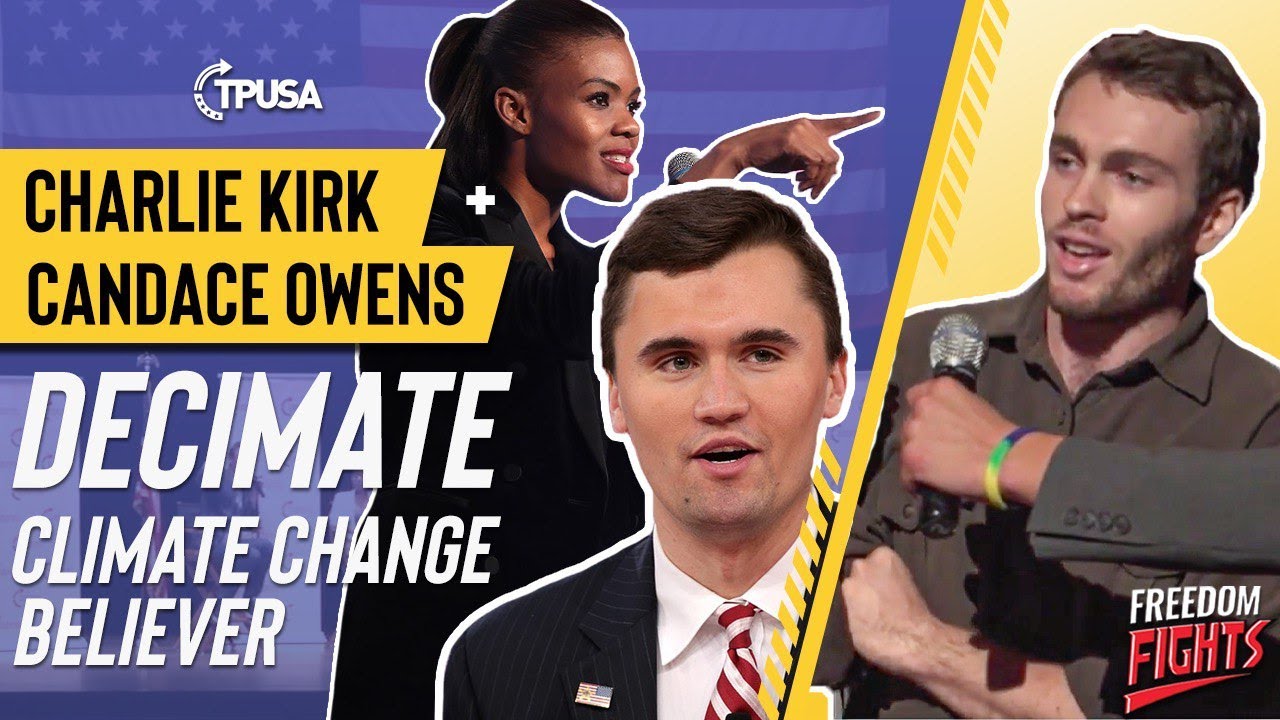
Charlie Kirk Challenges College Student on Climate Change Science and the Paris Agreement Debate
Enjoying this? Share it with someone who needs to see it.
Up Next
Charlie Kirk Debates Student on Climate Change, Carbon Emissions, and the Conservative Movement's Skepticism
7:36
Charlie Kirk Encounters a Male Feminist Activist Exposing Pro-Choice Hypocrisy on Abortion and Child Neglect Laws
5:14
Candace Owens Exposes How Every Left-Wing Policy Is a Calculated Attack on the American Family
29:19
Charlie Kirk Challenges College Student on Climate Change Science and the Paris Agreement Debate
A college freshman confronts Charlie Kirk about climate change policy, sparking an intense exchange about scientific proof, consensus, and economic trade-offs. Kirk dismantles the 97% consensus argument, questions whether human contribution to global temperature changes can be proven using the scientific method, and defends Trump's withdrawal from the Paris Agreement. The student attempts to explain the Seuse effect and isotope evidence, but Kirk pushes back on whether correlation equals causation, ultimately arguing that science isn't a democracy and that the dissenting voices in climate science deserve attention. The debate highlights fundamental disagreements about how science works, what constitutes proof, and whether America should restructure its economy based on contested theories.
During a public forum, a college freshman approached Charlie Kirk with a question about reconciling facts over feelings with Trump's climate and environmental policy. The student described climate change as a significant threat based on evidence and research they had encountered. Kirk immediately challenged the framing, asking the student to specify which threat exactly they were referring to.
When the student clarified they meant climate change, Kirk pointed out the linguistic shift from "global warming" to "climate change." He argued that Democrats love manipulating language, explaining that scientists changed the terminology because there was no factual data to back up global warming claims. According to Kirk, they switched to "climate change" because the climate is always changing, making the term more defensible. He described this as a lie designed to extract tax dollars for agreements like the Paris Climate Accord, which had no actionable plan and hurt America economically.
Three Questions That Challenge Climate Orthodoxy
Kirk pressed the student with three specific questions: Can you prove humans are contributing to climate change? Can you prove how long it's been happening and what the causation is? Can you prove that anything we can do can stop it? The student, acknowledging they were just a freshman in college, attempted to answer affirmatively but Kirk interrupted, asserting that no one can actually prove these things.
The student tried to explain that's how science works, but Kirk countered by invoking the scientific method. He emphasized that these three fundamental questions remain unanswered with absolute certainty, which is why there continues to be debate about restructuring the entire carbon-based economy. Kirk highlighted that other countries like India and China are aggressively pursuing fossil fuels, and if America restricts itself through international agreements while competitors don't, it creates an economic disadvantage.
The Market Versus Government Mandates
Kirk clarified his position on energy transitions: if the market naturally moves toward a carbon-free economy, that's fine. However, the government should not subsidize such a transition, nor should America enter international pacts that restrict economic competitiveness while countries that oppose American interests burn as much coal and natural gas as possible. He agreed with the assessment that the Paris Agreement wasn't worth the paper it was written on, containing nothing actionable, making Trump's decision to withdraw completely justified.
The Seuse Effect and Isotope Evidence
The student attempted to provide scientific evidence, mentioning the Seuse effect and explaining that certain isotopes of carbon decay when taken in by plants that eventually become fossil fuels underground. When these fuels are burned, they release those isotopes into the atmosphere, and increasing concentrations of these isotopes suggest a link to human activity. Kirk acknowledged familiarity with the concept but pressed further: Can you draw a direct correlation using the scientific method between the aggregation of those isotopes and rising global temperatures, more so than sunspots or natural climate activity?
The student answered affirmatively but Kirk remained skeptical, noting that real climatologists who aren't government-funded or highly politicized continue to debate these very questions. The fundamental issue, according to Kirk, is establishing causation rather than mere correlation.
Dismantling the Consensus Argument
When the student invoked the "99% consensus" among scientists, Kirk immediately challenged the premise. He asked about the remaining 1%, pointing out that science is not a democracy. We don't vote on gravity or Newton's second law, he argued. Scientific truth isn't determined by majority opinion. The student corrected themselves, citing the 97% consensus statistic instead, but Kirk dismissed this as a "totally flawed statistic."
Kirk made a compelling argument: if something can be proven 100%, then it's true. But 99% or 97% represents opinion, not absolute scientific certainty. He expressed particular interest in the 3% of scientists who disagree and defect from the consensus, wanting to understand why they hold different views. That dissent, Kirk argued, is what science is all about. The scientific method depends on gathering evidence, disagreeing, and discussing. The existence of that dissenting minority indicates the matter hasn't been proven beyond a shadow of a doubt.
What Constitutes Scientific Proof
The core of Kirk's argument centered on the difference between consensus and proof. If there were direct causation or correlation between fossil fuel activity and rising global temperatures proven without a shadow of doubt, the consensus would be 100%, not 97% or 99%. The fact that credible scientists disagree demonstrates that the science isn't settled. Kirk emphasized that those scientists who have put their entire work and life on the line yet still dissent deserve to be heard and their objections addressed.
The student protested that Kirk didn't want to do the reading, but Kirk countered that he had read much more on the topic than the student had. He returned to his fundamental question: Is science a democracy? The answer is no. You can't prove something true by popular vote, even among scientists. If 99% of people in a room believe something, that doesn't make it factually correct. Scientific truth requires rigorous proof through the scientific method, not majority agreement.
Kirk concluded by emphasizing that he was presenting facts: the claims about climate change and human causation haven't been definitively proven. Until they are, he argued, America shouldn't restructure its entire economy or enter into disadvantageous international agreements based on contested theories and incomplete science.