Charlie Kirk Challenges College Freshman on Climate Change Science and the Flawed 97 Percent Consensus Claim
Enjoying this? Share it with someone who needs to see it.
Up Next
Charlie Kirk Dismantles Climate Change Activist on Carbon Dioxide and Fossil Fuels at Campus Event
3:03
Charlie Kirk Exposes Joe Biden's Corruption and China's Role in the Coronavirus Pandemic
43:52
Charlie Kirk Debates the Green New Deal as Mitch McConnell Forces Senate Vote on Climate Proposal
4:19
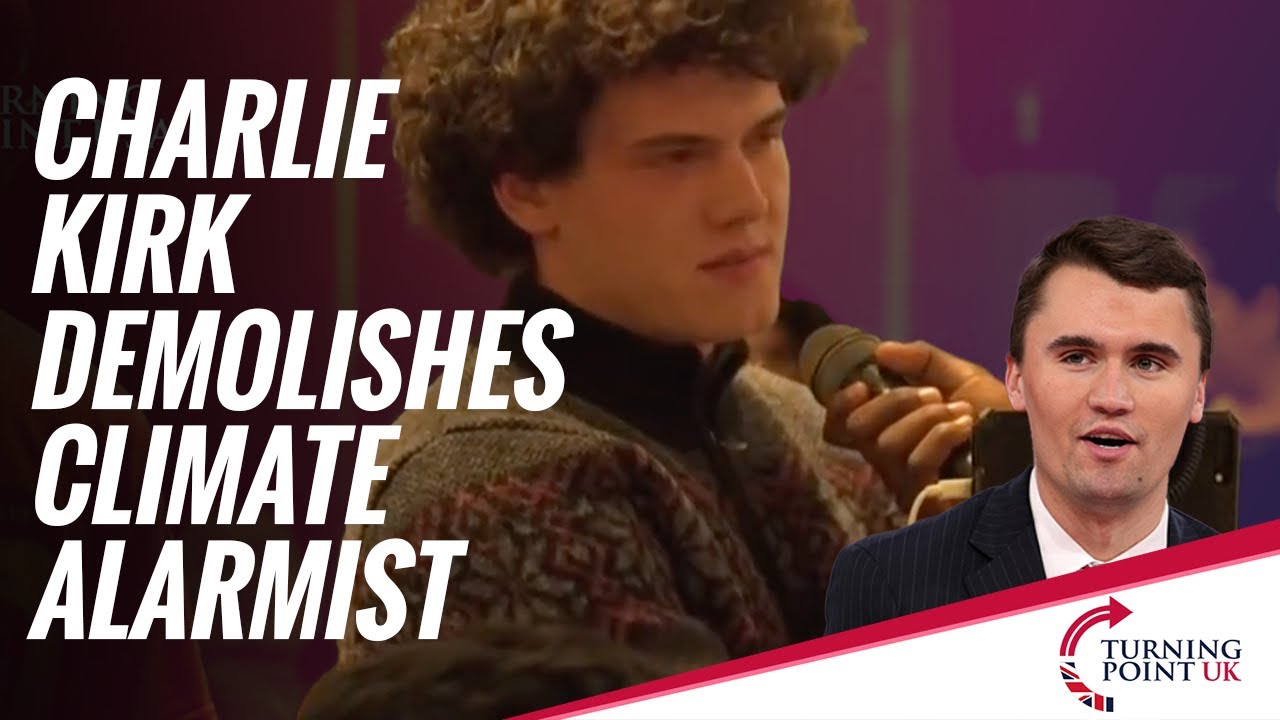
Charlie Kirk Challenges College Freshman on Climate Change Science and the Flawed 97 Percent Consensus Claim
Charlie Kirk engages with a college freshman who questions how Kirk's support for facts over feelings aligns with climate policy. The exchange exposes critical gaps in the climate change narrative, from the shift in terminology from global warming to climate change, to the inability to prove direct human causation using the scientific method. Kirk challenges the widely cited 97 percent consensus statistic, arguing that science isn't determined by majority vote and that the dissenting three percent deserves serious examination. The discussion culminates in Kirk's assertion that proponents cannot definitively answer three fundamental questions about climate change, human contribution, and the effectiveness of proposed solutions.
A college freshman approached Charlie Kirk with a pointed question: How does Kirk reconcile his commitment to facts over feelings with positions on climate policy, given what the student perceives as a significant threat based on research and evidence?
Kirk immediately identified a linguistic shift in the climate debate that many overlook. The movement changed its terminology from "global warming" to "climate change" for a specific reason: scientists looking into global warming found no factual data to back up their arguments. The climate is always changing, which made "climate change" a safer, more defensible term.
This linguistic pivot, according to Kirk, represented something larger—a pattern of misleading the public, extracting tax dollars for agreements like the Paris Climate Accord, with no actionable plan while America lost economic competitiveness. Trump's decision to withdraw from what Kirk calls a "terrorist group" was the right response.
Three Questions That Cannot Be Answered
When the student insisted there are scientific curves and studies proving global warming, Kirk presented three fundamental questions that get to the heart of the climate debate:
Can you prove humans are contributing to rising global temperatures?
Can you prove how long it's been happening and what the causation is?
Can you prove that anything we can do can stop it?
The student, a college freshman, admitted he couldn't personally answer these questions but suggested the evidence exists. Kirk's response was direct: No one can answer those three questions definitively.
The Seuss Effect and Scientific Proof
The student attempted to explain the Seuss effect—certain isotopes of carbon that decay when taken in by plants, turn into fossil fuels underground, and when burned release isotopes into the atmosphere. The increasing concentration of these isotopes, the student argued, shows the link to human activity.
Kirk pressed further: Can you draw a direct correlation using the scientific method between the aggregation of those isotopes and rising global temperatures? More importantly, can you prove this connection is stronger than natural factors like sunspots or natural climate activity?
The student insisted that "real climatologists" have established these connections, but Kirk countered that real climatologists—those not government-funded or highly politicized—are still debating these very questions.
The Flawed 97 Percent Consensus
When the student invoked the famous "99 percent consensus" (later corrected to 97 percent), Kirk identified a critical logical flaw: Science is not a democracy. We don't vote on gravity or Newton's second law. If 99 percent of people in a room believe something, that doesn't make it true.
The student argued these are scientists who have dedicated their entire lives to this work. Kirk's response cut to the heart of the scientific method: If it's 100 percent consensus, then it's provably true. But 99 percent means it's still an opinion, still subject to debate.
More importantly, Kirk argued, the three percent that disagrees deserves examination. Why do they disagree? What evidence do they have? That's what science is all about—gathering, disagreeing, and discussing. If there were definitive proof of direct causation or correlation between fossil fuel activity and rising global temperatures, there would be 100 percent consensus.
The Economic Reality
Kirk brought the discussion back to practical policy implications. Should we completely restructure our carbon-based economy for something that still has immense debate, dialogue, and discussion around it? Countries like India and China are trying to acquire as many fossil fuels as possible.
If the market naturally moves toward a carbon-free economy, Kirk supports that transition. But the government should not subsidize it, nor should America enter international pacts that restrict economic competitiveness while countries that oppose American interests burn as much coal and natural gas as they can.
The Paris Agreement, Kirk emphasized, wasn't worth the paper it was written on. There was nothing actionable in it, and Trump was right to pull America out completely.
Facts Over Feelings
The exchange concluded where it began: the student came arguing that Kirk should align with facts, but Kirk demonstrated that the "facts" the student presented haven't been proven beyond doubt. The scientific method requires definitive proof, direct causation, and replicable results—standards that climate change advocacy hasn't fully met despite the rhetoric of settled science.
Kirk's position isn't anti-science; it's pro-scientific rigor. The three percent of scientists who dissent from the consensus aren't deniers to be dismissed—they're practitioners of genuine scientific inquiry, asking the hard questions and demanding proof rather than accepting claims based on democratic vote among researchers.