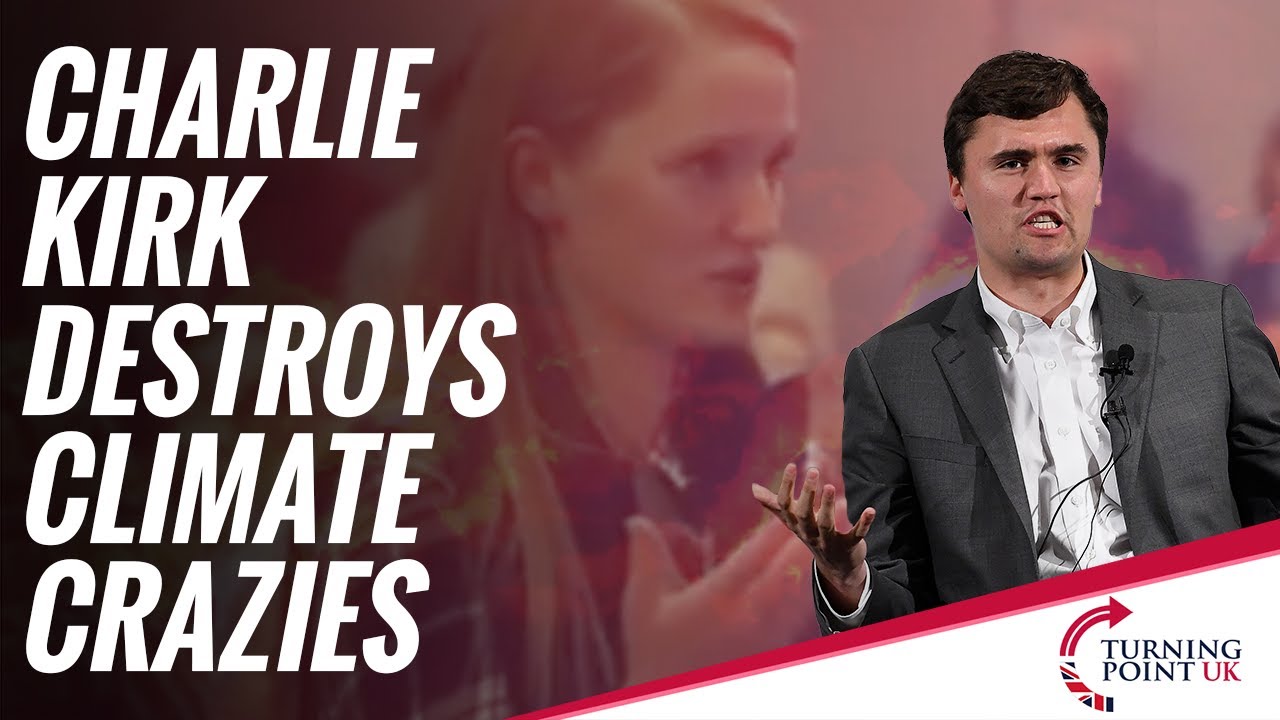
Charlie Kirk Challenges College Student on Climate Change Evidence and the Scientific Method
Enjoying this? Share it with someone who needs to see it.
Up Next
Charlie Kirk and Candace Owens Launch Turning Point UK to Fight Cultural Marxism Across British Universities
1:16:18
Charlie Kirk Explains the Conservative Approach to Climate Change and Millennial Concerns About Environmental Policy
2:31
Charlie Kirk and Candace Owens Defend Free Markets Against Tucker Carlson's Critiques at UK Event
14:15
Charlie Kirk Challenges College Student on Climate Change Evidence and the Scientific Method
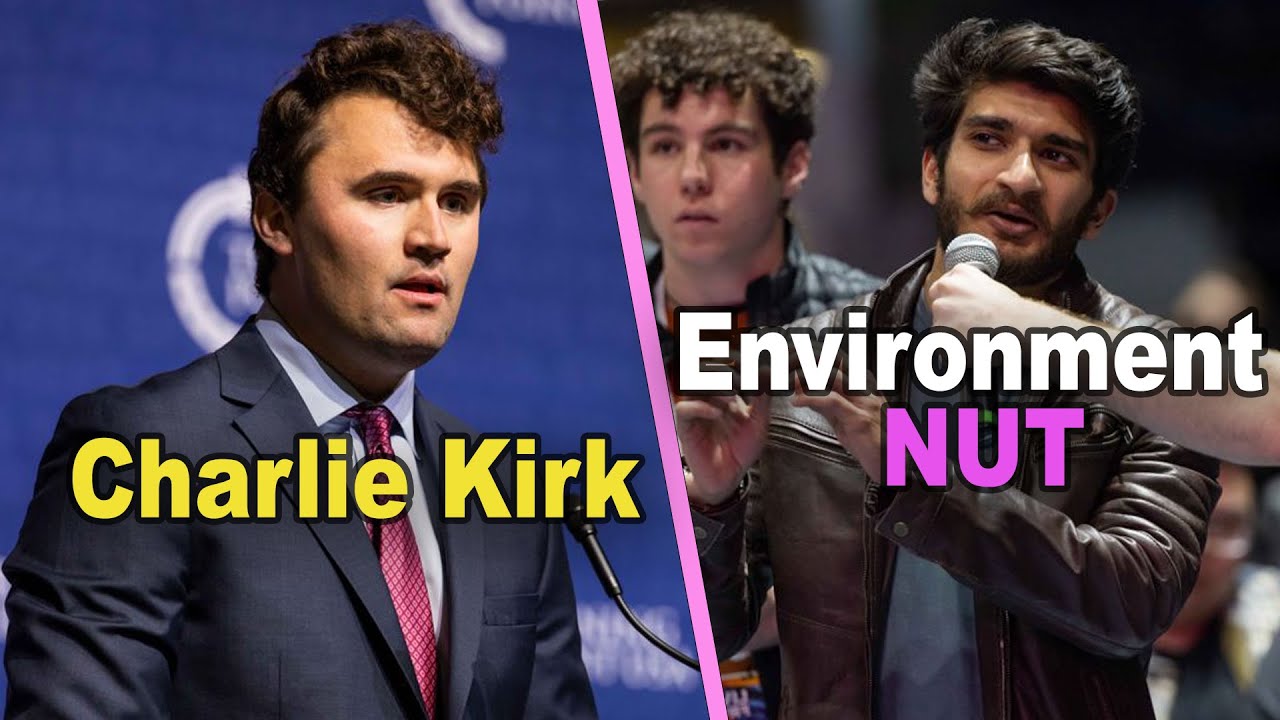
A college freshman questions Charlie Kirk about reconciling facts over feelings with Trump's climate policy. What follows is an exchange on scientific proof, the Paris Agreement, and whether consensus equals truth. Kirk presses three questions: Can humans be proven to contribute to climate change? Can proposed solutions be proven effective? And at what cost? The conversation reveals fundamental disagreements about the scientific method, the difference between correlation and causation, and whether a 99% consensus settles scientific debate.
A college freshman approached Charlie Kirk with a pointed question about reconciling a commitment to facts over feelings with Trump's environmental and climate policy. The student cited what he viewed as a significant threat based on evidence and research he had encountered.
Kirk immediately challenged the premise, pointing to a linguistic shift in the climate debate. He noted that Democrats changed the terminology from "global warming" to "climate change" because scientists examining global warming found no factual data to support their arguments. Since the climate is always changing, the term became more flexible and harder to disprove.
Kirk connected this to policy, explaining that the terminology shift was part of a larger pattern: telling lies, extracting tax dollars for the Paris Agreement which had no actionable plan, while America lost ground economically. Trump's response was to pull the United States out of the Paris Agreement entirely.
Three Questions That Cannot Be Answered
Kirk pressed the student with three specific questions designed to test the certainty of climate change claims. First, can you prove humans are contributing to it? Second, can you prove how long it's been happening and what the causation is? Third, can you prove that anything we can do can stop it?
The student, acknowledging he was just a freshman in college, attempted to answer affirmatively. Kirk's position was clear: no one can answer those three questions definitively. The student disagreed, saying that's not how science works, and that you can prove human contribution using the scientific method.
The Economic and Geopolitical Reality
Kirk reframed his questions to emphasize the practical implications. Can you prove humans are contributing? Can you prove what we're going to do will actually affect global temperatures positively or negatively? And at what cost are we going to completely restructure our carbon-based economy for something still subject to immense debate, dialogue, and discussion?
He highlighted the geopolitical dimension: countries like India and China are actively acquiring as many fossil fuels as possible. If the market wants to move toward a carbon-free economy, that's acceptable, but the government should not subsidize it. More importantly, the United States should not enter international pacts that restrict American economic competitiveness while countries that oppose American interests burn as much coal and natural gas as they can obtain.
Candice Owen, who was present, agreed that the Paris Agreement wasn't worth the paper it was written on and contained nothing actionable. Trump was right to withdraw from it completely.
The Seuss Effect and Isotopic Evidence
The student offered a technical explanation, mentioning the Seuss effect. He explained that certain isotopes of carbon decay when taken in by plants and then transformed into fossil fuels underground. When these fossil fuels are burned, those isotopes are released into the atmosphere. The increasing concentrations of those specific isotopes show that climate change is almost certainly linked to human activity.
Kirk challenged whether a direct correlation could be drawn using the scientific method between the aggregation of those isotopes and the rise in global temperatures. Could this correlation be shown more convincingly than natural climate activity or sunspots?
The student answered affirmatively. Kirk's curiosity was genuine: real climatologists who are not government-funded or highly politicized still debate these questions.
Consensus Is Not Science
The student invoked the commonly cited 99% consensus among scientists. Kirk immediately challenged this framing: science is not a democracy. We don't vote on gravity or Newton's Second Law. Science requires proof, not popular opinion.
When the student insisted there was a 99% consensus, Kirk asked him to prove it. The student suggested that if Kirk didn't want to do the reading, he didn't have to. Kirk countered that he had read far more on the subject than the student had.
Kirk then pressed the logical point: is science a democracy? The student agreed it was not. Kirk pointed out the contradiction—if something is true at 100% but only believed at 99%, that 99% represents opinion, not proven fact. The student argued that the 99% refers to scientists who have dedicated their entire lives and work to the question.
Kirk noted that the actual statistic commonly cited is 97%, which he considers a flawed statistic. But even accepting it as true, the three percent who disagree and defect are worth examining. Why do they disagree? What are their reasons? This is what science is about.
The Scientific Method Requires Proof, Not Agreement
Kirk argued that if there were direct causation or correlation between fossil fuel activity and rising global temperatures that could be proven beyond a shadow of doubt, the consensus would be 100%. The three percent who defect and disagree represent the essence of the scientific method—gathering, disagreeing, and discussing.
He concluded by returning to the student's original framing. The student approached with the premise of disagreeing with facts. Kirk's response was simple: the fact is that climate change caused by human activity hasn't been proven. The student came seeking to hold Kirk accountable to facts over feelings, but Kirk turned the question around—where is the factual proof that meets the standards of the scientific method?