Charlie Kirk and Nigel Farage Discuss Brexit Victory, Boris Johnson, and the Western Elite Power Grab
Enjoying this? Share it with someone who needs to see it.
Up Next
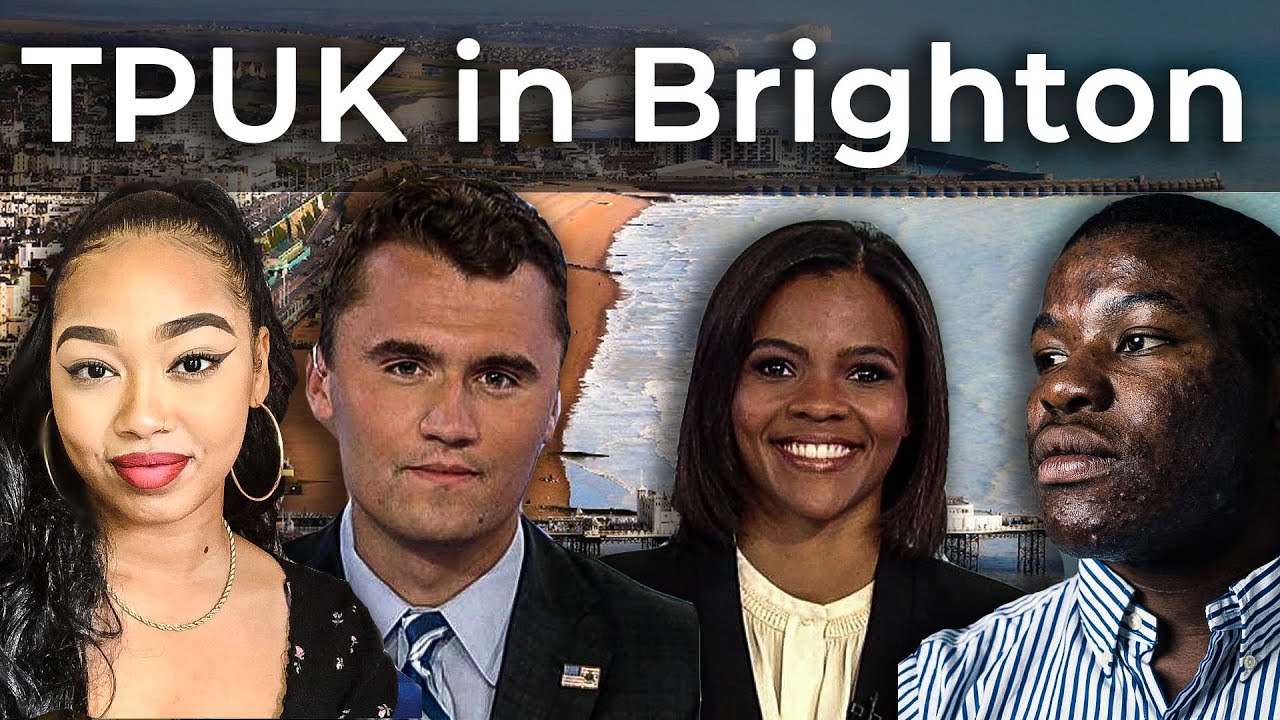
Charlie Kirk and Candace Owens Launch Turning Point UK to Fight Cultural Marxism Across British Universities
1:16:18
Charlie Kirk and Glenn Beck on Trump's Victory, Rush Limbaugh's Legacy, and Bold Personnel Picks for the Second Term
16:04
Donald Trump Jr. on the Most Amazing Political Comeback in American History and Why Exile Made Them Stronger
22:56
Charlie Kirk and Nigel Farage Discuss Brexit Victory, Boris Johnson, and the Western Elite Power Grab
Charlie Kirk sits down with Nigel Farage in London following the Brexit Party's massive European election victory. Farage shares how he influenced Trump voters in 2016, warns about Boris Johnson's metropolitan liberal instincts, and explains why the Brexit Party now leads UK polling. The two discuss Western elites attempting to consolidate power through supranational organizations, the death of genuine conservatism in Britain, and why corporatism has replaced capitalism. Farage reveals his concerns about whether Boris Johnson will deliver Brexit on October 31st and makes clear he's prepared to be either Johnson's greatest ally or deadliest enemy depending on which path the new Prime Minister takes.
Farage's European Election Triumph and Its American Parallels
Charlie Kirk travels to London to meet with Nigel Farage following the Brexit Party's stunning victory in the European elections. For Americans unfamiliar with the context, Britain was legally scheduled to leave the European Union on March 29th following the Brexit referendum, but the government kicked the can down the road, forcing the country to participate in European elections once again. The Brexit Party's performance shocked the establishment, winning 50% more votes than the nearest competitor and doubling the combined total of the Conservative and Labour parties.
Farage explains his unique role in American politics, particularly his influence on Trump voters in 2016. He recounts how on the morning of the Brexit referendum, a suppression poll showed the Remain campaign ahead by 10 points, designed to discourage Brexit supporters from voting. The pollster who released that deceptive data was later rewarded with a seat in the House of Lords. This experience informed Farage's message to American voters when he spoke at Trump rallies in Mississippi and elsewhere throughout 2016.
"I kept saying to people don't listen to what the polls say, don't listen to what the predictors say," Farage recalls. "They're using this as political devices and weapons." He notes that on the morning of November 8, 2016, New York newspapers showed a 98.1% chance of Hillary Clinton winning. Kirk remembers being in Trump Tower with Donald Trump Jr., watching the New York Times forecast meter tick from 99.9% for Clinton all the way back as results came in.
The Elite Power Grab Through Supranational Organizations
Kirk and Farage identify a common thread running through Western politics: elites making a coordinated power grab while being simultaneously annoyed and terrified by populist voices giving representation to middle class workers. Farage provides historical context for the current situation, explaining that post-1945 international structures like the United Nations and the European project began with good intentions after a world ravaged by war.
"Let's have a set of institutions through which we can cooperate and work together," Farage explains. "Forty or fifty years ago you'd have been mad to oppose these organizations. But as ever with humankind, behind it there was an ulterior motive: another attempt to try and create one-world government."
The discussion turns to how these organizations evolved from cooperation forums into vehicles for centralized control. Farage points to 28 European countries now governed by unelected bureaucrats in Brussels. Kirk notes that if Hillary Clinton had won in 2016, she was committed to making America an extension of this European single world government model through agreements like the Paris Climate Accord, the World Trade Organization, TPP, and NAFTA.
"These have all been deliberate attempts from an American standpoint to do exactly what the EU did," Kirk argues. He makes a distinction between genuine bilateral free trade deals and political unions disguised as trade agreements. The conversation highlights China's manipulation of the system, being classified as a developing nation while stealing Western intellectual property and dumping mass-produced steel across global markets.
Why Cultural Issues Trump Economics in Modern Politics
Kirk observes that conservatives too often focus exclusively on economic arguments while ignoring culture. "I'm a supply-side guy, I'm a free market guy, I believe all those things," Kirk says. "But those arguments don't have a lot of resonance with people." Farage agrees, noting he witnessed supply-side economics succeed during Reagan and Thatcher's time, creating tremendous social mobility in the 1980s. However, that debate doesn't resonate the same way today.
What makes the current political moment remarkable is that Brexit, Trump, and the transformation of Italian politics all happened during relatively benign economic times. Normally, new political movements emerge during recessions and depressions. "This is all happened at a time of benign economics and it is cultural," Farage emphasizes.
The cultural divide manifests geographically. In Britain, London dominates as the center of mainstream media and career politics, while driving 50 miles north reveals completely different people with different attitudes. Kirk sees the same pattern in America between coastal elites and Middle America. "We're getting boxed out by Malibu and Manhattan," Kirk says, crediting America's Electoral College for still giving voice to flyover country.
Farage identifies a widening divide where the rich get richer while those who were doing well 20 years ago now struggle. In Britain, young people can't afford to buy houses. The population crisis compounds these problems, with Britain's population rising by over half a million people annually, 80% directly attributable to immigration policy. The country lacks infrastructure to cope with 300,000 new arrivals yearly, contributing to property market inflation, intolerable traffic, and increasing crime in certain areas.
The Death of Genuine Conservatism in Britain
Kirk asks what Americans should make of Boris Johnson's seemingly inevitable path to becoming Prime Minister. Farage's assessment is blunt: "There isn't a conservative party in this country." He describes Johnson as "lively, entertaining, fun, makes people smile," but struggles to articulate what Johnson genuinely believes. "He's actually a very metropolitan liberal figure in many ways."
However, Johnson did one important thing: he came out for Brexit during the referendum campaign and genuinely helped the cause. This makes him "nailed on as a Brexiteer" who will become Prime Minister on July 22nd. The question is whether he truly believes in Brexit with his heart and soul, because he'll need that conviction to face down a globalist, Remain-dominated Parliament.
"I want Boris to succeed because I want this country free of the shackles of this appalling bureaucracy in Brussels," Farage says. He wants Britain to reengage more deeply with the United States and other allies worldwide. But when asked directly whether Britain will leave on October 31st, Farage says, "I don't think so."
Kirk offers advice from the American populist movement: hold Johnson accountable from day one, and Johnson should secure a bilateral trade agreement with America within his first 30 days to use as leverage against the EU. Farage reveals that President Trump, during his recent state visit, demonstrated genuine admiration and respect for the British people, contrasting sharply with Obama who always flew straight to Berlin. Substantial groundwork for a bilateral deal has already been done on the American side, while Britain has barely started.
The German Domination of Europe
The irony of the European project is striking. Designed to decentralize power away from Germany after World War II, it has instead made Germany the power center of the entire continent. Farage pinpoints 2008 as the turning point when the banking crisis created tensions within the eurozone. The fundamental impossibility of northern and southern Europe sharing the same economic and monetary union became apparent.
"Before 2008, nobody ever said to me it's a German-dominated Europe," Farage notes. "Since 2008, no one has suggested to me that it's not." Germany took control of the entire European project at that moment. This concentration of power in unelected bureaucracies is exactly what Westminster has become: a beautiful museum while big decisions on environmental policy, employment protection, and even fishing quotas are made in Strasbourg.
The Brexit Party's Historic Rise and Future Strategy
Farage launched the Brexit Party on April 12th after realizing his political work wasn't finished. Having forced the referendum on David Cameron and helped win it, he thought his political career was complete. The government's failure to deliver Brexit changed that calculation. The party won the European elections and now holds the distinction of being the biggest party from the whole of Europe in the European Parliament.
The grand opening of the new European Parliament on July 2nd will see Farage walk in with the largest contingent. But he didn't establish the party just to fight European elections or even just to achieve Brexit. His goal is to completely reform British politics, dragging wonderful traditions into the 21st century. He advocates for genuine constitutional change, including replacing the unelected, unremovable House of Lords with an elected Senate.
Four consecutive opinion polls now show the Brexit Party leading in general election voting intention. Kirk observes that Farage could potentially become Prime Minister, though Farage frames it differently: "Boris Johnson, I could be his best friend and ally or his deadliest enemy. It all depends what route Boris takes."
Kirk offers pointed advice to Johnson: "If you begin your prime ministership trying to appease the left, you will fail. Do what is right, act with courage and conviction, and then you'll be successful." People want direction, not endless attempts to appease Labour and globalist Conservatives. If Johnson chooses confrontation with the Brexit Party, Farage promises, "If he wants a fight, I'll give him one."
Brexit as Economic Opportunity, Not Burden
For skeptics, Farage and Kirk frame Brexit as an amazing opportunity rather than a burden. Britain can become the financial capital of the Western Hemisphere alongside America. Without EU bureaucracy and ties, capital will flow to Britain. Given a choice between Britain and Berlin, people will choose Britain because Berlin remains financially obligated to 27 other countries. Britain possesses amazing institutions and incredible intellectual capital positioned to thrive independently.
The Importance of Turning Point UK
Kirk describes hosting a Turning Point UK event in London. Farage attended Turning Point USA events in Washington DC and witnessed the energy and optimism of young people, recognizing that the organization gave young people hounded for their opinions a safe space and hope. He identified a massive gap in Britain, where the Young Conservatives are "a complete waste of time, full of geeks, just pointless."
Farage encouraged Kirk to establish Turning Point UK, and Kirk executed. "I think it's fantastic and I think you're going to grow very very quickly," Farage says, pledging his full support. The need is urgent because Labour's feeding ground is immigrants being fearmongered toward and college and university students. Labour benefits from virtually an entire education system teaching students to worship Jeremy Corbyn, which is why two out of three young people voted Labour in the last general election.
Corporatism Has Replaced Capitalism
Kirk and Farage agree that both will fail if they view everything through a technocratic lens focused exclusively on corporate tax cuts. While Kirk supports such policies and can argue for them, they don't resonate with taxi cab drivers and steel workers. These are the voters who formed Reagan's Democrat coalition and Thatcher's working-class support, the base that Trump stole from the Democratic Party.
The fundamental problem is that Western politics has shifted from capitalism to corporatism, where a handful of multinational corporations control the world. Kirk describes the system precisely: both center-right and center-left want about 500 approved companies that donate to campaigns, employ their spouses on boards of directors, and pay for vacations. Policies are written for these 500 companies, not for the 5.4 million people in Britain running their own businesses as entrepreneurs and sole traders in technology, programming, and the modern economy.
"There's literally nobody sitting on the front governmental benches in Westminster that's ever run a business or has any understanding of these people," Farage laments. Regulation crushes these entrepreneurs. Breaking away from the European Union and its court-made laws will allow Britain to give these people hope.
Kirk's Prediction and Churchill's Example
Kirk offers his prediction, hoping he's wrong: Boris Johnson will kowtow to the left. As a metropolitan liberal, he'll get invited to parties and media coronations, then hedge on Brexit. This will increase Farage's support. Johnson won't call a snap election and will produce some abbreviated deal on October 31st that angers Brexit supporters. "I see a weak-kneed Republican from the states," Kirk says, basing his assessment on patterns of how technocratic advisors operate.
The next election isn't scheduled until 2022, but Farage puts it at 50% odds for autumn 2019. If Johnson is brave, he'll say Britain is leaving October 31st regardless of House of Commons negativity, then call an election asking if the British people will support him. With anything over 40% of the vote translating to a majority under the British system, and with Brexit Party alliance, victory would be assured.
Farage invokes Winston Churchill's example. After Dunkirk, with the British army evacuated but tanks and artillery left behind, Britain was virtually defenseless. The logical move was cutting a deal with Hitler like France had done. Senior figures including the Foreign Secretary wanted exactly that. But Churchill told the cabinet there would be no surrender, no going back. Britain would defend itself even if everyone had to die choking in their own blood. The cabinet stood and cheered.
"We're not facing life and death here literally," Farage concludes, "but what we are facing is whether we're going to reclaim our rightful place in the world as a free independent nation who countries like you respect, or whether we're going to give up and frankly become an outer province of this European monstrosity. It's not life and death, but it is about the future of our nation. It's a crucial moment."