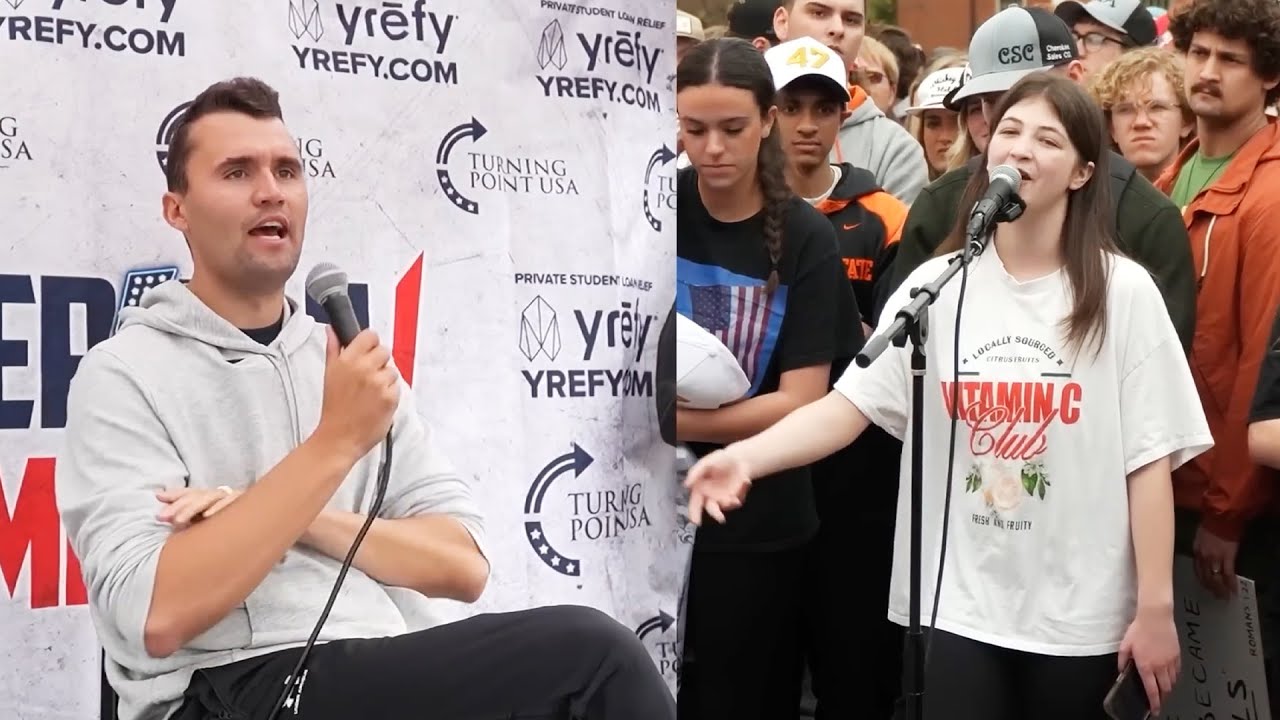
Charlie Kirk Debates College Student Anthony on Abortion, IUDs, Viability, and When Life Begins
Enjoying this? Share it with someone who needs to see it.
Up Next
Charlie Kirk Debates Abortion Rights Activist on When Life Begins and the Morality of Termination
7:42
Charlie Kirk Defends the Value of Life in Heated Abortion Debate with Young Activist
8:27
Charlie Kirk Debates College Student on Abortion Rights and When Human Life Begins at Campus Event
7:00
Charlie Kirk Debates College Student Anthony on Abortion, IUDs, Viability, and When Life Begins
Charlie Kirk faces off with a pro-choice college student named Anthony in a detailed debate covering abortion rights, whether IUDs constitute murder, the concept of viability, and the fundamental question of when human life begins. Anthony challenges Kirk on topics ranging from the right to privacy precedent in Roe v. Wade to gay marriage and bodily autonomy. Kirk counters with arguments about the binary nature of life and death, DNA uniqueness, and the distinction between liberty and license. The exchange explores deep philosophical questions about what makes a human being viable, the degree of dependency argument, and whether financial hardship justifies ending a life. Kirk maintains that prolifers face the harder task of convincing people to take responsibility while arguing that human development begins at conception, making abortion morally indistinguishable from eliminating a two-year-old.
Anthony, a college student with different political views than the crowd, approaches Charlie Kirk for what he acknowledges will be his first debate on abortion. Anthony makes clear from the start that despite disagreeing with the audience's worldview, he wants to engage respectfully, noting that respectful disagreement is foundational to American values.
The debate begins with Anthony referencing a previous discussion Kirk had with Dean Withers about whether women with IUDs are murderers. Kirk clarifies his position that IUDs prevent conception, making them no different than condoms or birth control. However, Anthony pushes back, suggesting that Kirk previously argued with Dean that when conception happens and a unique human life is created, an IUD prevents that life from attaching to the uterine wall. Kirk maintains that IUDs prevent fertilization rather than destroying an already-formed zygote.
The Right to Privacy and Slippery Slopes
Anthony shifts the conversation to the overturning of Roe v. Wade and the right to privacy precedent that case established. He argues this creates a dangerous slippery slope because the same right to privacy has been used in other cases, specifically mentioning gay marriage and Obergefell v. Hodges. Anthony contends that when you overturn a case relying on the right to privacy, you risk unraveling other rights, including the right to marry whoever you want regardless of political affiliation or personal beliefs about gay marriage.
Kirk responds by drawing a distinction between liberty and license. He explains that conservatives believe in liberty, which means being able to do things that elevate humanity and society, but not license, which would allow anything regardless of consequences. Kirk uses the example of marrying a 12-year-old, pointing out that while that could be framed as freedom, it's actually license. He emphasizes the importance of having the philosophical maturity to distinguish between liberty and licentiousness.
Women's Rights and the Right to Life
Anthony asks whether American women, comparing states with abortion access like Illinois to southern states without it, have more rights and freedom of choice regarding bodily autonomy now than before. Kirk responds affirmatively that states outlawing abortion do give women more rights because women in the womb aren't being murdered and they have the right to life.
This leads to the fundamental question that becomes central to the debate: when does life begin? Kirk asserts that science reflects human development starting at conception, and Anthony agrees with the term "human development." Kirk then presses the point that if it's human development, it must be human life, challenging Anthony to find another word besides "life" to describe what's happening.
The Binary of Alive or Dead
Kirk presents what he considers an unanswerable question for abortion supporters: if a developing fetus is not dead because it has a heartbeat, DNA, and cells that are forming and splitting, what word other than "alive" would describe it? Anthony admits he wouldn't necessarily call it alive or dead, suggesting there's a distinction he can't label with one word.
Kirk argues this is a critical point that abortionists cannot answer because there is no third option. He explains that we always exist on the binary of alive or dead. Something can be alive and require support through medicine or a ventilator, but it's still alive by all objective measurements. We have clinical definitions in hospitals for when someone is dead, but we don't have an agreed-upon clinical definition of when something is alive. Kirk contends that when a human being is going through the process of human development in utero, it is technically alive and therefore it's a human life, but we use different language to try to dehumanize the being.
The Viability Argument
Anthony pivots to discussing viability, noting that around 24 to 26 weeks a baby is considered viable and can be born prematurely. Kirk acknowledges that miraculous NICU babies can be born at 20 or 21 weeks, but grants that around 24 weeks a baby can survive in a NICU (neonatal intensive care unit).
Kirk then challenges the viability standard by asking Anthony about babies born around 24 or 25 weeks who must go to a NICU, where very small babies have all sorts of machines supporting them because they haven't gone through the entire process of gestation. These babies, cut 15 weeks early, aren't viable in the sense that they can't survive without machines. Kirk asks if they're alive, and Anthony agrees they are.
Kirk then asks how this is any different from a 16-week-old fetus that requires an umbilical cord. He points out that viability is defined as being able to exist outside the womb, but NICU babies cannot exist without external supporting devices. They cannot breathe on their own or clear their bladders. Kirk describes how NICU babies can be the size of a Sharpie pen with 15 different contraptions attached. He notes there's likely a NICU baby in the audience, and someone raises their hand.
The key question Kirk poses is that NICU babies were not technically viable under the pro-abortion definition because they could not survive without external support. External support could be an umbilical cord or it could be a baby ventilator. Anthony acknowledges he doesn't necessarily agree with the external support definition of viability.
Redefining Viability
Kirk asks Anthony to provide his own definition of viability, promising to hold him to that standard. Anthony struggles to articulate a clear alternative, eventually suggesting viability means existing outside the womb, maybe not necessarily on its own because even infants under five can't provide for themselves, but something existing outside the womb.
Kirk explains that a NICU baby essentially mimics the gestational process outside of the womb. A 27-week-old baby would not likely survive without all the contraptions and machines. Technology has created what is essentially a counterfeit, though a pretty good one, of the gestational process that babies would otherwise get in utero. These babies are still alive. When a NICU baby is born at 26 weeks, they get a birth certificate and social security number, but they have a bunch of machines and aren't able to breathe on their own. Anthony agrees this is a human being.
The Difficulty of Choice and Degree of Dependency
Anthony acknowledges that it's easier for him to sit there and debate being pro-abortion since he's not a woman, not pregnant, and not a mother. He suggests that if he were a mother, he would have a different perspective, noting that it's obviously a hard choice to make. He also raises the issue of access to healthcare if you view abortion as healthcare.
Kirk identifies this as slipping into a separate argument about degree of dependency. He pushes back on the idea that it's a tough decision, arguing that when women are properly educated that abortion is murder, it's not actually a difficult decision. He doesn't think any mom wants to murder their child, except perhaps those who are psychopathic.
Anthony interjects that it's only murder if you consider it murder. Kirk responds that regardless of what you call it—termination, elimination—based on basic reason, human development, and human life, the unjust taking of a human life is necessarily murder.
The Financial Hardship Argument
Kirk poses a critical question: Is it ever right to take a life if you don't have the money to support that life? When Anthony mentions healthcare or access, Kirk rephrases it: If a mother had a 2-year-old baby and she lost her job, went into bankruptcy, and fell into poverty, would she be allowed to eliminate or terminate her 2-year-old baby because it might help her save money?
Anthony says no, acknowledging he understands Kirk's point about viewing a 2-year-old the same as something else. Kirk asserts that a 2-year-old is morally indistinguishable from a two-week-old in utero. Anthony responds that this is Kirk's opinion, but Kirk challenges him to explain why it's different.
Anthony struggles to articulate the difference beyond noting that one is older and that the definition of when life begins will always be contested. Kirk disagrees, expressing confidence that biological truth will win because human development does have a starting point. He believes that once ethics can align with science and biology, there will be an agreed-upon idea of when life begins.
Scientific Progress and Evolving Understanding
Kirk provides historical context for how scientific understanding evolves. During the smallpox epidemic, doctors gave people arsenic because they thought having diarrhea would help get smallpox out of the system. In the 1700s, bloodletting was common practice when people were sick, trying to get as much blood out as possible. Then came the discovery of antibiotics and germ theory.
Kirk argues the same evolution is happening with abortion. The more we learn about the process of human development, the more ultrasound technology advances, the more we come to the conclusion that it is a human life.
DNA and Bodily Autonomy
Kirk asks Anthony a final question: Would you agree that what makes you fundamentally unique from the person next to you is your DNA? Anthony agrees that from a biological standpoint, DNA is what makes him unique at a molecular level, though he argues there are other factors beyond just DNA.
Kirk distills it down to biological truth: DNA gives you autonomy, and you should have autonomy over your own DNA. When Anthony hesitates to go that far, Kirk points out that the abortion argument is "my body, my choice," which is essentially saying "my DNA, my choice."
Kirk then delivers what he considers the clinching point: If it's not your DNA, why should it be your choice? Anthony sees where Kirk is going but doesn't necessarily agree. Kirk presses him to explain why, asking him to think about it outside his ideological worldview as a freethinker.
The Extension of Self Argument
Anthony argues that a woman's right extends to what is almost a part of her body because it's attached to her body. Kirk counters that while it's attached to her body, it's not her DNA. He uses the example that Anthony's mom cannot vote for him because she is a different, distinct person.
Anthony maintains that he considers a developing baby part of the mother, not just attached to them. He suggests that if Kirk asked his mother, she would say that when she was pregnant with him, she felt like he was an extension of herself. Anthony acknowledges it's much harder to make distinct separations and that he's obviously not educated enough to debate all the nuances.
The Harder Argument
Kirk concludes by acknowledging that prolifers have a hard job. Their job is to tell millions of people to take responsibility for their actions. Their job is to say that every human being is inherently valuable because it's a human being. He admits this is a harder argument than the pro-choice position, which he characterizes as "if it feels good, do it, and if something annoying happens, eliminate it."
Kirk maintains that prolifers believe you should not be able to eliminate another human being just because it might make your life mildly inconvenient. He acknowledges they simply have a difference of opinion. The pro-life job is harder, but they believe they're right. Anthony thinks he is right as well. Kirk expresses hope that the pro-life position will win one day and thanks Anthony for his time.