Charlie Kirk Debates Abortion Rights Activist on When Life Begins and the Morality of Termination
Enjoying this? Share it with someone who needs to see it.
Up Next
Charlie Kirk Debates Teen on Abortion Rights, Rape Exceptions, and When Human Life Begins
8:47
Charlie Kirk Defends Pro-Life Stance with Split-Ticket Voter in Powerful Campus Exchange
10:17
Charlie Kirk Confronts Pro-Choice Activist on When Life Begins at Campus Event
3:21
Charlie Kirk Debates Abortion Rights Activist on When Life Begins and the Morality of Termination
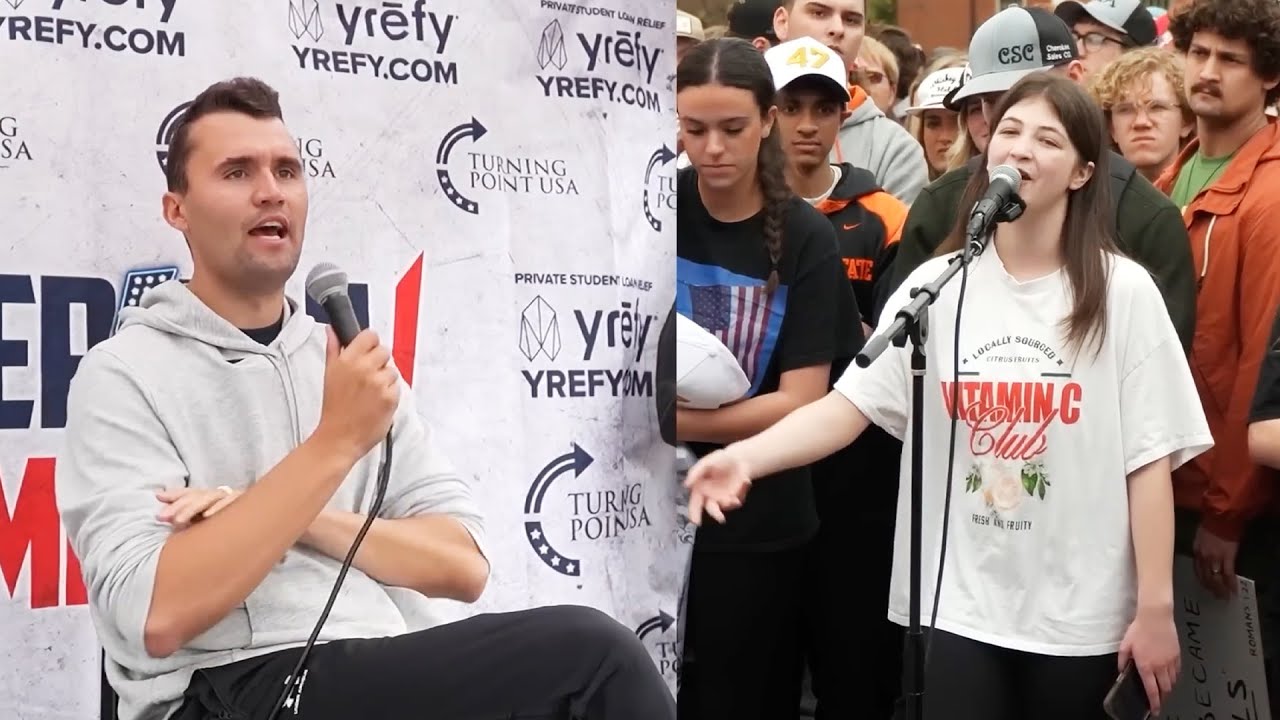
Charlie Kirk engages in a heated debate with an abortion rights activist, challenging her understanding of fetal development and the moral implications of abortion. Kirk argues that life begins at conception based on biological facts about DNA formation, while his opponent maintains that personhood begins at birth. The exchange covers key questions about heartbeats in utero, the definition of personhood, medical exceptions, and adoption alternatives.
Charlie Kirk begins the debate by issuing a pop quiz to his opponent about fetal development, asking when heartbeats begin for babies in utero. Through a Socratic exchange about eggs and fertilization, Kirk establishes that his opponent, despite being a woman, cannot answer basic questions about fetal development. When she admits she doesn't know when heartbeats begin, Kirk points out the irony that he may know more about the female reproductive system than she does.
Kirk then pivots to what he considers the fundamental moral question, invoking Romans and arguing that God has written on every human heart the knowledge that murdering a baby is wrong. His opponent quickly counters that abortion isn't murder because it's not a baby, setting up the central dispute of the debate.
Defining Personhood: Embryo Versus Baby
The core of the debate centers on when an embryo becomes a baby deserving of human rights. Kirk's opponent argues that it's an embryo, not a baby, and therefore doesn't have the rights of a person. When Kirk presses her on when it becomes a baby, she initially states when it is born, but then reveals inconsistency by saying she doesn't agree with full-term abortions.
Kirk seizes on this contradiction, asking why she would have abortion limits before birth if it only becomes a baby at birth. He challenges her to draw a line for abortion and explain the moral standard behind it. She cites medical reasons, but Kirk refocuses the question on the moral status of a fetus that can recognize the mother's voice, has a heartbeat, and has brain waves.
The DNA Argument for Life at Conception
Kirk presents his central biological argument: life begins at conception because that's when an individual's unique DNA is formed. He explains that everything about a person is determined by DNA that comes into existence when egg and sperm meet. According to Kirk, this is where each person's journey starts, not at birth, first words, or first steps.
He emphasizes that DNA is coded XX or XY and contains all the unique characteristics that God individually curated for each person. This coding doesn't happen at 8 or 10 weeks, Kirk argues, but at the moment of conception. Therefore, the fertilized embryo deserves the same protections as any other human being.
The Medical Exception Debate
When his opponent raises the scenario of medical abortions where the mother's life is at risk, Kirk offers a consistent response: perform a cesarean section instead of an abortion. He argues that C-sections are actually safer and quicker than abortions and have the benefit of saving both lives rather than just one.
His opponent pushes back with increasingly dire hypothetical scenarios. Kirk clarifies that removing an already-dead baby is not an abortion by definition. He maintains that actual abortion involves injecting the baby's spinal fluid with cyanide poisoning while the baby squirms and gasps for air.
The Holocaust Comparison
Kirk makes one of his most controversial arguments when he directly compares abortion to the Holocaust, claiming that 45 million babies have been aborted, making it nearly eight times worse than the Holocaust in terms of sheer numbers.
When challenged on this comparison, Kirk asks what the moral difference is between a small baby in the womb and a grown person killed at Auschwitz. He argues that denying human rights to smaller humans while granting them to grown humans is the same logic used to justify historical atrocities.
The Adoption Alternative and Unwanted Children
His opponent shifts the debate to what happens to children born into bad households or who end up in orphanages. Kirk responds that there are twice as many people on adoption waiting lists than there are abortions each year, suggesting demand exceeds supply. He advocates for making adoption easier rather than using the possibility of difficult circumstances as justification for abortion.
Kirk forcefully rejects the concept of unwanted children, arguing that it is never right to justify mass elimination of people under the guise that they're unwanted. He draws another parallel to historical atrocities, arguing that dehumanizing language has always been the precursor to genocide.
The Dehumanization Argument
Throughout the debate, Kirk repeatedly emphasizes what he sees as dehumanizing language used by abortion advocates. He argues that terms like embryo and fetus are deliberately used to obscure the humanity of the unborn, making it psychologically easier to justify their termination.
Kirk concludes by highlighting what he views as the weakness of pro-abortion arguments when subjected to questioning. He positions his stance as rooted in biological consistency and reality rather than feelings or personal autonomy.