2,422 videos 1,389,747,653 views US Joined Aug 30, 2018
Charlie Kirk is the Founder and President of Turning Point USA, the largest and fastest growing conservative youth activist organization in the country with over 250,000 student members, over 150 full-time staff, and a presence on over 2,000 high school and college campuses nationwide. Charlie is also the Chairman of Students for Trump, which aims to activate one million new college voters on campuses in battleground states in the lead up to the 2020 presidential election. His social media reaches over 100 million people per month and according to Axios, he is one of the "top 10 most engaged" Twitter handles in the world. He is also the host of “The Charlie Kirk Show,” which regularly ranks among the top news shows on Apple podcast charts.
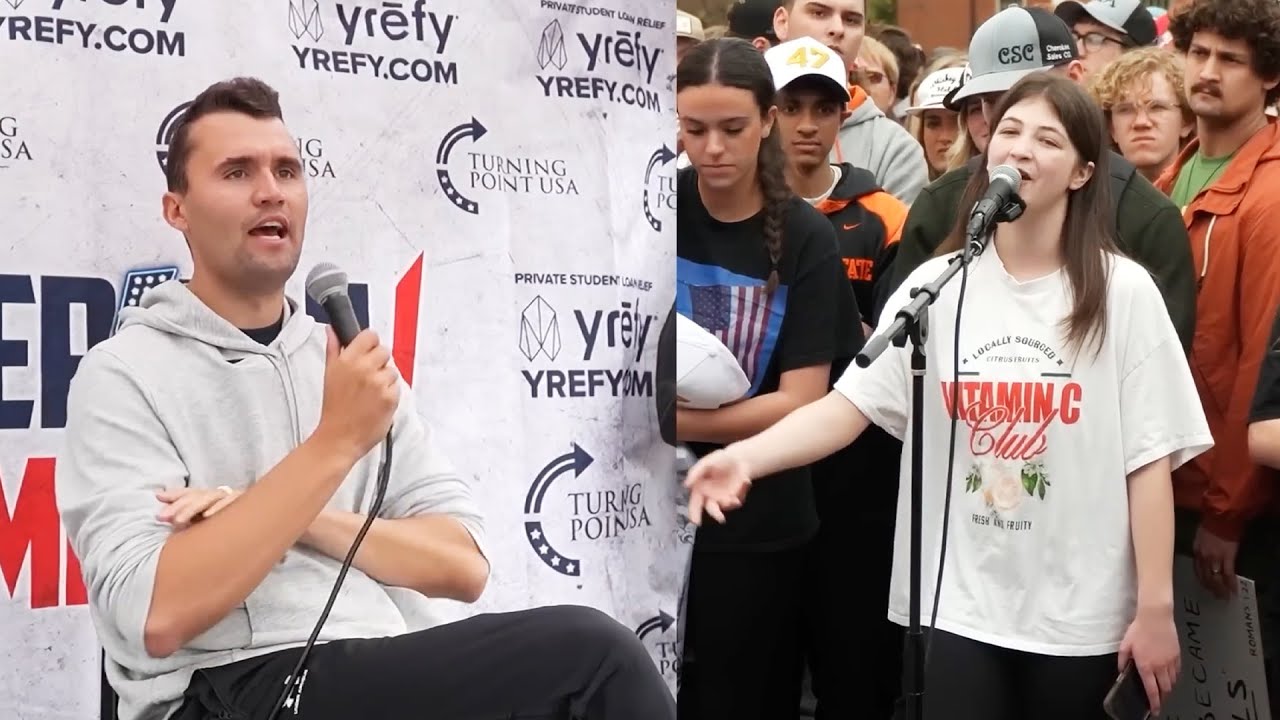
Charlie Kirk Defends Pro-Life Stance with Split-Ticket Voter in Powerful Campus Exchange
Charlie Kirk engages in an intense discussion with a pro-choice split-ticket voter who questions whether the Republican Party should abandon its pro-life stance. Kirk methodically challenges the voter's position by examining when human life begins, the relevance of conception circumstances, and whether moral standards should differ based on location in or outside the womb. The conversation explores fundamental questions about human rights, universal equality, and the inconsistencies in pro-choice arguments. Kirk addresses common scenarios including rape, incest, socioeconomic concerns, and selective abortion based on gender or disability, pushing the voter to confront the logical implications of their position.
A student approaches Charlie Kirk explaining they split their vote roughly 50/50 between Democrats and Republicans. Identifying as pro-choice, the student questions whether the Republican Party should risk everything by maintaining an uncompromising pro-life stance. The student asks Kirk to explain his position on why Republicans refuse to budge on this issue and whether it's worth potentially destroying the party over the abortion question.
Kirk responds directly, identifying himself as one of those Republicans who will defend the pro-life position. He immediately redirects the conversation to foundational questions, suggesting the student research Margaret Sanger, the founder of Planned Parenthood, and her true motivations.
Establishing the Foundation: When Does Life Begin?
Kirk asks permission to pose some simple questions to the student, who admits to not being well-versed on the topic despite identifying as pro-choice. Kirk begins with the most fundamental question: when does human life begin?
When the student answers "at conception," Kirk presses forward: if life begins at conception, shouldn't it be illegal to kill that human life? The student wavers, bringing up circumstances of conception. Kirk notes this is an important topic, acknowledging that rape and incest represent less than 1% of all abortions, but agrees to address this concern.
Kirk proposes a hypothetical compromise: would the student agree to make abortion illegal in all cases except rape, incest, and life of the mother? The student refuses, shifting to a different argument about the lack of social safety nets for women. Kirk reframes this redirect: if there's no social safety net, does that make it acceptable to murder someone you can't afford to care for?
The Rape Exception Argument
Kirk systematically addresses the rape exception argument. He presents a thought experiment involving two ultrasounds—one of a baby conceived in rape, one conceived in a loving relationship. He asks the student to identify which is which. The answer, of course, is that it's impossible to tell.
Kirk extends this logic: someone in the audience was conceived in rape, but you can't identify who. His point is that human rights are universal, granted by God because all people are made in the image of God. Therefore, life should be protected regardless of how someone came into the world.
The student continues to insist it should be the woman's choice, arguing that she's caring for the baby. Kirk counters with his own six-month-old son as an example. He asks why he shouldn't be able to harm his son, whom he's also caring for. When the student says that would be wrong, Kirk asks why the standard doesn't apply equally to a six-week-old baby in utero.
The "My Body, My Choice" Argument
The student falls back on the position that it should simply be the woman's choice. Kirk challenges this directly: if the DNA inside the woman isn't hers, why is it her choice? The student argues the woman is caring for the baby. Kirk uses his six-month-old son again as a comparison—he's caring for his son outside the womb, so why does temporary location inside the mother's body change the moral equation?
The student struggles to answer, repeatedly stating they just think it should be the woman's choice without providing logical justification. Kirk continues pressing: the student has already agreed human life begins at conception, so shouldn't that human life have human rights?
Challenging the Black and White Framework
The student argues the issue shouldn't be "so black and white." Kirk immediately asks: is murder black and white? The student says no, then provides examples of justified killings—shooting a Nazi in self-defense during Nazi Germany. Kirk asks if an unborn baby is equivalent to a Nazi threatening someone's life. The student admits no.
Kirk explains that in abortion, medical professionals break the baby's back, dismember the child, or in the case of chemical abortions (the abortion pill), starve the baby of nutrients. The baby experiences pain for days as progesterone levels drop to nothing before being discharged over a toilet. When the student asks about timing, Kirk clarifies that chemical abortions are legal in all 50 states between 3 to 10 weeks and are actually more dangerous for women than surgical abortions.
Universal Human Equality
Kirk establishes his core principle: we have universal human equality that doesn't stop based on size, level of development, environment, or degree of dependency. It's wrong to murder someone now and it was wrong to murder them when they were five weeks in the womb.
When the student asks about women who want to perform abortions at home, noting that such procedures will occur regardless of legality, Kirk uses the rape analogy. Rape is illegal, yet rape still occurs. Does that mean rape should be legal? The student agrees rape should remain illegal, acknowledging the flaw in the "it will happen anyway" argument.
The student persists, asking why society can't provide a "safe environment" to perform abortions. Kirk counters that there's no such thing as a safe abortion because it ends in murder. He adds that abortion is also unsafe for women, causing trauma and medical complications, with emergency room visits up nearly 2,000% due to the abortion pill.
The Subjectivity Problem
Kirk addresses the inconsistency in language and moral standards. A pregnant woman who wants her baby says "I'm having a baby." Another pregnant woman who doesn't want the baby says "it's a clump of cells I can terminate." Kirk asks why morality should be subjective—why one person gets to decide what the being is while another person in identical circumstances can decide differently.
The student dismisses this as mere terminology. Kirk insists it's not about terminology but about basic fundamental human morality. If a mother finds her two-year-old annoying, why can't she terminate that child? It's her choice, the child is dependent on her, and she's larger and more powerful. The student responds that it's against the law. Kirk presses: so should abortion also be against the law, since it's illegal to murder a two-year-old? The student says no but can't articulate why.
Selective Abortion Scenarios
Kirk presents several real-world scenarios to test the consistency of the student's position. First: a woman finds out she's having a baby with Down syndrome. Should it be legal to abort that baby based on that information? The student surprisingly says it should be illegal.
Kirk notes they agree on this point, then asks about a woman who discovers she's having a boy but wants a girl. The student dismisses these as hypothetical questions. Kirk clarifies these aren't hypothetical at all. In Iceland, it's the law to abort babies with Down syndrome. In most Eastern European countries, babies with disabilities are sent to asylums where parents never see them again. These are real situations happening around the world.
The Final Position
Kirk restates his position: a human life is a human life regardless of its size, level of development, environment, or degree of dependency. He asks if the student can understand where he and other pro-lifers are coming from. The student acknowledges they understand Kirk's position.
Kirk delivers his closing statement: America has over a million and a half murders per year, and society calls it healthcare. He thanks the student for their time and asks if they're a Christian. When the student says no, Kirk responds that he could tell, then thanks them again for the conversation.