2,422 videos 1,389,747,653 views US Joined Aug 30, 2018
Charlie Kirk is the Founder and President of Turning Point USA, the largest and fastest growing conservative youth activist organization in the country with over 250,000 student members, over 150 full-time staff, and a presence on over 2,000 high school and college campuses nationwide. Charlie is also the Chairman of Students for Trump, which aims to activate one million new college voters on campuses in battleground states in the lead up to the 2020 presidential election. His social media reaches over 100 million people per month and according to Axios, he is one of the "top 10 most engaged" Twitter handles in the world. He is also the host of “The Charlie Kirk Show,” which regularly ranks among the top news shows on Apple podcast charts.
Charlie Kirk Debates Teen on Abortion Rights, Rape Exceptions, and When Human Life Begins
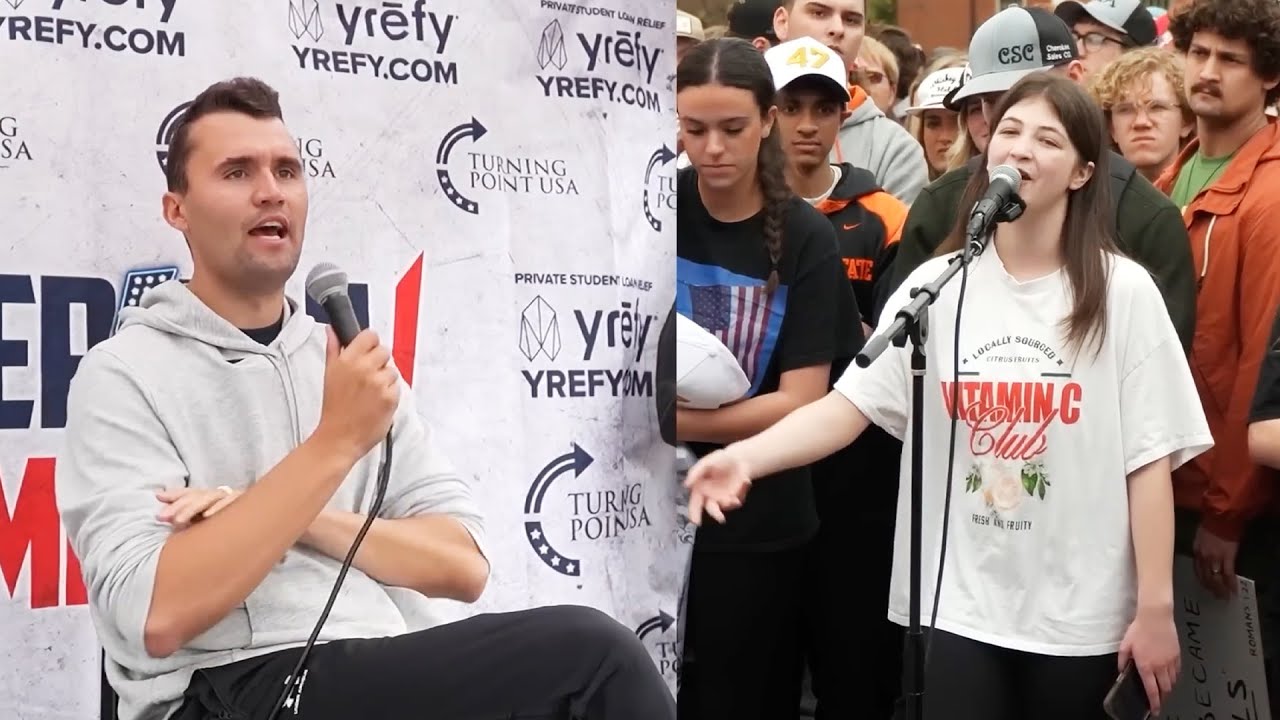
Charlie Kirk engages in a passionate debate with a 16-year-old student over abortion rights, particularly in cases of rape. The conversation examines fundamental questions about when life begins, bodily autonomy, and the moral status of unborn children. Kirk argues that human rights begin at conception regardless of circumstances, while the student contends that women should have the choice not to carry pregnancies they don't want. The exchange touches on fetal development, adoption system challenges, population concerns, and whether the circumstances of conception affect the value of human life.
A young woman approached Charlie Kirk with a pointed question about abortion in cases of rape. "Why should women who are raped have to give birth to that baby?" she asked. Kirk's response cut straight to what he sees as the fundamental issue: "Do you believe life matters or not?"
The student clarified her position, stating she believes life matters "after the person is born or the child after the person's." This set the stage for a debate about when human life begins and what moral status should be granted to developing humans in the womb.
Defining Life: The 20-Week Question
Kirk presented a specific scenario to test the student's position. He asked about a baby at 20 weeks of development, questioning whether such a baby is alive. The student initially said no, prompting Kirk to list the developmental milestones present at that stage:
Heartbeat (which begins at six weeks)
Ability to hear the mother's voice
Consciousness
Unique fingerprint
Unique DNA
Ability to empty its own bladder
"What about it is not alive?" Kirk challenged.
The Dependency Argument
The student shifted her argument to dependency, contending that because the baby is attached via umbilical cord and relies on the mother for nutrition, it shouldn't be considered alive in the same way. "If that child is still living on the baby inside of the mother, it should not like it isn't alive," she argued.
Kirk countered this logic by pointing out that newborn babies also depend entirely on their mothers for food for "months and months and months." He then extended the comparison to people on feeding tubes, asking whether they forfeit their right to life due to their dependency on external nutrition.
The student struggled to articulate why birth itself should be the dividing line for moral worth, eventually pivoting back to her central concern: "Women shouldn't have to be forced to give birth to that child if they don't want to."
The Ultrasound Challenge
Kirk presented what he considered a decisive thought experiment. He asked the student to imagine two ultrasounds—one of a baby conceived in rape, the other conceived in a loving relationship. "Which one is which?" he asked.
The student acknowledged she couldn't tell the difference. Kirk pressed the point: "Exactly. So, they both deserve human rights."
But the student maintained her position: "I'm not saying that there's a difference between those two. I'm saying that if a mother doesn't want to give birth to her child, she shouldn't have to."
The Murder Question and Newborn Comparison
Kirk then asked whether the student believed it should be permissible to kill a newborn if the mother doesn't want the baby. The student said no. When Kirk asked why, she responded that "you wouldn't have the child if you didn't want it. That's the point of abortion."
This exchange highlighted the crux of the disagreement: the student saw a meaningful moral distinction between ending a pregnancy and ending the life of a born child, while Kirk saw no such distinction if both involve human life.
My Body, My Choice: A Gendered Debate
The conversation took a turn when the student invoked the common pro-choice slogan: "It's my body, my choice." She then challenged Kirk's standing to speak on the issue, saying "you're a man and you get to make those decisions."
Kirk directed her to address the same argument to Riley, a woman standing beside him who shares his pro-life views. "Your logic must be equally applicable to all sexes," Kirk insisted. "Say that same statement to her."
The student initially resisted, saying she was directing her comment at Kirk as a man. But Kirk pressed the point that the issue isn't about gender but about principle.
Riley's Perspective as a Pro-Life Woman
Riley entered the conversation, addressing what she sees as inconsistent logic in the pro-choice position. "It's just a flawed logic to insinuate that if you have a heartbeat, these certain qualifications, that is what determines human rights," she said.
Riley argued that human rights begin at conception because that's when a human being exists. "The moment you're conceived, you are a human, right? We all just agreed that the species is a homo sapien. You are a human at that point. That's when human rights begin."
She found it ironic that those who claim to champion human rights don't extend those rights to unborn children. "As a woman, I believe every single life is worthy. Every life matters," Riley stated.
Trump and the Overturning of Roe v. Wade
The student brought up former President Donald Trump's role in overturning Roe v. Wade, noting that "he is the one he said that he is the reason that Roe v. Wade is overturned."
Kirk's response was enthusiastic: "Praise the Lord. Roe versus Wade is overturned."
The student expressed concern that this decision "kills other women in general," though she didn't elaborate on this claim in the transcript.
Population Concerns and Texas Birth Rates
Kirk shifted the conversation to demographic concerns, noting that "we have more babies being born in Texas than ever before since the abolition of abortion. Isn't that a good thing?"
The student seemed to view high population as a problem, but Kirk countered with concerns about population decline. "We have a declining population. We have a population collapse," he said. "The world is on the verge of a population extinction event. We don't have enough babies. We're below replacement levels in the West."
The Biology of Pregnancy and Consent
Kirk returned to what he sees as a fundamental point: "How do people get pregnant?" His implication was that pregnancy typically results from consensual decisions, and those decisions carry potential consequences.
The student immediately challenged this framing: "What if you don't decide? What if you do not decide to have sex and you get raped?"
Kirk acknowledged the evil of rape but maintained his position: "It's still a human life. You don't get to kill a baby just because a human life occurs. Something evil, rape, does not get better when another evil action occurs."
He then made a striking point: "Somebody in this audience was conceived in rape. Can you tell me who?" His argument was that a person's worth doesn't depend on the circumstances of their conception.
Abortion as Murder
Kirk explicitly stated his view that abortion constitutes murder even in cases of rape. "An abolition of an extermination of human life is called what? Murder. So yes, abortion is murder even in the case of rape. And that's a hard thing to internalize."
The student continued to struggle with the terminology, questioning whether what's in the womb is truly a "child." Kirk asked what species it is, and she agreed it's human. He then challenged the idea that development stage affects moral worth: "You're not fully formed. Riley's not fully formed. I'm not fully formed. We actually go through this process of development our entire life. An embryo is just one stage upon human development. It doesn't mean you get less rights just because you're earlier in the human development scale."
The Adoption System Debate
The student raised practical concerns about what happens to children after birth, particularly those born to mothers who can't care for them. She mentioned drug addiction, financial inability to raise children, and the challenges facing children in the adoption system.
When Kirk and Riley suggested adoption as the solution, the student countered with statistics: "Do you know how many kids are actually adopted from adopting agencies? 25% of these kids get adopted before they are 18."
She argued that children who age out of the adoption system often become homeless or struggle with addiction themselves. "You say that we cannot have an abortion, but you are not doing anything to make—" she began, before Kirk interrupted.
Riley acknowledged that "there certainly could be reforms within the foster care community and within the adoption system," but emphasized that "there are plenty and plenty and plenty of families of women who are hoping to be able to adopt because they can't conceive on their own."
The Adoption Waiting List
As the conversation concluded, Kirk cited a statistic he considered significant: "There's twice as many people on the adoption waiting list than there are actually being adopted."
The student appeared to interpret this differently, responding that even if the process were streamlined, "only 50% of these kids would be adopted. And there are still 50% of these children which are—"
Kirk suggested she had missed his point about the long waiting list indicating high demand for adoption, but the conversation ended before the point could be fully explored. He thanked her for her time and moved on to the next question.
A 16-Year-Old's Perspective
At one point in the debate, when challenged about what she was doing to help children in the adoption system, the student revealed she was only 16 years old. "What am I supposed to do? I'm 16," she said, highlighting the youth of some of the individuals engaging Kirk on these complex moral and political issues.