2,264 videos 1,363,043,183 views US Joined Aug 30, 2018
Charlie Kirk is the Founder and President of Turning Point USA, the largest and fastest growing conservative youth activist organization in the country with over 250,000 student members, over 150 full-time staff, and a presence on over 2,000 high school and college campuses nationwide. Charlie is also the Chairman of Students for Trump, which aims to activate one million new college voters on campuses in battleground states in the lead up to the 2020 presidential election. His social media reaches over 100 million people per month and according to Axios, he is one of the "top 10 most engaged" Twitter handles in the world. He is also the host of “The Charlie Kirk Show,” which regularly ranks among the top news shows on Apple podcast charts.
Charlie Kirk Defends Trump Administration Deportation of Foreign Students for Pro-Hamas Speech at Michigan State Campus
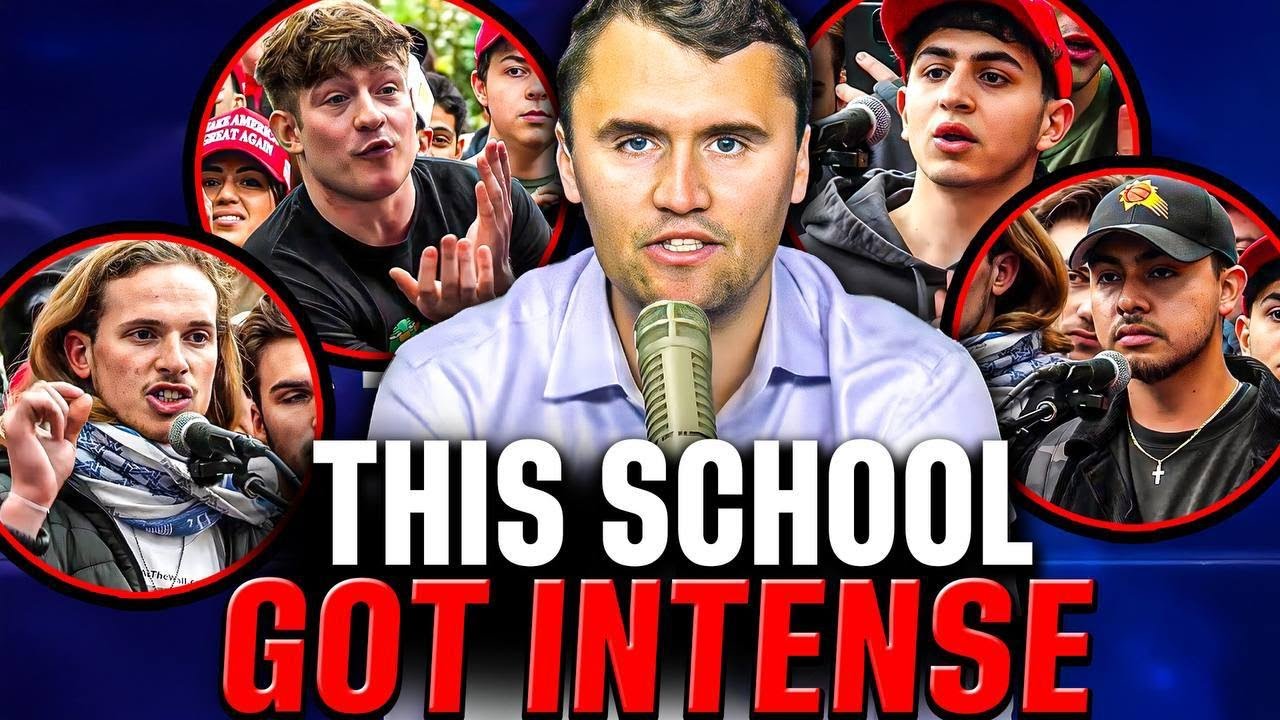
Charlie Kirk faced a heated exchange at Michigan State University over the Trump administration's deportation of foreign students for speech deemed contrary to U.S. foreign policy interests. A student challenged Kirk on whether deporting lawfully present immigrants for constitutionally protected speech aligns with American values. Kirk argued that visitors on student visas have conditional rights and can be expelled for speech supporting groups like Hamas, while acknowledging the policy could potentially be abused by future administrations. The debate highlights the tension between free speech protections and immigration enforcement when foreign students engage in political advocacy.
Constitutional Rights for Foreign Students Debated
At a Michigan State University event, Charlie Kirk was confronted by a student named Alex about the Trump administration's deportation proceedings against foreign students for political speech. The student specifically referenced cases involving revoked student visas at Michigan State and the University of Michigan, as well as the deportation of Mahmoud Khalil, a lawful permanent resident.
Kirk responded by drawing a clear distinction between U.S. citizens and visitors on student visas. "Of course, it's consistent with the Constitution because they're not U.S. citizens. They're visitors," Kirk explained. "So, as a visitor, you have to be a visitor on our terms, and if you break that compact, you get returned back to your country of origin."
Limited Constitutional Protections for Visa Holders
Kirk acknowledged that foreign students do receive some constitutional protections while in the United States. He conceded that students charged with crimes receive due process and Fifth Amendment rights. However, he emphasized that these rights are not equivalent to those granted to U.S. citizens.
"There are restrictions on rights for visitors," Kirk stated. "For example, they cannot vote. There are limitations on their ownership of firearms. As a visitor, you do not have unlimited free speech rights. You don't. They are conditional to you being expelled."
Kirk cited specific immigration law provisions that allow the government to deport individuals whose speech is deemed contrary to U.S. foreign policy interests. He argued that advocating for Hamas falls into this category and justifies deportation.
Historical Context and Hypothetical Scenarios
To illustrate his position, Kirk posed a hypothetical scenario involving a student from Afghanistan supporting al-Qaeda during the Iraq and Afghanistan wars. "Let's say a student was here on a student visa from Afghanistan saying that they support al-Qaeda. Is that worthy of deportation?" Kirk asked.
The student responded by distinguishing between mere advocacy and material support for terrorism, arguing that only the latter should warrant deportation. The student also pointed out that the Trump administration was not invoking the terrorism-related provisions of immigration law, but rather using broader foreign policy discretion granted to the Secretary of State.
Concerns About Government Overreach
The student raised concerns about the practical implications of the policy, warning that it could lead to law enforcement and ICE agents demanding papers from protesters on campuses. "If the Secretary of State can deport any non-citizen they want for their speech, you would have police and ICE going up to people at protests on campuses, including protests you might agree with, and asking people for their papers," the student argued.
The student also presented what Kirk acknowledged as the strongest counterargument: What would prevent a future administration, such as a hypothetical Kamala Harris presidency, from using the same authority to deport conservatives by claiming their speech contradicts foreign policy objectives related to combating racism?
Kirk's Response to Potential Abuse
Kirk admitted this was "the best argument" the student had made. He conceded that the provision could potentially be abused by future administrations. However, he attempted to distinguish between targeting supporters of recognized terrorist organizations like Hamas and using vague concepts like "racism" as a foreign policy justification.
"Could this provision be abused in the future? Yes," Kirk acknowledged. "Why am I largely in support of it more than even the specifics? I think we need to push back on this idea that you can behave however you want while you're a visitor and there's nothing we can do to expel you."
The Case of Mahmoud Khalil
The student specifically mentioned Mahmoud Khalil, noting that he was a lawful permanent resident with a green card, not just a temporary visa holder. Kirk maintained his position, stating that even green card holders are still considered guests rather than citizens and can be subject to deportation.
Kirk's broader argument centered on the principle that the United States has the right to set conditions for visitors and to remove those who don't align with what he described as "agreed upon American values." He emphasized that his concerns were primarily about national security threats rather than mere political disagreement.
The exchange concluded with Kirk thanking the student for making a valid point about potential abuse, while maintaining his overall support for the Trump administration's policy on deporting foreign students whose speech is deemed problematic.









Comments
Be the first to comment on this video.