2,422 videos 1,389,747,653 views US Joined Aug 30, 2018
Charlie Kirk is the Founder and President of Turning Point USA, the largest and fastest growing conservative youth activist organization in the country with over 250,000 student members, over 150 full-time staff, and a presence on over 2,000 high school and college campuses nationwide. Charlie is also the Chairman of Students for Trump, which aims to activate one million new college voters on campuses in battleground states in the lead up to the 2020 presidential election. His social media reaches over 100 million people per month and according to Axios, he is one of the "top 10 most engaged" Twitter handles in the world. He is also the host of “The Charlie Kirk Show,” which regularly ranks among the top news shows on Apple podcast charts.
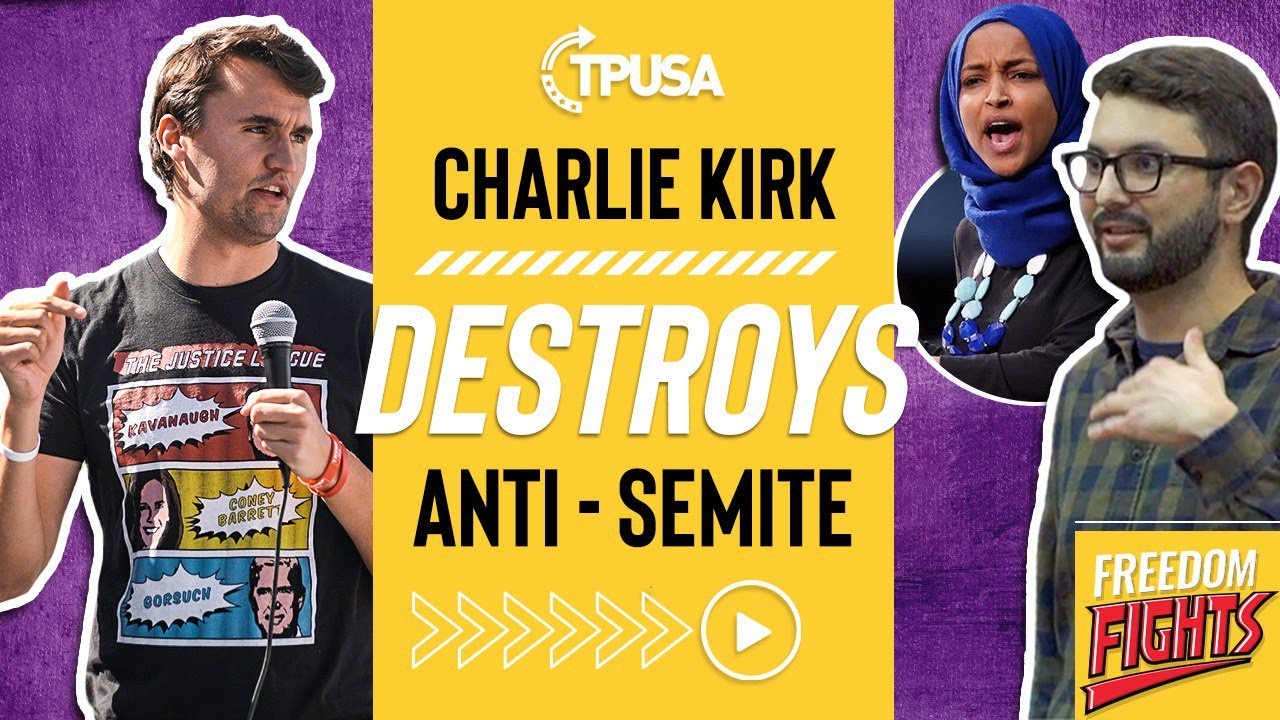
Charlie Kirk Debates Arab Student on Israel-Palestine Conflict, Hamas and the October 7th Attacks
Charlie Kirk engages in a tense but respectful debate with Yousef, an Arab student who voted for Trump, over the Israel-Palestine conflict. The conversation covers the October 7th Hamas attacks, accusations of genocide, ethnic cleansing, the International Court of Justice investigations, and whether Palestinians can govern themselves. Kirk challenges claims that Israel intentionally targets civilians and questions the viability of a two-state solution, while Yousef argues Israel has committed war crimes despite condemning Hamas as terrorists. The exchange reveals the deep divide in how each side views the conflict's history, with Kirk concluding he's never been more pessimistic about finding a solution when two parties operate from completely different realities.
Two Different Realities: A Debate on Israel and Gaza
Charlie Kirk engaged in an extended debate with Yousef, an Arab student and Trump voter, on one of the most divisive topics in modern politics: the Israel-Palestine conflict. The conversation, which remained civil despite fundamental disagreements, highlighted the seemingly unbridgeable gap between two perspectives on the same historical events.
The debate began when Yousef asked Kirk whether he believed Israel should displace Palestinians from Gaza to Egypt and Jordan, and whether such action constituted ethnic cleansing. Kirk acknowledged the difficulty of the question, stating he didn't know what the solution was but emphasizing that the people of Gaza have shown themselves "incapable of self-government" since self-governance has repeatedly resulted in terrorist activity and war with Israel.
The Question of Solutions
When pressed on alternatives, Yousef suggested that an Arab state should govern Gaza, with Hamas removed from power. Kirk pointed out that Gaza democratically elected Hamas in 2006, and that when Hamas controlled the territory, it became a terrorist hotbed. Yousef countered that Palestinians haven't been able to democratically elect leadership since 2006, though Kirk noted this could be because "the people liked it" rather than because they were prevented from voting.
The conversation turned to the celebrations that occurred in Gaza following the October 7th attacks. Kirk asked why people would celebrate such violence, with Yousef responding that "it didn't start on October 7th." This response illustrated a fundamental divide in how each participant viewed the conflict's timeline and causation.
Defining Genocide and War Crimes
Kirk emphasized his worldview of judging situations based on "right and wrong and just and unjust" rather than "oppressor or oppressed." He argued that what happened on October 7th was "never acceptable" regardless of prior grievances—kidnapping and killing civilians was "unprovoked, unprompted" and against international law.
Yousef claimed Israel had committed war crimes and genocide, pointing to the International Court of Justice investigation of Israel. Kirk dismissed the ICJ as anti-Israel, claiming it's "funded largely by Arab" sources including Qatar and Saudi Arabia and "very wealthy Gulf dictatorships." When Yousef asked if Kirk could see "a single instance of Israel going out of its way to kill civilians," Kirk said he could not.
The debate over terminology became heated when discussing genocide. Kirk defined genocide as targeting "a certain group because of their ethnicity, race, or cultural religion." When asked if October 7th constituted genocide by his own definition, Yousef said no, explaining that the ICJ is investigating Israel but not Hamas for genocide. Kirk found this reasoning insufficient, noting that he had watched videos of Hamas fighters laughing during their attacks.
Conspiracy Theories and Mossad
Yousef ventured into more controversial territory by suggesting that Mossad, Israel's intelligence agency, knew about the October 7th attack in advance. He argued that Hamas only had "Chinese bicycles and homemade drones," making it implausible that Israeli intelligence wouldn't detect the preparations. He theorized that Mossad wanted the attack to happen to justify a larger military response against Palestine.
Kirk called this theory "insane," asking whether Yousef truly believed that Mossad, "which are Jews," wanted 1,300 Jews to die. Yousef clarified that he didn't think they knew the exact death toll but wanted "to see something so that they can be able to actually attack Palestine." Kirk responded that this represented "a much lower view of Jewish people" than he holds, though Yousef maintained he believes in Israel's right to exist.
Kirk acknowledged that the question of whether Israel knew about the attack and issued a stand-down order was legitimate, noting he had asked that question himself without getting answers. However, he drew the line at hypothesizing that Mossad intentionally allowed it to happen. Kirk pointed out that the attack occurred on Shabbat, a holy day when 90% of IDF troops weren't present, which could explain the security failure.
The Moral Calculus of Response
Kirk pressed Yousef on a fundamental moral question: who is the "good guy or bad guy" in the equation of Israel versus Hamas? Yousef said Hamas is bad but "what the Israeli government is doing is bad as well," leading Kirk to conclude they simply don't have an agreement on basic moral premises.
When Kirk asked what Israel should have done in response to the October 7th attacks, Yousef suggested targeting "Hamas members in a better way" using special forces and precision equipment. Kirk found this answer unsatisfying, noting that Israel did use such methods and that he "never gets a concrete answer" to this question. He stated he wouldn't "defend everything that every IDF soldier ever did" but found it telling that "everything that Israel does gets so hyper-examined through this lens that no other country ever gets held to the standard of."
Comparative Atrocities
Yousef challenged the notion that no other country does what Israel does with Palestine. Kirk asked him to pause and consider whether anyone has done anything worse to Palestinians than Israel, pointing to the internment camps for Uyghur Muslims in China and "North Korean open-air concentration camps" as examples of worse treatment of populations.
The debate over the use of the word "genocide" became particularly heated. Kirk accused critics of Israel of "intentionally" overusing the term to "cheapen actual genocides that have happened in the last 100 years." Yousef insisted he wasn't cheapening other genocides and still recognized that other genocides have occurred. When Yousef confirmed he believes Israel is "intentionally trying to kill as many people of Gaza as possible," Kirk sarcastically noted they're "not doing a great job of it" since "the population keeps going up."
Facts on the Ground
Kirk cited evidence that contradicts the narrative of Israel deliberately targeting civilians: Israel drops leaflets before bombing to warn people, performs medical emergency surgeries for people from Gaza "every single day all throughout Israel," and saves Gazan lives daily. When Yousef pointed out that Israel had bombed churches, Kirk acknowledged he had spoken out against such incidents.
Historical Context and the Ottoman Empire
The debate shifted to historical precedents when Kirk referenced a previous statement questioning whether Jews had ever lived peacefully under Arab rule. Yousef pointed to the Ottoman Empire and the Andalusian Empire from the 8th to 12th centuries, calling it "the Golden Age of the Jews" where Jews lived in peace for four centuries.
Kirk found this example "completely lackluster," noting that during much of this period Jews were in exile and not living in Israel, questioning how it could be considered a "Golden Age" if Jews weren't in their homeland. Yousef insisted this was what historians called it, not just Muslim sources, but Kirk remained unconvinced, saying he wouldn't point to the Ottoman Empire as an example of peace for Jews.
The Thought Experiment
Kirk posed a hypothetical: "If Israel laid down all of its weapons, what would happen?" Yousef acknowledged that Hamas or "the Arab world would take control of Israel." When Kirk asked why the Arab world would do this, pointing to the Six-Day War and Yom Kippur War as examples, Yousef claimed Israel "attacked Egypt" in the Six-Day War, a characterization Kirk rejected as historically inaccurate.
Two Planets, One Problem
Kirk expressed his deepest pessimism about the conflict's resolution: "I have never been more pessimistic that this problem will ever be solved, not because of you, but because there's just two different realities when it comes to this, and you cannot solve a problem when one side has a completely different telling of history than the other."
Yousef acknowledged there are "extremists on both sides," but Kirk pushed back on the equivalence, stating that while there might be some extremists on the Israeli side, "all of Hamas is extreme." When Yousef asked which country's values more closely resembled American values—Israel or the Palestinian Authority—Yousef agreed it was Israel.
The Two-State Solution Question
Discussing a potential two-state solution, Yousef said it would mean "Palestine would have the right to exist and they would have the right to govern themselves." Kirk challenged this by asking why Palestinians couldn't be part of Jordan, questioning what defines Palestinian national identity. When Yousef said Palestinians are Arabs who were born in Palestine or have Palestinian parents, Kirk probed further, asking "at what point does somebody become a Palestinian?"
This led to Kirk's most controversial statement in the exchange: when asked if he believes Palestine has the right to exist, he said "no" because "it's a non-existent place." He clarified that the territory is "called Judea and Samaria," using the biblical and Israeli administrative names for the West Bank.
The Closing Statement
Kirk concluded by reiterating why he finds it difficult to sympathize with Gaza: "I find it very hard to sympathize at all with a group that decided to attack another civilian force of babies and girls and go to a concert and keep them with hostages and then play the victim. Instead of playing the victim, they never should have attacked Israel October 7th."
When Yousef reiterated that "it didn't start on October 7th," Kirk acknowledged there were conflicts in 2012 and 2014, but characterized them as "little skirmishes" that didn't rise to the level of what happened on October 7th. He argued that Hamas "invited the Israel response" and "knew what was going to happen" and are now "complaining about it."
Yousef affirmed one final time that "what Hamas did was wrong" and that he believes Hamas committed wrong. Kirk's final response emphasized that Israel won't "listen to your complaints when you go and massacre civilians and women." The two thanked each other for the conversation, which remained respectful despite profound disagreements.
The exchange perfectly illustrated Kirk's closing observation: this conflict involves two parties operating from entirely different historical narratives, moral frameworks, and factual understandings. Without agreement on these foundational elements, finding common ground remains an extraordinary challenge.