2,422 videos 1,389,747,653 views US Joined Aug 30, 2018
Charlie Kirk is the Founder and President of Turning Point USA, the largest and fastest growing conservative youth activist organization in the country with over 250,000 student members, over 150 full-time staff, and a presence on over 2,000 high school and college campuses nationwide. Charlie is also the Chairman of Students for Trump, which aims to activate one million new college voters on campuses in battleground states in the lead up to the 2020 presidential election. His social media reaches over 100 million people per month and according to Axios, he is one of the "top 10 most engaged" Twitter handles in the world. He is also the host of “The Charlie Kirk Show,” which regularly ranks among the top news shows on Apple podcast charts.
Charlie Kirk Debates Israel-Palestine Two-State Solution with Illinois State University Student Demetrios from Wheeling
Charlie Kirk engages in a substantive debate with Demetrios, a student who drove two and a half hours from the Chicago suburbs to challenge him on the Israel-Palestine conflict. The exchange covers fundamental questions about Palestinian identity, territorial claims, the right to self-determination, and what a peaceful resolution might look like. Demetrios pushes back on Kirk's positions while acknowledging Hamas as an obstacle to peace, leading to a spirited discussion about indigenous claims, the legitimacy of states, and the path forward in one of the world's most contentious conflicts.
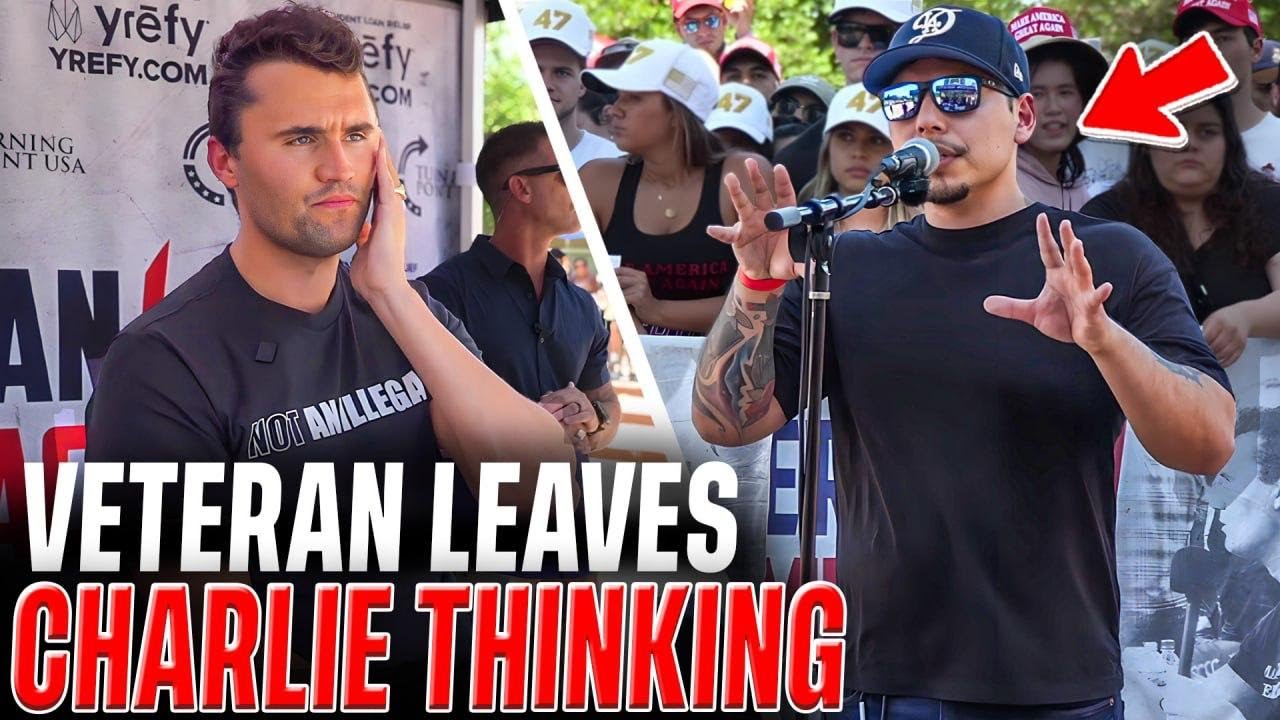
At Illinois State University, Charlie Kirk faced an unexpected challenger. Demetrios, a student who had driven two and a half hours from the suburbs of Chicago, specifically from the Wheeling area, stood before Kirk with a mission. He had been watching Kirk's videos for years, appreciating the logical framework Kirk brought to complex issues. Two weeks before this encounter, Demetrios had been watching Kirk's content thinking he wanted to get in front of him for a conversation. The next morning, he discovered Kirk was coming to ISU, and he knew he had to make the trip.
Demetrios opened with genuine admiration. He praised Kirk's journey from Wheeling to becoming someone who travels with President Trump, visits Greenland with Donald Trump Jr., and operates in what he called "the Court of Kings." Kirk humbly responded that he still has to pinch himself that a kid from Wheeling who went to MacArthur Middle School and Wheeling High School could achieve such things, calling it an "only in America success story."
But Demetrios didn't come just to praise. He came with a warning rooted in their shared geographic origins: "Sometimes when we get to that point, when we reach the heights of height, the highest of heights, we lose the sense of what's right." He wanted to run the gauntlet with Kirk on Israel and Palestine.
Defining the Israel-Palestine Question
Demetrios began by attempting to frame Kirk's position: a one-state solution with Israel as that state, based on Jews being the true indigenous people to that land. Kirk offered a more nuanced position. He stated that Israel's existence is a miracle, not a mistake, referencing the creation of Israel in 1947-1948. He affirmed Israel's right to exist and described neighboring government structures as ranging from "annoyingly evil" to "largely illegitimate," particularly the Palestinian Authority. However, Kirk clarified he would welcome a multi-state solution if neighboring entities acted like legitimate states similar to Jordan or Egypt, rather than as terrorist proxies.
Kirk acknowledged he tries not to be too ideological on the topic, though he noted there is a theological undercurrent to his position as a Christian. He then turned the conversation to Demetrios, asking him to articulate his position.
The Question of Palestinian Identity and Rights
Demetrios reframed the entire debate. He rejected the premise that the question should begin with "does Israel have a right to exist," arguing that Israel clearly does exist and has won the right to exist. Instead, he proposed the question should be whether Palestine has a right to exist or whether Palestinian people have a right to self-determination.
Kirk immediately pressed for definitions. What is Palestine? Who are Palestinians? What geography are they entitled to? Demetrios defined the Palestinian people as those living in the land of Palestine, which he described as the region between Egypt and Syria. He cited the ancient historian Herodotus who described the region as "Palestina," derived from the term "Peliset" referring to the sea peoples.
Kirk quickly countered that Herodotus lived long after the creation of the nation of Israel. He then pressed further: would this definition of Palestine that encompasses the region between Egypt and Syria include Tel Aviv, Jerusalem, Hebron, and Capernaum? When Demetrios answered affirmatively, Kirk zeroed in on the implications.
The Tel Aviv Test
Kirk asked directly: do Palestinians have a moral right to set up a government in Tel Aviv? Demetrios hesitated, then said he didn't think so. He acknowledged Tel Aviv as the current core of the Israeli state and suggested that any Palestinian state would more likely be established around Gaza or the territories in the West Bank.
Kirk then shifted to the fundamental question of Palestinian identity as a distinct people group or ethnic nation. The exchange became rapid-fire as Kirk pressed Demetrios to define who Palestinians are. Are all Jordanians Palestinians, given that many Palestinians are Jordanian refugees? Demetrios attempted to trace Palestinian identity back to the Canaanites who mixed with other groups, including Palestinian Christians who were among the first to convert to Christianity.
Kirk interrupted the historical narrative, pointing out that Demetrios himself had just referred to the location as "the land of Israel, not Palestine." When Demetrios discussed Palestinian Christians as potentially the most indigenous to the region, Kirk countered that Jews predated them, with the land of Canaan or Judea and Samaria belonging to the Jews for well over 4,000 to 5,000 years.
The Comparative Question
Kirk then posed what he considered a fundamental question: there are 45-plus Arab majority, Muslim majority countries in the world, so why does one Jewish majority country receive so much attention, including Demetrios's advocacy?
Demetrios attempted an analogy. He asked if the existence of 20-plus Bantu majority countries in Africa would give Black Americans the right to return to their homeland and establish a state. Kirk said no, citing the example of Liberia. When Black Americans attempted to establish that nation under President Monroe, they set themselves up as a ruling class, pushed indigenous Liberians into the interior, and were eventually investigated for forced labor practices.
Demetrios acknowledged this point but noted it didn't fully answer his concerns about Palestinian rights and self-determination.
Finding Common Ground on a Path Forward
As the exchange drew to a close, Kirk asked what Demetrios would consider to be a resolution to what's happening in the region. Demetrios's answer surprised many in the audience with its pragmatism. He stated clearly that he doesn't believe a peaceful future can exist with Hamas, calling this a morally clear statement. He suggested Israel should focus on destroying the tunnel networks, getting hostages back, and using their extensive intelligence network—the same one they've used for decades to assassinate neo-Nazis on different continents—to target Hamas leadership in various countries through unconventional means.
Then Demetrios made what Kirk considered a reasonable suggestion: work with the Palestinian Authority. He acknowledged the Palestinian Authority is corrupt, but argued it's better than the terrorists. This pragmatic approach seemed to catch Kirk somewhat off guard. Kirk responded that he found very little to disagree with in that assessment.
A Respectful Conclusion
The exchange ended on a note of mutual respect. Kirk acknowledged they would need to continue this discussion at another time. Both thanked each other, with Kirk offering a blessing. What began as a challenge from a student who felt obligated to speak truth to someone from his own community ended as a demonstration of how substantive disagreement can be conducted with respect and good faith.
The debate touched on fundamental questions that have vexed diplomats, scholars, and activists for generations: What defines a people? What creates legitimate territorial claims? How do we weigh competing indigenous narratives? And perhaps most importantly, what practical steps can actually lead to peace rather than perpetual conflict?
While Kirk and Demetrios didn't resolve these questions, they modeled something increasingly rare in discussions of Israel and Palestine: the willingness to engage deeply, define terms carefully, press for logical consistency, and ultimately acknowledge where common ground exists, even amid significant disagreement.