Up Next
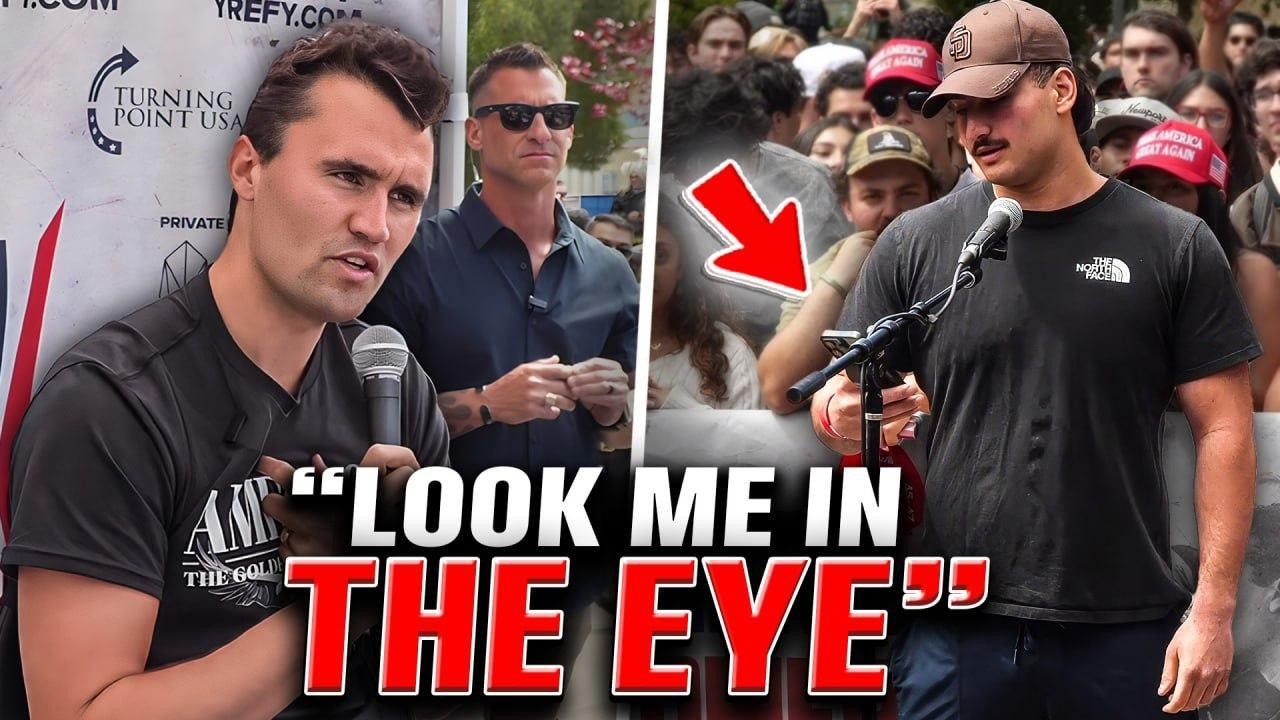
Charlie Kirk Debates Palestinian Christian on Israel Support, Christianity, and Middle East Persecution
9:34
Charlie Kirk Dismantles Pro-Palestinian Arguments on Israeli Occupation, Gaza Withdrawal, and Temple Mount Access
27:02
Piers Morgan Reveals His Honest Take on Israel-Palestine After Removing His Journalistic Hat
27:30
Charlie Kirk Explains Why Honoring the Sabbath Will Change the World and Addresses Israel Criticism
Charlie Kirk defends his commitment to the Jewish Sabbath tradition and unpacks the complex distinctions between criticism of Jews, Israel, and the Israeli government. Speaking at a Q&A session, Kirk shares his perspective on why disconnecting from modern life one day per week creates better health outcomes and stronger families. He addresses the rise of antisemitism, explains his support for Israel's existence while acknowledging the complexities of the Israeli-Palestinian conflict, and reveals he's writing a book titled "Stop in the Name of God" about the transformative power of Sabbath observance. Kirk argues that this ancient practice given at Sinai offers modern civilization a preservative tool against anxiety, depression, and the relentless demands of digital culture.
The Sabbath Practice That Changed Everything
During a Q&A session, Charlie Kirk was asked about his practice of not responding to messages on Sundays because he participates in the Saturday Sabbath. Kirk lit up at the question, calling it "the best question anyone's ever asked." As a Christian, he acknowledged the ongoing debate about whether Christians are bound to the Jewish Sabbath, noting there are compelling arguments on both sides.
Kirk revealed he is currently writing a book titled "Stop in the Name of God: Why Honoring the Sabbath Will Change the World." His central argument addresses the modern crisis of hypermaterialism and digital frenzy. He believes the Sabbath is a gift God gave to the Hebrews that contemporary society has chosen to ignore, despite its profound benefits.
The practice is straightforward: for one day, you stop. That day becomes holy and different from the rest. Kirk emphasized this principle applies even to agnostics and non-Christians, pointing to concrete evidence that people who honor the Sabbath live longer, experience greater happiness, and have better health outcomes. He cited the Seventh-day Adventists as an example of this phenomenon.
From Slavery to Freedom Through Rest
Kirk highlighted a fascinating detail from the biblical text. In the retelling of the Ten Commandments in Deuteronomy, the only difference appears in the Sabbath commandment. Moses tells the people they shouldn't work seven days because they are no longer slaves. Kirk explained that Moses was essentially saying only slaves work seven days straight.
He argued that Western society has become enslaved to work, which is creating widespread depression and anxiety. As a free market capitalist, Kirk acknowledged this might seem contradictory, but he maintains that the relentless "more, more, more" culture of constant texts, alerts, emails, and WhatsApp messages is destructive.
For Kirk personally, the practice looks like working intensely for six days, then turning off his phone from Friday night through Sunday morning. He tries to make that time distinct and different, using it for his best thinking and quality time with his family. He believes everyone has the agency to disconnect and make the choice to no longer be subservient to the demands of modernity.
A Civilizational Preservative
Kirk connected the Sabbath to Jewish survival throughout history. Despite being expelled from numerous countries and facing persistent hatred, including in the present day, the Jewish people continue to thrive and grow. He believes God has provided a preservative for civilization, and that preservative is the Sabbath.
Distinguishing Between Jews, Israel, and the Israeli Government
When asked about his comment regarding hatred of Jews, Kirk made an important distinction: "Not everyone who is against Israel hates the Jews, but everyone who hates the Jews is against Israel." He observed a troubling trend on social media and in broader culture—a temptation to blame Jews for all of society's problems, which he called sloppy and wrong.
Kirk insisted on the maturity to differentiate three distinct issues: Jews as a people, Israel as a nation, and the Israeli government as a political entity. He described Judaism as uniquely complicated because it encompasses a people, a religion, an ancestry, and a culture. It's almost unparalleled in the world—you can be born into it, identify as an atheistic Jew, yet there's also a religious text.
He argued that Israel is fundamental to Judaism, describing "God, Torah, Israel" as the informal trinity of Judaism. However, he maintained that one can support Jewish life, support Jews, and support Israel while disagreeing with the current Israeli government. This is a perfectly mature position to hold.
The Problem of Conflation
Kirk acknowledged having both disagreements and agreements with Netanyahu, stating this is completely acceptable. He believes much of the finger-pointing around these issues could be de-escalated by viewing them through this differentiated lens.
He criticized both sides of the debate. Those who blame "the Jews" for problems engage in irrational thinking. Those who say Israel shouldn't exist present a more reasonable argument to engage with, even though Kirk disagrees. And those criticizing the Israeli government are operating on yet another level entirely.
The problem emerges, Kirk explained, when pro-Israel advocates conflate these three things and immediately accuse anyone criticizing Netanyahu of being against Jews. He called this approach immature and sloppy, arguing it creates resentment where it otherwise wouldn't exist.
Biblical and Historical Foundations
When asked whether his belief in Israel's existence is biblical or political, Kirk clarified he's not a theologian but aligns with an interpretation of Ezekiel 36 regarding the reconstitution of the state of Israel as prophesied. He mentioned the theological debate around eschatology—the study of end times—noting there are pre-tribulation and post-tribulation Christians. Kirk identifies as "pan-trib," joking that "it's all going to pan out in the end."
He stated his approach simply: Jesus will return, and he'll be on the welcoming committee, not the planning committee. Rather than focusing heavily on end-times theology, Kirk wants critics of Israel to acknowledge something remarkable: it is miraculous that Israel in its current form exists.
From a historical perspective, Kirk marveled at what David Ben-Gurion and the Zionists accomplished. Israel was attacked from every direction from its founding, completely under siege and brutalized. Interestingly, the Balfour Declaration proposed the smallest suggested size for Israel compared to all other plans at the time.
The Right to Defend Into Existence
Kirk reframed the common question about Israel's "right to exist." He finds this question somewhat of a cop-out. The more important moral question, he argued, is whether a country has the right to defend itself into existence. If a country can prove it can exist, should it be given recognition?
He emphasized his desire to find reconciliation on this issue but insisted there's a dangerous downplaying of what happened on October 7th. At the same time, he acknowledged that pro-Israel advocates need to recognize that war is awful and brutal. As a Christian, he finds the videos of children being killed terrible and wants to see the conflict end.
Kirk expressed disgust at examples like Nikki Haley signing bombs to be dropped in Gaza, calling it repulsive and disgusting. Those weapons would be used against complete casualties of war who shouldn't be targeted.
Self-Determination Versus Terrorism
When asked how he reconciles being pro-Israel with Palestinian self-determination, Kirk drew a sharp distinction. He said what some well-meaning Arabs are doing in the West Bank is righteous. However, what Hamas did on October 7th was categorically not a fight for self-determination.
Kirk detailed the events: 1,300 people killed when Hamas entered kibbutzim and a music festival on Shabbat, a holy day that fell 50 days after the Six-Day War. They killed 1,300 people and took 200 hostages, filming the atrocities on GoPro cameras. Some called their relatives on WhatsApp saying, "I just killed 10 Jews. Can you believe it?"
This, Kirk insisted, was not self-determination but something horrific, brutal, and evil that every person with a conscience should condemn. He acknowledged the settlements in the West Bank make the situation difficult and raised important questions: What is a Palestinian? What are the borders? Who's in charge?
Kirk also pointed out that some people believe Palestine should extend "from the river to the sea," meaning they don't believe in a Jewish state at all. He operates from the premise that a Jewish state should exist. If someone wants a Palestinian state, he's open to hearing the contention, but they need to specify where, who would govern, and how it would work.
If the proposal is nothing more than the eradication of Jewish life between Jerusalem, Tel Aviv, and Haifa, then the conversation has regressed from discussing the Israeli government, to Israel as a nation, to having a problem with Jews themselves. Kirk believes this gradation of regression is very harmful to productive dialogue.
The Holiest Day of the Year
Following Kirk's remarks, a Jewish speaker elaborated on the significance of the Sabbath in Judaism. Contrary to what many assume, the holiest day of the year in Judaism is not Yom Kippur but the Sabbath itself. The Sabbath is truly holy, meaning it's different from the other six days of the week.
The speaker explained that God created the world in six days and rested on the seventh, giving humanity the mandate to observe the Sabbath as one of the Ten Commandments. The Sabbath appears twice in the Bible with different verbs: "remember" the Sabbath and "observe" or "guard" the Sabbath in Deuteronomy.
Jewish tradition includes eating two loaves of bread on Friday night for two reasons: to remind of the double portions of manna that fell from heaven on Friday (since none fell on Saturday), and to represent the two terminologies in the Ten Commandments—remembering and guarding.
The principle is profound: when you observe the Shabbat, the Shabbat will observe you. It protects you and blesses the rest of the week. While specifically a mandate for the Jewish nation, the whole world benefits from taking a day off. The practice is spiritually infusing and beautiful for family unity.
Friday Night as Weekly Thanksgiving
The speaker described how every Friday night becomes like Thanksgiving—families and friends gather around the table to talk and connect. One tradition shared involved a family with 14 children where each sibling compliments the one sitting next to them, sharing what they found special about their brother or sister that week. Parents bless their children every Friday night in a moment when the children are actually listening.
Israel's Divine Mandate and Global Contribution
Addressing Israel's right to exist, the speaker stated clearly that God who created the heavens and earth gave Israel to the Jewish people. It is their land, a gift to preserve and use to fulfill their mandate to be "a light unto the nations."
Looking at Israel's 77-year modern history, the speaker catalogued the nation's gifts to the world: ingenuity, accomplishments, and inventions across all areas of life including agriculture, education, medicine, communication, and travel. Israel remains at the cutting edge of advances benefiting all humanity.
The speaker posed a challenging question: What has the Palestinian leadership gifted to the world? What has the Arab world accomplished in comparison? Acknowledging that Arab nations have oil while Israel doesn't, the speaker emphasized that Israel's true resource is its divine mandate to bless whoever they can.
The formula is simple: whoever Israel blesses will be blessed. The plea to the world is equally simple: let us be, let us live and let live, let us live in peace. The moment Hamas and other enemies put down their arms, there will be peace. If Israel puts down its arms, there will be bloodshed, as demonstrated on October 7th.
The speaker concluded with hope that the Western world will appreciate and acknowledge the Jewish journey—3,337 years of struggling to be God's emissaries and ambassadors in doing good for the world. The prayer is that God's countenance will continue to shine and bring peace to the Middle East and the entire world.
Video Transcript
So Jews are, you know, is a very
complicated thing because it's a people,
but it's also a religion and it's an
ancestry, but it's a culture. Almost
nothing like it in the world, right?
Where you're kind of born into it and
you can be like an atheistic Jew, but
there's also like a religious text. And
then there is Israel, which I believe is
fundamental to Judaism.
Mr. Charlie Kirk has been a wonderful
friend of Israel and the Jewish people
and is a truth seeker. Throughout the
October 7 war till today, Charlie Kirk
has sided with the right side of
history. He has subjected himself to
various talks throughout the world.
Please listen in to this amazing
question and answer and see how Mr. Kirk
handles himself and how he's able to
talk from the heart and to talk the
truth. Kindly subscribe to this channel
so we can continue on growing this
channel bringing a little bit of light
pushing away a lot of dark
vacation and he's saying you don't
respond on a Sunday because you
participate in
Saturday actually. Yes. Sorry. That's
right.
Yeah. That's very astute.
Yeah. So kind of like more why do you
kind of like is that something you've
taken from the Jewish tradition?
Now I really like you. Uh now you asked
the best question anyone's ever got. I
could talk about the Sabbath all day
long. Um I don't know if anyone is
interested in this so you could roll
your eyes but I I am I'm a Christian. So
whether or not we're bound to the Jewish
Sabbath is hotly debated. There's great
arguments for it, great arguments
against. I'm actually writing a book
right now on why I honor the Sabbath.
It's very simple. It's called Stop in
the Name of God, why honoring the
Sabbath will change the world,
basically. And it is an argument that in
this hypermaterialistic, very fast,
digitally frenzied world that there is
this there is this gift that I believe
the Lord gave the Hebrews that we have
decided to just gloss over. And it's
very simple. It's that for one day you
will stop. That it will be holy. That it
will be different. For those of you that
are agnostic or not Christian, I still
encourage you to do this. People that
honor the Sabbath live longer. We know
this with the 7th day Adventists. They
actually are happier. They have better
health outcomes. Everything about
disconnecting from modernity is good
from you. It isn't arguable. Like this
is this is a material fact. But why is
it that we have forgotten it? Well, for
me personally, I work like crazy for six
days. On Friday night, even Sunday
morning, I turn my phone off and I try
to stop. I try to make it distinct. I
try to make it different. It's where I
do my best thinking. It's where I do my
best time with my family. Um, and again,
this kind of goes back to, okay, we're
trying to create all this new stuff.
Like, wow, we're gonna have this new
technological invention in innovation.
We're going to have this vaccine and you
we're going to be a solve this with
quantum mechanics and quantum computing.
And I'm kind of like honestly something
was told to us on Sinai that we
shouldn't forget that like you shouldn't
work for seven days. In the retelling of
the ten commandments in the book of
Deuteronomy,
the only difference of the retelling of
the ten commandments is when Moses says,
"Hey, you shouldn't work seven days
because you're no longer a slave." What
Moses is saying is like only slaves work
for seven days actually. And we in the
West have kind of been slaves to our
work. And I say this as a free market
capitalist. That's not good. It's making
us depressed. It's making us anxious.
And I all of you have the agency to
disconnect from that to make a choice to
no longer have to be subservient to the
ever more more more next text, next
alert, next email, you know, next
WhatsApp message. And it kind of goes
back to a theme I've been saying that it
has worked. It's also a phenomenal uh
civilizational preserving tool. It's
worked for the Jews. They've been kicked
out of a lot of countries and a lot of
people have hated the Jews, including
right now. and they're thriving and
they're growing and they continue. I
think God has given us a preservative
for a civilization and I believe it is
the Sabbath.
Thank you very much. Um just picking up
on a comment you just made just then
about um a lot of people hating the Jews
right now. Um would you elaborate more
specifically on what you're talking
about?
Yeah. Not everyone who is against Israel
hates the Jews, but everyone who hates
the Jews is against Israel. So, it's an
important connection. Look, I mean, it's
coming from both sides. We all see
what's happening on social media. There
is this kind of temptation to blame the
Jews for all of your problems. I think
it's sloppy and it's wrong. No group is
perfect. No group is going to act in a
in a, you know, in a directionally
consistent way. But look, I I think that
it's at least in my country, I don't
know if that you guys are seeing a
similar rise in the United Kingdom, but
I think that there is this temptation to
say that all the world's suffering is
because of a small group of people, many
of whom I have not met. And I I reject
that wholeheartedly.
But would you say the criticisms is of
the Jews or of the state of Israel,
which I think
Oh, no. Those are two different things.
So, there are three issues here and
that's a very good question. And we must
have the maturity to differentiate them.
And in the Q&A, we could talk Israel,
Gaza, whatever you want, obviously. But
there is a difference between Jews,
Israel, and the Israeli government. And
I acknowledge those differences. So Jews
are, you know, is a very complicated
thing because it's a people, but it's
also a religion, and it's an ancestry,
but it's a culture, almost nothing like
it in the world, right? Where you're
kind of born into it and you can be like
an atheistic Jew, but there's also like
a religious text. And then there is
Israel, which I believe is fundamental
to Judaism. God toward Israel is the
informal like trinity of Judaism. And
then the Israeli government, you can
support Jewish life and support Jews and
support Israel, but not support this
current Israeli government. It's a
perfectly mature view to have. It's
fine. Like I I have disagreements with
Netanyahu. I have agreements. It's I
think it's okay. But I actually think we
could deescalate a lot of the
fingerpointing around this issue if we
look at it through that lens that anyone
who says like, "Oh, we're going to blame
the Jews." Well, then that that's the
first like no one here rationally I
think would if you believe that then we
could talk about it. But then if you're
like, well, I don't think Israel should
exist or I don't like Israel. Okay,
that's another step, but that's a more
reasonable argument, one I wouldn't
share. But then if you're criticizing
Israeli government, so where I think a
problem emerges is where my side, where
I am pro-Israel, we conflate those three
things and we immediately say that
you're against Netanyahu, therefore
you're against the Jews.
I'm sorry. I I think that's immature.
sloppy and it actually creates more uh
resentment uh where it otherwise would
not exist.
Thank you. Um on the state of Israel in
terms of its existence?
Oh, here we go. Great.
I was going to leave it to the Q&A but
we started um uh just a question and a
belief in the state of is Israel
existing in its current form. Is it
biblical or is it just a political
belief?
Okay. So you asked is it biblical or
what? So is your belief on this current
state of Israel, where it is and how
it's formed, is that is that belief
biblical?
So I'm not Got it. I'm not a theologian.
Uh but I am uh definitely more, let's
say, aligned with a view of Ezekiel 36
that there is a reconstitution of the
state of Israel. And that was
prophesized. I will bring you from
across the lands and graft you together.
More I don't want to get into that.
Again, if you guys want to talk about
end times theology, I'm honestly going
to be like, let's get a more important
question cuz I don't know it that well.
I'm not that interested in it. It's
called esquetology. There's like there's
pre-tribulation Christians and then
there's post-tribulation Christians. I'm
pantrip. It's all going to pan out in
the end. Okay. Uh Jesus will return. I'm
going to be on the welcoming committee,
not the planning committee. Um and so
like I'm not I'm not overly interested
in that. Um, instead I think what is
lost and I think I would like at least
the anti-Israel advocates I don't want
to say anti-Israel the critics of Israel
that will come up and ask questions to
acknowledge this that it is miraculous
that Israel in this current form exists.
I mean it's really unbelievable what
Bengurian and the Zionists were able to
pull off um from just a Zionist
perspective. It is a miracle considering
they were attacked from every direction
from its charter completely under attack
and totally brutalized. Number two, it's
interesting because in the Balffor
declaration, as you will know, it
actually was the smallest suggested size
for Israel as of all the four plans. All
that to say, what do I believe about the
current composition of the state of
Israel? Well, my historical analysis of
whether, you know, it should be formed
or not, I actually think it should be is
not that relevant. The more important
moral question is, what do you think
about what is happening right now? Uh,
do you think that Israel has I I I don't
like the qu I think it's a little bit of
copout. Like, do you think Israel has a
right to exist. I think more
importantly, do you believe that a
country has a right to be able to defend
itself into existence? That's a more
important question that if a country can
prove to itself that to you that it can
exist, should it then be given
recognition? So, I don't know if that
answers your question. It's kind of just
a mind dump on the topic. I seek to
actually find reconciliation on this. I
think there is a downplaying what
happens on October 7th to a great
detriment. And I think that at times
those of us that are per Israel need to
acknowledge war is awful. War is brutal.
I'm a Christian. I hate when I see these
videos of these kids being killed. I
mean it's terrible. I want to see this
come to an end. I mean like who can
possibly see that and support that. And
anyone who's like for example like Nikki
Haley signing bombs that are going to be
dropped in Gau. Like that's repulsive.
I'm sorry. That's disgusting. Okay. Like
that's going to be used against people
that shouldn't like that are just
complete casualties in the war. And so
yeah, I I I I hope that offers some
clarity on that.
Yeah, thank you. Um, but then in terms
of the question of being pro-Israel and
the right of Israel to exist when
Palestine very much exists and they're
fighting for their own
self-determination, how do you reconcile
both?
So, I would push back a little bit. I
think what some well-meaning Arabs are
doing in the West Bank is is righteous.
What Hamas did on October 7th was not a
fight for self-determination. I I I
would find great exception to that
claim. Uh going 1300 people going in on
a holy day on samat shamatra 50 days
after the six- day war um on Shabbat to
go to kabutzes and a music festival to
kill 1300 people and take 200 hostages
all while filming it on GoPro cameras
and then some of which not all calling
back to their relatives on WhatsApp
saying I just killed 10 Jews. Can you
believe it? I just killed 10 Jews. I'm
sorry. That's not a fight for
self-determination. that's something
horrific and brutal and evil that every
human being with a conscious say that's
wrong and we don't support that and so
again as far as this idea of
self-determination there are important
and these are not trap questions the
settlements make it very difficult in
the West Bank what is a Palestinian what
are the borders who's in charge these
are again and it also kind of goes back
to this because I also have to throw it
back some people believe that Palestine
or whatever the state will be called
let's just call it PA is from the river
to the sea okay so then you don't
believe in in a Jewish state. I come I
come from the premise that I think a
Jewish state should exist. If you want a
Palestinian state, tell me where, tell
me who, tell me how, and I will be
open-minded to hear that contention. But
if it's nothing more than the
eradication of jewelry between, you
know, Jerusalem, the Tel Aviv, and Hifa,
I'm sorry. That's where now we're
blurring on the going backwards, not
forwards, from, okay, we're going from
Israeli government to Israel to some
problem with the Jews. Does that make
sense? That kind of g that gradation of
regression, I think, is very harmful to
the dialogue. And Mr. Kirk hit it on the
nail, as they say. Once again, he hit it
out of the park. Well, thank you for
promoting the day, the Sabbath day. In
Judaism, it's actually called the
holiest day of the year. It's a trick
riddle. If you ask any Jewish person,
what's the holiest day of the year?
Well, first they'll jump out and say
yonipur, day of atonement, but it's not.
The day of Sabbath is the holiest day of
the year. It is truly holy. Holy means
that it's different than the other six
days of the week. Yes, God created the
world on six days, rested on the
seventh. And God gave us the mandate
that we need to observe the Sabbath.
It's in the ten commandments.
But twice in the Bible, it's recorded
about the Sabbath. The first time it
says to remember the Sabbath and the
second time in Deuteronomy, it says
observe the Sabbath.
And it actually just one of the
traditions why we eat two loaves of
bread Friday night. One reason is to
remind us of the double portions of the
mana that came from heaven that on
Friday we got a double portion because
mana would not show up on Saturday
because of Sabbath. So we have two
loaves of bread. But also to represent
the two terminologies in the ten
commandments of remembering and
guarding. What does that mean? It's one
thing to remember the Sabbath. The other
thing is to observe it. And when you
observe the Shabbat the Saturday,
Saturday will observe you. It will
protect you from Saturday. It blesses
the rest of the week. So that is just
thank you Charlie for talking about
Sabbath. We want to promote this as much
much as much as possible. Yes, it is
specifically a mandate given to Jewish
nation but the whole world. if they want
to be able to take a day off. It is
highly recommended, spiritually
infusing, and it and it's it's so
beautiful for the family unit when every
Friday night is like Thanksgiving. Every
Friday night you sit around the table,
family and friends and guests, and we
talk about each other. I have a sister
who who has 14 children and they had a
tradition that every Friday night every
child every sibling will look at the
sibling sitting next to them and give
them a compliment and say what do you
see special in your sibling this week
and they just go around the table each
one complimenting each other how
beautiful is that to take a moment
Friday night parents bless their
children every Friday night how often do
you get to bless your children in a way
that they're listening to you that is
the gift Shabbat.
When it comes to Israel, when it comes
to the right for existence,
it is very clear that God who created
the heavens and the earth gave us
Israel. It is our land. It was a gift to
us to have, to preserve, but most of all
to carry out our mandate to be a light
unto the nations. And that is what
Israel is all about. When you look in
the last 77 years, what Israel has
gifted the world, all of its ingenuity,
all of its accomplishments,
all of its inventions in all areas of
life, from agriculture, education,
medicine, communication, travel, you
name it. Israel is at the cutting edge
of bringing advances for all humanity,
for the whole world. Let me ask you,
what has Palestinians gifted to the
world? What has the Arab world truly
accomplished in comparison to what
Israel continues to accomplish? And it's
okay. You know, they have oil. We don't.
What we have, we have a mandate from
God. Our mandate is be a light unto the
nations to do whatever you can. Bless
whoever you can. Whoever you bless will
be blessed. So we just pray and ask the
world let us be. Let us live and let
live. Let us live in peace. The moment
Hamas and our other enemies put down
their arms, there'll be peace. If we put
down our arms, there'll be bloodshed as
we have seen on October 7. So, we hope
that the Western world will appreciate
and acknowledge our journey, will
acknowledge and realize that for 3,337
years, we have struggled just to be
God's emissaries, ambassadors in doing
good for the world. Let's pray and we
hope that God will continue his
countenance will shine upon us and bring
peace to the Middle East and to the
whole world speedily in our days. Amen.
God bless you. God loves you.