2,422 videos 1,389,747,653 views US Joined Aug 30, 2018
Charlie Kirk is the Founder and President of Turning Point USA, the largest and fastest growing conservative youth activist organization in the country with over 250,000 student members, over 150 full-time staff, and a presence on over 2,000 high school and college campuses nationwide. Charlie is also the Chairman of Students for Trump, which aims to activate one million new college voters on campuses in battleground states in the lead up to the 2020 presidential election. His social media reaches over 100 million people per month and according to Axios, he is one of the "top 10 most engaged" Twitter handles in the world. He is also the host of “The Charlie Kirk Show,” which regularly ranks among the top news shows on Apple podcast charts.
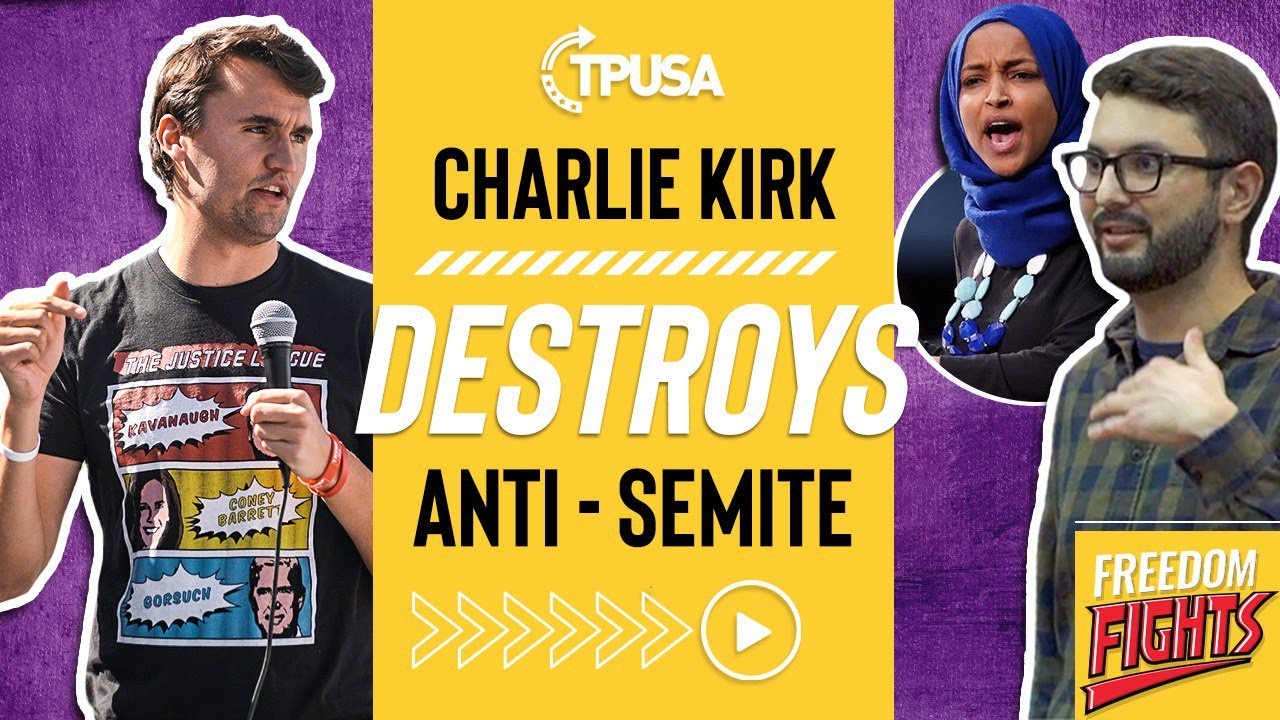
Charlie Kirk Debates Palestinian Christian on Israel Support, Turkey's Role in Armenian Persecution, and U.S. Foreign Aid
Charlie Kirk engages in a thoughtful exchange with a Palestinian Christian who questions America's support for Israel, particularly regarding arms sales to Turkey that impact Armenian Christians. The conversation explores the complexities of U.S.-Israel relations, the Armenian genocide, Turkey's problematic role in NATO, and whether Israel or Muslim-majority nations better protect Christian communities. Kirk defends Israel's right to exist while addressing concerns about foreign aid priorities, the moral significance of the Holy Land, and the treatment of Christians across the Middle East. The discussion reveals areas of agreement and fundamental differences on faith-based foreign policy.
A Palestinian Christian audience member approached Charlie Kirk with a polite but firm disagreement about his support for Israel. The questioner, who identified as a big fan of Kirk, raised concerns about Israel's military relationship with Turkey, specifically pointing out that Israel sells missiles to Turkey that are used against Armenian Christians. He questioned how a Jewish nation could justify helping another country eliminate a Christian population.
Kirk immediately redirected the focus, arguing that the problem extends beyond Israel. He pointed out that Turkey is part of NATO, meaning America also provides significant financial and military support to the country. Kirk characterized this as fundamentally an American problem rather than solely an Israeli issue, noting that the arms Israel sells to Turkey are often repurposed American weapons.
Turkey's Role in NATO and the Armenian Genocide
Kirk expressed strong opposition to Turkey's continued membership in NATO. He acknowledged the Armenian genocide, stating his belief that Turkey should be expelled from the alliance for its historical actions against the Armenian people. He described Turkish President Erdogan as "a very very bad guy who's becoming an Islamic dictator of a failing country" and argued that Turkey offers nothing of value to America.
The questioner accepted this framing but pressed forward with a second question about what benefits the United States receives from its partnership with Israel, given the substantial aid America provides.
The Christian Case for Supporting Israel
Kirk responded by appealing to the questioner's Christian faith. He asked how Christians know the Bible is true, answering that it comes from the land of Israel. When the questioner referred to the area as Palestine, Kirk challenged this terminology. After confirming that the audience member was a Palestinian Christian, Kirk expressed appreciation for his faith and then pivoted to biblical arguments for supporting Israel.
Kirk cited Genesis 12:3, referencing God's promise to bless those who bless Abraham's descendants, and mentioned that the Apostle Paul explicitly states that Christians should bless the Jews. He argued that Christians have a covenant with Israel and a responsibility to honor the Jewish people.
The Palestinian Christian offered a different interpretation, suggesting that biblical commands to love and honor apply to all people equally, not specifically to Jews. He argued that the passage could be understood in the context of honoring all nations and peoples, noting that at the time the Bible was written, there weren't as many distinct countries.
Finding Common Ground
Kirk shifted the conversation to establish areas of agreement. He asked the questioner directly whether Israel has a right to exist, and the young man responded affirmatively. Kirk also asked if he believed anti-Semitism is real, which the questioner also confirmed. Kirk stated that these agreements represented the most important foundations of the discussion.
However, the questioner then challenged Kirk on U.S. aid being used to level Gaza. He asked whether American money was well spent on Israel's military response. Kirk defended Israel's actions by pointing to the October 7th attack, in which Hamas killed 1,300 Jews in what he described as "the most horrendous way imaginable." He argued that Israel was responding to an unprompted and unprovoked attack that Hamas had invited.
Christianity Under Jewish Versus Muslim Control
Kirk posed a pointed question: Would Christianity be better served with Israel controlled by Jews or by Muslims? The Palestinian Christian responded with his personal experience, stating that he has found Muslims more receptive to the Christian faith than Jews. He also argued that thousands of churches throughout the Middle East have been preserved for thousands of years under Muslim control and receive funding.
The questioner contended that both Muslims and Jews have coexisted with Christianity for millennia, making it difficult to argue that one would do better than the other. He specifically mentioned that evangelical churches exist in Riyadh, Saudi Arabia, and that one can say "Jesus is Lord" there, though he clarified that in Islam, Jesus is recognized as a prophet.
Religious Freedom in Muslim-Majority Countries
Kirk challenged this assertion, expressing skepticism that one could walk the streets of Tehran or Riyadh and openly proclaim Jesus as Lord. The questioner maintained that this was possible, noting that Jesus is recognized as a prophet in Islam and that he had personally witnessed this.
The Palestinian Christian shared that part of his extended family are Armenian Christians who have lived in Tehran their entire lives. He described a thriving Christian community there with churches they attend every Sunday, where they openly wear crosses without problems. He pointed to Egypt, Syria, and Jordan as Muslim-majority countries with thousands of churches where Christian communities are protected.
Kirk pushed back, asking whether Coptic Christians in Egypt had been treated well over the last decade. He referenced mass persecution of Christians, noting that many have been leaving these countries and some have been killed. He acknowledged that while there are extremist Muslims, the best argument one could make is that Jesus is revered in Islam as a prophet, but not the ultimate prophet. In practice, Kirk argued, Islam is not compatible with open Christianity, at best wanting Christians to "stay in your corner," and at worst engaging in mass persecution.
The Right to a Jewish Homeland
Kirk stated his position clearly: Jews should have a right to their own homeland. He pointed out that Muslims have 40 Muslim-majority countries and questioned why Jews shouldn't be allowed to have one. The questioner agreed with this principle but returned to his original concern about why America provides so much support and aid to Israel when the country has significant domestic problems, drawing a parallel to the $300 billion sent to Ukraine.
Kirk offered several justifications. He mentioned that the United States receives benefits in return, including weapons technology. But more significantly, he argued for a moral obligation to protect "the cradle of civilization and the place where our Lord and Savior walked on water and rose from the dead and proves where the Bible is true."
Kirk emphasized that Israel is not like every other nation—it's not comparable to sending money to Chad or Senegal. He described Israel as special, arguing that Christians have a moral commitment to that land based on its biblical and historical significance.
Personal Experiences in the Holy Land
Kirk asked if the questioner had been to Israel, and the young man confirmed he had visited Israel, Jordan, Lebanon, and Egypt. Kirk asked if being in Jerusalem as a Christian had any impact on him. The questioner agreed it was beautiful and amazing, expressing a wish to return every day.
However, the conversation took a more personal turn when Kirk asked if the questioner felt safe walking the streets of Bethlehem without armed guards. While the questioner said yes, he then shared that his own family members had been thrown to the ground by Israeli guards for wearing crosses. Kirk responded that such treatment was unacceptable.
Seeking Reciprocity and Safety
Kirk stated his desire to see both sides become less radicalized. He shared his personal experience that the Israeli community has been very welcoming of Christians and their faith in the homeland, but he has not felt the same reciprocity from the Islamic world.
He concluded by noting what he sees as a disturbing trend in Islam across the West, where Islamic communities are antagonistic towards Christianity and taking over areas that used to be dominantly Christian. Kirk stated that he feels safer with Israelis than with most Arab Muslims.
The exchange ended cordially, with Kirk thanking the questioner for being polite and respectful throughout the discussion, and offering to take a photo together.