2,422 videos 1,389,747,653 views US Joined Aug 30, 2018
Charlie Kirk is the Founder and President of Turning Point USA, the largest and fastest growing conservative youth activist organization in the country with over 250,000 student members, over 150 full-time staff, and a presence on over 2,000 high school and college campuses nationwide. Charlie is also the Chairman of Students for Trump, which aims to activate one million new college voters on campuses in battleground states in the lead up to the 2020 presidential election. His social media reaches over 100 million people per month and according to Axios, he is one of the "top 10 most engaged" Twitter handles in the world. He is also the host of “The Charlie Kirk Show,” which regularly ranks among the top news shows on Apple podcast charts.
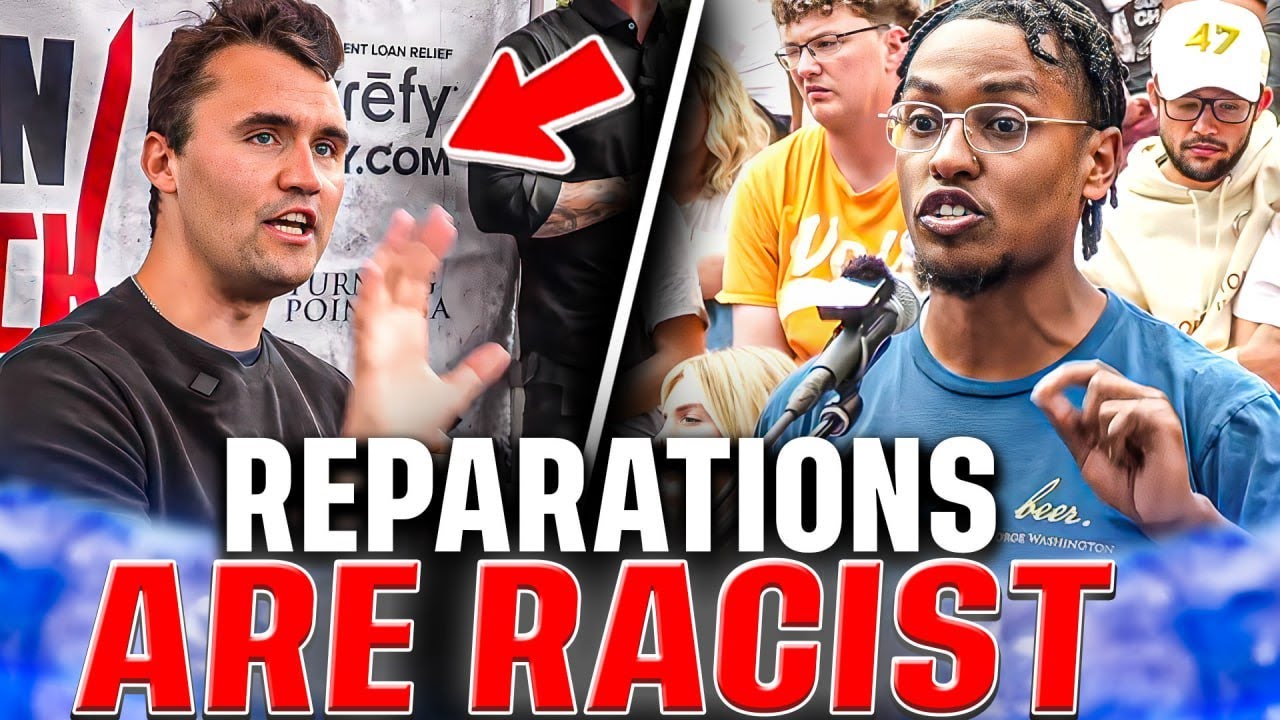
Charlie Kirk Discusses Reparations Debate and the Future of Black America with Thoughtful Audience Member
A respectful exchange between Charlie Kirk and an audience member explores one of America's most contentious topics: reparations for descendants of slavery. The conversation moves beyond typical talking points to examine why reparations have been granted to other groups but remain controversial for Black Americans, the case of Tulsa Race Massacre survivors denied compensation, and whether government spending has actually improved outcomes in Black communities. Kirk offers a provocative perspective that shifts the discussion from resources to values, challenging assumptions on both sides of the debate.
Charlie Kirk engaged in a thoughtful dialogue with a longtime supporter who raised questions about reparations for Black Americans. The audience member approached the topic with nuance, acknowledging that no Black American alive today has been enslaved, while questioning why there appears to be significantly more resistance to reparations for descendants of slavery compared to other groups who have received compensation for historical wrongs.
Historical Examples of Reparations in America
The audience member presented several examples of reparations that have been granted in American history. Asian Americans received compensation for their incarceration during World War II. Native Hawaiians have received various forms of restitution. Perhaps most ironically, even former slave owners in the northern states were compensated when they were required to give up their slaves. Yet when the conversation turns to reparations for Black Americans whose ancestors endured slavery, the idea is often dismissed or even treated as laughable.
The Critical Distinction: Direct Victims Versus Intergenerational Claims
Kirk identified a fundamental difference that distinguishes the reparations debate for Black Americans from other historical examples. In the cases cited, reparations were given directly to the people who experienced the harm. These were not intergenerational payments passed down through family lines. The discussion involves events that occurred over 150 years ago, creating a different circumstance entirely.
Kirk also noted an important complexity: not every Black person in America is a descendant of slaves. Some have mixed heritage, and some are recent immigrants from African or Caribbean nations whose ancestors were never enslaved in the United States. This creates significant complications in determining who would even qualify for such reparations.
The Tulsa Survivors: A Test Case That Failed
The audience member presented what he considered a critical test case for understanding the reparations debate. Two survivors of the 1921 Tulsa Race Massacre, both over 100 years old, attempted to sue the Oklahoma government for reparations for their lost property. These were not descendants making claims about ancestral harm—these were the actual victims who lived through the violence and destruction of one of the worst episodes of racial violence in American history.
Despite fitting the criteria that critics often cite—being directly affected rather than generations removed—these survivors were denied reparations. To the audience member, this denial confirmed his suspicion that the resistance to reparations isn't really about the principle of compensating only direct victims, but rather represents a specific bias against Black Americans receiving such compensation.
Kirk's Challenge: Has Government Spending Worked?
Kirk acknowledged he wasn't familiar with the specific Tulsa case and committed to researching it. However, he posed a broader question that reframed the entire discussion: Have we spent significant money on the Black community over the last 50 years, and if so, has it worked?
Kirk argued that trillions of dollars have been invested in programs aimed at improving the well-being of Black Americans since the 1960s. Despite this massive expenditure, he contends that Black America is actually poorer per capita and on average in relation to other groups than it was in the 1960s. This observation led him to a controversial conclusion: the issue isn't about resources or money, but about values.
A Values Crisis, Not a Resource Problem
Kirk stated that the values currently predominant in the Black community are, in his view, quasi-suicidal. The audience member, who had opened by sharing that he was raised by two loving parents away from many of the problems facing some Black communities, acknowledged this as a fair point.
Kirk emphasized that having two parents is one of the greatest predictors of success, if not the single greatest factor. He expressed his hope that every child—Black, white, or Asian—would have the benefit of being raised by two parents, calling it a ticket to success regardless of race or background.
Finding Common Ground
The exchange concluded on a respectful note, with the audience member acknowledging he didn't expect to change Kirk's mind but wanted him to consider the perspective. Kirk appreciated the thoughtful approach and committed to researching the Tulsa survivors case that had been presented.
The conversation demonstrated that even on highly contentious topics like reparations, productive dialogue is possible when both parties approach the discussion with respect and a willingness to acknowledge complexities. The audience member conceded points about intergenerational claims and the role of family structure, while Kirk committed to examining a specific case that challenged his broader framework.
The debate over reparations continues to divide Americans, touching on questions of historical justice, contemporary responsibility, government effectiveness, and the best paths forward for communities facing challenges. This exchange captured many of those tensions while modeling how such conversations might proceed with more light than heat.