Charlie Kirk Dismantles White Privilege Narrative in Heated Exchange with Student on Systemic Racism
Enjoying this? Share it with someone who needs to see it.
Up Next
Charlie Kirk Destroys the Myth of Systemic Racism in America with Data and Truth
2:17
Charlie Kirk and Candace Owens Dismantle White Privilege Argument With Military Member at Campus Conversation Event
7:36
Charlie Kirk Debates Student on Racism Versus Fatherlessness as America's Biggest Problem at Campus Event
7:46
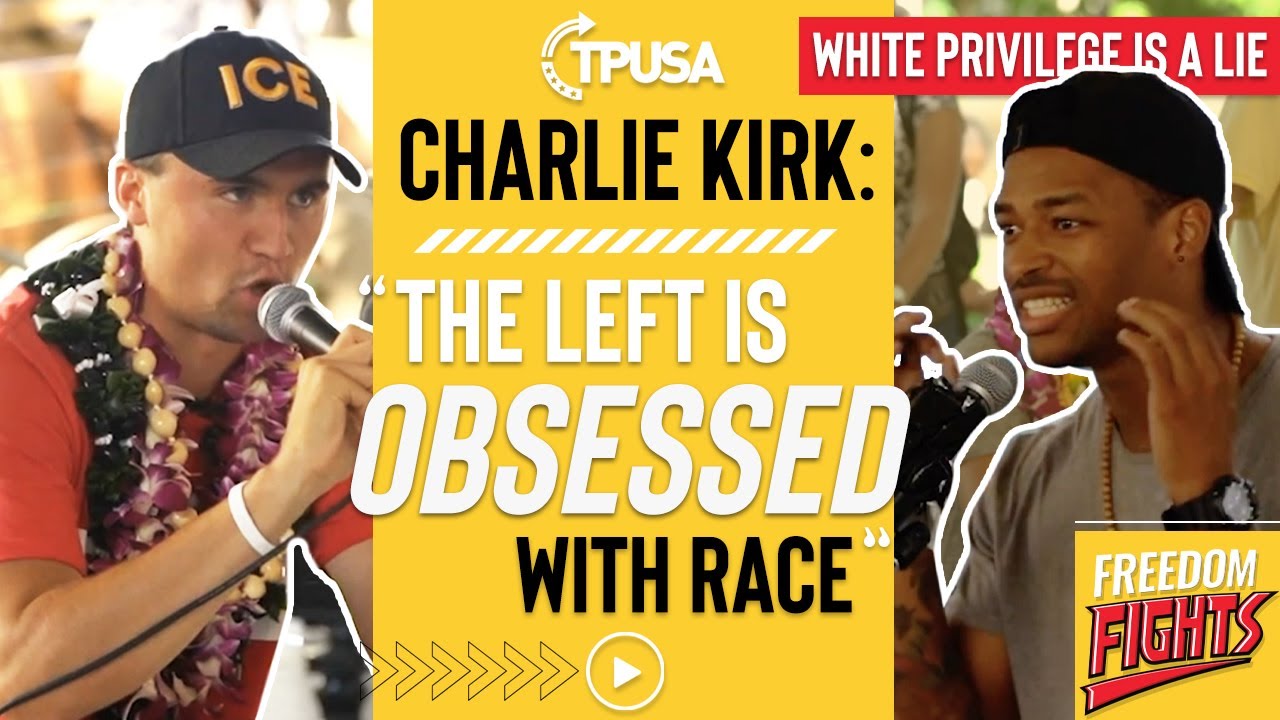
Charlie Kirk Dismantles White Privilege Narrative in Heated Exchange with Student on Systemic Racism
Charlie Kirk engages in a compelling debate with a student who claims white privilege and systemic racism determine outcomes in America. The student argues that former Arizona Governor Jan Brewer's policies like SB 1070 prove institutional racism exists, and that his experience as a minority will be harder than white Americans. Kirk flips the script, systematically presenting evidence of affirmative action, race-based healthcare policies, and corporate hiring practices that actually favor minorities over white applicants. The exchange culminates in Kirk arguing that the real privilege in modern America runs opposite to the mainstream narrative.
The Challenge: Proving White Privilege and Systemic Racism
A student confronts Charlie Kirk with a direct challenge: "How can you come here and tell me there's no such thing as white privilege and no such thing as racism?" Kirk's response is immediate and unequivocal: "There's no such thing as white privilege or racism." He then clarifies his position, stating that while racism exists on an individual level, it is not institutional.
The student attempts to use a judicial ruling as evidence of institutional racism, to which Kirk responds that judges can be wrong. He challenges the student to provide specific evidence rather than relying on vague references to court decisions.
Jan Brewer and SB 1070: Evidence of Racism?
The conversation shifts to former Arizona Governor Jan Brewer, with the student claiming she signed policies because "she hates Latino people." Kirk immediately demands evidence for this serious accusation. The student references a documentary about Raza Studies, a Mexican American studies program, as supposed proof of Brewer's racism.
Kirk acknowledges he's not well-versed in that specific documentary but asks what's wrong with exploring alternative explanations for Brewer's policy decisions. The student then brings up SB 1070, describing it as "basically a law for an officer to pull me over and ask for my papers, but I've never even been to Mexico."
Kirk counters by stating he believes people should be asked for their papers regardless of their appearance, a position that sets up the core confrontation of the debate.
The White Privilege Claim
The student then presents what he believes is the smoking gun evidence of white privilege: "Who are they going to ask for their papers, me or you?" This question assumes that police officers would racially profile the student while leaving Kirk alone.
Kirk immediately pushes back, noting that he gets asked for papers all the time and can show "my pile of dudes to prove that you're a citizen of the United States." When the student suggests Kirk doesn't understand because "you don't look like me," Kirk refuses to accept the premise that the student is being targeted solely because of the color of his skin.
"Guess what, I get pulled over too," Kirk states, rejecting the notion that being asked for identification is evidence of racism or white privilege.
The Victim Mentality Diagnosis
Kirk shifts from defense to offense, offering the student what he frames as genuine advice: "You're looking at the world as a victim. You're looking at the world as if there's systemic racism and the evil white man that's trying to crush you. It's a lie. It's a lie that is designed to keep you down. It's a lie that is designed to try and disempower you."
He emphasizes that white people also get pulled over and asked for their papers, and reiterates his position that non-citizens without proper documentation should be deported, regardless of race.
The Student's Response: Different Journeys
The student attempts to nuance his position, stating: "I'm never going to call myself a victim, but I'm not blind to the fact that my journey is gonna be different than someone that doesn't look like me."
This statement sets up Kirk's most detailed counterargument of the entire exchange.
Kirk Flips the Script: Who Really Has Privilege?
Kirk agrees that their journeys will be different, but then delivers a systematic breakdown of how modern American institutions actually favor minorities:
Affirmative Action: "Affirmative action laws benefit people of color above white applicants to certain universities."
Healthcare Distribution: "In Texas, if you try to get Regeneron or monoclonal antibodies, the specific position of the Texas Health and Human Services is we only give Regeneron to Hispanic and Black people and not to white people."
Corporate Hiring Practices: "At State Street Capital Advisors, if you want to be a financial manager, you know they're not allowed to hire white people without board permission, yet they can hire Hispanic people and Black people as much as they want."
Airline Industry: "United Airlines wants to double the amount of Hispanic and Black pilots and try to hire less white pilots."
The Conclusion: Reversing the Privilege Narrative
Kirk concludes with a direct reversal of the student's original premise: "You're right, you and I have it different, and currently the current regime and status quo is making it easier for you. You have privilege."
The exchange represents Kirk's argumentative strategy of accepting his opponent's framework—that racial privilege exists in America—but then providing concrete policy examples to argue that the privilege actually runs in the opposite direction of what mainstream narratives claim. Rather than denying that institutions treat people differently based on race, Kirk argues that when they do, it's to the benefit of minorities, not to their detriment.