Up Next
Charlie Kirk Debates Student on Affirmative Action, DEI, and the Pursuit of Excellence Over Diversity
8:00
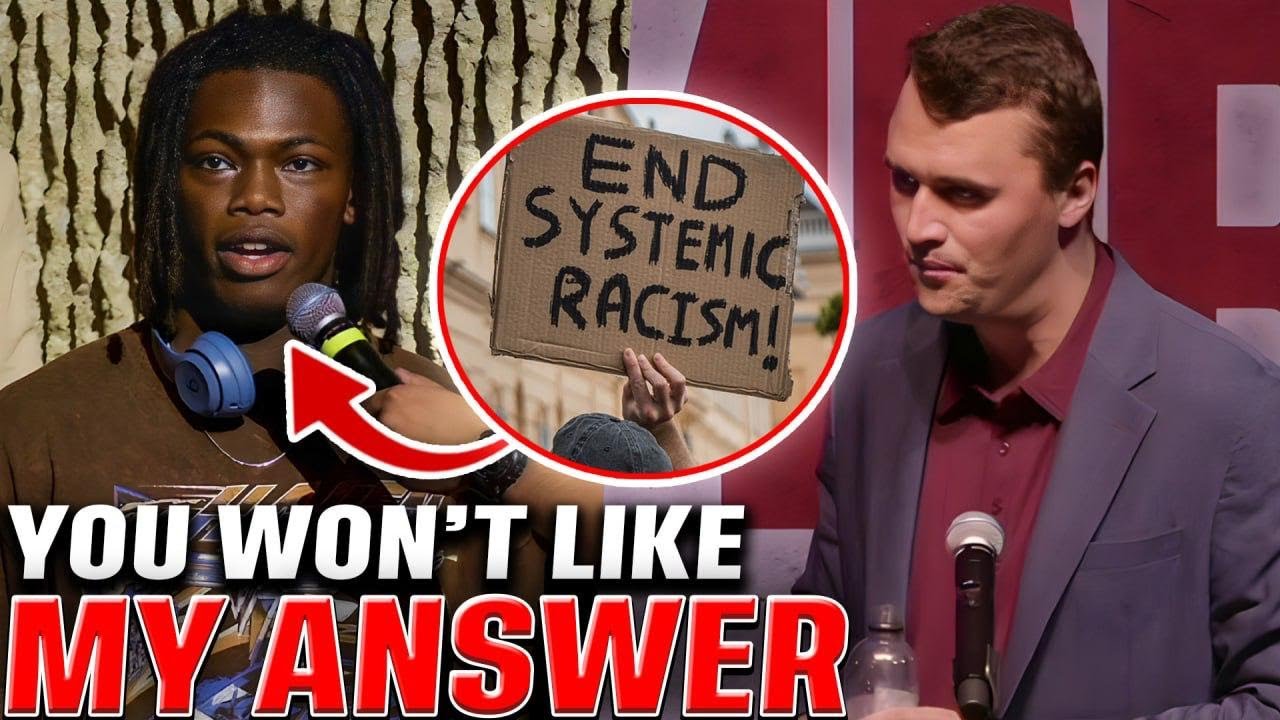
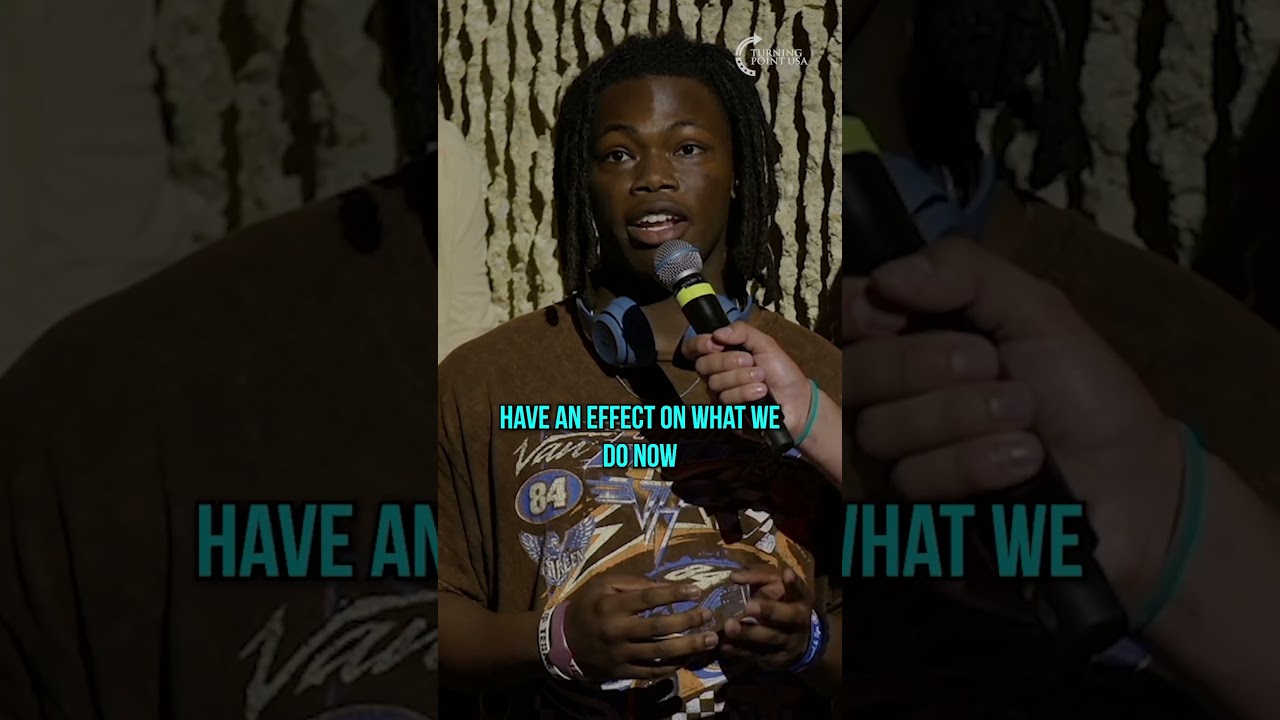
Charlie Kirk Debates Texas Student Malcolm on Systemic Racism, DEI, and the Victim Mentality Holding Black America Back
10:31
Charlie Kirk Debates DEI Critics on Merit, Diversity, and Excellence in American Institutions
33:30
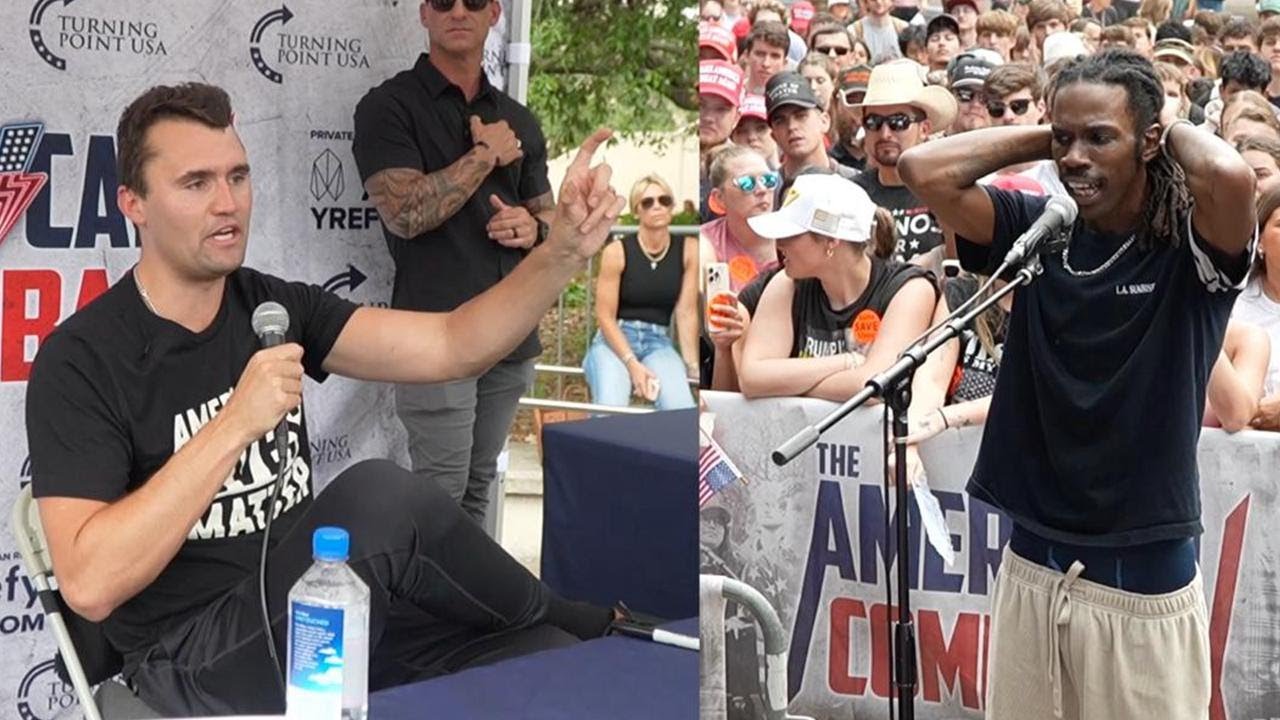
Charlie Kirk Debates Texas A&M Student on DEI, Systemic Racism, and Cultural Responsibility in America
Charlie Kirk engages in a heated debate with a Texas A&M student about DEI policies, systemic racism, and the role of culture versus discrimination in determining outcomes for black Americans. The conversation covers everything from college admissions and affirmative action to family structure, incarceration rates, and why some minority groups thrive while others struggle. Kirk argues that internal cultural choices 'not systemic racism' are the primary factor holding back black communities, while the student contends that historical oppression continues to have lasting impacts. The exchange reveals fundamental disagreements about victimhood, personal responsibility, and whether America remains a racist country.
The Opening Challenge: Does DEI Mean You Don't Belong?
The conversation begins when a black student at Texas A&M challenges Charlie Kirk's views on DEI (Diversity, Equity, and Inclusion), expressing concern that Kirk's earlier statements suggest the student doesn't belong at the university simply because of his race. Kirk immediately clarifies his position: people should not be in positions just because of the color of their skin, hard stop.
When the student presses Kirk on whether he feels the student is only there because of DEI, Kirk responds that he's not prejudging or stereotyping anyone—he's making a statement about how DEI functions as a system. The student, however, feels that Kirk's characterization of DEI implies that people of color in prestigious positions may not have earned them based on merit alone.
Breaking Down DEI: Equity, Outcomes, and the Harvard Case
Kirk provides his definition of DEI, focusing particularly on the concept of equity. He explains that equity is outcome-based and attempts to ensure people of different skin colors achieve the same outcomes regardless of whether they're qualified. His primary example is the Students for Fair Admissions v. Harvard Supreme Court case, where evidence showed that black students could have SAT scores 300 points lower than Asian students and still gain admission to Harvard.
Kirk's fundamental position is clear: when hiring for organizations or admitting students to universities, merit and character should be prioritized, and race should mean nothing. He argues that society should build around things that matter—skills, qualifications, character—rather than things that don't matter, like skin color.
Historical Context: The Legacy Argument
The student introduces the historical dimension, pointing out that black people have only been able to completely and legally make profit for themselves for around 60 years, since segregation ended and the Civil Rights Act passed in 1965. Kirk challenges this framing directly: How did something that happened 60 years ago impact the student's life specifically?
The student responds that it impacts him all the time, but Kirk points to the student himself as evidence—attending Texas A&M, doing well—as a living example that the historical oppression narrative doesn't hold up. The student counters by pointing to impoverished neighborhoods in Chicago and St. Louis where black communities lack access to quality education.
The Uncomfortable Question: Why Did Things Get Worse?
Kirk poses a question that shifts the entire debate: Why has the black community gotten poorer since the passage of the Civil Rights Act? The student attributes this to culture perpetuated through years of oppression. Kirk finds this answer revealing, noting that black families were actually wealthier when America was segregated and more openly racist.
Kirk brings up specific statistics: in 1960, before the Civil Rights Act, 20% of black children were in single-father homes and 80% had a dad around. Today, those numbers have inverted—70% of black youth don't have a father in the home. Kirk argues that this represents the collapse of black family structure over the past 60 years, not an improvement.
When asked why this happened, the student mentions increased incarceration rates and perpetuated culture. Kirk challenges this: how does one go to jail? The implication is clear—people go to jail because they committed crimes. The student feels this dismisses the complexity of the issue, while Kirk sees it as evidence that choices, not systemic forces, determine outcomes.
Comparing Trajectories: Jews, Asians, and Hispanics
Kirk introduces comparative examples to test the systemic racism hypothesis. He asks how the Holocaust impacted Jews—an event that occurred 80 years ago where half of all Jews on the planet were killed and everything they earned was taken. Yet Jews are doing exceptionally well today. The student responds that Jews received reparations and acknowledgment.
Kirk challenges this: what reparations? The student mentions acknowledgment through money, but Kirk points out that America has acknowledged slavery happened as well. The fundamental question remains: if historical trauma 80 years ago impacts material prosperity, how did Jews defy the curve?
Kirk extends this analysis to Asians, who are now the wealthiest minority in America, many of whom arrived with no money in the 1950s and 60s. He also notes that Hispanics have been gaining income substantially over the last 20 years. The student's response to all of this is that it comes down to culture and the opportunities provided to different groups.
Kirk doesn't accept this explanation, insisting that black Americans have had the same opportunities. The student counters that people still look at black Americans like criminals every day.
Crime Statistics and Cultural Messaging
Kirk decides to be brutally honest rather than politically correct, asking directly: Do black people commit more crimes than white people? The answer, he states, is yes—and it's not even close. The student agrees but insists you have to take into account the culture that has been perpetuated.
Kirk presses further: does the student mean internal black culture? The student says it's deeper than that. Kirk then asks whether the average rap artist that a black kid in the hood listens to is glorifying marriage, family, and saving money. The student responds that this is what sells because it's a culture thing, and it's not isolated to the black community—everyone listens to it.
Kirk acknowledges that this music is bad for everyone who listens to it, but his point is that black youth, as they are being raised, have role models who largely do not glorify staying with one woman, getting married, or going to church. He challenges the student to show him black role models who are promoting these values. Kirk's conclusion is that internal black culture has collapsed over the last 60 years, no longer elevating family or commitment.
Systemic Racism: Real or Rubbish?
Kirk asks the student directly: Do you feel that systemic racism isn't real? The student believes it is. Kirk poses a simple test: What can I do that you can't do? Name it. The student initially hesitates, calling this a slippery slope fallacy, noting that back in 1940, he could have answered that question easily—there were bathrooms he couldn't use, major league teams he couldn't join.
The student then offers his current experiences: he can't walk into a grocery store and get the same looks Kirk does. He describes being looked at in a hyper-paranoid way at Brookshire Brothers a couple weeks prior. Kirk dismisses this as an insanely paranoid way of living life and not evidence of systemic racism. He notes that if he walks into a black neighborhood, he gets bad looks too.
The student attributes these looks to the way Kirk and others treat black culture. Kirk responds that America has gone to ridiculous lengths to prove it's not racist—in fact, being called racist is the worst thing you can be called in America. He points to the George Floyd protests in 2020, when hundreds of millions of dollars were given to Black Lives Matter, though the money's ultimate destination remains unclear and it didn't improve the material worth of black America.
DEI as Rewarding Bad Culture
Kirk returns to the student's main point about DEI. He argues that when you practice DEI, you are actually rewarding bad culture. Even though the student acknowledged cultural problems, Kirk says DEI sends the message that someone should be in a position based on the color of their skin. Kirk's alternative: skin color doesn't matter—if you want a position, work harder, study harder, and you might get it.
The student brings up underfunded communities where schools are based on property value. Kirk counters that school choice is now the law of the land in Texas, so that argument no longer holds. The student asks if Kirk expects a single-parent home to just pick up and move into a rich neighborhood. Kirk redirects: let's go back to why they're a single-parent home in the first place.
Personal Responsibility vs. Systemic Forces
Kirk asks whether the student believes in the principle that you should take responsibility for your decisions. The student insists it's not just one person's decisions—it's much deeper than that. Kirk disagrees, calling this a belief, not a fact, while the student insists it is a fact.
Kirk returns to his comparative examples: Why do Jews do so well if the Holocaust didn't permanently impact their material worth? Why do Asians do so well? Why are Hispanics getting wealthier? If America were truly racist, these trajectories wouldn't exist. The student's answer is a difference in culture and the way each culture is treated in America.
Kirk challenges the student one more time: other than bad looks at the grocery store, how is the student's future as a man in America restricted by racism? The student mentions that his natural hair is seen as unprofessional in offices and workplaces, that people give him dirty looks, and that people automatically assume the worst about him.
The Victim Mentality Debate
Kirk accuses the student of having a victim mentality, saying the student is at one of the wealthiest countries ever, at an amazing university, with all the opportunity imaginable, yet all he wants to do is look backwards at everything that prevented him when he himself is a glaring example that systemic racism doesn't exist and that you can achieve your wildest dreams.
The student pushes back strongly, saying he never claimed to be the only black person who exists—there are many people whom this culture is affecting today. Kirk responds that black Americans are the richest black people on earth. You cannot find a black-majority country or any country with significant black representation where black people are as wealthy. Even the poorest people in America are in the top 2% of wealth around the world.
Kirk's fundamental belief: stop acting like you're a victim and start making better choices. The student insists this is not a victim mentality. Kirk disagrees, stating that white people are not out to get black people, and there is nothing holding black people back. In fact, he argues the opposite is true: you can get into colleges with lower test scores, and you can say things that white people can't say and not be fired for it.
The N-Word Exchange and Credibility
The student mentions that people say the n-word around campus all the time and just walk around like it doesn't mean anything. Kirk expresses skepticism, asking if people say it derogatorily. The student says yes. Kirk states flatly that he doesn't believe this is true, asking why the student would lie.
The student asks why he would lie. Kirk says the student is trying to indict the moral character of Texas A&M. The student clarifies he's not indicting one or a few people. Kirk notes that the student first said it happens all the time, now it's one person. He sees this as the student resorting to what he calls a race hoax to make it seem as if white kids on campus are racist and terrible.
Kirk draws a parallel to Jussie Smollet, saying lies like this must be challenged. He asks directly if the student is claiming a white person comes up to him and derogatorily says a slur. The student clarifies he's not saying it was word-for-word like that. Kirk responds that if it's not being used derogatorily, then it's not an insult and shouldn't be brought up as evidence of racism.
Speech Freedoms and Cultural Double Standards
Kirk explains that black people can say things that white people cannot say—and it's more than just one word. Black people are allowed to talk about black culture in ways that white culture cannot. For example, black people can say there's a baby mama problem in black America, and white people are not allowed to say that. Kirk then says it himself: there is a baby mama problem.
He continues with more examples: Black people are allowed to say there is a fraud issue within the PPP loan applications in black America. Black people are allowed to say that black individuals, despite being 13% of the American population, commit 55% of the murders. If most white people said that at a job, they would get fired for being racist. Kirk says he doesn't care because he says whatever he wants, but the point stands: black individuals have much more intellectual and public freedom than white people do.
The student asks why a white person would just walk up and attack black culture from the outside. Kirk reminds him that the student was the one who brought up people suffering in Chicago. Kirk is simply explaining why: bad decisions that have been institutionalized, enabled by rap artists, athletes, and people at the top level of black society who refuse to challenge the core problem in black America.
The Core Rot in Black Culture
Kirk delivers one of his most forceful statements: the problem is that black leadership allows degeneracy and hedonism to eat the soul of what once was a beautiful black culture. Instead of addressing this, they go around saying it's the boogeyman of racism, that the white man is out to get you. The result, Kirk argues, is that black America is doing worse than it was in the 1960s. That is the contention. Period.
The student insists it's not just about the present day—it's much deeper, rooted in history. Kirk asks what doesn't matter. The student means things that happened in the past. Kirk has addressed this multiple times with his comparative examples.
The Final Question: How Do You Want to Be Hired?
Kirk shifts to a personal question for the student. When he is hired for a job, would he rather be hired because of his race or because of how qualified he is? The student says it doesn't boil down to just that. Kirk insists that's exactly what DEI is. The student disagrees. Kirk states definitionally that DEI is the hiring of people based on race—you get extra points if you're black. That's how it works. Racial quotas elevate people based on the color of their skin.
The student asks if Kirk thinks he got extra points to come to Texas A&M. Kirk says he doesn't know—the student said he was qualified—but affirmative action was institutionalized at Harvard, Texas, and many other places. Kirk reiterates: there is nothing preventing black people from prospering. Nothing. The only thing is that they have been hypnotized to be victims of their own mind, to think there's a white person out to get them.
The student calls these life experiences and accuses Kirk of denying the experiences he just shared in front of everyone. Kirk responds that if the best example of racism is getting bad looks in a grocery store, America has made incredible racial progress. The student insists there are many other people with different experiences. Kirk says he's happy to hear every example, but it boils down to this: America is not a racist country. It is the least racist country ever to exist.
What's the Solution?
Kirk explains that America goes out of its way not to be called racist, to demonstrate compassion and a desire to help people of different skin colors. But at its core, Kirk doesn't think skin color matters that much. He wants a country that aims toward Martin Luther King Jr.'s dream—one based on content of character and competency. He believes the hyper-racial obsession of the country is bad for everybody, including black America.
Kirk asks the student: What would you do to improve the material well-being of black America? The student answers: education. Kirk points out that trillions of dollars have been spent on education. The student says the education system needs fundamental change—there's not enough funding, teachers aren't paid enough, and public school education funded by property taxes means low-income neighborhoods get low-quality teachers.
Kirk poses a final question: If you had to choose between more money for education or more dads for black kids, what would you say? The student responds that the two go hand in hand. Kirk disagrees: if you're educating but there's not a dad at home reinforcing it, the education doesn't work. He points to Chicago, Baltimore, and Detroit, where hundreds of billions of dollars have been spent but entire classes of kids can't read at grade level.
The Path to Privilege in America
Kirk offers his framework: If you want to have a privileged life in America, it's very simple—start acting a certain way. His belief system centers on the most foundational family unit. When that breaks down severely, don't be shocked if that group stays in poverty over a longer period of time. He notes that Asians are incredibly loyal in marriage, which is one reason Asian-Americans do so well. Hispanics do very well. White Americans increasingly are also struggling with family breakdown.
The student interjects that Asians and Hispanics also came to America by choice. His ancestors did not. Kirk interrupts before the student can elaborate: the student should be kissing the ground with gratitude because he's right—he didn't come here by choice. But Kirk's point is blunt: the student should be thankful he's not in Africa. He should be thankful he's in the United States of America.
That's Kirk's final word.
Video Transcript
give me your perspective on DEI and
because based on what I heard earlier, I
feel like you don't think I belong here
because really
>> how I am a black man and because of the
I didn't I'm not qualified enough to be
here. Yes, I am.
>> Okay, great. Then you belong.
>> But why do I have to prove that to you?
>> You brought it up. I didn't.
>> Okay, but can you
>> can you explain to me your position on
DEI?
>> Yes. People should not be in positions
just because of the color of their skin.
Hard stop. Okay. But Okay. But do you
feel like I'm here because
>> I'm not I'm not feeling anything towards
you. Actually, I'm not prejudicing you.
I'm not stereotyping you. I'm saying
it's a material.
>> You're not saying you are. I'm not
saying you are.
>> No, you are. You said I don't feel
comfortable being here. You started with
>> I didn't say I wasn't comfortable being
here. I said I feel like you made it to
where I got here through DEI.
>> So, let's examine that. What have I said
that makes you feel that way? when you
mentioned how DEI is only just putting
people of color and marginalized groups
in spaces even if they're not so and so
>> correct that's exactly what DEI does
>> but that's not that's not all that it
does you're categorizing it as something
it isn't
>> no that's exact that is that is the
charter missions
>> that's not all
>> okay so diversity equity so equity is
outcome based is about making people who
are of different skin colors have the
same outcome regardless whether or not
they are qualified the Best example we
have of this is the Students for Fair
Admission Harvard Supreme Court case
where black students they did not
literally they could have a SAT score
300 points lesser than the Asian
equivalent and still get into Harvard.
That is DEI in practice. I believe when
you're hiring for an organization or for
a company or for whatever you are doing,
you should prioritize merit and
character and race should mean nothing.
We should build around things that
matter and not things that don't matter.
You have to also you have to also take
into the fact that black people have
only been able to completely and
completely legally be able to make
profit for themselves for around 60
years. And this is no no since
segregation ended in 1965 and the um E
equal rights act in 1965. So what were
you tell there's not
>> how does that So let's talk about you.
How did that impact you? How did
something that happened 60 years ago
impact your life?
>> It impacts me all the time. What do you
Okay,
>> you're at Texas&M. You're doing great.
>> Okay. Yes, sure. Yeah.
>> So, aren't you a living example that all
that's a bunch of nonsense and you could
just act good and, you know, behave well
and secure.
>> But there's but there's also living
examples of the exact opposite. If you
look in the impoverished neighborhoods
in certain parts of Chicago or St.
Louis, there's black communities being
thrown aside because they're not getting
education.
Okay. So, I think we can get somewhere.
Why have black the black community
gotten poorer
>> since the passage of the Civil Rights
Act? Tell me that.
>> Because of the way the culture has been
perpetuated through the years.
>> Think about it. So, they were richer
when we were segregated and more racist.
America's become less racist.
>> What about Tulsa?
>> Yeah. No one's going to defend what
happened in Tulsa again. But let's talk
>> We're talking about a lot of different
cities. We're talking about Chicago,
Tulsa. But let's let's again this is a
very important point. Do you think the
fact that 70% of black youth don't have
a data around is probably pretty
important?
>> That's because of the culture that I
>> So let respectfully allow me to
interject. How does the white culture
impact the fact whether or not a black
dad stays around when he impregnates a
woman?
>> I'm not saying it's the white culture.
I'm saying what is it? the culture that
has been perpetuated through the 200
years of slavery, the hundred years of
segregation and Jim Crow laws,
>> the marriage. So, I got to interject
again. I'm sorry. I don't mean to
interrupt too much, but the the in 1960
before the Civil Rights Act, 20% of
black youth had a dad around. Now, it's
I'm sorry. 20 20% were single fathers,
80% had a dad around. It's been
inverted. So, we actually have seen
black dads run away from their kids the
last 60 years. Why is that? because of
the raised incarceration rates, because
of the perpetuated culture.
>> So, how does one go to jail?
>> That's obvious. I'm not answering that
question.
>> Yeah. So, maybe it's because they
committed crimes.
>> Okay. But the when you're forced for
you're it's not just a Oh, it's it's
this is old. This is in the past. This
doesn't affect you anymore.
>> Okay. So, actually, let's take a
different group. How did the Holocaust
impact Jews? They're doing pretty well.
>> Well, because they got reparations. We
did this.
>> How what reparations the Jews did?
acknowledgement through money, through
>> We acknowledge slavery happened.
>> Okay, but but you're sitting here and
acting like it plays no role.
>> No, no, no. But to your argument, the
Holocaust was 80 years ago. Half of all
the Jews on the planet were killed.
Everything they earned was taken. Jews
are doing great. If all of a sudden
something that happened 80 years ago
impacts your material prosperity, how
did Jews defy the curve? How did poor
Asians do so well? Why is it that Asians
are now the wealthiest minority in
America, many of whom came with no money
in the 1950s or 60s?
>> Because of the culture and opportunities
that were provided to them.
>> But no, but you're you're not hearing me
out. Black Americans have had the same
opportunities. However,
>> people still look at us like criminals
every day.
>> Hold on. But like I don't look at you
like a criminal.
>> I'm not saying you do. I'm saying some
people do.
>> But I mean, can I Do you want me to be
brutally honest with you or do you want
me to be politically correct?
>> Brutally honest with you.
>> Okay. Do black people commit more crimes
than white people? Yes,
>> it's not even close.
>> Okay,
>> but but you al you have to take into
account the culture that has been
perpetuated.
>> Okay, got it. So I we can agree on this.
Do you mean internal black culture?
>> Um it's it's not it's deeper than that.
Like
>> do you think let's take time out. Do you
think the average rap artist that a
black kid in the hood is listening to is
glorifying marriage and family and
saving your money?
>> That's what sells because it's a culture
thing. It's not just within the black
community. No, but hold on. Everyone
listens to it. It's not just isolated.
>> It's it's it's bad for everyone who
listens to it. The point being is that
black youth as they are being raised,
>> their role models are largely not
glorifying staying with one woman,
getting married, going to church. And if
if you're wrong, show me the black role
models that are doing that. There might
be a couple I could think of, maybe, but
if it's about culture, you're right. The
internal black culture has collapsed the
last 60 years. We're no longer elevating
the family. We're no longer elevating
staying with the person that you're
with. So, our contention here as
conservatives is that the systemic
racism stuff is a bunch of rubbish.
Instead, it's systemic bad choices.
>> Do you feel that systemic racism isn't
real?
>> Of course not. What can you What can I
do that you can't do? Name it.
>> Okay.
>> No. No. Seriously, what what what can I
do that you can't do?
>> Fallacy. That's a slippery slope. I
don't know why.
Cuz if back in 1940, you would have been
able to answer that question. Well,
Charlie, there's a bathroom over there
that I can't go to. There's a major
league team.
>> I can't I can't walk into the grocery
store and get the same looks that you
do. I walked into Brookshshire Brothers
a couple weeks ago and I was looked at
insanely hyper paranoid way of living
life. That's not evidence, right?
>> It's a real,
>> by the way, if I walk into a black
neighborhood, I get bad looks, too.
Okay? So, I don't know what the
contention is. because of the way you
treat our culture and the way you
perpetuate
the the way we treat your culture. We
have we have gone to such great
calisthetics and ridiculous gymnastics
to prove that we're not racist. In fact,
it's the worst thing that you could be
called in America. We had during, you
know, George Floyd 2020, we had hundreds
of millions of dollars given to Black
Lives Matter. I don't know where that
money went. Did it improve material uh
worth of black America? So, I mean go
and we actually do know where it went
actually. And so, but going back to your
main contention when you are when you
practice DEI because that was your main
point, right? You are rewarding bad
culture. You even acknowledge it. You
are saying that someone should be there
based on the color of their skin. We say
skin color doesn't matter. If you want
that position, work harder, study
harder, and then you'll be you might be
able to get that position.
>> We're forced into underfunded
communities where schools are based off
of property value. We can't Well,
actually, school choice is now the law
of the land here in Texas. So, that's
not correct. Do you just expect a single
parent home to pick up and move into
some rich neighborhood?
>> Well, again, so let's go back to why are
they the single parent home and the
hundreds of
>> not do you believe in the maxim or the
belief that you should be you should
take responsibility for your decisions?
>> It's not just one person's decisions.
It's so much deeper than that.
>> Why are you trying to you're
>> that that's where you and I have a
different belief. You believe in this?
>> It's not. It's a fact.
>> No, it's a it's a belief. Again, you
have to tell me then, why do Jews do do
so well? Holocaust didn't impact their
material worth. How did Asians do so
well? And by the way, even more so, why
are Hispanics getting so much wealthier?
If we were so racist, why are Hispanics
all of a sudden gaining income the last
20 years? There's some there's something
>> difference in culture. I don't know why
y'all are crapping,
but it's a difference in culture. the
way that the way that each culture is
treated is so vastly different in
America.
>> But again, you have to tell me, other
than bad looks at the grocery store, how
else is your future, you as a man in
America, not a black man, how is your
future somehow restricted by racism?
>> My natural hair is seemed as
unprofessional when I go into an office
or workplace. When I walk around in
certain places, people just assume, like
I've said earlier, the dirty looks. When
people think you are automatically the
worst of the worst solely because
>> we don't think that. You think like 10
times?
>> Because you think you know what white
people think and you don't.
>> I don't know what white people think.
>> Then why do you keep on saying you know
what white people think?
>> I've seen it. I'm not saying you've seen
our thoughts. I've seen what people have
done to me and people who look like me
around the world and around in America.
How? Again, you you are let's just make
an example. You are here in the
wealthiest country ever.
>> Yes.
>> At an amazing university with all the
opportunity imaginable in front of you
and all you want to do is look backwards
at everything that prevented you when
you are a glaring example that there is
no systemic racism and you can actually
achieve your wildest dreams.
>> Whoa. Whoa. I've never said that. Hey,
I'm not the only black person who exists
out there. There's so many people who
this culture is affecting to this day.
Do you know black Americans are the
richest black people on earth? You
cannot find a a black majority country
or any country where black people have
significant representation where they
are as wealthy cuz even the poorest
people in America are in the top 5% the
top 2% of wealth around the world. And
so my whole belief is stop acting like
you're a victim and start making better
choices.
>> Acting like a victim respect
>> it's not it's this is not a victim
mentality.
>> No it it fundamentally is because white
people are not out to get you. There's
nothing There is nothing holding black
people back.
>> There is, let me say that again. There
is nothing holding black people back. In
fact, the opposite. You can get into
colleges with lower test scores. But
>> you could say things that white people
can't say and not be fired for it.
>> Black people are wildly
disrepresentation.
>> People say that to me all the time and
they just walk around like it doesn't
mean anything around here.
>> Say what? Say the what?
>> The n word. I'm not going to say it on
this public platform, but people say it
to me all the time. Derogatorily.
>> Yes.
>> No. I think you're lying.
>> I Why would I be lying?
>> So, you're trying to tell me at this
campus, did you report at the student
services?
>> I'm not I have too much on my plate to
worry about this.
>> So, it's Oh, so So, you're going to say
at this campus, you're going to indict
the moral character of Texas A&M.
>> I'm not indicting the moral character
of one person or a few people.
>> Oh, now it's one. So, you heard it all
the time and now it's one. Got it. So,
>> it's not okay. You're
>> No, but this is the point is that I
don't believe you because now you resort
back to a race hoax to make it seem as
if the white kids on this campus are
like racist and terrible kids.
>> Oh, so was was it a black guy that said
it to you?
>> There I'm not
>> It matters a lot because this is how
lies are able to grow. Just Smlette, we
see this. You have to challenge them. Do
you think I'm lying when I'm I say that
people say the n word around here you
just
>> if I think a white person comes up to
you derogatorily and says shut up n word
I absolutely
>> I'm not saying they said it
>> but I asked I said are they saying it
derogatory
>> but that doesn't mean it's word for word
like that
>> but okay so then it's not an insult then
so then don't bring it up as if it's
evidence of racism
>> because you brought the nword up first I
didn't you no no no you specifically
said name me it's instance of the word
>> I said I said black people can say
things that white people can't say. Of
course, that's true.
>> But that's automatically implying that
one word.
>> It's more It's more than that. But but
but let me just kind of build this out.
>> What is it then?
>> There's a lot of things black people can
say.
>> Explain it to me.
>> You want You want me to give you more
examples of things? Yes. Black people
are allowed to talk about black culture
in a way that white culture cannot. For
example, black people can come up and
say that there's a baby mama problem in
black America. And white people are not
allowed to say that. Oh, I just did. So,
what are you going to do? Cancel me.
Black people are allowed to say, Black
people are allowed to say,
>> "I'm a grown man. I got way."
>> Black people are allowed to say that
there is a systemic fraud issue within
the PP loan application of black
America. Black people are much easier to
able to say that black individuals,
despite being 13% of the American
population, commit 55% of the murders.
If most white people say that at a job,
they would get fired for being a racist.
I don't care cuz I say whatever I want.
So, black individuals have much more
intellectual public freedom than white
people do. If a white person were to
come up and say, you know, black America
really needs to get its act together and
stop sleeping around all the time and
needs to actually have because it's
true. Because why would you just walk up
to someone and talk and attack their
culture from the outside?
Hold on. You were Let's look at Let's
look at the evidence. You said to
myself, you said there's all these
people suffering in Chicago. There's all
these people that are terrible. I'm
telling you why. It's because there's
been bad decisions that have been
institutionalized. Let me finish. and
rap artists and athletes and people to
top a level of black society that refuse
to ever challenge the core rot in black
America, which is that they are allowing
degeneracy and hedonism to eat the soul
of what once was a beautiful black
culture. And instead, they go around
saying it's the boogeyman of racism. The
white man is out to get you. And the
result is black America is doing worse
than it was in the 1960s. That is the
contention. Period.
>> It's not just that. It's a cultural.
It's so much deeper than the present day
we are in. I don't know why you're
pretending like it just doesn't matter.
>> I I What doesn't matter? You mean things
that happen? Again, I've I've been
through this multiple times. Let me Let
me just ask you one.
>> You're not You're not listening to
understand. You're listening to reply.
>> No, I I I I'm doing both actually. And
so, but let me just like ask one final
question, right? Which is that like you
have your entire future ahead of you.
>> When you are hired for a job,
>> would you rather be hired because of
your race or because of how qualified
you are?
>> It doesn't boil down to just that.
That's what DEI is, man.
>> No, it's not.
>> Yes, it is. It is definitionally the
hiring
>> of just they're not just going to
immediately see they're going to
>> you get extra points if you're black
with DEI. That's how it works. Racial
quotas elevate people based on the color
of their skin.
>> So, do you think I got extra points to
come here?
>> I don't know. You said you were
qualified, but affirmative action was
institutionalized in Harvard and in
Texas and a lot of other places. There
is nothing that is preventing black
people from prospering. Nothing. The
only thing is that you guys have been
hypnotized to be victims of your own
mind. To think as if there's a white
person out to get you. I walk in the
grocery store, they look at me
differently. All that stuff is complete
rubbish. You want the thing that is
preventing
>> life experiences. You're just denying my
experience I just shared to you in front
of all these people.
>> If you think that, okay, let me just be
very clear.
>> America has come really far. If your
best example of racism is getting bad
looks in a grocery store, we have made
incredible racial moral. experience.
There are so many other people.
>> I'm happy to hear every example that
they have. It boils down to this. We are
not just a racist country. We are the
least racist country ever to exist. We
go out of our way not to be called the
Rword to demonstrate that we aren't
racist. To show to people that I
actually have compassion for others and
that I want to try to help, you know,
people of different skin color. But at
at its fundamental core, I have to go
back to this. I don't actually think
skin color matters that much. I don't. I
want a country that aims towards MLK's
dream of one based on content of
character and one on competency. I think
the hyper racial obsession of this
country is really bad. It's really bad
for everybody involved, including black
America. And I would just ask you, what
would you do to improve the material
well-being of black America? What is
your solution?
>> Education.
>> Okay, we've we've spent trillions of
dollars on education. Trillions.
>> You need to like fundamentally change
the system education because there's not
enough funding. There's not teachers are
not paid enough anywhere. Let's be
honest. Like we need to like seriously
fix our education, especially in when
public school education comes from
property taxes. When you're in a
lowinccome neighborhood, you're not
going to get high income teachers.
>> If if you had to choose more money for
education or more dads for black kids,
what would you say?
>> That goes hand in hand. Education goes
the family. That's why if we get more
dads into homes, it starts solving the
problem.
>> No, education is what solves the
problem.
>> Hold on. But we we again, if you're just
educating and there's not a dad at home
reinforcing it, we've seen this play
out. We see this in Chicago. In
Baltimore, we've spent hundreds of
billions of dollars in Baltimore,
Chicago, Detroit. We have entire classes
of kids that can't read at grade level.
We have a we have incredible examples of
this. And it goes back to this. If you
want to have a privileged life in
America, very simple. start acting a
certain way. Our belief system is that
you come down to the most foundational
family unit and when that breaks down so
severely, don't be shocked if that group
when it acts that way stays in poverty
over a longer period of time. Asians are
incredibly loyally married. It's one of
the reasons why Asian-Americans do so
well in this country. Hispanics do very
well. White Americans increasingly are
not doing
>> also came here by choice, too.
We I my my ancestors did not come here
by choice, but
>> Okay, so
>> we don't have to go too far into that.
>> We don't have to go into that. I want to
get the next question again.
>> You should be kissing the ground because
you're right. You didn't come here by
choice.
>> But the other I'm telling you right now,
you should be kissing the ground with
gratitude cuz you're right.
>> You are not in Africa and you should be
thankful you're not in Africa. That
you're in the United States of America.
That's my end. Thank you very much.