
Up Next

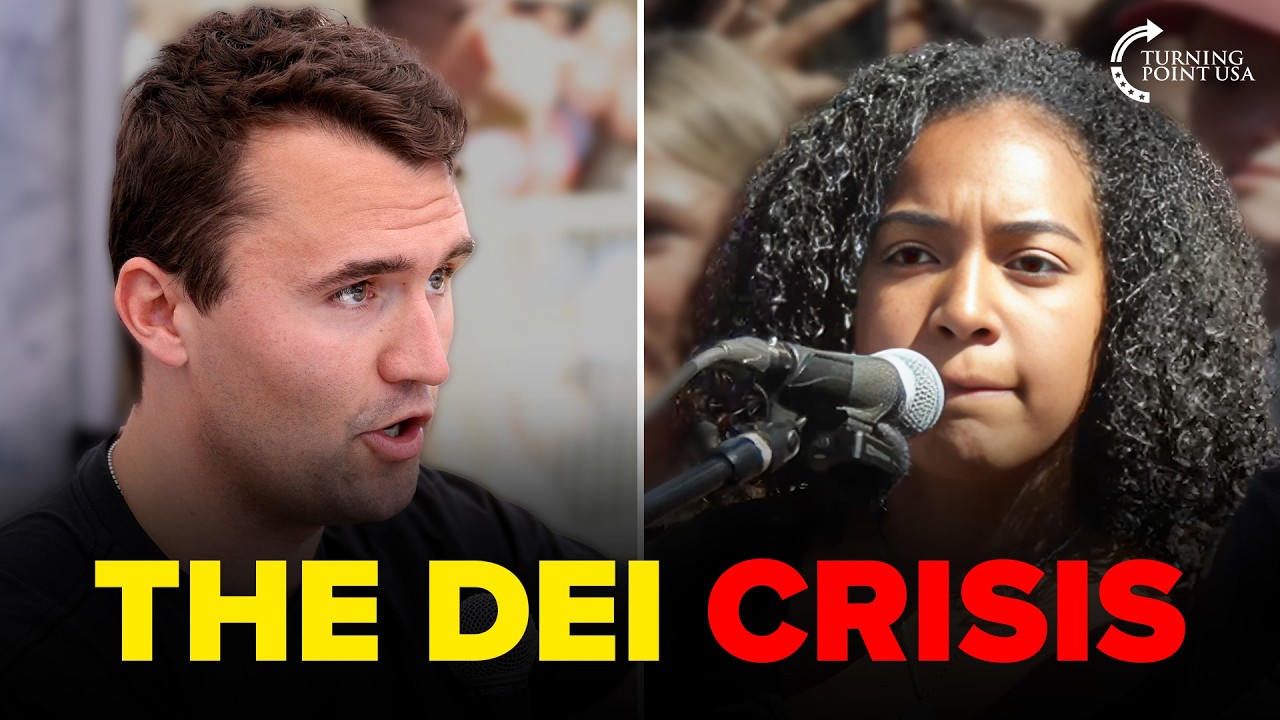
Charlie Kirk Debates White Privilege and DEI With College Student on Merit Versus Race-Based Policies
11:49

Charlie Kirk Debates Texas A&M Student on DEI, Systemic Racism, and Cultural Responsibility in America
18:47

Kirk vs. Critics: Clashing on Immigration, Trump, and Affirmative Action
11:27

Related Books
Browse Conservative Books





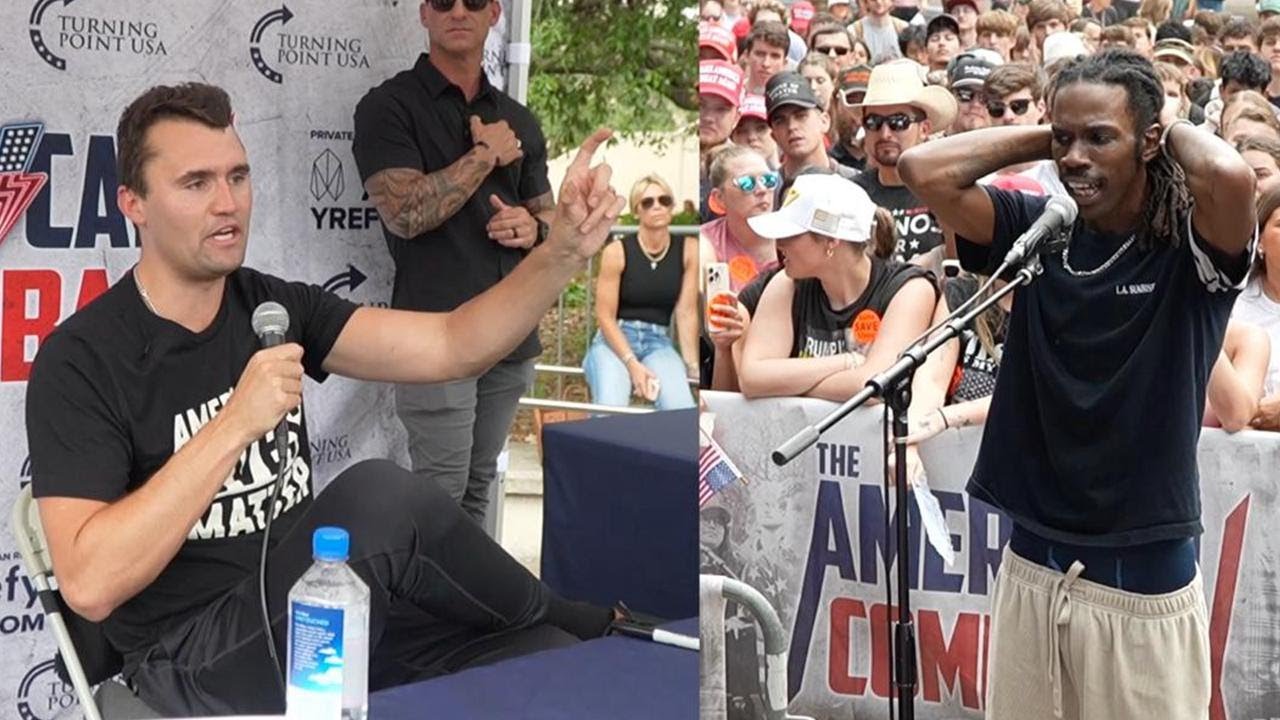
Charlie Kirk Explains Why Unity Beats Diversity and Defends Merit Over DEI at Texas A&M
Charlie Kirk faces pointed questions from a Texas A&M student about diversity, unity, and merit-based systems. The discussion moves from sports metaphors to Supreme Court cases, examining whether diversity strengthens or weakens institutions. Kirk argues that America's founding principle of e pluribus unum prioritizes unity over differences, defending recent Supreme Court decisions against affirmative action while his questioner challenges the implications of eliminating diversity protections. The exchange becomes a microcosm of the national debate over DEI policies, discrimination, and what truly makes America strong.
The Diversity Versus Unity Debate
Charlie Kirk visited Texas A&M and fielded challenging questions from students about his stance on diversity. When asked why he believes diversity is a weakness, Kirk immediately reframed the conversation around unity. His argument centered on a fundamental principle: unity creates strength, while diversity inherently represents division.
Using sports as a metaphor, Kirk explained that winning teams require unified direction. If a football team trying to win an SEC championship gives every player different call signs and strategies, coordination breaks down. The same principle applies to countries, militaries, corporations, and any organization seeking excellence. Success comes from shared purpose, not from emphasizing differences.
The student pressed Kirk on how diversity translates to "different call signs" in practice. Kirk provided a concrete example: when someone like Ilhan Omar enters America without sharing American values, without speaking the language, and with hostility toward the country, those differences become weaknesses rather than strengths. Importing large populations from places like Somalia or other parts of the developing world without cultural integration creates division rather than national cohesion.
E Pluribus Unum: Out of Many, One
Kirk directed attention to the Latin phrase on every dollar bill: e pluribus unum, meaning "out of many, one." This founding principle, according to Kirk, represents the true American ideal. The Founders never claimed diversity itself was strength. Instead, they recognized that regardless of background or skin color, shared humanity and shared values create national strength.
The phrase "diversity is our strength" directly contradicts this founding motto. E pluribus unum suggests that many different people can become one unified people through shared principles. The modern diversity ideology, Kirk argued, emphasizes perpetual differences rather than common ground. It focuses on what divides rather than what unites.
When the student pointed out that the Founding Fathers themselves were diverse individuals from various backgrounds, Kirk agreed they were many people but emphasized they were united in purpose. The student then raised the Native American contribution to the Revolution, but Kirk corrected the record: the American Revolution succeeded primarily because of French support, not Native American alliances. The French, though foreign, shared European ancestry and values with the colonists.
The Merit Versus Diversity Challenge
Kirk challenged his questioner to provide one example of an institution, company, or sports organization that deliberately pursued diversity for its own sake and became more excellent as a result. The student responded with a World War II example: the Navajo code talkers whose language helped defeat German forces.
Kirk acknowledged this as a legitimate use of linguistic diversity but reframed it within his argument. The Navajo code talkers were American soldiers, viewed and treated as equal human beings. Their language provided a tactical advantage, but they were valued for their contribution to shared American victory, not for diversity as an abstract goal. The war itself was fought for the promise of e pluribus unum against Japanese and Nazi totalitarianism.
Kirk then flipped the script, arguing that organizations prioritizing diversity over merit consistently decline in excellence. When Harvard ignored the Students for Fair Admissions case and elevated diversity above academic merit, the institution became weaker, not stronger. Lowering excellence standards to meet diversity quotas prevents organizations from reaching their full potential.
DEI and Discrimination: The Harvard Case
The conversation turned to DEI (Diversity, Equity, and Inclusion) policies, which Kirk strongly opposes. When the student suggested that DEI protects people of different backgrounds, Kirk pointed to concrete evidence of discrimination.
In the Students for Fair Admissions Supreme Court case, documentation revealed systematic discrimination in Harvard admissions. Asian applicants faced a 300-point penalty on standardized test scores compared to black students. White applicants received a 100-point penalty. Qualified Asian and white students with higher test scores were rejected while black students with lower scores gained admission.
Kirk called this exactly what it is: racism. The student agreed that the Harvard admissions practice was racist. Kirk then pressed further: Harvard defended these practices in court based on affirmative action policies, which are foundational to modern DEI ideology. The Supreme Court ultimately ruled these practices unconstitutional.
According to Kirk, DEI doesn't protect against discrimination—it is discrimination. DEI elevates certain groups based on race rather than merit, which violates both the 14th Amendment and the Civil Rights Act. These constitutional protections establish that discrimination based on race or color is illegal. DEI policies work in the opposite direction, giving preferential treatment based on racial categories.
Colorblind Society Versus Race-Obsessed Culture
Kirk advocated for a colorblind society where character matters more than skin color. This principle echoes Martin Luther King Jr.'s vision of judging people by the content of their character rather than the color of their skin. The student resisted this framing, arguing that eliminating diversity protections would allow discrimination to return.
Kirk distinguished between protection from discrimination and elevation through discrimination. The 14th Amendment and Civil Rights Act provide legitimate protections against treating people differently based on race. DEI goes beyond protection to actively elevate certain racial groups over others, which itself constitutes discrimination.
At the University of California, job applicants had to submit diversity statements as the first screening criterion. Seventy-five percent of white applicants were immediately rejected based on their diversity statements before their qualifications were even considered. Kirk presented this as DEI in practice: racial quotas and hyperracialization replacing the pursuit of excellence.
The fundamental question, according to Kirk, is whether Americans want to move toward a society that cares about character and competency, or one increasingly obsessed with racial categorization and quotas.
DEI Hires in Government
The discussion turned to specific examples of DEI hiring in politics. Kirk pointed to several high-profile cases where race or gender explicitly determined selection. Tim Walz became Kamala Harris's running mate because Democrats needed a white man on the ticket to appeal to white male voters—a demographic they ultimately lost by nearly 30 points anyway.
Kamala Harris herself, Kirk argued, was a DEI hire. Joe Biden publicly announced he would select a black woman as his running mate before making his choice. This made race and gender the primary selection criteria rather than qualifications or merit. Similarly, Ketanji Brown Jackson was selected for the Supreme Court after Biden promised to nominate a black woman, again making race and gender the determining factors.
Kirk defined DEI hiring as publicly stating demographic criteria—wanting a certain race, gender, or skin color—rather than simply seeking the most qualified person. The student challenged Kirk on whether the Trump administration consisted entirely of merit-based selections. Kirk defended the administration, saying he had supported all the appointments.
The NBA Example: Merit in Action
To illustrate the difference between merit-based and diversity-based selection, Kirk used professional sports as an example. The NBA is approximately 75% black, and the NFL is about 50% black. These percentages exist not because of racial quotas or DEI policies, but because team owners and managers want to win championships.
NBA and NFL teams are cutthroat businesses focused entirely on performance. They select the best basketball and football players available, regardless of race. The racial composition of these leagues reflects performance reality, not demographic engineering. Kirk asked whether the NBA should be forced to become half Asian to match national demographics. The student agreed that only the best players should make the teams.
This agreement revealed common ground: excellence matters more than skin color. The disagreement centered on whether DEI policies actually protect merit or undermine it. Kirk argued that DEI does the opposite of what professional sports do—it prioritizes demographic representation over performance and competency.
Signal Gate and Cabinet Qualifications
The student brought up "Signal Gate," an incident where a reporter allegedly accessed sensitive information about war plans. Kirk pointed out that the investigation is ongoing and the responsible party remains unknown. It could have been National Security Advisor Mike Waltz, a staffer, or someone else entirely. Making definitive claims without evidence doesn't strengthen an argument.
More importantly, Kirk noted, even qualified people make mistakes. The relevant question is whether officials are fundamentally qualified for their roles. Kirk contrasted Defense Secretary Pete Hegseth—a frontline combat veteran—with Lloyd Austin, who was hospitalized for nearly a week without informing anyone, disrupting the national security chain of command during the Biden administration. Kirk heard no liberal complaints about that serious breach.
Kirk described the current cabinet as the most qualified and anti-DEI administration in American history, filled with people who fought wars, built businesses, and made consequential decisions. This contrasts with selections made primarily because individuals fit demographic criteria boxes rather than demonstrating excellence.
The Bottom Line on Merit
Throughout the exchange, Kirk's central argument remained consistent: when building the best team, company, military, or country, competency should be the only criterion that matters. Skin color should be irrelevant. Organizations and nations that prioritize demographic representation over excellence inevitably decline in performance and competency.
The student challenged this position by defending diversity protections and questioning whether eliminating them would allow merit to flourish or discrimination to return. Kirk maintained that true protection from discrimination already exists in the 14th Amendment and Civil Rights Act. DEI policies add a new layer of discrimination rather than preventing it.
Kirk summarized his position with a memorable phrase: DEI stands for "Didn't Earn It." When people are elevated to positions based on demographic characteristics rather than qualifications, the message sent is that they didn't earn their position—they were selected to fill a quota. This undermines both the institutions making these selections and the individuals selected.
The exchange ended with Kirk reiterating that Americans must choose between two visions: a merit-based society that selects the best regardless of race, or a DEI-based society that prioritizes diversity and demographic representation. Kirk firmly believes that merit creates excellence and national strength, while DEI creates division and declining competency.
Video Transcript
[00:00] My friend Colin Plume from Noble Gold
[00:02] Investments just released his new book,
[00:04] Silver is the New Oil. And it says, "If
[00:06] you don't own Own Silver yet, you're
[00:08] already behind." Colin says that as
[00:10] demand for technology, energy, and
[00:12] industry soarses, silver's value is set
[00:14] to surge. The question is, are you ready
[00:16] to profit? This book reveals why silver
[00:19] is the most underrated asset today, and
[00:21] how to invest before the world catches
[00:24] on. I've read Silver is the New Oil, and
[00:26] you should, too. Get it now. available
[00:28] on Amazon. Yes. How you doing, Charlie?
[00:34] We're good. How you doing? It's hot
[00:37] today, ain't it? Got to get used to it
[00:39] down here, man. One right before we
[00:42] start. Could I please get a signed hat?
[00:44] Depends.
[00:47] Do you charge cheddar around here? You
[00:49] charge? No, I've been throwing out hats
[00:51] for free. Damn. I just got to jump next
[00:53] time, I guess. All right. Well, I feel
[00:56] pretty American today. We're down to our
[00:57] roots, standing up for what we believe
[00:59] in. I think that's powerful. I'm pretty
[01:02] sure a branch of that is why you're
[01:04] here. I just had one question for you
[01:06] real quick. Probably go into
[01:09] two or three or four or five, whatever.
[01:15] So, all right. I've heard you say before
[01:18] you think diversity is a weakness. I
[01:19] just want to ask you why you think
[01:22] diversity is a weakness. Well, think
[01:24] about it. Unity is a strength. Diversity
[01:26] is not. If you're trying to create a
[01:27] team, for example, if you guys want to
[01:29] win the SEC again, of which I am pulling
[01:30] for Texas A&M to win an SEC championship
[01:34] again, and every single player is
[01:37] getting different call signs, that is
[01:40] that is definitionally different. And
[01:42] unity is what creates a good football
[01:44] team. We're brought together by what
[01:45] brings us together, not what is
[01:47] different. And so differences are
[01:50] actually not a strength. You're trying
[01:51] to create a team, a country, a military,
[01:53] a football team, a unit, a corporation,
[01:55] or so and so so on and so forth. Okay.
[01:57] Well, glad we're not a football team.
[01:58] I'm glad we're a country. So, it's a
[02:00] metaphor, right? I get you. So, you say
[02:02] different call signs. How is me being
[02:05] diverse from someone in the crowd here,
[02:08] us getting different call signs?
[02:11] Well, I mean, what again, it's it's a
[02:12] metaphor, right? Well, yeah, but you use
[02:14] a metaphor to explain. So, for example,
[02:16] if someone I'll try to boil it down for
[02:18] you so you can understand. Gotcha. If if
[02:20] like Elon Omar comes into America and
[02:22] doesn't share our values, doesn't speak
[02:25] our language and hates America,
[02:27] different call signs, not united,
[02:30] diversity becomes a weakness, not a
[02:32] strength. When you import a lot of
[02:34] people that don't share your values like
[02:36] we have been from Somalia and from the
[02:38] third world, all of a sudden they say
[02:40] diversity is a strength. Is it really?
[02:42] Is diversity a strength in Minneapolis?
[02:44] Is that really a strength? No. You know
[02:46] what is a strength? the unity we find in
[02:48] being an American, not in being Muslim
[02:51] or in being whatever faction or tribe
[02:53] that you come from. Okay, so basically
[02:55] like just to make sure I'm getting this,
[02:58] if we're all united as one thing, not
[03:02] diverse. E pluribus unum. So it's the
[03:04] Latin phrase out of many one. Okay, so
[03:06] the the diversity is our strength is at
[03:08] odds with what's on every one of your
[03:10] dollar bills. On your dollar bill is a
[03:12] phrase e pluribus unum which means it
[03:14] doesn't matter your skin color, your
[03:15] background. Our founders did not say
[03:17] diversity is our strength. They said we
[03:19] are all humanity and that is our
[03:20] strength which is fundamentally
[03:22] different than the phrase diversity is
[03:23] our strength. Okay. Well, I'm glad you
[03:25] brought up the founding fathers then
[03:26] because they weren't all the same
[03:28] person. There was so many people that
[03:29] made up and there were many of them.
[03:30] You're right. Okay. Yeah. But there were
[03:32] so many people that made up America.
[03:33] There were so many tribes that were here
[03:34] before us and they were the whole reason
[03:36] why we even won the American Revolution.
[03:38] So in that sense, diversity would be a
[03:40] strength. In World War II, we use an We
[03:42] won the revolution because of the
[03:44] French, not because of the Native
[03:45] Americans. And they're not American, so
[03:46] that's still diverse. That still goes to
[03:48] my They were actually They were
[03:49] European, of which was our ancestry. But
[03:52] okay, what's the point? Fair enough. I'm
[03:53] not My point is is that I believe that
[03:56] your statement that diversity is a
[03:58] weakness is just simply not true. Okay.
[03:59] So, let's put it on you. Show me an
[04:01] institution, a company, a sports
[04:04] organization that aims to get more
[04:07] diverse for diversity sake and becomes
[04:09] more excellent. Show me one example.
[04:11] I'll go even better than that. I'll show
[04:12] you a country that did that. During
[04:14] World War II, we use the Navajo language
[04:16] to counterag German forces. Without
[04:19] their language and the diversity in this
[04:20] country, we wouldn't be able to do any
[04:23] of that.
[04:25] Okay? They were Americans and American
[04:28] soldiers. And in fact, we looked at them
[04:30] as equal human beings and we're able to
[04:32] use a different language to our
[04:33] advantage. In fact, what we were
[04:35] fighting for was the promise of e-
[04:37] plurbus unam. We are fighting up against
[04:39] Japanese totalitarianism and Nazi
[04:42] totalitarianism. And I will go even step
[04:44] further. At every organization that
[04:46] tries to make diversity a priority,
[04:48] whether it be Harvard that ignored the
[04:49] students for fair admission course, you
[04:51] lower excellence and you elevate
[04:53] diversity, which lowers the flourishing
[04:55] and the capacity for any organization,
[04:58] company, or group of people to be the
[05:00] best versions of themselves. So you're
[05:01] very anti-Dei, I suppose. Oh yes, very
[05:04] much so. I mean, like for example, do
[05:05] you think the NBA should be half Asian?
[05:08] I don't care if they're better than any
[05:10] of the players that come. They're
[05:11] better. Exactly. Excellence matters more
[05:13] than skin color. We agree. Yes. Better.
[05:17] Better. Not skin color. That's what our
[05:19] We are pro merit, not prode. That's the
[05:22] point. If you believe that is true, then
[05:24] you would support DEI cuz DEI is what
[05:26] defends other people that are foreign.
[05:30] What are you talking about? DEI is
[05:32] literally pro diversity. We need these
[05:35] protections to be able to protect people
[05:37] that are different. So, how is it that
[05:38] the NBA 75% black? It's because they're
[05:41] better at basketball than white people
[05:43] generally are. It's not because that's
[05:45] because of DEI. Oh, really? What de What
[05:48] DEI? No. No, seriously. What DEI
[05:50] program or policy does the NBA have? Do
[05:53] they have a Do they have a stated goal
[05:54] saying we're only going to hire black
[05:56] people? No. The NBA owners say, "We want
[05:58] the best basketball players." And they
[06:00] end up with a 75% black league. The NFL,
[06:03] it's a cutthroat business. They want the
[06:04] best possible football players. They end
[06:06] up with 50% of the NFL being a black
[06:09] league. We want the best. We want
[06:11] better. We don't care about the color of
[06:13] your skin. We want merit and we want
[06:14] excellence in this country.
[06:19] If it wasn't for DEI, we wouldn't be
[06:21] giving other people a chance that aren't
[06:23] American or white. That's the whole
[06:25] point of the other people. DEI is at
[06:28] odds with the 14th Amendment. Explain to
[06:30] me. The 14th amendment says you cannot
[06:33] discriminate based on color, based on
[06:35] race. Actually, it's even more. That's
[06:36] the civil rights act. Going back to the
[06:37] 14th amendment says literally at its
[06:39] core that we have a human equality
[06:42] because we're all human beings. That DEI
[06:44] says actually we understand that, but
[06:46] we're going to give more preferences to
[06:48] this skin color over that skin color
[06:50] because diversity is our strength.
[06:52] Explain to me how that works. It works
[06:54] because there was so many years of just
[06:57] constant turmoil between people that
[06:59] weren't our skin color. So you need to
[07:00] instill extra protections. Oh, so you
[07:03] need to discriminate against white
[07:04] people. Now that's what how am I
[07:05] discriminate against white people? Let
[07:06] me give an example at the Harvard
[07:07] admissions. So the students for fair
[07:09] admissions, you're familiar with that
[07:10] Supreme Court case. It's the highest
[07:11] profile Supreme Court case that comes
[07:13] around DEI and college admissions. Are
[07:14] you are you aware of that? Go ahead. You
[07:16] should you should educate yourself on
[07:17] it. We found out that Asians had to they
[07:20] got a 300 point deduction on
[07:22] standardized test versus black students.
[07:25] White people got a 100point deduction on
[07:27] entr tests in Harvard University versus
[07:29] black students. This the students for
[07:31] fair admission Supreme Court case that
[07:33] all of you guys should look up. In fact,
[07:34] in practice, we saw it was much easier
[07:37] to get into Harvard as a black student,
[07:39] regardless if your test scores were
[07:40] lower than a white student, even if your
[07:43] test scores were higher. That is active
[07:45] discrimination against Asian and white
[07:46] people and against everything that we as
[07:48] Americans stand for and that we believe
[07:50] in. That is racism at its core.
[07:53] I agree that it is racism. DEI is
[07:55] racism. Can we agree? DEI was racist. I
[07:57] just I just said that's racism. You
[07:59] described something that happened with
[08:00] Harvard admissions hundreds of schools.
[08:03] Okay. Okay. But you brought up Harvard
[08:04] because that that is the that is the
[08:06] test case. But we saw the documents.
[08:07] Okay. Well, I'm just going to go off of
[08:08] what you said. You said Harvard. You
[08:10] said it was racism. I said I agreed.
[08:13] When Harvard went to court, did they say
[08:15] that DEI allowed them to do that? And
[08:16] they only did that because of DEI. They
[08:18] they did it because of affirmative
[08:19] action, which is a outgrowth of DEI.
[08:21] Affirmative. They literally said this
[08:23] was because of our stated affirmative
[08:24] action policies. So affirmative action
[08:26] DEI are one and the same. They are
[08:28] sister policies of one another. So they
[08:30] said literally the students for fair
[08:31] admission course in front of the Supreme
[08:32] Court that was ruled unconstitutional by
[08:34] the way was is affirmative action
[08:36] constitutional and found out no actually
[08:38] it's not constitutional to preference
[08:40] one racial group over another when
[08:42] another racial group is as qualified if
[08:45] not more qualified just because you want
[08:47] college to everyone to look different. I
[08:49] don't care if college looks different. I
[08:51] care about if you have a competency, if
[08:53] you have excellence, and if you have
[08:54] merit. I care if you are qualified, not
[08:57] whether or not you are black, white,
[08:58] Asian, Mexican. I want the best, not the
[09:01] most colorful. Okay, but if you realize
[09:04] if you get rid of the protections that
[09:05] were protecting those people previous,
[09:07] you're going to allow people that are
[09:09] not merit based. I'm not I'm not trying
[09:11] to get rid of the 14th amendment. You're
[09:12] trying to get rid of DEI. Well, no.
[09:14] First of all, DEI is not a law. DEI,
[09:16] actually, well, affirmative action was.
[09:17] I'm trying to DEI is the forceful
[09:19] implementation of racial standarding
[09:21] practices and racial quotas. DEI is
[09:24] basically saying we are going to build a
[09:26] college and organization based on
[09:29] hyperracialization not on the pursuit of
[09:30] excellence at the University of
[09:32] California in order to get a job at the
[09:34] University of California. You had to
[09:35] submit a diversity statement as the
[09:38] first thing that they would they would
[09:39] look at and 75% of white applicants were
[09:42] immediately dismissed upon the review of
[09:44] their diversity statement. That is DEI
[09:46] in practice. That is affirmative action
[09:48] in practice. And can't we both agree we
[09:50] want a colorblind society, not a
[09:52] raceobsessed society? Can't we agree to
[09:53] that? If you allow all of society to be
[09:56] color blind and if you're throwing away
[09:58] all these years of just constant turmoil
[10:00] towards other races, you're going to go
[10:02] towards So you don't want colorblind.
[10:05] What do you mean? Do you want
[10:07] colorblind? Do you want us to get closer
[10:09] to a society where we care about
[10:10] character, not skin color? Don't you
[10:12] believe that the content of character
[10:14] should matter more than skin color? I
[10:16] believe that you should not be getting
[10:18] rid of protections that are like what?
[10:20] Tell me what you are. You're quite
[10:22] literally DEI is not a protection. DEI
[10:24] is an elevation. It's a different thing.
[10:26] DEI is not a protection against
[10:27] discrimination. DEI is an elevation
[10:30] which is discrimination. DEI is that I'm
[10:32] going to take this group of people and
[10:33] promote them not based on anything
[10:35] they've earned. DEI stands for didn't
[10:36] earn it, just so you know. and we're
[10:38] going to elevate them to a place and a
[10:40] position of authority or power and
[10:42] circumstance just because they have a
[10:44] different pigmentation. We think that is
[10:46] immoral and wrong and everything against
[10:48] what we believe in as Americans.
[10:50] Everything. So would you agree that the
[10:52] current federal government, the
[10:54] administration, that they're not DEI
[10:56] hires? Of course, you would agree that
[10:58] they're all there because of merit.
[11:00] Well, some of them are there because
[11:01] they're friends of the president, but no
[11:02] one was hired because of their race. You
[11:04] know who is a DEI hire? Tim Waltz was a
[11:06] DEI hireer. They they needed a white guy
[11:09] on their ticket because they were doing
[11:10] bad with white men. News flash, we still
[11:12] won white men by nearly 30 points.
[11:13] Didn't work. And so they they literally
[11:16] only chose Tim Walsh because the color
[11:18] of skin. Kla Harris was a DEI hire. They
[11:20] said, "We need a black woman on our
[11:22] ticket." Katangi Brown Jackson was a DEI
[11:24] hire. DEI is when you publicly state a
[11:27] criteria where I want a certain race. I
[11:29] want a certain group. I want a certain,
[11:31] you know, skin color, certain
[11:32] pigmentation. So, can you point to one
[11:34] person in the Trump administration that
[11:35] was hired because of their race? One
[11:37] person? I didn't say because of race. I
[11:39] No, that's what DEI is, though. All
[11:40] right, then. But I simply asked, do you
[11:42] believe that they're all there because
[11:43] of their merit that they all should be
[11:44] there? Yeah. I mean, I've defended all
[11:46] of them, of course. So, yes. So, what
[11:47] about when Signalgate happened? When you
[11:49] let a reporter find what about
[11:50] Signalgate? When you let a reporter hear
[11:52] about war plans? Do you think that was
[11:55] Well, first of all, we don't even know
[11:56] who did it. So, when it's mer you could
[11:58] still make mist Who did it, actually?
[11:59] Who did Signalate? Who let the reporter
[12:01] in? Tell me. It was freaking Who? Who
[12:03] did Paul? Who? Whose name? Who? Yeah,
[12:05] you don't know. Actually, we don't know.
[12:06] No one actually knows. Could have been
[12:07] Mike Waltz. It could have been a
[12:08] staffer. It could have been Dan
[12:09] Caldwell. We actually don't know. So,
[12:11] don't come up here, professor, and know
[12:13] something you don't know. That it's
[12:14] actually still an active Department of
[12:15] Justice investigation. Number two,
[12:17] what's that contention? That people
[12:18] might make mistakes and errors. Yes. But
[12:20] you know what? Pete Hgsth is much more
[12:21] qualified than Lloyd Austin. Because
[12:23] Pete Hgsth was a frontline warrior and
[12:25] fighter on the front lines of our war.
[12:27] In fact, I did not hear a single liberal
[12:29] complain about Lloyd Austin when he was
[12:31] hospitalized without telling anybody for
[12:33] nearly a week that interrupted the chain
[12:35] of command and the flow of our national
[12:37] security when Joe Biden was president.
[12:39] This is the most qualified cabinet in
[12:40] American history that we have seen.
[12:42] People that have fought the wars, people
[12:43] that have run businesses, people that
[12:45] have done the most consequential
[12:46] decisions ever. It's an anti-Dei
[12:48] administration ever. where we look at
[12:50] Joe Biden, you Kla Harris that literally
[12:52] has done nothing meaningful in her life
[12:54] who was only there because she was, you
[12:55] know, a black woman and she fit a
[12:58] specific criteria box. And so we asked
[13:01] the question, do what kind when you are
[13:03] trying to build the best? Shouldn't the
[13:06] best be the only thing you care about,
[13:08] not the colored one skin? That is why we
[13:10] are promarit and anti anti-Dei.
[13:13] Oh, so Kla Harris was a DEI hire then.
[13:16] Yes. They said they needed a person of
[13:17] color on the ticket. Uh, I mean,
[13:19] obviously not an attorney, right? You
[13:22] could still be an attorney and be a
[13:25] Okay, I got you. But a businessman can
[13:28] run for president, right? And actually
[13:30] win twice and still be your president.
[13:32] Yes. Right. So, you believe that someone
[13:34] who was the vice president? Aren't you
[13:36] with Dean and Parker's crew? No. I think
[13:38] you are actually. No, you're you're this
[13:41] is Dean, you are not sending your best.
[13:43] Do you want to see my ID? You are not
[13:44] sending your best. I'm not I can't hear
[13:47] you. You're not sending your best.
[13:48] Anyway, last question. Do you think
[13:50] someone who's a vice president isn't
[13:51] qualified to be president? She she
[13:54] shouldn't have been vice president in
[13:55] the first place. Why not? They voted for
[13:57] her. Okay. Yes. The point being is that
[13:59] she was a DEI pick. If you're if your
[14:01] argument, if the hill you want to die on
[14:04] is that Kla Harris is the best of
[14:07] DEI. Good luck with that. I will rest my
[14:10] case. We want merit. You want Kla
[14:13] Harris. We're going to live in a much
[14:15] better country.
[14:17] Thank you so much. All right. Thank you.
[14:22] No hat. Thank you.



Comments
Be the first to comment on this video.