Eric Metaxas and Victor Davis Hanson Discuss the Murder of Charlie Kirk and Free Speech
Enjoying this? Share it with someone who needs to see it.
Up Next
Eric Metaxas on Faith, Joy, and the Murder of Charlie Kirk: Finding Hope in Tragedy
1:05:43
Nick Freitas Explains Why Charlie Kirk's Murder Changed Everything for America's Future
2:00:33
A Former Liberal Natalie Beisner Reflects on Political Violence, Free Speech, and Why America Changed Forever
16:48
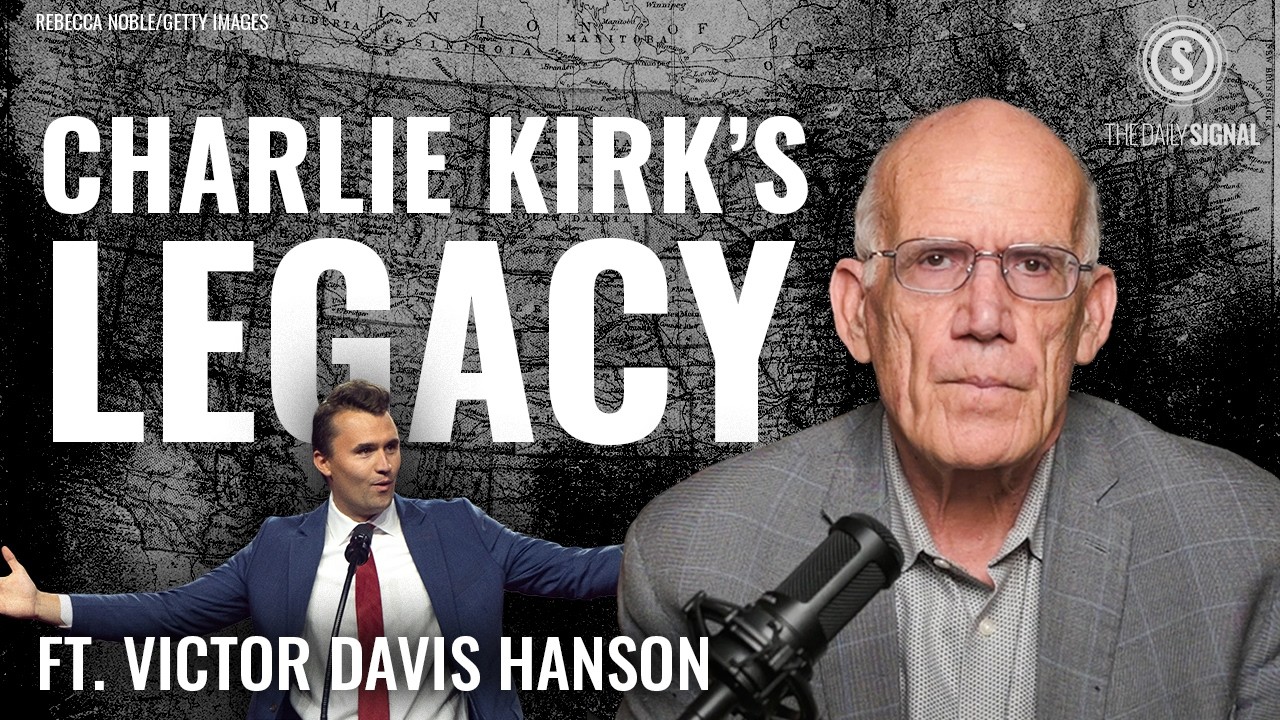
Eric Metaxas and Victor Davis Hanson Discuss the Murder of Charlie Kirk and Free Speech
Eric Metaxas sits down with historian Victor Davis Hanson to examine what Hanson calls a political assassination and the dangerous atmosphere created by relentless Nazi and racist rhetoric. Hanson argues the murder represents a watershed moment exposing how revolutionary leftist ideology has permeated institutions from Harvard to the New York Times. The conversation explores how average Americans are rejecting extremism, the consequences of cancel culture turned against its creators, and why figures like Stephen King and former generals face no accountability for spreading demonstrable falsehoods. Metaxas and Hanson discuss President Trump's lawsuit against the New York Times, the collapse of elite institutional credibility, and signs that swift punishment and social ostracism may finally curb political violence and hateful speech.
Victor Davis Hanson opens the conversation by addressing what he believes everyone understood: the murder of Charlie Kirk was a political assassination. Hanson describes Kirk as "the most gifted political activist, probably media figure, organizer of either party, either persuasion under 40," and argues this was an effort to take him out. He points to the dangerous atmosphere created by constant rhetoric calling people Nazis, racists, and transphobes, coupled with a revolving door justice system that fails to swiftly punish violent crimes.
Hanson cites the case of D Carlos Brown, a 14-time felon, as evidence of how this permissive system creates a toxic environment. He argues that when people believe they won't be fully and swiftly punished for heinous acts, and when they think a large segment of the population will put them in the pantheon of leftist heroes, it creates a dangerous mixture that leads to tragedies like Kirk's murder.
A Watershed Moment for American Culture
Eric Metaxas characterizes this as a tipping point and watershed moment in American culture. He notes that while hate has existed in the culture, when it manifests in murder, average Americans understand the nation cannot continue on this path. What Metaxas finds extraordinary is not just the murderous act itself, but the foolishness of people openly celebrating it, demonstrating they lack even the barest appreciation of what it means to be an American—that murder is wrong and free speech is good.
Hanson agrees, describing the situation as "a putrid scab" that when torn off revealed how sick people truly are underneath. He references polls showing that up to 30 to 40% of people who identify as progressive approve of killing political enemies, citing Red Cross polling data. Hanson believes people collectively reached a breaking point after multiple horrific incidents, including the murder of Arania Zerutska on light rail and murders in Auburn and Queens.
The End of Apology and the Reassertion of Common Sense
Hanson argues that Americans are done putting up with leftist ideology. People are no longer afraid to say there are two sexes, to question dangerous drugs and anti-depressants given to people in the trans community, or to call out figures like Joy Reid for constantly collectivizing entire demographics by race. He believes these events over the past month have shown people these attitudes are symptomatic of a deeper problem that cannot continue.
The conversation turns to what Hanson sees as a potential historic political shift. He predicts we might see for the first time in our lifetime a sitting president win midterm elections in his first administration because people are genuinely angry and will vote against anyone Democratic, whether fair or not.
Metaxas frames this as the "reductio ad absurdum" of leftist values—that at some point bad ideas go far enough that everyone recognizes they cannot work. People can live in bad faith for a while, but eventually they see the fruit, eat it, get sick, and say "now I see." This disgust extends to institutions like the New York Times, Harvard, and Yale.
Defending Normative Values Against Revolutionary Ideology
Hanson articulates what he sees as a reassertion of traditional American values. He argues that society must defend normative phenomena like the nuclear family and two-parent households with two to three children. While tolerant of alternative family structures, Americans are refusing to back down from defending what has been the civilizational norm throughout Western history.
In a multi-racial society, Hanson insists race must be incidental, not essential, to identity. Anyone who identifies primarily by their tribe is a tribalist destructive to the idea of multi-racial democracy. He states that 65 years after the civil rights movement began, Americans will not keep going backwards with reparations and hyphenated identities.
On gender issues, Hanson says Americans are sympathetic to gender dysphoria and want people to get proper medical attention, but will not back down from the position that biological men cannot dress in front of young girls or compete in female sports. What's different now, he argues, is there's no apology, no worry about what critics will think, whether books will be trashed by the New York Review of Books, or whether children will get into Stanford. Nobody cares anymore about those consequences.
The Crackup of Transgender Ideology
Metaxas acknowledges there will always be cowards who care about institutional approval, but believes enough people no longer care and are willing to call out the cowards. He recalls his revulsion at seeing the Vanity Fair cover featuring Bruce Jenner photographed by Annie Leibovitz, whom he calls "the Lenny Riefenstahl of our time." He argues that publications like Vanity Fair and the New York Times have pushed an agenda using the best photographers to make the public believe lies.
The sad people who have bought the transgender lies are starting to crack up, Metaxas argues, pointing to the young man who murdered two children in a Catholic school as an example of this crackup. He believes the leftist cultural elites who pushed this ideology so hard are now stymied, realizing they have nothing and nowhere to go.
The Bankruptcy of Elite Institutions
Hanson notes that the left lacks political power, having lost the House, Supreme Court, and presidency, and is on the wrong end of most issues by a 70-30 margin. He cites three magazine covers as examples of media bankruptcy: the New York Times photoshopping Trump as Hitler, Rolling Stone making mass murderer Dzhokhar Tsarnaev look handsome and photogenic, and Taylor Lorenz's interview with Luigi Mangione, treating the assassin of a health care CEO who worked his way up from the lower middle class as some kind of 19th century anarchist folk hero.
These examples reflect the bankruptcy of the Democratic party, which Hanson believes has been taken over by a revolutionary nihilistic culturally suicidal faction. Traditional Democrats are afraid of this faction but will be brought down by them. Average people will not emulate revolutionary methods but are determined to prevent these people from destroying the republic.
The Irrelevance of Cultural Elites
After a break, Metaxas and Hanson discuss how cultural elites have pushed an agenda that, like the Soviet Union, can only be sustained for so long before fracturing. The Emmys ceremony demonstrated that cultural elites know they have lost touch dramatically with middle America and don't know what to do except huddle together and pretend it's not true.
Hanson argues these elites don't understand it's no longer 1950 when figures like Clark Gable and Gary Cooper commanded the nation's attention. Technology has fragmented the media landscape, and the people receiving awards are unknown to most Americans. They're not Natalie Wood or Robert Redford anymore. The same applies to the Grammys and Tonys—nobody cares. Network news accessible for free sometimes has no greater audience than Fox News that requires payment.
These institutions exist in a time capsule, and their reaction to irrelevance is to double down. Hanson speaks from his position at Stanford, noting that for four years the university deliberately admitted only 9% white males, broadcast that fact on their website, trashed Jewish students protesting Hamas, broke rules to let pro-Hamas people camp out and take over the student union for four months, and allowed the president's office to be trashed.
People are questioning whether Stanford means anything anymore when students are admitted with no SAT scores during this period. Faculty privately admit they give 70 or 80% A grades and either lower grading standards, reduce required work, or create new easy courses. This is happening across higher education, with institutions running on the fumes of their former reputations. The same is true of network news, the book industry, and magazines like Vogue.
The Fall of Oxford and the Ivy League
Metaxas expresses gratitude that people no longer care about these discredited institutions. He recalls a pinheaded Oxford undergraduate dressed like a slob who celebrated Kirk's murder. Metaxas debated at the Oxford Union 18 years ago and was already depressed by what passed for undergraduate thinking. He's used to seeing this at Yale and Harvard, but finds it fascinating to watch these institutions in freefall, with most people realizing they're factories of Marxist madness. Some people still want the degree, but increasing numbers are waking up to the fact that what they thought was prestigious has no clothes.
Hanson notes that students at the Oxford Union were traditionally the top students at Oxford University, but the undergraduate who celebrated Kirk's murder was admitted with less than sterling credentials. Rather than demonstrating gratitude for the opportunity by impressing everyone with his work, he played the role that got him admitted—the anarchist weird-looking trash-talking person completely exempt from criticism because he identifies tribally by his superficial appearance. Hanson believes this no longer works and these people are destroying institutions like Oxford.
The End of Elite Exemption
The question, Hanson argues, is when the left will feel that people promoting this ideology are no longer exempt from the consequences. If someone's child goes to Harvard and others respond "So what? Harvard doesn't mean anything anymore," or if someone lives in the nicest part of Cambridge or Malibu but their security patrol no longer protects them, or if they step in feces walking downtown in Los Angeles or San Francisco—that's when change happens.
This entire experiment was predicated on the idea that everyone else was a lab rat and the left would experiment with ideas as moral superiors in bicoastal globalized circles. They made out like bandits while deplorables were experimented on with no fracking, high crime, critical race theory, and critical legal theory. Like maestros orchestrating an opera, they thought they would control everything. Now people are refusing to play along, and elites will not be exempt from the madness they created. Nothing can protect them from what they did, and Hanson believes that's going to create a significant change. These elites are starting to realize they can't ride the subway anymore, can't walk at night in Chicago on the Magnificent Mile, and their kids at prestigious universities like the University of Chicago aren't safe.
Trump's Lawsuit Against the New York Times
After another break, Metaxas turns to the topic of consequences for institutions that have spread misinformation. President Trump is suing the New York Times, which has purveyed leftist lunacy for a long time but really "jumped the proverbial shark" in 2016. The lawsuit reportedly seeks $15 billion in damages. Metaxas finds it wonderful that there's a president willing to scare these institutions and say there will be consequences, describing Trump as "crazy enough actually to believe that there ought to be consequences."
Most Americans are cheering Trump on because he's suing the New York Times on behalf of the nation, not just for what they've written about him personally. Hanson notes the irony that the left used the court system to break people—the Southern Poverty Law Center would sue people they knew weren't racist just so targets wouldn't have the ability to defend themselves. The right never really used the court system but has now inherited that technique from the left.
The Boomerang Effect of Leftist Tactics
What's happening now, according to Hanson, is a boomerang effect. The left set precedents, especially during the Obama and Biden years, establishing norms of behavior. Now the right is saying they don't really like using courts or suing people for what they say, but since that's what the left has been doing repeatedly with cancel culture and deplatforming, the right will respond in kind.
In normal times, Hanson explains, there would be latitude under the First Amendment for "ogres and ghouls" to celebrate Charlie Kirk's murder, and that latitude still exists. But since the left canceled everyone during the Me Too movement and beyond, if someone works for an institution, the right will demand that institution release them from employment. People can say whatever they want, but that's a business decision. If an institution keeps someone who has become a liability, people will refuse to read their material or participate. The left says this is unfair, but the left taught the right these methodologies. As Reverend Jeremiah Wright once said, "The chickens have come home to roost."
Defining Cancel Culture and Appropriate Consequences
Metaxas clarifies that while everyone can be against cancel culture, it's necessary to define what that means. He distinguishes between different types of consequences. Americans believe in the free market, so if companies like Target, Disney, or the LA Dodgers are stupid enough to promote vile things, people have a right to make them pay a price. When Budweiser crossed lines, consumers appropriately made them pay by refusing to buy their products.
But mocking the murder of someone is different from representing something people don't like. It's one thing for someone to advocate a position; it's another to mock the murder of a young man. What's fascinating to Metaxas is that many people have been shocked that they could say something so particularly vile—something almost anyone would agree is vile—and think there would be no consequences.
Hanson agrees these people flee to the protection of the First Amendment while being crude, evil, and satanic. But all people are saying is they will identify those who speak this way and put the ball in the court of their employer. If the employer condones speaking evilly of the recently departed, people will refuse to buy or read that product. They will socially ostracize but won't try to sue to have someone dismissed, because people have the right to be as evil as they want, and others have the right not to patronize them.
This approach has been very effective. Hanson has been shocked by how quickly people on record have been dismissed, perhaps not in England but in America, because employers think the person has gone beyond the decency of what a humane society expects, even if the employer is liberal.
The Line Between Criticism and Celebrating Murder
Metaxas emphasizes that it's one thing to say while someone is alive "I hate Charlie Kirk, I think he's a jerk." That's one level of speech. But when someone has been murdered, people should understand they've crossed a line that any civil society doesn't cross. We're not going to put people in jail for saying vile, despicable things, but the Constitution doesn't give anyone the right to keep a job. Employers can say "I don't like the cut of your jib. Goodbye."
There's a healthy correction happening, and Metaxas is grateful for it. He raises the issue of misinformation and the role of the New York Times and other institutions in purveying lies. He expresses something almost like sympathy for people who genuinely believe Donald Trump is Hitler. They're obviously wrong, but it's interesting that they genuinely believe this because they've been led to believe it's true. This raises questions about the guilt of the media.
Military Generals and the Normalization of Extreme Rhetoric
Hanson points out it wasn't just the media. During Trump's first term, General Michael Hayden, former head of the CIA, compared Trump to jailers at Auschwitz. General Barry McCaffrey, a hero of the first Gulf War, said Trump was Mussolini. General Stanley McChrystal said Trump was a pathological liar. After Trump left office, General John Kelly said he was a fascist, and General Mark Milley said he was a dangerous fascist.
All of these generals were subject to Article 88 of the Uniform Code of Military Justice, which prohibits disparaging the commander-in-chief, yet they were completely exempt from consequences. What's fascinating now, Hanson notes, is that no retired generals are coming out saying Trump is a fascist. It's not because they changed their opinions but because they feel we're in a new age of accountability and don't want to be on the front pages of the Wall Street Journal subject to Article 88 violations.
The Dangerous Ignorance of Cultural Figures
After another break, Metaxas addresses the preposterous statements made by figures who should know better—former Vice President Dick Cheney and former President Joe Biden denouncing Trump as a fascist, proving their frightening ignorance. They don't know what a fascist is but know the word and use it anyway.
The ignorance extends to figures like novelist Stephen King, who denounced Charlie Kirk as having said gays should be stoned to death—something Kirk never said, would never say, and would denounce anyone for saying. It's fascinating that someone like King lives in such a bubble that he earnestly believes these false things. Rosie O'Donnell echoed the same lie days later as though they knew Kirk approved of stoning gay people. It's extraordinary how exquisitely out of touch these cultural figures are.
The Illusion of Immunity and Competitive Extremism
Hanson believes these figures speak from financial or career security, feeling completely immune from consequences. They want to outdo the next person in their liberal circle. He cites the case of Washington Post columnist Karen Attiah, who was fired after claiming Charlie Kirk disparaged Black women. She put words he didn't say in quotation marks—something Hanson knows from his own syndicated column experience is a fireable offense in publishing or writing. He was surprised the Washington Post actually fired her, but she's now on a crusade claiming her speech was suppressed.
The dynamic, Hanson explains, is that people in elite circles believe they run corporations, higher education, popular culture, the media, and the Ivy League. In their bubble, they're the smart people running the country. One person calls someone a fascist, so another has to say Nazi. Someone says Nazi, so another says Hitler. Someone says Hitler, so another says he's killing more people than the Holocaust. There are no consequences until someone ignorant, mentally deranged, or simply agreeable comes out of the woodwork to commit violence, expecting to become popular and a cult figure like Luigi Mangione.
The only thing that will stop this, Hanson argues, is swift, sure, and severe punishment for people who use violence, combined with social ostracism for people who engage in extreme language, regardless of their station.
Signs of Hope and Institutional Accountability
Metaxas believes we're at that point and is thrilled people have had enough. He's mystified that the Washington Post still has enough standards to fire someone for fabricating quotes, seeing it as a hopeful sign at least for that institution. He thinks CBS and others have a handful of sane people who may tack toward the truth, but hopes the rest "all goes down in flames, not literally."
The conversation concludes with Metaxas thanking Victor Davis Hanson for his time, noting it's always a privilege to have him on the program.