Victor Davis Hanson Reveals Charlie Kirk's Secret to Mobilizing Young Conservative Voters in America
Enjoying this? Share it with someone who needs to see it.
Up Next
Victor Davis Hanson on Cancel Culture, Charlie Kirk's Death, and the Double Standards in Public Discourse
9:07
Steven Crowder Returns Change My Mind After Charlie Kirk Assassination Sparks Leftist Political Violence Crisis
1:26:49
Brandon Tatum Reveals How Football Dreams Died and Police Career Sparked Conservative Rise
2:36:45
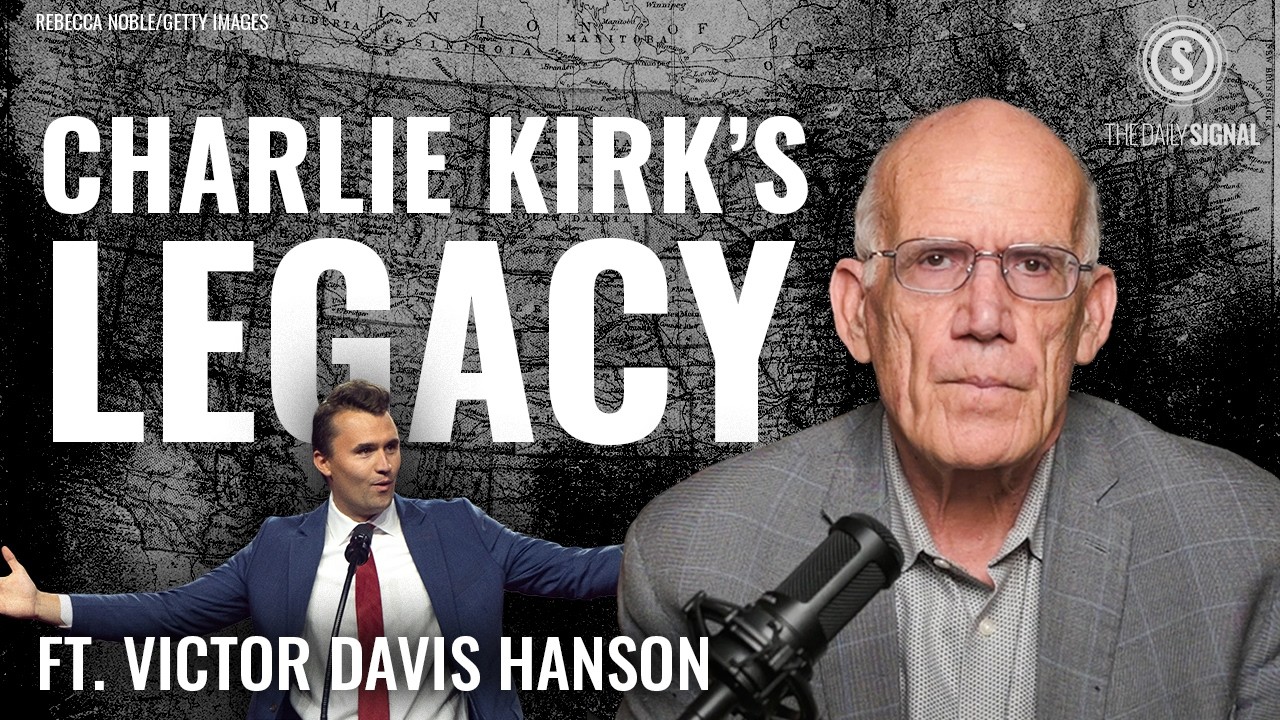
Victor Davis Hanson Reveals Charlie Kirk's Secret to Mobilizing Young Conservative Voters in America
Victor Davis Hanson examines Charlie Kirk's approach to political organizing and his success in reaching young voters. Kirk understood something fundamental: today's youth aren't rebelling against conservatism, they're rebelling against a liberal establishment that has become the status quo. By reframing traditional values as counterrevolutionary, Kirk mobilized a generation to challenge the dominant paradigm of DEI, open borders, and radical environmentalism. Hanson explores how this strategy may have been decisive in securing key electoral victories and why Kirk's message resonated with young Americans seeking normality in a chaotic culture.
Victor Davis Hanson examines the remarkable political organizing achievements of Charlie Kirk, founder of Turning Point USA, following reflections on his legacy and impact on American politics. Kirk built one of the most successful youth political movements in recent history, with Turning Point USA receiving requests for 75,000 new chapters while simultaneously maintaining careers as a columnist and podcaster.
Kirk's influence extended far beyond organizational metrics. His efforts contributed to a significant shift in youth voter turnout and preferences, potentially securing crucial electoral victories. In the 2020 election cycle and beyond, Kirk helped reverse traditional patterns of young voter engagement, increasing turnout while shifting preferences by six to 20 percent in key states. In some demographic categories, particularly the 18 to 29 age group, his influence may have delivered more votes for Donald Trump than his opponent received. Even in the broader 18 to 39 demographic in Michigan, the split approached 50-50, a remarkable shift in traditional voting patterns.
Understanding the Nature of Youth Rebellion
Hanson identifies Kirk's core insight: young people possess innate characteristics that make them natural agents of change. They arrive at political consciousness full of energy, hormones, and ideas. They haven't experienced decades of life that might calcify their thinking, and they naturally question authority. This skepticism and rebelliousness isn't learned—it's fundamental to the developmental stage they occupy.
Rather than fighting against this natural inclination, Kirk harnessed it. But he did something clever that distinguished his approach from traditional conservative outreach to young people. He didn't ask them to suppress their rebellious instincts or conform to established norms. Instead, he redirected their natural inquisitiveness and skepticism toward a different target.
Redefining the Establishment
Kirk's message to young Americans contained a provocative thesis: they had misidentified the establishment they should be rebelling against. The dominant cultural, educational, and political institutions in America aren't conservative—they're thoroughly progressive.
Hanson outlines the evidence Kirk presented to young people:
Network news, PBS, and NPR represent establishment media
Elite universities including Harvard, Yale, Princeton, Berkeley, and Stanford dominate higher education
Corporate boardrooms at companies like Budweiser, Target, and Disney control commercial culture
Popular culture, visible in events like Super Bowl halftime shows, reinforces progressive messaging
Kirk argued that the baby boomers who led the revolutionary movements of the 1960s and 70s had become the establishment themselves. They now occupied positions of power throughout American institutions, but their thinking had ossified. Trapped in the amber of their youth, they continued promoting ideas that originated decades ago: DEI (Diversity, Equity, and Inclusion), critical race theory, critical legal theory, radical green environmentalism, and open borders.
The Counterrevolutionary Message
Kirk's approach inverted the traditional political framework. He told young people they should indeed rebel—but as counterrevolutionaries, not revolutionaries. The society they inhabited didn't represent uptight 1950s conservatism. Instead, it embodied chaos, disorder, and the absence of rules. Issues like transgenderism debates, DEI mandates, open borders, and a dysfunctional legal system created confusion rather than liberation.
Young people had suffered under this system, Kirk argued. They faced obstacles to achieving goals that historically brought happiness and fulfillment: getting married, having two or more children, buying a home, participating actively in their communities, embracing patriotism, and maintaining traditional values. These aspirations weren't establishment positions—they were counterrevolutionary.
Kirk's message empowered young people to channel their youthful energy not toward destroying order, but toward restoring it. What they had experienced growing up represented an aberration from normality and common sense. Their mission as counterrevolutionaries was to overthrow the dominant paradigm that had diminished their opportunities and made their lives miserable.
The Strategy in Action
Throughout his career, Kirk implemented this philosophy by engaging young people, particularly on college campuses, where progressive orthodoxy maintained its strongest institutional hold. He didn't ask students to avoid questioning authority or to remain passive and traditional in a conventional sense. Instead, he encouraged their natural skepticism while directing it toward challenging the establishment's radical positions.
This approach proved effective because it aligned with young people's developmental psychology while offering them a coherent alternative vision. Rather than asking them to defend the status quo, Kirk invited them to overthrow it—but in service of restoring principles, traditions, and social structures that had been abandoned by the ruling class.
Hanson concludes that Kirk's understanding of this dynamic—that establishment power in America had shifted from conservative to progressive, and that rebellion now meant championing traditional values—explains his extraordinary success in mobilizing young voters and potentially altering the course of American elections.