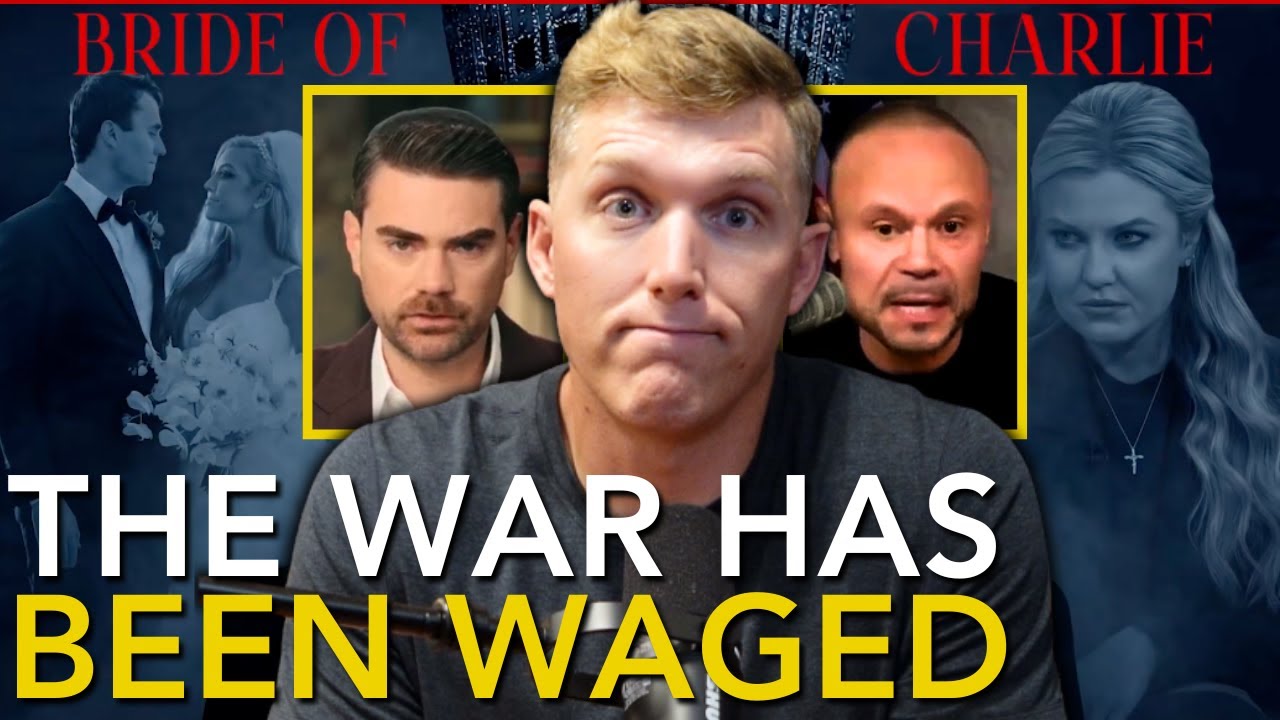
There's a huge civil war going on on the right right now and the question is, you know, what what direction is the country going to go? I certainly think that hiring Candace is probably the biggest mistake of my professional life so far. I've asked Candace on two separate occasions. What do you actually believe? And on both occasions, she told me, "I believe what the people believe. I am the voice of the people." But she's essentially she's articulating audience capture as a virtue. She's now talking about doing expose documentaries on Charlie Kurt's widow. You know, that's that is evil. I see a huge alignment between, you know, Antifa thugs tearing down statues of Christopher Columbus and George Washington and Thomas Jefferson and people on the so-called new right saying that Churchill is the chief villain of the Second World War or that America shouldn't have used uh the atomic bomb to end the Second World War. That's just rhetorically tearing down our statues in the same way that Antifa is physically tearing down our statues. I think that Tucker is doing an enormous amount of damage to the Trump coalition. >> Jeremy Boring, welcome to Trigonometry, >> man. Happy to be here. >> It's great to have you on. Uh we've been meaning to have you on for the first time. In fact, I believe we're the first video interview you're doing since leaving the Daily Wire. >> Yes. Uh this is my first I think you believe you call them podcasts. >> No, we call it the show. I don't know. Francis and I were talking about this the other day. Why do people still call these podcasts? It's like a full-on visual show, right? Well, you know, it's interesting. When we first started the Daily Wire with the Ben Shapiro show, uh, and the Andrew Clayven show, we shot the first two episodes on the same day with video and it was important to us from the very beginning to be video first. And for the first five or six years after that that we would go to the big podcast conferences, they would criticize us for having video and they would say, "Well, you're not you're not real podcast if you're real podcasts are audio only." And then the last three or four years of going to podcast conferences, every single panel is how to add video to your podcast. >> Right. No, totally. Uh I I've always thought of we've always thought of trigonometry as a show. Of course. >> Um I think podcast is a kind of legacy term, but we've got right into the conversation. We want to talk also about the pen dragon cycle which is super exciting that you you've just um released and um you've got straight into the conversation we wanted to have first which is about new media. There's something that you were kind of at the root of from the very beginning. So talk to us about that and how you see the landscape because obviously there's been a lot going on as I'm sure you're aware. >> Yeah, absolutely. Well, you know when we started the Daily Wire in 2015, all of this was very new. Obviously there were people um involved in con on the right in America in new media long before we were. You know, Andrew Breitbart, uh obviously a mentor to both Ben and I. Um Matt Drudge charging the way. You had the sort of bloggers who were really instrumental in fighting off a lot of early leftwing narratives online like Little Green Footballs and some guys like that. But I think that what we what we really brought to the table was we were one of the first to really see the opening in social media. Um, and we were the first to see the opportunity in podcasting to see these two new areas. One which we thought could be incredibly effective for marketing and distribution and the other which we thought could be a great medium uh for actually getting our message out. And we married those two things and and had a huge amount of success in the early days particularly around Facebook because it was the wild west back then. you know, people people particularly on our side weren't uh fast to adopt. Um, and they were as consumers of course, but not as content creators and marketers. Uh, and people on the other side hadn't figured out yet that we would that we would become very good at it. So, the sort of cancel culture and all of the tools that later were developed >> to try to limit the reach of conservatives in those spaces hadn't happened yet. And so, we we had the world was sort of our oysters wide open in front of us and and we took it. Uh I I think one of my criticisms of conservatives broadly speaking is that we're typically so late to adopt new technologies and new opportunities when they present it themselves. And that's interesting because we purport to really believe in free markets. You know, we we purport to believe in uh those mechanism of profit motive of incentive of finding efficiencies in the market and taking them. But then we're also sort of constitutionally afraid of new technologies, afraid of new uh of change. And so we sometimes uh allow the conservative part of our conservative DNA to out uh to sort of outvote the part of us that would be sort of economically motivated. And for that reason, we wind up not being players in some of the big areas. I think we're seeing it probably right now already in AI, but we it was certainly true in social media at the very beginning. And I think that's one of the things that set Ben and I apart is that we were either um had the foresight to realize that there was an opportunity here or had the foolishness not to realize that uh there were dragons and so we just charged right off the map and went into that that area. >> Well, but what's happened since that time when you were early pioneers is I don't think there's any shortage of right off center right voices now in new media. And in fact, there's so many now that there is a civil war going on. I think it's fair to say within it. Um, and I imagine you have some insights on that given that some of the big players are people that you've either worked with directly at the Daily Wire or just know through otherwise. >> Well, obviously the movement is small and and if you're in it for very long at all, you know everyone as you guys I'm I'm certain know everyone. Um, and yeah, there is, of course, there's a huge civil war going on on the right right now. And in part, it's happening because, uh, Donald Trump is a one-term president. You know, it's a unique thing in our history. There's only been one other example of non-consecutive uh, terms for a for a second term president. It essentially means Donald Trump was a lame duck from the day he was elected to this second term. Now, he's he's made a lot of moves to make that less true. He had a great particularly around foreign policy, he had a great first year of his second term, which you might not always see from a second term president, but you can tell that like the buzzards are circling. People understand that, you know, a lot of a politician's power is in their ability to win the next election. Donald Trump doesn't have constitutionally the power to win the next election. And everybody wants now to define what's going to happen next in the conservative movement. And there's an opportunity for people to make a lot of money, an opportunity for people to seize a lot of power, an opportunity to advance new visions for what the future of conservatism in America and and globally can be. And then there's structural issues around social media and and how we're incentivized as creators of content within that framework. You know, I think those two things and the sort of inherent problems in both are creating this really confluent moment where we see almost open civil war and in some cases very open civil war on the right as people are both trying to make money, build their own brands, and compete for actual true political power in a postTrump world, which is rapidly approaching. You know, we're we'll have our midterms this year uh and then you will immediately be in the next presidential cycle. I mean, starting in 2027, we'll be trying to figure out who the next president of the United States is going to be. And because we know it can't be Donald Trump, the question is, you know, what what direction is the country going to go? It's very difficult, isn't it, Jeremy, to remain pure in inverted commas or to have your intentions remain pure when you've got so many, how can I put this, competing incentives when you're a podcaster or you have a company like the Daily Wire? How do you ensure that the choices you make are the right ones? >> Well, you can't ensure that your choices are always going to be the right ones. You probably have to accept in life that some of your choices will be the wrong ones. Both because you're reacting to incentives because at times you have limited information because it and because at time, you know, all sin and fall short of the glory of God. We certainly made our share of mistakes at the Daily Wire during my tenure. I think we hit a lot more than we missed. Um, but when you're a big company and when you're uh when you're helping people navigate the complexities of worldview, of politics, of even theology, your misses are consequential. And some of our misses were were quite consequential. I think though that to your question, you one has to have a vision for what it is that they're trying to accomplish and and one has to rightly order their priorities. Of course, we all have a lot of competing priorities. You know, the Daily Wire was deliberately set up to be a for-profit organization because part of our premise in setting up the company was recognizing that conservatives too often rely on nonprofit mechanisms to promulgate their worldview. While the left, which purports to hate market economics, almost exclusively uses uh for-profit institutions to promulgate their worldview. So, like by our own definition, we chose the less efficient and therefore less successful mechanism. We wanted a Daily Wire to be a corrective to that from the very beginning, which necessarily means that making money has to be a high priority. >> But making money can never be the highest priority. When you're ordering the priorities of a company like the Daily Wire, when you're ordering the priorities of um a business like the business you have with trigonometry, you you have to keep the mission um as your number one priority because definitionally all the other priorities will subordinate to it. If you ever find yourself making profit or audience growth the number one priority, then necessarily the mission will subordinate itself to that priority. And that's when you start making really cynical decisions. And in my experience, I've made cynical decisions. Of course, in my career, every time I make a cynical decision, it's come back to bite me. >> Uh I think that that's not true if you are a cynical person. I mean, there is a lane for the pure cynic. I I call it the grift industrial complex. Beware >> the grift industrial complex. It's real. Uh it it can be incredibly lucrative and it can be incredibly rewarding too in terms of the feedback that you get from audience. If you tell people what they want to hear, they are always very happy with you. If you tell people always what they want to hear, they reward you financially. They they reward you um uh you know by clicking and by liking by giving you that affirmation and that dopamine and pretty soon that becomes the thing that you serve. You know pretty soon um you're you don't wield cynicism. Cynicism wilts you over time and I I think we see a lot of people falling into that trap right now. >> Well we absolutely do and I mean well let's talk about it. I mean, one of the people who is at the forefront of movement that you've just talked about, let's call it the Griffith Industrial Complex, is Candace Owens. >> When Candace worked for you, do you sometimes look back at the decision and think that wasn't a good one when she was working at the wire? >> Yeah. Well, I certainly think that hiring Candace is probably the biggest mistake of my professional life so far. Um, at the time I had misgivings about Candace, but I it wasn't a completely cynical decision. I believed that uh Candace could be a great force for good in the world. Um, I still believe that Candace is the most talented person I've ever met, not just in conservative media, but in in any media. She has it. You know, she has that star quality. You know it the moment that you meet her. Unbelievable charm, unbelievable charisma. The camera absolutely loves her. She uh she has incredibly unique gifts and skills in that area. And when she wields those gifts and skills for good, she's incredibly effective. She was during the BLM movement uh in America. Some of the content that we made when we first brought Candace on was focused on that topic and I think she was as good as anybody in the world and made a really positive impact. I've said before Candace is like nuclear energy. You know, if you if you harness it properly, she can power a city. if you lose control, she'll flatten the city. And I think that's what we're seeing now. Ca Candace, uh, all those same gifts that she has at various times used for good, she's now using for ill. And there's no one better. The problem is, if what you're pursuing is bad and you're the best at it, you're going to do an incredible amount of damage. And Candace is doing an incredible amount of damage. >> Do you think one of the things that, and I' I've talked about this quite a bit in the past, you've talked about the camera liking people, etc. We are in the business where charisma is so overindexed that people very often will consume confuse charisma with accuracy. They will say, "Well, this person is very charismatic, therefore what they're saying is true." And that seems to be a big problem. I don't know if I don't know how much of a problem it is on the left, but within the right-wing media ecosystem, there just seems to be the sense that if you get someone charismatic saying something crazy, that seems to get millions of views. Is there something about the conservative mindset or is there something about the way people think about the that they're particularly susceptible or am I being unfair and are people on the left just the same? >> Well, of course, people on the left are susceptible to this. There's a reason that um you know every actor in Hollywood they have they are who they are because they have star power. They have gotten the platforms that they have because they're incredibly charismatic and great on screen and great at telling stories and they're all crazy and they've been uh promulgating a horrible worldview for for decades. So of course that's a problem on the left. It manifests itself differently on the right though because the left has almost hegemonic uh representation among you know the the instruments of popular culture and has for the lifetime of just about anyone who could be watching this now. Uh and so for that reason a lot of their audience capture happened in places that were less consequential. It happened in narrative fiction. I say less consequential and probably it's actually more consequential over time. Yeah. But less sort of urgent uh than say someone like Candace Owens might might be. >> And so you just don't see it in the same way because your your average interaction with say a radically left-wing Hollywood actor isn't them telling you their opinion, it's them performing a role or playing a part. uh because the right was sort of boxed out of that the the major apparatus of of culture formation for the last several decades. You know, we've found in part because of the work of Daily Wire and in part because with the work of others, we found these alternative lanes which are much more direct talking into the camera, saying what you believe. And so that's where we've actually built our audiences. Uh that's the kind of trust that was placed in us from day one. And so I think you see the abuse of it a lot more clearly on the right. And there may be something in the sort of conservative mindset that makes us more susceptible to say conspiracy theory. You know, when you're when you're a hammer, everything looks like a nail. When when I I had a teacher in high school had a poster on the wall that said, "Just because you're paranoid doesn't mean they're not out to get you." You know, >> I think that's a Nixon quote. >> It's a Nixon quote. It is. Yeah. Yeah, it's a great Nixon quote that but that is a a conservative kind of point of view that because we're we are in a sort of bunker mentality. We are hard done by and we are beset and so you do begin to see um you do begin to see probably threats that aren't there patterns that aren't there. I mean, I think that's probably part of the bunker mindset is well put because I think a lot of it is there's a sort of feeling on the right that I certainly see that people feel like the world is moving in a direction they really don't like >> and therefore there must be a small group of people that are in charge of this process >> with very tiny hats >> ideally with very tiny hats. But but but actually I I you know you could see this happening even before the explosion in anti-semitism that we've seen recently. There was the the they were looking for a framework to explain everything. The theory of everything is a small number of people have got together and they've decided to ruin our lives which I think is a simplistic explanation of this thing. Why is that such I mean I guess throughout history that's been a very appealing way of looking at things, right? >> Yeah. Well, of course, because most people either don't have a lot of power uh or perceive themselves not to have a lot of power and I actually think the latter is far is the more dangerous phenomenon that we're dealing with right now. Uh, and and so the assumption is that somebody has to be in charge. Somebody has to be running it. It it obviously isn't me. I'm not getting the things that I want. The world isn't working out the way that I think that it should. So, it must be working out the way someone else thinks that it should. Of course, the reality is that if you've ever met anyone in government. >> Yeah. Now, it's also funny to me that, you know, the the billionaire who's been famous literally as long as I've been alive with a gold toilet on his personal 767 is somehow not a part of whatever the ruling elite uh is even in his second term as president of the United States. So, I think all of these sort of all these sort of uh Illuminati elite, you know, kind of view conspiratorial views do fall apart upon contact with with the real world. But that's not to say that there aren't actual conspiracies. And actual conspiracies do make it harder to to debunk the concept of the conspiracy theory. And one of the perhaps the biggest reason we're living through what we're living through right now is because of co 19 because of the reaction of the governments of the world uh to this novel corona virus. It was >> you know one of the most formative especially for this young generation. Imagine being in high school uh and being sent home for a year or two years or in some cases three years uh because of a disease that did not affect you demographically you are unaffected um and then learning over time how much of it was overreaction and that's generous how much of it was opportunistic uh and that's probably the the most true case and how much of it was downright cynical and a power grab by governments and I think that's probably true in some aspects of it. But you take all of that together and and now tell people that conspiracy theories aren't real >> and well, it's a losing argument because we just lived through, you know, one of the great conspiracies really in in human history. Um, and it of course we're going to be dealing with the damage of that overreach by governments for the rest of our lives. It's a it was a generationally consequential event. I try to be very careful and guarded with my language. and never want to say because of the corona virus or because of co 19 because of course none of these things are because of co 19. They're all because of the reaction of governments and media organizations and the apparatus of popular culture which are almost completely dominated by the left uh to seize power, seize uh seize economic opportunity and in some cases just panic and overreact. I mean, you know, sometimes the sometimes there is no obviously conspiracy except stupidity, >> but I I don't see how we in the short term easily overcome the psychological damage done to free people across the West by our governments in relation to CO. >> It's such a profound point and because I have this joke is like which is we all treated CO like a bad one night stand where we're just going to walk away going, "No, that never happened. I never said this. I never did that. And uh we're just all going to walk away and pretend like it was just one big dream. >> Yeah. Super normal to lock children in their houses for 3 years. Couldn't possibly be a consequence for taking people in the most socially formative years of their lives and putting them behind a computer >> uh where their only interaction with other human beings is digital interaction. All going to work out fine. >> Universities are a bad deal. Six figures of debt for a bachelor's degree that signals less every year. Four years spent navigating ideological rules instead of learning how to think. Grades are inflated, standards are lowered, and disscent is punished. We call it higher education, but it's mostly expensive daycare with a credential attached. The University of Austin, also known as UATX, is different. Admissions at UATX are based on test scores alone. No essays, no resumes, nobody cares who your parents know. If you're smart enough, you're in. UATX students turned down Chicago and fled Barard to complete a demanding great books core including Aristotle, Shakespeare, Toxville alongside real math, science, economics, and AI. Classes are small. Professors actually know your name. Grades aren't padded. Excellence is measured and rewarded. From day one, students work directly with top founders, investors, and institutions, building companies, doing serious research, and landing real internships. And here's the part that changes everything. There is no tuition. Thanks to private donors, every UATX student graduates debtree, free to take risks, start companies, and build a life instead of paying off loans. If you want a credential, look elsewhere. If you want a serious education that actually prepares you to lead, apply to the University of Austin. Visit austin.org. That's austin.org. One of the things I wanted to talk to you about is we talked a little bit about touched on it almost like charisma. >> I've got this theory and I'd be very interested to hear your view on it having worked with actors and influencers. To me, charisma and mental illness >> are kind of almost intrinsically linked. And I'll tell you why. Because when you see someone in real life and you talk to them, and I've seen this with a lot of actors, I'm like, "Oh my god, this this guy's crazy." You put a camera on him, boom, it's charisma. That edge that I don't know where he which way he or she is going to go in real life, you're like, "That's scary." On camera, that's magic. >> Yeah. Well, I think of it as in in aerodynamic terms, there's a concept called uh uh aerodynamic instability, right? That you want your fighter jets to be unstable. Dynamic instability, I think they call it. Because the whole point of a fighter jet is that when it's in a dog fight, it has to very quickly move. And it's, as it turns out, an airplane is designed not to do that. The whole purpose of an airplane is to go straight for a long time. It it's not like the movies, you know? I mean, if you were ever on a giant jumbo jet and all the engines went out, do you know what would happen? Almost nothing. You would go because the wings are doing the work right now. You will eventually crash because there's not enough thrust to to create lift. But those wings are going to keep you. It's not like you just go into the ground. No, you'll go straight for a long time. The pilots will have a ton of time to try to find someplace where they can put down safely because a plane is meant to be very aerodynamically stable. But a fighter jet, no. A fighter jet, if the engine goes out, it crashes into the ground instantly because it needs all of that thrust of those giant jet engines to keep it going straight because at any moment it could want to go in a different direction. And so what makes a great fighter jet a great fighter jet? What makes a great rock star a great rockstar? What makes a great actor or public speaker or or show host charismatic and great is dynamic and stability. It is that very idea that at any moment, right when you think you've got them in your crosshairs, they're going in a completely different direction, you know. So, yeah, I think there I've never heard anyone kind of frame it up as mental illness, but >> it's probably true. You're not the same as this. >> I'm offended here because you're either saying I'm not charismatic or it's mentally ill. Which one is it? Maybe both. >> Maybe a little bit of both. >> But, and that's fine for an actor. That's fine for a comedian. That's fine for, you know, a lot of a rockstar. I kind of want my rock stars to be on age. I don't want my rockstar to go home or to go to a hotel and have a, you know, a cup of cocoa in an early night. I want him to be out living my dreams, right? Yeah. My political influences. I don't want my political influences to be like that. I want my influ political influences to be like someone like Ben. I may disagree with Ben on certain things, but I know that he's consistent. He's logical. The same with Constantine. But when you have political influences like Cand, >> like Candice and Tucker, >> that's another package entirely, isn't it? >> Yeah. Well, I'd be careful about conflating Candace uh with Tucker. You know, Candace Owens is engaged in a as I as I see it, Candace is engaged in um a project of self agrandisement. I've asked Candace on two separate occasions, "What do you actually believe?" And on both occasions, she told me, "I believe what the people believe. I am the voice of the people." >> Never mind that that's a completely amoral statement. Never mind that uh I don't know who the people are in this conversation. Uh never mind that the people, whoever they are, can obviously be wrong. Candace is actually saying something profound. She's she's saying, "I will say whatever gets the most reward." She may not even know that that's what she's saying, but she's essentially she's uh articulating audience capture as a virtue. Tucker Carlson, I don't believe I don't believe Tucker Carlson's engaged in uh in audience capture. I think Tucker Carlson is part of a small cohort of people. Uh cohort includes Marjorie Taylor Green, cohort includes Steve Bannon, cohort includes Nick Fuentes. Although I'm not saying that Nick Fentes and Tucker Carlson uh believe all of the same things, but these are people engaged in an actual political project. You know, these are people who are engaged in trying to create a new American majority premised on left-wing economic populism and right-wing social populism. You can say what you want about that, whether it's good or bad, you can say what you want about it. But it it is a political enterprise. They believe that they can create a majority and that that majority can rule the country. Uh and it's a new vision in terms of the ruling class in our country. We It's not that there's never been people who put forward that vision, but it's never been as poised to seize to seize actual political power as it is right now in the hands of those uh of that group of people. So I I don't >> you know some of the sort of superficial qualities look the same, but I don't think it actually is the same. Candace is not engaged in a political project. Tucker Carlson is very much engaged in a political project. >> So flesh flesh out the political project. Left-wing economic populism that is protectionism at home. Uh redistribution of wealth. >> Yes. >> Protection of the the ordinary man against the corporate powers etc. that kind of stuff. >> Uh and on the right it would be a kind of nivist identitarian worldview or tell us more. >> Yeah. Well, I think you you summed it up well. I would add that on the right it's also uh conservative social policy. I mean you'll hear Tucker when he talks about uh Maduro and he'll say things like well he may be a communist. I don't know if he is a he may be a communist but he but he outlawed gay marriage in his country and he you know outlawed abortion in his country. >> Uh I think Tucker has rightly recognized that right-wing social policy tends to be very popular among working people. Mhm. >> Uh >> he's also recognized that redistribution of wealth, people like getting checks, people like >> um and it's also very easy, especially in the wake of COVID, I think, and in the wake of other sort of failures of what whatever the elite is. I don't think that there is a you know, sort of secret cabal of uh of you know, Jewish billionaires running the world or anything, but obviously there is sort of a ruling class. there are a sort of you know people who have more power or more agency in the country than others and I think he realizes that because that group is necessarily small and because envy and resentment are very real parts of of man's nature it's always easy to stir people up economically against that group >> even when that group which in the case of Tucker it's funny because a lot of the sort of tech billionaires agree with Tucker's political project but nevertheless it's very easy to you get the bulk of people angry at that group of people, >> angry at unchecked immigration, which you should be angry at unchecked immigration, angry at the excesses of the left social policy uh over the last 50 years, angry about the divorce rates in the country, uh about the illegitimacy rates uh in the country, the the the fatherhood crisis happening in the country, the collapse of masculinity that's happening in the West, the the >> those are all each and everyone real problems. If you marry these things together, perhaps there's a majority uh that will have a politics that's new. You know, when Tucker says I I'll end with this. When Tucker says JD Vance and Marjorie Taylor Green and I can change the foreign policy of this country, >> well, believe him. He's telling you what his project is. He's trying to change >> the sort of historic politics of the country. That that's it. >> Candace isn't. >> Well, that No, it's a very good distinction you make. And I suppose I mean if you take it at the level of um being angry at certain things that have been done there is a majority of people not just in America I think across the western world actually who are rightly I think frustrated with open border immigration policies uh the the destruction of masculinity as a positive force in the world I think is I think it's atrocious and has been horrific for for our societies and on many other things. And that's not something that even right-wing people or leftwing people have to agree. It's it's kind of a majority opinion. >> It's a majority opinion >> and lots of other things we we could talk about. >> Uh my issue I suppose is is more about whether being angry about stuff becomes a productive force or whether it remains a destructive force because if you don't convert anger into solutions that are forward-looking then all you're doing is stirring people up for and you talk about candidas being self aagrandizing. Well, as you said, there's the incentive structure in the in the media game. You know, I always tell this story and we joke about this. So, when when when Francis and I first started trigonometry had a girlfriend, a very smart woman. And whenever we used to complain about the state of the world or look, this thing happened or that thing happened, she'd always say to us, look, whatever is bad for the world is good for trigonometry, right? And in the media game, ultimately that is unfortunately true. And so stirring people up to be angry while offering no practical solutions is a perfectly good game plan if what you're trying to do is make money, build a platform, make a bigger audience for yourself, etc. Is there a constructive vision behind all of this or is it more of a just a destructive force at this point? >> Again, I just wouldn't conflate the two categories. the the grift industrial complex and the people who belong to that category uh probably don't care about the political outcome. >> They you as you say whatever is bad for the world is good for the bottom line. Whatever is bad for the world is good for the the subscriber count. Whatever is bad for the world is good for my engagement. >> The people engaged in the political project that I suggested, you know, they do have a constructive vision. I'm using constructive here in u definitionally not quantitatively. I don't think that it's constructive. I think it's a bad vision. Um but it is a vision to seize power and remake the world order. You know it is a it is a vision to um end the postwar consensus. It is a vision to um have a post-liberal west at the fringes. They talk about this fairly openly post-lberalism and sort of a reduction in human freedom because they blame human freedom for the excesses uh of the west over the last generation or two generations. Um, and this is this is why I I see a huge alignment between, you know, Antifa thugs tearing down statues of Christopher Columbus and George Washington and Thomas Jefferson and people on the so-called new right saying that Churchill is the chief villain of the Second World War or that America shouldn't have used the atomic bomb to end the Second World War or that man didn't, you know, America didn't walk on the moon or that 9/11 was an inside job. That's just rhetorically tearing down our statues in the same way that Antifa is physically tearing down our statues. It's saying that the narrative structure on which the country is premised or more broadly the West is premised. um our sort of our short sort of shared legacy was either a lie um told by evil men to gain power over you uh or in some cases it was uh well I'll say it essentially they're saying that those structures were a lie >> um and therefore there is nothing to conserve >> that's why I think it's a fundamentally anti-conservative proposition. It's a very radical and reactionary proposition. It's saying everything that has been great about the country was wrong. All of our greatest achievements were actually immoral. Uh because when you when you have a sort of national identity, that national identity, as it turns out, is an immune system against tyranny. If you want to bring about a tyrannical post-liberal uh authoritarian order, you have to get rid of that underlying narrative, that story that people tell themselves that allows them to see themselves as free, to see themselves as being on the side of freedom, to see themselves as being on the side of human advancement and human flourishing. So I it is constructive in so far as they are constructing a a new governing philosophy and implementing it. I think um it's destructive in the sense that I think everything that's that actually is good and true about our role in the world is the very thing that will be the first casualty of of this new political project. New year, new systems, right? This is the time when we all look at the messier parts of our business and think there has to be a better way. And there is. Streamlining your communications is one of the quickest and easiest upgrades you can make. That's why today's episode is brought to you by Quo, spelled quo, the smarter way to run your business communications. A missed call is money out of the door. Quo helps you and your team share one business number, reply faster, and stay on top of every customer conversation, so you never miss an opportunity to connect with your customers. Your entire team can handle calls and texts from one shared number with a full conversation thread visible to everyone. Quo works wherever you are, right from an app on your phone or computer. It lets you keep your existing number and makes it easy to add teammate or new numbers as your business grows. And Quo isn't just a phone system. Quo's AI automatically logs calls, generates summaries, and highlights next steps so nothing gets lost. It can even respond after hours, keeping your business responsive when you're offline. Make this the year when no opportunity and no customer slips away. Try Quo for free. Plus, get 20% off your first six months when you go to quote.comtrig. That's quo.comtr quote. No missed calls, no missed customers. >> Well, you say that they're having they're having an impact though. I don't remember the exact word you used. And you mentioned JD Vance. I mean, so far the Trump administration's foreign policy has been an utter repudiation of that entire worldview, I would argue. But do you you see it JD Vance as a champion of that movement that and and potentially taking over and implementing that vision? Is that what you're saying? >> I don't know. You know, I think that JD Vance is a unique figure in my lifetime in American politics because he is he plays it incredibly close. Uh I don't know and I think very few people know what JD Vance what his actual political northstar is. Um, you know, Tucker Carlson claims him when he says Marjorie Taylor Green, JD Vance, and I will change the foreign policy or can change the foreign policy uh of this country. You know, that's that's one side claiming JD Vance. Now, do they actually have a claim on JD Vance? I I don't know that they do. Um, I think one has to look at the fact that JD has a apparently a very close relationship with Tucker. um that he has not repudiated Tucker as Tucker's rhetoric has gotten more and more and more outside of uh outside of any sort of traditional American conservatism and ask themselves why why does JD remain so close to Tucker? I think it's premature to say it's because he is a part of that new political project. Um I think it's just as likely that it's a sense of loyalty. JD uh owes a lot of his political career to Tucker. Tucker took a bet on JD Vance when very few other people would both in his run for Senate and in helping um by all accounts helping uh point Donald Trump toward the the idea of selecting JD as his running mate. Uh it may be out of you know and listen I on some I respect that uh friendship is actually a really important concept to me I think >> and gratitude and loyalty >> gratitude and loyalty are very important values. Uh I don't think that we should, you know, there's sort of this other debate on the right and people who I normally align with very much. You know, people who I respect greatly like Dennis Prager, uh Ben have made the case recently that that um friendship should not trump uh people who are in our business actually holding other people to account for the things that they say. And I think that that is I understand why they've taken that view. Uh, and I think there's a lot of truth to the view, but I don't think that the view is entirely true. I think friendship should cause us to give people a lot of latitude, a lot of rope to try to deal with things privately before we try to deal with them publicly. I mean, friendship is an incredibly important virtue, right? Uh, and of course, friendship can't ultimately prevent us from being publicly critical when we've exhausted all these other mechanisms. So probably I have a more nuanced perspective on that maybe than some others. But um but all of that to say yes, maybe that's why JD Vance seems so aligned with Tucker and and if so, understandable. There's also a political reality. >> JD Vance has to keep together the Trump coalition in order to have a chance to be president in three years. Uh and that means that he probably politically from his point of view needs all the people who listen to Tucker just as much as he needs all the people who listen to Ben Shapiro. Donald Trump particularly in 2020 and 2024 did a great job of building that coalition. I think and others have uh have said as much. Uh so this is not an original thought. I think that Tucker is doing an enormous amount of damage to the Trump coalition. And I think that that will become a political liability uh if left unchecked for JD Vance. But right now, if I'm JD Vance, I can understand politically why you wouldn't want to get into the business of dividing up the coalition, drawing lines, which makes it harder presumably to become the next president, or he's actually a part of their political project. It could be any of those three things. And I think that uh only time is going to help us understand which of those three things it is. But I think it would be cynical to assume right out of the gate that just because JD Vance is is friends with Tucker Carlson and just because Tucker Carlson claims JD Vance, that's politically advantageous for Tucker Carlson to do, right? That doesn't mean that JD Vance is a part of Tucker Carlson's political project. >> And obviously, I certainly hope he's not. I think that, you know, sometimes it's easy to say, well, Donald Trump, poor Donald Trump, what a buffoon that he chose JD Vance and JD is actually part of this project to take apart his coalition and he only picked JD Vance because Tucker Carlson told him to. That's sort of like saying George W. Bush only invaded Iraq because the Jews told him to. It's like, you don't become the president of the United States and not have your own judgment and your own opinions. Uh, I like to think that probably uh Donald Trump isn't some puppet that can be wielded by >> uh by other nefarious political actors. He chose JD Vance in the end. Maybe on Tucker's recommendation, but he chose him. I'd like to think that he believes therefore that JD Vance can be a good um steward of the coalition that Trump built. >> We've been talking about this movement and I'm loving the conversation. And we've talked about the intellectual side of it, the political side of it, but there's I think there's one element that we haven't spoken about, which is the spiritual, religious side of it. >> A lot of these people in this movement are Christians. They're very, very devout Christians or hardline, however you want to describe it. And when they talk about America, it's almost to me like they're talking about a modern-day Sodom and Gomorrah. >> And the only way that to deal with a Sodom and Gomorrah is what God did, which was to burn it to the ground. >> Fire. Yeah. Yeah. Well, listen, there there is a religious component to a lot of what's happening. You know, people like Nick Fuentes like to lead with Christ as king as a as a sort of tribal rally cry, right? Rallying cry. Uh, I think that that's anathema to I think what they're actually the term Christ is king is not anathema to Christianity or the gospel message. Um, but what they are admittedly doing by invoking the term Christ is king is Nick Fuentes is very clear about what he's doing when he uses Christ as king. He chose a rallying cry that would exclude Jews. >> That's why he chose it. So therefore, Christ is king is a way of excluding uh Jews from the political project that that he's engaged in creating. I think that is anathema to the gospel. I think it's using the the name of the Lord in vain. I've said as much publicly before. I think one should be very careful about wielding the name of God for personal or tribal uh gain. Um does that mean that there so that is a religious component to what's happening? uh and where there is religion, there is a spiritual component as well. I say that as a believer. I'm a Christian. I therefore believe that when one invokes Christ, uh they're invoking something real. Now, whether they have the power to actually make such an invocation uh your mileage may vary. Um but they're certainly playing with forces. You know, Hamlet might say, you know, there are more things in heaven and earth than a present in our philosophy, right? Like he they're they're they're playing with something that's real, whether they think it's real or not. >> Uh but I don't think that it is. You know, sometimes you just talk because it's your turn to talk and what you should really do is think for a second. What I would say is the language of religion is being used right now to the benefit of people who as far as I can see do not have uh are not engaged in a project that's consistent with the gospel of Christ. Um but it is very powerful tribal language. They're they're wielding sort of elemental forces that have existed in all cultures throughout time and in the case of Christianity, I believe, forces that are quite true and they're wielding them for personal gain and to great effect because they are greatly effective tools. Um, I don't I don't think that what's being expressed is any sort of true Christian religion. And I don't think that the fruit that's being that will be born out of this political project is fruit that's consistent with any sort of Christian fruit as might be described in scripture. But they they are giving God quite a bad name at the moment by by using him in the way that they are. Because to me, as somebody who was raised Catholic, I went to Catholic school from the age of four right through to the age of 18, Jesuit school, so I know a little bit about Christianity and Catholicism in particular. >> Mhm. >> It seems to me an incredibly vengeful movement. >> Oh yeah. >> And that is not corresponding with the teachings of Jesus Christ as >> very Old Testament. >> Yeah. Well, I would say that a big part of what's happening is a sort of I don't mean this in the in the church sense of schism because of course Protestants and Catholics are in schism >> but I mean in a political sense there's an effort to create schism between Catholics and Protestants particularly in America >> because Protestants in America are supportive of the state of Israel broadly speaking and this sort of trad Catholic movement uh that that's very popular in the country right now among this group of people in particular young male you know ginzy men white men are being really drawn to Catholicism in part because of the failures of American evangelicalism over the last 20 25 years uh and in part because of the excess of of well what they would say are the excesses of liberalism right over the last >> 40 years they're they're being drawn to something that's more lurggical that's older that's more structured that's more uh that emphasizes works more than it emphasizes vagaries like faith what they might perceive as vagaries like faith they want something that they can do something they can belong to they want to be part of a tribe not not everything about tribalism is bad you know we do belong to tribes But they want that sense of feeling and purpose. They've been ostracized from the country in which they are the historic majority. They've been told every day that everything that's wrong with the world is because of them when of course that can't possibly be true. They were they've been children for most of the time they've been on the planet. And so they're they're drawn to things that feel to them uh substantive. And you know, of course, Catholicism is not anti-semitic. Uh but Catholicism has had uh struggles with anti-semitism throughout history. >> Uh struggles that have been addressed even in even in the 20th century by the church, you know, that they've that they've acknowledged and that they've taken enormous, I think, steps to try to mitigate against. A lot of these cath the young Catholics in the country right now are sort of evoking a Catholicism before those changes were made. Uh and I think it's just sort of I think that it's a confluence as we were discussing earlier. kind of this this moment where um the appeal of trad Catholicism is connected to the fear of these conspiracies is connected to the the blaming of a smaller and smaller group which eventually ends up with the smallest group which is Jews. you know, uh, a a skepticism and and um, sort of aversion to the idea that there are powerful elites who run things. You know, I think that all that has sort of conflated in this moment where there there is this tribal, spiritual and very Catholic move. I say very Catholic because not because it's broadly cath not because Catholicism is broadly this but because this is broadly Catholic if that makes sense. >> Uh and it's a it's an open effort to separate off um Protestants from political power on the right. You know when Tucker Carlson says that he hates Christians Zionists more than he hates anyone he walked that back. But what he is talking about is Protestants in the country. He's saying the people who have historically voted Republican in the country aren't the Republicans that we want as part of this new conservative right-wing >> coalition. And so there is this very religious component to it all. Um I don't think that it's being motivated by religion. I don't think that what's happening is an expression of religion in the country. I think religion is being used as a tool. This kind of goes to a broader thing that I think about which is both for audience capture, both for overthrowing uh liberal democracy and and ushering in a more authoritarian form of government in the country. Um both for getting clicks and getting views, both cynicism, both anti-semitism which is being wielded by so many people uh left and right right now. In all of these instances, people are, >> I think, trying to wield evil tools, wield evil as a tool to advance their agendas. And what they're missing is that you cannot wield evil. You are the tool that's wielded by evil. >> Everybody thinks that they can kind of ironically or well, I'm smart. I can use these tools, but they won't impact me. But you can't. You know, you grew up Catholic. Like evil is a active force, not a passive force. Evil can be personified. It has opinions. It has agenda. Uh and it and it gets the final vote when you start trying to wield it for your own personal gain. I I think we see that so clearly with what Candace has become. I mean, she's now, >> you know, talking about doing expose documentaries on Charlie Kurt's widow. >> You know, that's that is evil. Is Candace evil? that I'm not I'm not the judge of Candace's soul, but Candace is doing evil. >> And she's doing evil, I think, because she cynically believed that she and maybe still believes that she can wield these evil tools to her own gain. And that works in the short term sometimes. It doesn't ever work in the long term. >> No, because what you're talking about fundamentally is your soul. >> Yeah, that's right. I spend a stupid amount of time at a desk writing, researching, and prepping for trigonometry episodes. After a while, I realized the setup I had just wasn't good enough. the wobble, the wrong height, the back pain. If your desk is making your day worse, you feel it. That's what's pushed me to upgrade properly. Anyone who works long hours knows that sitting all day is brutal. You need a workspace that adapts to you, not the other way round. That's why I switched to the E7 Pro from Flexispot. The E7 Pro is built for people who actually use their desk properly. It has a 440 pound static load capacity, a height range from 25 in up to just over 50 in, and a dual motor three-stage leg system that keeps the whole thing rock solid, even at full height. You can tap on it, lean on it, or load it with your gear, and it doesn't wobble. I tested it the way any normal person would. No movement, no flex, no irritation. It's the first desk I've had that feels genuinely stable. And with a 15-year warranty and a 30-day risk-free return, they clearly trust their own build quality. If you want a better workspace for yourself, something that actually fits your body and your day, check out the E7 Pro from Flexispot. Go to flexispot.com and use our code trigger30 to save an extra $30. They also offer special discounts for medical workers, students, graduates, teachers, and military personnel. That site again is flexpot.com or click the link in the description of this episode. Every day as a human being, you have a choice, whether to do the right thing or to do the thing that will serve you in the short term. >> But ultimately, the thing that will serve you in the short term will ultimately lead to somewhere you really don't want to be. And the problem is, and we've touched on this before, is we have now got a media ecos media ecosystem that incentivizes the short term. It incentivizes the clicks so that you can make those short-term choices, but eventually what you end up as is something deeply awful in the way that human cells can mutate and turn into cancer cells. And it seems to me we need to have this conversation which is when we look at our influences do we go is this politics or is this entertainment because I talk to a lot of people who go you know what I listen to Candace Owens and I watch her and I love her and I go and I'm like why? And they go I look I know she's mad but it's fun and it's entertaining. And you go so what is she? Is it politics? Is it entertainment? Nick Fuentes, is it politics or entertainment? Tucker is far more to the political side. That's clear. But there's this whole raft of other people and you can't actually understand or pigeon hole what they are. And you get this with other people as well. People who go Bassamus, former guest on the show, talks about Gaza. When he's exposed, he goes, I'm just a clown. >> Clowns on. >> Yeah. Clowns on. Politics or entertainment? What is it? What are you? Well, again, I on the specifics, I think that Quentes is engaged in in a great political project. I think he's a formidable uh opponent for anyone who believes in human freedom. Um, but yes, for many on the sort of grift industrial complex side of things. Uh, it is primarily entertainment. And you know, I had a you say people tell you that they listen to Candace. I had a guy tell me recently, he said, you know what, what should I say to my wife? you know, she keeps she keeps telling me about things that she hears Candace say, and I I don't even know how to respond to them. I said, I I would just respond by say telling her fun things that you saw in some porno video that you watched. He said, "Whoa, what are you talking about?" I said, "Well, the same level of shame should accompany both statements." Like, >> uh, one should be ashamed to say publicly that they're watching Candace Owens now. and Candace Owens, who is at war with the widow of her purported best friend, Charlie Kirk. Uh, this is this is so far beyond the pale. You know, the fact that people can say with a straight face, oh, what do you make of what Candace said? What I make of it is that it is a kind of pornography. >> It is it is rhetorical pornography. It does the same thing that regular pornography does. It titilates. It stimulates. It's slightly naughty. Uh, it's great for getting clicks and it makes tons of money on the internet >> and you shouldn't be able to look at it if you're under 18 or >> um Well, it's interesting. I I I'm curious about the political project side of things because I think it's fair to say actually that you know what you call the Grift Industrial Complex, they've always been people and the more attention they can get, the more crazy stuff they'll say. And that that is a and that is something actually, you know, we can talk about the influences. I honestly think it comes banned down to personal responsibility. You as an individual have a choice about whether you consume this or not. And pornography is the same. I don't want to ban pornography. Does it mean I think people should consume as much of it as possible? No. Right. And those are those there's a lot of room for personal responsibility within this. This is one of the things that people like us get accused of is like we want to censor the I don't want to censor anyone. I'm just saying that this is it's like I don't want to prevent McDonald's from being sold. I'm just saying McDonald's is probably not good for you, you know, or as good for you as other food. At least I'm going to get sued by McDonald's. And anyway, you get my point. But the political side of it is interesting because I think whatever we may say about the direction that these people want to take the West in, I think many of the critiques of the status quo, as we've discussed before, actually quite legitimate. and James our who we've had on the show who's now a big influence within reform but he's very good friends with JD Vance as I'm sure you know one of the smartest people I've ever met one of the best people I've ever met too when he was on the show he talked about the fact that in his view or at least the view he was putting forward woke is the inevitable consequence of liberalism and so if you hate woke as I think we all do his argument will be well you have to look at where it came from and therefore this calling for a post-liberal world view and post- liberal order is a natural reaction I think to that. So why are they wrong? >> Well, they're not they're not wrong in diagnosing that that we have a problem. >> I think that they're wrong in that they remove human agency. All these all these sort of isms are looking for an original sin. You know, communism says the original sin is class and libertarianism says the original sin is uh government coercion. And you know this new right says the original sin is liberalism. But of course the original sin is original sin. Original sin is pride and the fall in the garden and the thing that leads to all of the other problems that these people are trying to diagnose as the uh problem. But where I find fault with that is that it removes any agency after the problem. You know people will say I supported the Iraq war in my early 20s. Now people will say well obviously the Iraq war went very poorly. And so people will say, "Well, was it a mistake to invade Iraq?" And their evidence that it was a mistake will be a bunch of things that happened that they basically imply were inevitable once the decision to go to Iraq was made. >> But it wasn't inevitable that we would send too few troops. It wasn't inevitable that we would disband the Ba'ath Ba'ist army and therefore there'd be nobody to hold the country. It wasn't inevitable that Barack Obama would win the presidency. two presidential elections later uh running on a promise to pull all the troops out of Iraq no matter what and then did so which gave rise to ISIS and uh uh required us send troops back in and retake cities that we had already taken. None of those things were inevitable. Those were other decisions that also got made to actually get to the heart of was it a mistake to go to Iraq? Um you almost have to ask that question after working your way backward through all the other mistakes. And I would say the same with liberalism. We live in a world of problems. Uh many of those problems you can trace back to, you know, the enlightenment and and the beginning of the sort of liberal movement in the west. But at each one of those points along the way, humans were humans fallen from the actual original sin were making any number of decisions uh that all compiled to bring us to this moment that we're in. And it was not necessar I I just can't say that there was only one thing that there was only one moment of true human agency that ever existed and it was the moment that your political uh philosophy got inspired by. Oh yeah man. Yeah. Just if Caveman Joe had never had, you know, two rocks when Caveman Tom only had one rock, then we wouldn't have all these problems today. I just I don't buy that kind of an argument. There are we we have the excesses of the liberal order today that we're rightly trying to figure out how to deal with. I don't think that one has to go all the way back and say liberalism itself has failed. Hum liberalism just means human freedom. Human freedom has not failed. Human freedom is consistent with the gospel. It's for freedom that Christ has made you free. the idea uh of man's relationship to God being governed by law as it turns out was never God's actual design uh to be fulfilled in man. Uh and so he brought about human freedom in Christ and that's a picture of what's also true in government. You know, the liberal order also gave us everything like the entire modern world to say, well, we have to get rid of the thing that has allowed us to lift billions of people out of poverty, that's allowed us to uh create these unbelievable technological advancements and increase human flourishing in so many ways to say that it is the fundamental problem. I just think that's a mistake. I think we could look I think we could look back at all the what is inevitable because of actual original sin is that whatever system is put in place is going to degrade over time and bear uh and collapse under its own weight over time. The the illiberal order that that some of these people want to put in place and listen I think some of them probably want an illiberal order that's virtuous and I think some of them want an illiberal order that is not virtuous. Uh but even if I grant that the illiberal order will be a virtuous illiberal order, that it'll be a strong man for good, >> that is still going to break down. I think it'll break down much faster than liberalism broke down. >> The the the um again because there is an actual thing called actual original sin. And and it isn't class and it isn't government coercion and it isn't uh democratic politics and it isn't uh human freedom. It's it's sin. and sin just corrupts everything as it goes. So, you know, I I think people are looking for a simple solution to what is actually an unsolvable problem, which is the problem of man. And one of the beautiful things about particularly America's uh form of liberalism as as um sort of created by our two founding documents, the declaration and then the constitution is it it sort of built into its understanding of the world the problem of original sin, actual original sin. And it sought to constrain or mitigate some of the worst excesses of actual original sin by strong protection from minority rights, not just populism, by not allowing one branch of government uh to hold in in itself too much of the power, too much authority, to actually require government to be small, to require government to be slow so that people can't react out of impulse in every moment. And I would say it's it seems just as uh likely to me that most of the problems we face now are because of the the erosion of those systems which were meant to positively channel liberalism breaking down as they are to I would blame blame that long before I would blame the concept of liberalism itself. Well, and that really I think is the question now before we move on to other things is how do you articulate a positive vision of how to deal with the excesses of liberalism that have become woke and embedded themselves in institutions etc without going to the simple solution the scapego etc. What is the positive vision uh to address all this without going tyrannical without going into this into this type of worldview? Well, I think that we can look back at moments when Western civilization was functioning much more uh in a much more healthy way. And you don't have to look back all that far. You know, we we were discussing a little bit before the show in in the brief time that we got together, uh, how different the world was before, just before CO 19, how if we could get in a time machine and go back to 2019, >> we probably would be shocked by the reality even though it was only, you know, six years ago and we all lived through it and were adults and fully formed and had laid down with ladies and, you know, gone to war. what like and we can't even remember what the regular world was like before they stopped it spinning on its axis and then tried to hit control altdelete and reboot the whole damn thing. >> Uh history I say this all the time history for people will ask me I'm particularly bad at this people say do you remember when this person did this and I'll say yeah and do you remember when this person did this? Yeah. Which came first? I don't know because history becomes very two-dimensional to me. History flattens. It does. It does for all of us. You should probably get a little longer than I get out of it, but history becomes very flat. But history wasn't flat. History was just as complex and robust as the present, obviously. And if you could go back just a little ways, the West was doing great. You know, the Reagan Thatcher moment in the 1980s was an unbelievable moment of economic growth, economic prosperity, uh strength, the defeat of the Soviet Union, the the uh victory of liberalism and democracy over tyranny. Um you don't have to look back, you don't have to even look back at all. You only have to look across land mass